
Some evenings, when the house finally goes quiet, you might find yourself thinking the same thought again and again. You want more. More confidence, more options, more stability, and a future that feels bigger than just getting through the week.
You may also be wondering whether education is still for you. If school went badly before, or life got in the way, it's easy to assume that door has closed. It hasn't.
A level history can be a powerful way back in. Not because it's easy, and not because it's only for teenagers, but because it helps you build serious skills in a steady, practical way. It teaches you how to read carefully, think clearly, and explain your ideas with confidence. Those skills matter at university, at work, and at home when your children see you sticking with something that matters.
Your Time to Take Control of the Future
A lot of adult learners start from the same place. They're capable, hardworking, and full of life experience, but they don't always feel confident on paper. They might be raising children, working long shifts, or trying to rebuild after years of putting everyone else first.
That feeling of being stuck can sit in the background. You do what needs doing each day, but part of you keeps asking whether this is all life is going to be.

A new chapter can start small
For many adults, the first step isn't dramatic. It's a quiet decision. It's saying, “I'm going to do something for my future.”
A level history suits that moment well. It gives you a respected qualification, but it also gives you something deeper. It helps you trust your own mind again. You stop seeing yourself as someone who “missed their chance” and start seeing yourself as someone who is growing.
That change matters in family life too. Children notice effort. They notice persistence. They notice when a parent studies at the kitchen table, keeps going after a hard day, and proves that learning doesn't end when school does.
You don't need a perfect past to build a strong future.
Why this choice can feel so meaningful
History isn't just about old dates and famous names. It's about people, power, choices, conflict, change, and the way one decision can shape generations. Adult learners often connect with that because they've lived enough life to know that choices matter.
You may come to a level history with more strength than you realise:
- You understand responsibility. You already know how to show up, even when you're tired.
- You've seen real life. That helps you understand motive, pressure, and human behaviour.
- You know why you're doing this. That reason can carry you through difficult weeks.
If you want to become a role model for your children, move towards university, or open the door to more fulfilling work, this subject can be the start of something proud and lasting.
What Is A Level History Really Like for Adults
You might be reading a topic title such as The Tudors or The Cold War after a full day of work and wondering what you have signed up for. That feeling is normal. The good news is that A level history is usually much more manageable, and much more interesting, than nervous learners expect.
A level history is a respected qualification with universities and employers because it shows more than subject knowledge. It shows that you can read carefully, weigh evidence, and explain your thinking clearly. For an adult learner, that matters. You are not starting from scratch. You are bringing years of judgement, responsibility, and real-world experience into your studies.
It works more like investigation than memorising
A common worry is that history means memorising endless facts. Dates, names, and events do matter, but they are only part of the picture. The fundamental task is to examine what happened, ask why it happened, and decide which explanations are strongest.
History works like a case file. You gather evidence, test each piece, and build a clear argument from it.
That is why many adults find the subject more suitable than they expected. If you have ever compared two accounts of the same workplace problem, listened to both sides of a family disagreement, or questioned whether a headline tells the whole story, you have already used the kind of thinking history asks for.
For example, if two sources describe the same event differently, your job is not to guess which one is "right" as quickly as possible. Your job is to slow down and ask useful questions:
- Who wrote it?
- Why did they write it?
- What could they genuinely know?
- What might they be leaving out?
- How does it compare with other evidence?
That step-by-step approach often suits adults well because it rewards patience and judgement, not quick guessing.
Adult learners often have a real advantage
Teenagers can do very well in history. Adults often bring strengths that are harder to teach.
You may already understand motive, pressure, and consequence because you have lived through difficult choices yourself. You may be better at spotting bias because you have seen how people present events in ways that protect their own interests. You may also be more focused, because you know why this qualification matters to your future and to the people who depend on you.
If you are exploring A Levels for mature students, history is often a strong choice because it rewards steady effort and mature thinking, not just school-style recall.
History asks you to examine evidence, make sense of complexity, and trust your judgement.
The subject builds skills that carry into real life
A level history develops skills that stay useful long after the course ends:
- Analysis: picking out the important points from a large amount of information
- Written communication: explaining an argument clearly and persuasively
- Judgement: weighing different interpretations before reaching a conclusion
- Planning: organising essays, revision, and longer assignments in a sensible way
Those are not just academic skills. They help at work, at university, and in everyday decisions. For adults returning to education, that can make the course feel worthwhile in a very practical way. You are not only studying the past. You are strengthening the habits of mind that can improve your future.
Exploring the Past from Your Own Home
For adult learners, flexibility matters almost as much as the subject itself. You may need to study after work, early in the morning, or in the small quiet gap after the children are asleep. That's why online learning can make a level history feel much more manageable.
A well-designed course doesn't throw everything at you at once. It breaks the subject into clear parts so you can build confidence step by step.
What the course usually includes
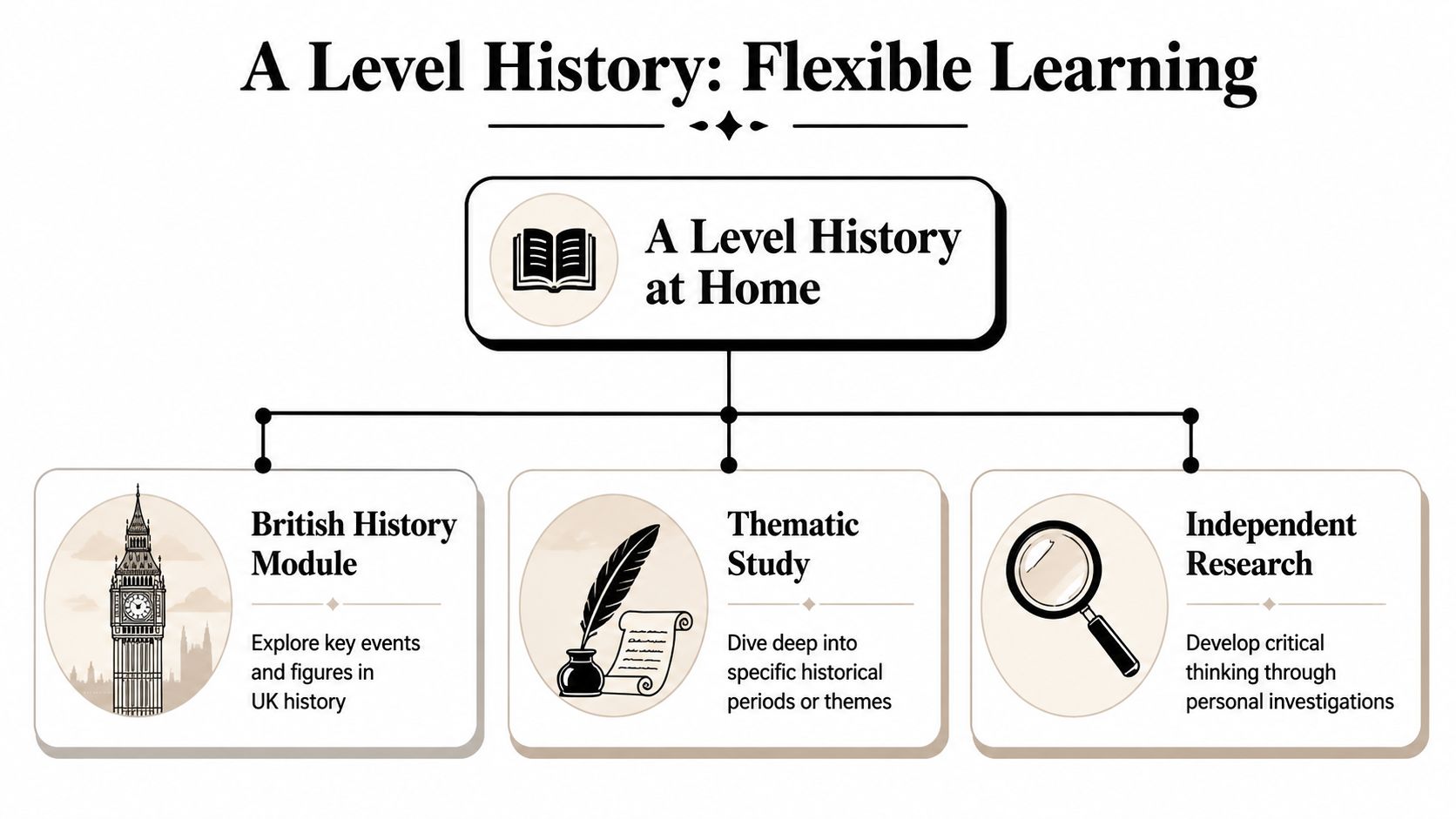
A level history often includes a mix of topics rather than one single story. In broad terms, learners usually study British history, a non-British topic, and an independent investigation.
The structure itself is carefully built. The AQA specification overview explains that the course uses a Breadth Study and a Depth Study across at least 200 years. That design helps learners first build wider understanding, then move into deeper analysis.
Why the structure works well for adults
Adults often worry that they've “forgotten how to learn”. Usually, they haven't. They just need a sensible framework.
This course structure helps because it does three useful things:
| Course part | What it helps you do |
|---|---|
| Breadth study | Build the bigger picture so events make sense |
| Depth study | Slow down and examine detail carefully |
| Independent research | Follow your own curiosity and develop confidence |
That's a strong fit for home study. You aren't just reading randomly. You're moving through a sequence that helps knowledge stick.
If you're considering distance learning for A Levels, this kind of layout is one reason history can work so well from home.
How online study fits real life
Studying from home doesn't mean studying alone. Good online learning gives you structure, feedback, and someone to turn to when you're unsure.
For many adults, the biggest advantages are practical:
- No commuting: your study time goes into learning, not travel
- More control: you can work around shifts, childcare, and family routines
- Steady progress: short regular sessions are often easier than long classroom days
Small, repeated study sessions often beat one exhausted weekend marathon.
The independent research part can be especially rewarding. Instead of only answering other people's questions, you get the chance to investigate a topic that interests you. That can make the subject feel personal, not just academic.
How Your A Level History Is Assessed
You finish work, clear the table after dinner, and open your notes while the house finally goes quiet. Then the worry creeps in. What if the exam feels nothing like you expected? What if coursework sounds more academic than practical? Those fears are common for adults returning to study, especially if school never made you feel confident the first time around.
Assessment in A Level History is more structured than many adults expect. You are being marked on a clear set of skills that can be practised, improved, and repeated until they feel familiar. That matters when you are fitting study around work, parenting, and everyday responsibilities, because clear targets are much easier to manage than vague pressure.
What you'll usually be marked on
Most specifications assess you through a combination of written exams and an independent researched essay, often around 3,000 to 4,000 words, depending on the exam board. In the exams, you may answer source questions, interpretation questions, and longer essays.
Each part tests a different skill. Source questions ask you to read carefully and judge evidence. Interpretation questions ask you to compare how historians explain the past. Essays ask you to build a reasoned argument, step by step, like making a case in a meeting where every point needs evidence behind it.
This variety can work in your favour. Adult learners often bring patience, perspective, and stronger real world judgement than they realise. If you have ever compared two versions of the same workplace problem, weighed up conflicting opinions, or explained a decision clearly, you have already used the same habits that history assessment rewards.
A reassuring fact about passing
If you are worried the qualification may be beyond reach, there is a helpful sign. A Level History had a 98.8% pass rate at grade E or above in 2024, according to Tutorful's review of A Level History difficulty.
That does not mean the course is easy. It means success is realistic for learners who keep showing up, practise the right question types, and improve steadily over time.
Top grades take more precision. Passing still matters.
For many adults, that first win can change more than one part of life. It can rebuild confidence, set a new example for your children, and prove to your family and to yourself that returning to education was a strong decision.
How to prepare without letting fear take over
A good way to handle assessment is to treat it like training, not judgement. You do not need to produce perfect answers from the start. You need to get familiar with the task, learn what markers want, and make one improvement at a time.
Focus on these three habits:
- Know what each question is asking. A source question needs analysis of evidence. An essay needs a clear line of argument.
- Plan before you write. Even a brief plan helps you stay calm and keeps your answer organised when you feel under pressure.
- Use feedback like a map. One repeated mistake, fixed properly, can raise the quality of every future answer.
If you want a clearer picture of how A Level grades are awarded and what each grade means, it helps to picture assessment as a ladder. You do not jump from uncertainty to excellence in one go. You climb one rung at a time, and every practice answer gets you higher.
Practical rule: Aim for a clear answer first. Then improve it.
Practical Study Tips for Busy Parents and Professionals
It is 8:45 at night. The kitchen is finally quiet, your work messages have stopped, and you are wondering whether there is any point opening your history notes when you feel this tired.
There is. Adult study often works best in smaller, steadier steps.
A Level History can fit around work and family life if you stop measuring yourself against a school timetable. You do not need hours of perfect concentration. You need a method that still works on busy weeks, interrupted evenings, and mornings when your mind is already full.
One useful method is spaced repetition, which means coming back to key material in short sessions over time instead of trying to force it all in at once. The adult learner study support video linked here explains that spaced repetition can improve retention by up to 200% for adult learners in some cases, when used consistently, in this YouTube resource discussing adult learner study support.
Make your life experience work for you
This is one of the biggest advantages adult learners have.
If you have worked with colleagues, raised children, managed a home, handled stress, or made difficult decisions under pressure, you already understand something history asks for all the time. You know that people do not act in a vacuum. They respond to fear, ambition, money, loyalty, status, and uncertainty.
That helps more than you may realise.
A younger student may memorise that a leader made a certain choice. You can often see why that choice felt sensible at the time, even if it led to disaster. That deeper understanding makes your essays stronger because history is not just a list of events. It is the study of people, pressure, and consequences.
Use your experience in practical ways:
- When revising an event, ask what problem each person was trying to solve. This helps you move beyond simple description.
- When reading a source, ask who wrote it, who they wanted to influence, and what they may have left out. That is close to the judgement you already use in everyday life.
- When planning an essay, organise it like a busy week. Put the biggest priority first, then build the rest in a clear order.
Build a study rhythm you can actually keep
A good weekly routine works like batch cooking. A little preparation early on makes the rest of the week easier.
Try a pattern like this:
- Early week: read one small part of a topic and write brief notes in plain English
- Midweek: spend 10 minutes reviewing those notes or testing yourself with question cards
- Later in the week: plan one paragraph or one essay answer
- Weekend or a day off: complete one focused task, such as analysing a source or writing one timed paragraph
This kind of rhythm is easier to keep because each session has a clear job. You are not sitting down and vaguely telling yourself to "do history". You know what today's task is.
Missed a day? Start again the next day. Adults who succeed usually do not follow a perfect plan. They return to the plan quickly.
How to study well when you are tired
Tired minds need fewer decisions.
Set up your revision so you can begin without a struggle. Keep one notebook, one set of flashcards, or one folder for each topic. If everything has a home, you waste less energy getting started.
These methods are especially helpful after a long workday:
- Use question cards: keep one fact, example, or argument on each card
- Say ideas out loud: explaining a topic while washing up can help fix it in memory
- Cut large tasks into tiny targets: revise one law, one rebellion, one reform, or one source
- Use a timer: 15 focused minutes often leads to more work than waiting for the perfect hour
Here is a simple guide for low-energy days:
| When you have… | Best task |
|---|---|
| 10 minutes | Review flashcards or a short timeline |
| 20 minutes | Read one source and note its message and purpose |
| 30 minutes | Plan one paragraph with evidence |
| 45 minutes | Write one timed paragraph or short response |
If starting feels hard, make the task smaller until it feels possible.
Write essays clearly, even on busy weeks
Many adult learners worry that academic writing means sounding clever. In A Level History, clear writing usually scores better than complicated writing.
Markers want to see a sensible argument. They want evidence. They want explanation. Fancy wording is not the goal.
A reliable paragraph structure looks like this:
- Make a point
- Add specific evidence
- Explain how the evidence supports the point
- Link it to the question
This works well because it gives your writing shape. On a stressful week, structure acts like a set of rails. It keeps you moving in the right direction even if your confidence dips.
Small, repeatable habits matter here too. One paragraph plan during a lunch break. One source annotation before bed. One short review while the kettle boils. Those pieces add up, and for an adult learner, they often add up faster than expected.
You are not starting from scratch. You are bringing discipline, judgement, and real-life experience into your studies, and that can become one of your strongest advantages.
Opening Doors to University and a Fulfilling Career
You finish work, clear the dinner plates, and open your laptop. A year ago, university might have felt like something you missed. Now it starts to look like a real route back in.
A level history can help you get there.
For adult learners, that matters in two ways. It can meet an entry requirement for higher education, and it can also show admissions tutors that you are ready for serious study after time away. That second part is easy to underestimate. Returning to education takes commitment, planning, and resilience. Universities respect that.

Where it can lead
History is a strong choice because it develops skills that travel well. You learn how to read carefully, weigh evidence, spot weak arguments, and explain your view in clear writing. Those are the same habits universities want across a wide range of degrees.
That means A level history can support applications for subjects such as law, politics, journalism, business, teaching, sociology, and history itself.
A helpful way to see it is this. A level history works like a solid set of driving lessons. You are not learning one road only. You are learning how to judge conditions, make decisions, and stay in control wherever the route leads next.
As noted earlier, history remains a widely respected subject. Adult learners often choose it because it keeps their options open while giving them a qualification with real academic weight.
Careers that value history skills
You do not need to become a historian for this course to pay off.
Employers in many fields want people who can make sense of complex information, write clearly, and reach balanced conclusions. History helps you build exactly that. If you have already handled work deadlines, family responsibilities, or difficult decisions in real life, you are adding those strengths to your academic skills. That combination can be powerful.
Common career directions include:
- Law and legal support
- Teaching and education
- Journalism and media
- Civil service and public policy
- Business and management roles
- Charity and community work
Here's a short video that may help you think about your next step:
The personal reward matters too
Qualifications can lead to better pay, more stability, and more choice. They can also change how you see yourself.
Many adult learners carry an old story from school. Maybe you were capable but unsupported. Maybe life got in the way. Maybe you learned to put everyone else first. Studying A level history gives you a chance to write a new ending, based on who you are now rather than who you were at 16.
Your family sees that. Children notice the evenings you keep going. Partners notice the discipline. The message is simple and powerful. Growth is still possible.
Success in education doesn't only change your CV. It can change the story your family tells about what is possible.
That is one reason this step can matter for years. It is not only about getting into university or aiming for a different job. It is about building a future with more choices, and showing the people around you that change can start at any age.
Answering Your Questions About Starting
Many adult learners reach this point late at night. The house is quieter, the emails have stopped, and there is finally a moment to ask the underlying question. Could I possibly do this now?
If that sounds familiar, you are in good company. Starting A level history as an adult often brings practical worries, not a lack of ability. You may be weighing study around shifts, school runs, bills, or caring responsibilities. That does not put you behind. In many cases, it gives you strengths younger students are still developing.
Am I too old to do a level history
No.
Adults often bring steady habits, clearer motivation, and a stronger sense of why the qualification matters. History rewards those qualities. You are not being asked to race. You are being asked to read carefully, weigh evidence, and build a reasoned argument. That work often suits someone who has managed real responsibilities.
Your life experience can help more than you may expect. If you have handled difficult conversations at work, compared different points of view in family life, or made decisions with limited information, you have already practised some of the same thinking skills history uses.
What if I didn't do well at school
School is one chapter, not the whole book.
Many adults study better now because the purpose is clearer. At 16, learning can feel like something done to you. As an adult, it is a choice you are making for your future, your confidence, and the example you set at home. That change in mindset matters.
You also know yourself better now. You may already know whether you learn best by reading, listening, writing things out, or studying in short focused blocks. That self-awareness is useful. It helps you build a study routine that fits your life instead of forcing yourself into one that never suited you.
What if exams aren't my strength
That worry is very common, especially for adults returning to education after years away.
A level history asks you to develop skills step by step. You learn how to write clearer essays, analyse sources, and judge interpretations with evidence. It works a bit like rebuilding fitness after time away. You do not start by running a marathon. You start with steady practice that gets stronger over time.
Pass rates have remained high, with 98.8% in 2024 and 98.7% in 2023, as noted in this guide to A-level History and exam structure. The same guide explains that the course includes different kinds of assessment, which gives learners more than one way to show what they can do.
That can be reassuring for adults. Some people gain marks through strong essays. Others do well when analysing sources. Many improve because they practise the method and get feedback.
Will online learning feel lonely
It can if you are left to figure everything out alone. Good online learning should feel structured and human.
Adult learners need clear teaching, useful feedback, and support that respects the fact that life does not pause for study. If a child is ill, work runs late, or your week goes off plan, you need a course that helps you get back on track without panic. The right support works like a reliable map. It shows you where to go next, even if you took a wrong turn last week.
Feeling nervous at the start is normal. Many capable adults feel that way. Once you begin, the course usually becomes more manageable because the unknowns start to shrink.
If you're ready to turn quiet hope into a real plan, Next Level Online College offers flexible online study designed for adults who are balancing learning with work, family, and everyday life. With the right support, a level history can become more than a subject. It can become your next step towards university, better career options, and the pride of showing your family what's possible.