
You've probably done the hardest part already. You've admitted to yourself that the maths you need for the next step in life matters, even if it's been years since you last sat in a classroom. That quiet decision, made after work, after the school run, after the washing-up and the bills, is the start of something bigger than a qualification. It's a choice to back yourself.
For many adult learners, A Level Mathematics feels like a serious return to study because it is one. It has a clear structure, a real workload, and a proper exam pattern, which is exactly why it can also be reassuring. The course is built in a way that rewards steady effort, not perfect confidence on day one. If you're thinking about studying through a flexible route such as Next Level Online College's mature student options, you're already looking in the right place for a version of learning that fits real life.
Starting Your A Level Maths Journey as an Adult
A parent might sit down at the kitchen table at 9.30pm, open a maths book, and feel two things at once. There's nervousness, because the pages look serious and the last lesson was a long time ago. There's also pride, because they know this is for them, their children, and the future they want to build.
That mix is normal. Adults do not come back to study because they already feel ready. They come back because they're ready to grow, even while they still feel unsure. A Level Maths can feel like standing at the bottom of a hill with tired legs, but you do not have to sprint. You just need a clear path and a tutor who understands that family life, work and energy levels all matter.
Practical rule: confidence usually comes after the first few wins, not before them.
The good news is that the course is designed to be learned in steps. The content is structured, the assessment is predictable, and the skills build over time. That gives adult learners something very valuable, a sense that progress is possible even if school felt awkward the first time round.
You are not too late. You are not behind in some permanent way. You're at a different stage of life, and this course can still open doors to university, promotion and the kind of example many parents want to set at home.
What an A Level Maths Course Covers
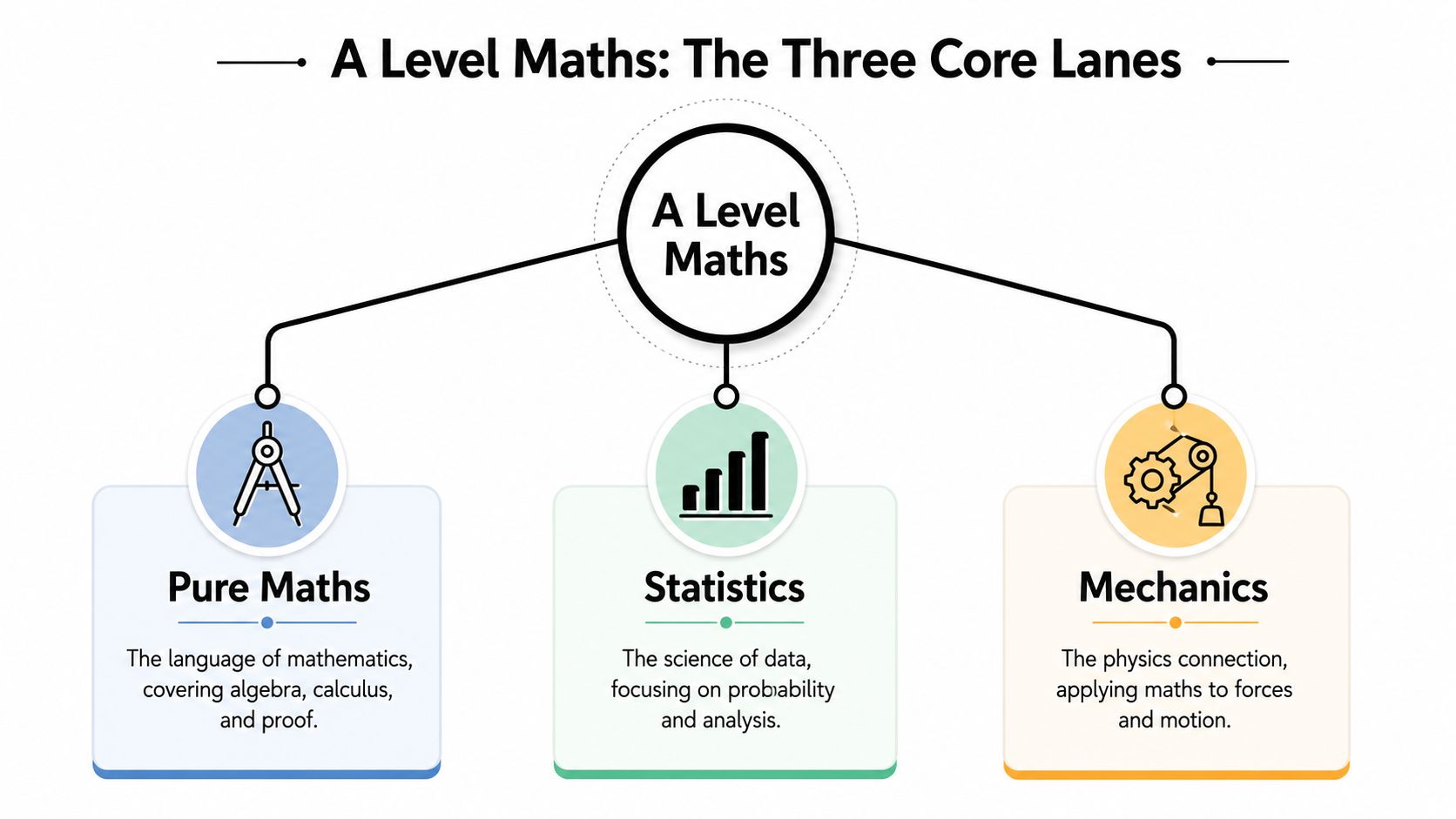
A Level Maths is organised into three lanes. One lane is pure maths, one is statistics, and one is mechanics. You do not have to guess what belongs in each part, because the course structure is set nationally, and providers in England work within that shared framework. The curriculum also centres on mathematical argument, language and proof, problem solving, and mathematical modelling as outlined by the AMSP curriculum overview.
Pure maths gives the subject its structure
Pure maths is where you learn how mathematical ideas fit together. It includes algebra, proof, calculus, exponentials and logarithms, and numerical methods. The work can feel like learning the grammar of maths, because once the rules start to make sense, the rest of the course becomes easier to read.
This part matters because it moves you from “I know a method” to “I understand why the method works”. That shift is one reason A Level Maths feels more demanding than GCSE. It asks for reasoning, not just repetition, and that can feel unfamiliar if you are returning after a long break.
Statistics helps you make sense of data
Statistics is the part of the course that connects maths to everyday information. Official Pearson planning materials include sampling, regression and correlation, and statistical hypothesis testing, alongside data representation, measures of central tendency and spread, probability, discrete random variables, binomial distribution and normal distribution in the Pearson course planner. That may sound crowded at first, but the underlying idea is straightforward. You learn how to read patterns, test ideas, and judge what numbers are telling you instead of just looking at a table or graph.
For adult learners, that can be reassuring. The methods are precise, but the goal is practical sense-making.
Mechanics connects maths to motion and forces
Mechanics is the part that feels closest to physics. It covers forces, motion, moments and moving objects, so maths becomes a way of describing how things behave in the world. That often makes it easier to picture what is going on, especially if abstract symbols have never felt comfortable.
Statistics and mechanics are not side topics. In many A Level routes, they are formally assessed and fully part of the qualification.
Together, these three lanes make the course more than a list of topics. They give you a toolkit for thinking clearly, solving problems and trusting your own reasoning. For returners, that matters just as much as the content itself, because confidence grows when each topic starts to feel like a manageable step rather than a wall.
How the Exams Work and What You Will Be Marked On
Assessment is often the part that worries adults most, because it can feel like the whole course rests on a few papers. In A Level Mathematics, the structure is clearer than it first appears. The course is commonly assessed through three exam papers at the end of Year 13, and major awarding bodies like Edexcel allocate one-third of the final grade to the combined Statistics and Mechanics paper according to the A Level maths syllabus overview.
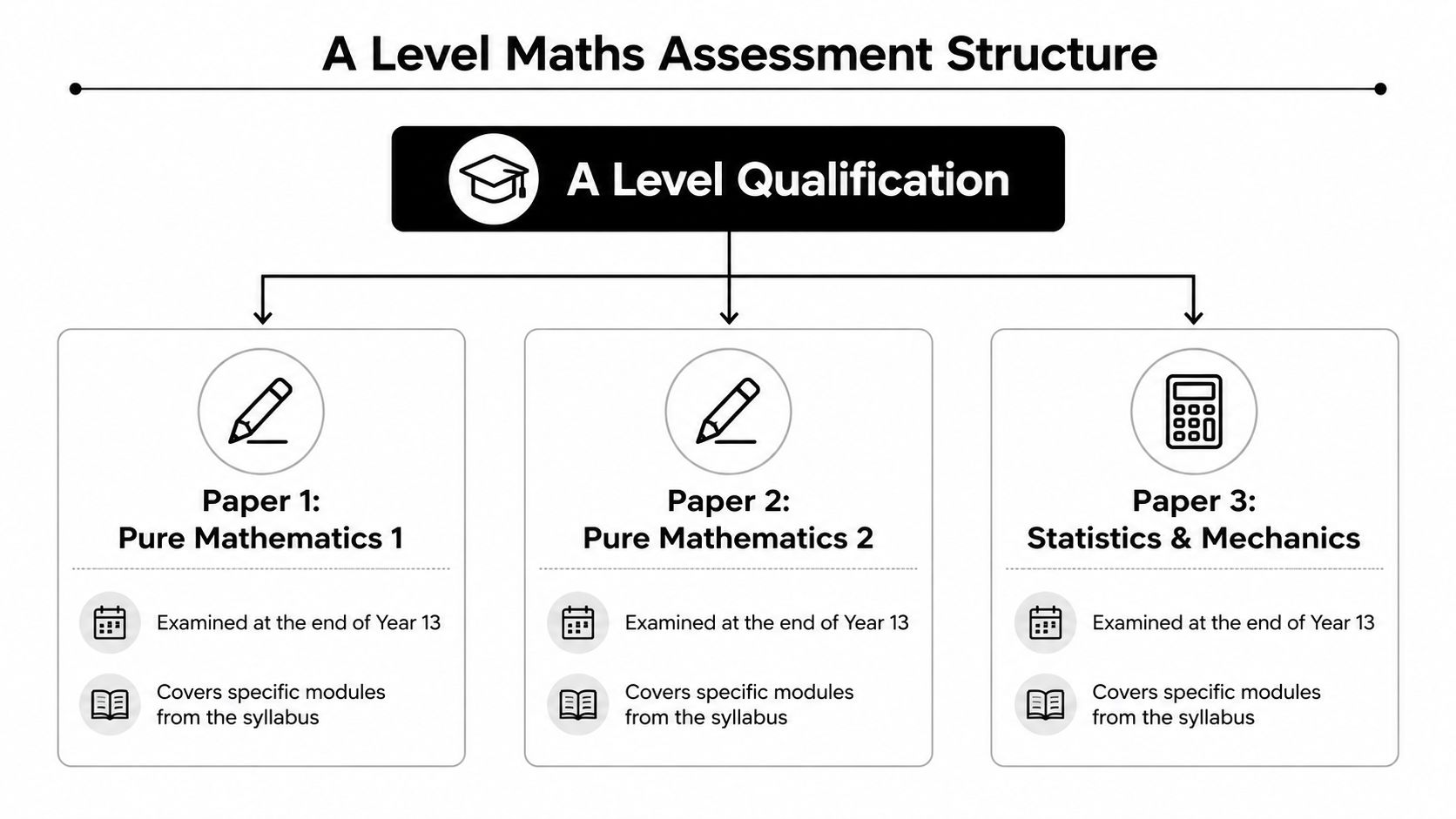
The papers are set up to check different parts of your understanding. Two of them focus on pure mathematics, where algebra, calculus and proof carry most of the weight. The third paper brings the applied side together, so it connects the methods you learn with statistics and mechanics questions that ask you to work carefully through a situation. It is less about guessing and more about showing steady reasoning from start to finish.
For adults returning to study, that can be reassuring. You are not being asked to be brilliant in one sudden burst, you are being asked to practise a clear method, spot what a question wants, and show how you got there. That is a skill you can build, just like rebuilding fitness after time away from exercise.
What examiners look for
Marks usually come from accurate method, sound algebra, clear working and a sensible final answer. If your method is weak, you can lose marks even when the final number looks close. If your working is clear, you often give yourself a better chance of picking up partial credit, which matters on longer questions.
A Level results are often talked about in terms of grades and progression, so it helps to have a plain explanation of what those grades mean in practice. A simple guide to A Level grades can make the relationship between marks, grades and next steps easier to follow.
Why the weighting matters
Statistics and mechanics carry real weight, so they deserve proper revision time rather than a rushed skim at the end. A common mistake is to spend most of the energy on pure maths and leave the applied paper until fatigue has set in. A steadier approach is to keep all three papers in view from the start, then return to the weaker areas often enough that they stop feeling unfamiliar.
The exam structure is fixed enough to plan for, and broad enough to reward consistent work. For anyone coming back after a break, that matters. A course like this does not rely on one lucky day, it rewards the kind of progress that builds confidence bit by bit.
The Significant Jump from GCSE to A Level Maths
A lot of adults arrive expecting A Level Maths to be GCSE with harder sums. Some of it does build on GCSE foundations, but a large part of the course asks for a different kind of thinking. That shift can feel unsettling at first, especially if you have been away from study for a while.
The step-up is really about depth as much as difficulty. You move into differentiation, integration, proof, exponentials and logarithms, numerical methods, probability distributions, hypothesis testing, and mechanics topics such as moments and varied acceleration as shown in school course overviews.pdf). That is not a small extension of familiar work. It asks you to think in a new way, with more precision and more care.
Why it can feel like learning a new language
GCSE often feels like learning to write solid sentences. At A Level, you are building short essays. You still use the same symbols and rules, but now you need structure, logic and clearer links between ideas. That is why some adult learners feel steady with calculations, then hesitate when they meet proof or a long modelling question.
A helpful way to think about it is: A Level Maths does not just ask, “Can you do the method?” It also asks, “Can you choose the method and explain why it fits?”
That is where good support matters. A learner returning after a long break usually needs more than a topic list. They need someone to slow the pace, name the gaps, and show how new ideas connect to what they already know. Flexible online study with proper pastoral support can make that gap feel much smaller, because you are not trying to hold everything together on your own.
What usually catches people first
For many returners, the first wobble comes when a question looks unfamiliar even though the maths inside it is familiar. That can be frustrating, especially if school memories were already shaky. The answer is not to panic. It helps to practise small, repeatable patterns until the new style starts to feel ordinary.
The jump is real, but it is not a cliff edge. It is more like climbing a staircase where each step feels higher than the last, but each one is still manageable once you know where to put your foot.
Choosing the Right Study Format for Your Life
A good course should fit around your life, not compete with it. That matters for adults because energy is limited, and time is already spoken for by work, childcare, commuting or caring responsibilities. The right format is the one you can keep going with on an ordinary Tuesday, not the one that sounds impressive on a website.
| Format | Flexibility | Typical Support | Best Suited To |
|---|---|---|---|
| Online | High, because you can study around shifts and family routines | Tutor contact, structured resources, and remote guidance | Working parents, carers and shift workers |
| Evening classes | Moderate, with fixed weekly sessions | Face-to-face teaching at set times | Learners who prefer a classroom rhythm |
| Traditional college | Lower, because attendance is tied to a timetable | In-person lessons, peer contact and campus services | People who can travel and commit to regular attendance |
Fully online study often works best for adults who need control over when they learn. It can also reduce the stress of travel and make it easier to keep going after a long day. That said, it only works well if the provider gives you structure, tutor access and a clear plan, because flexibility without support can become drift.
Questions worth asking before you enrol
- What support is included? Ask about tutors, feedback, and pastoral help, not just lesson access.
- How is the course structured? A sensible timetable can keep you moving when motivation dips.
- What qualification is awarded? Check that the route is recognised and suits your goal.
- What happens if life gets in the way? Adults need providers that understand pauses, setbacks and restarts.
If you're comparing options, this online A Level Maths route shows the kind of format many busy learners look for when they want study to work around real life.
The best provider is the one that makes you feel steadier, not smaller.
A Realistic Weekly Study Timetable for Busy Adults
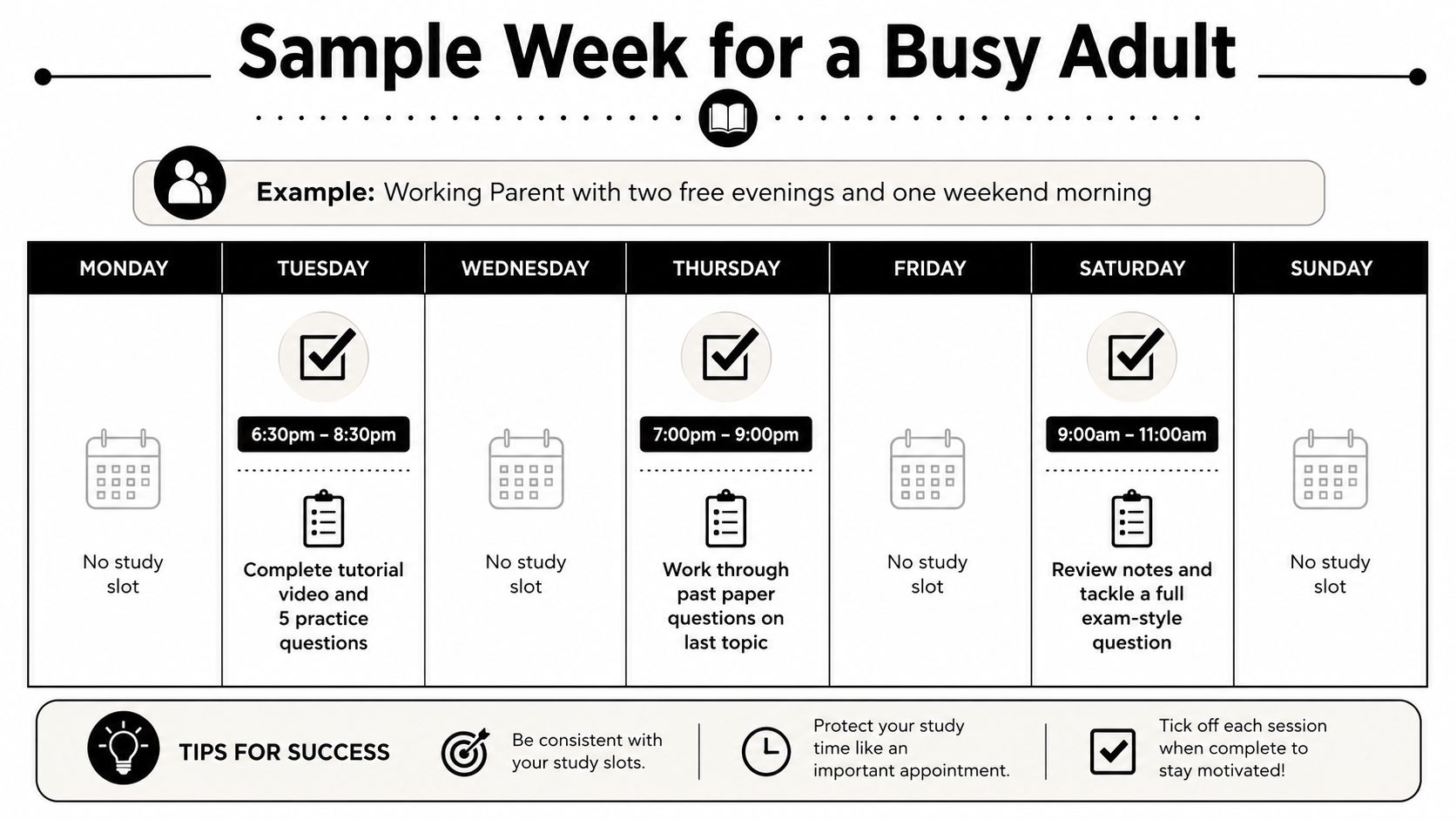
Take Sam, a working parent with two evenings free and one quiet morning at the weekend. Sam does not have endless spare time, and that's the point. The aim is not to build a perfect student life. It is to make maths part of an ordinary week without exhaustion.
A simple week can carry real progress
A sensible target is a small number of focused study hours spread across the week. On Tuesday evening, Sam watches one tutorial and answers a few practice questions. On Thursday evening, Sam works through past paper questions on the same topic. On Saturday morning, Sam reviews notes and tackles one full exam-style question.
That pattern works because it mixes three things, learning, practising and checking mistakes. Many adults try to do all three at once in a long session, then feel tired and behind. Shorter, regular sessions often stick better.
A rhythm that helps memory
A Sunday planning slot can make the week feel calmer. Sam spends a few minutes deciding what to study, which questions to try, and what to revisit. Then a Friday recap gives space to note what still feels shaky before the weekend study block.
Practical rule: if you miss a session, restart at the next one. Don't wait for a “fresh” week.
That matters because adult learners have busy lives. A missed session is not a failure. It is just part of real life. A flexible plan should be kind enough to bend without breaking.
Consistency beats cramming. A learner who keeps showing up for small sessions usually builds more confidence than one who saves everything for a marathon weekend.
Where A Level Maths Can Take You Next
This qualification opens doors because it signals problem solving, persistence and comfort with numbers. Many university courses either require or strongly prefer A Level Maths, including engineering, computing, economics, psychology, the sciences and teacher training. For adults who want a fresh start, that can mean a route into a degree that felt out of reach before.
It also has direct value in the workplace. People use A Level Maths to move towards promotion, an apprenticeship, or a shift into areas like data, finance and healthcare science. Those routes matter because they can lead to more responsibility, more confidence and, for many families, better pay and more stable work.
Why this matters at home too
When a parent finishes a serious qualification, children notice. They see that learning does not stop at school age. They see effort, patience and the courage to try something difficult again. That example can matter just as much as the certificate.
You do not need to choose between family and ambition. The course can support both. It can become the bridge between where you are now and the role model you want to be.
Choosing a Provider and Taking the First Step
The best place to start is with a simple checklist. Look for a provider that offers a regulated qualification, a recognised awarding partner, clear tutor support, pastoral help, flexible study options, transparent pricing and a real progression route into further study. Those things matter because adults need more than content, they need steady guidance and a course that respects busy lives.
Next Level Online College is one example of a UK-based online provider built around adult returners, with over 25 years of group experience supporting learners who need to fit study around real responsibilities. That kind of background can matter if you want confidence-building support rather than a one-size-fits-all model.

Three small actions you can take this week
- Book a callback so you can ask about support, timetable and qualification routes.
- Download a sample timetable and see how study could fit around your current week.
- Take a diagnostic quiz to find out where your starting point really is.
Those steps turn the idea into motion. You do not need to solve the whole future tonight. You just need to choose the next sensible step and let it carry you forward.
If you're ready to study in a way that fits work, family and real life, visit Next Level Online College and explore how its supported A Level Maths courses can help you build confidence, progress towards higher education and set a powerful example for your children.