
There are evenings when the house finally goes quiet, the washing is done, the children are asleep, and you sit at the kitchen table thinking the same thought again.
You want more.
Not just more money, though that matters. Not just a better job, though that matters too. You want to feel proud of yourself. You want to show your children that it's possible to start again, learn again, and build a different future, even after life has knocked your confidence.
If you've been searching for a levels online uk, there's a good chance you're not looking for a hobby. You're looking for a way forward. Maybe university has always been in the back of your mind. Maybe a career change feels overdue. Maybe you're tired of seeing good opportunities pass you by because you don't have the right qualifications.
That feeling is heavy. But it doesn't mean you've missed your chance.
Online A Levels can give adults in the UK a real, respected route back into education. They let you study around work, school runs, caring duties, and all the other pieces of real life. You don't have to become a full-time student to move your life forward. You can begin where you are, with the time and energy you have now.
Your Dream for Your Family Starts Today
A lot of adult learners carry a quiet sadness about education.
You might remember school as a time when you didn't get the help you needed. You might have left early to work. You might have had children young, or gone through hard things that made studying impossible at the time. None of that means you aren't capable now.
It means life was happening.
One of the bravest things an adult can do is return to learning anyway. Not because it's easy, but because it matters. When a parent chooses education, they aren't only gaining a qualification. They're showing their family what courage looks like.
The late-night turning point
Think about a parent who works all day, helps with homework in the evening, and still feels a pull towards something bigger. That person may doubt themselves. They may worry they're too old, too busy, or not clever enough.
Then one small thought appears. What if I tried?
That question can change everything. Not overnight. Not like magic. But step by step.
You do not need a perfect past to build a stronger future.
Online A Levels fit this moment so well because they meet adults where they are. You can study from home. You can organise your learning around family life. You can keep moving towards university or a new career without putting the rest of your life on hold.
Why this matters more than you think
Children notice what adults do far more than what adults say.
When they see you revising at the table, asking questions, trying again after a hard day, they learn something powerful. They learn that growth doesn't stop when school ends. They learn that setbacks aren't the end of the story.
That example can stay with them for years.
A qualification can open doors. It can help you apply for university, train for a profession, or prepare for work that feels more meaningful. But there's another reward too. You start to see yourself differently. Less stuck. More hopeful. More able.
For many adults, that inner change is where everything begins.
What Are Online A Levels and How Do They Work
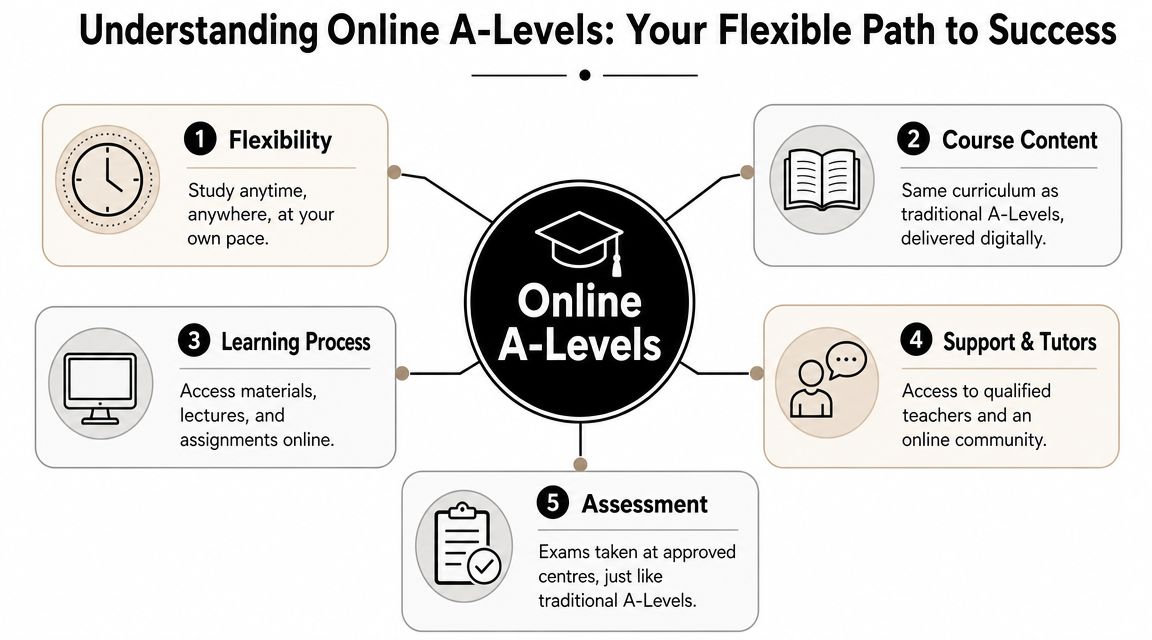
Online A Levels are the same qualification people recognise from schools and colleges, but studied through distance learning. In the UK, providers commonly structure them as a 2-year programme covering both AS and A2, and learners take exams at approved centres to gain the qualification, as explained by Oxford College's guide to distance learning level courses. The same source also notes that online A Levels are accepted by universities and carry UCAS points in the same way as in-person A Levels.
That matters because it means you're not choosing a lesser option. You're choosing a more flexible way to reach the same award.
Think of it as school built around your life
Traditional study often asks you to fit your life around a timetable. Online learning flips that around.
A good way to picture it is this. You have your course materials, subject guidance, assignments, and tutor support available from home. Instead of rushing across town to make a lesson at a fixed time, you can study when the house is quiet, before work, on weekends, or in short evening sessions.
For many adults, that makes the difference between “I wish I could” and “I can”.
If you want a clearer feel for how flexible study is organised, this guide to distance learning for A Levels shows the sort of structure adult learners often look for.
What your study life usually looks like
Most online A Level learners work through a set course in manageable chunks. That often includes:
- Digital learning materials that explain each topic in plain steps
- Tutor support when you get stuck or need feedback
- Assignments and practice tasks to help you check your understanding
- Revision guidance so you know what to focus on before exam season
Some adults worry that studying online means studying alone. It doesn't have to. The format is flexible, but support still matters. A strong provider gives you teaching, feedback, and encouragement, not just a folder of documents and a login.
Practical rule: If you can follow a recipe, use email, and make time in your week, you can learn online. The skill you need most at the start isn't brilliance. It's willingness.
Why adults often do well with this format
Adult learners bring strengths that younger students sometimes haven't built yet. You may be more motivated. You may know exactly why you're studying. You may be tired, yes, but also firmly determined.
That purpose counts for a lot.
Online A Levels also let you move with more intention. You can pause, reread, take notes slowly, and return to hard topics without feeling embarrassed. You're not trying to keep up with a classroom full of people. You're building understanding at your own pace.
That can be a surprisingly healing experience if school once made you feel left behind.
The Practical Steps to Exams and Assessments
This is the part many adults worry about most. They understand studying from home. They understand reading, note-taking, and revision. But then the question comes up.
Where do I sit the exams?
The key point is simple. Online A Level courses in the UK usually run for 2 years, but learners must sit their exams as private candidates at registered exam centres, as noted by UK Open College's online A Level information. Your learning can be flexible, but your final assessments still depend on exam-board timetables and getting booked into a centre.
What being a private candidate means
“Private candidate” sounds formal, but it's not something unusual or risky. It means you're entering for the exam independently, rather than through a school where you attend classes in person every day.
You study online. Then you take your exams at an approved centre.
That's the normal route for many distance learners.
A calm way to handle the exam process
Treat exam arrangements like a small project with a few clear jobs.
Know your exam board
Your subject will follow a specification from an awarding body such as AQA, Edexcel, OCR or CIE, so the centre needs to know exactly which exams you plan to sit.Start looking for a centre early
Don't leave this until the last minute. Centres have deadlines, limited spaces, and their own booking systems.Ask practical questions before booking
You want clear answers, not guesswork.
A simple checklist can help when you contact a centre:
Which exam board do you accept
Make sure it matches your course specification.Do you accept private candidates for my subject
Some subjects are easier to arrange than others.What are your booking deadlines
Missing a deadline can delay your plans.What documents do you need from me
Centres may ask for identification and exam details.Are there any special arrangements available
This matters if you have learning needs, anxiety, or require approved support.
If you're trying to understand what grades mean once results arrive, this page on A Level grades can make the system easier to follow.
Why adults sometimes get caught out
The hidden challenge with a levels online uk isn't usually the studying. It's the timing.
You may feel flexible because you're learning from home, but exams still happen on fixed dates. Centres also work to deadlines that arrive earlier than many first-time adult learners expect. That's why it helps to think ahead and keep notes of every deadline, email, and booking confirmation.
Book the exam side earlier than feels necessary. Peace of mind is part of good revision.
How to make exam season feel manageable
The final months can feel emotional. You're carrying a lot. You may be revising after work, looking after children, and trying not to panic. Here, routine helps more than motivation.
Try a simple pattern:
- Choose fixed study slots so revision becomes normal
- Break subjects into small topics rather than trying to do everything at once
- Use practice papers and tutor feedback to spot weak areas
- Prepare the logistics early so travel and paperwork don't become extra stress
You do not need to feel fearless before an exam. You only need a plan.
And every piece of that plan can be done one step at a time.
Your Pathway to University and a Better Career
A Levels matter because they open doors.
For many adults, the dream behind the qualification is university. For others, it's a job that pays better, feels more stable, or finally matches their ability. The qualification itself is important, but what it leads to is often what keeps you going on difficult days.
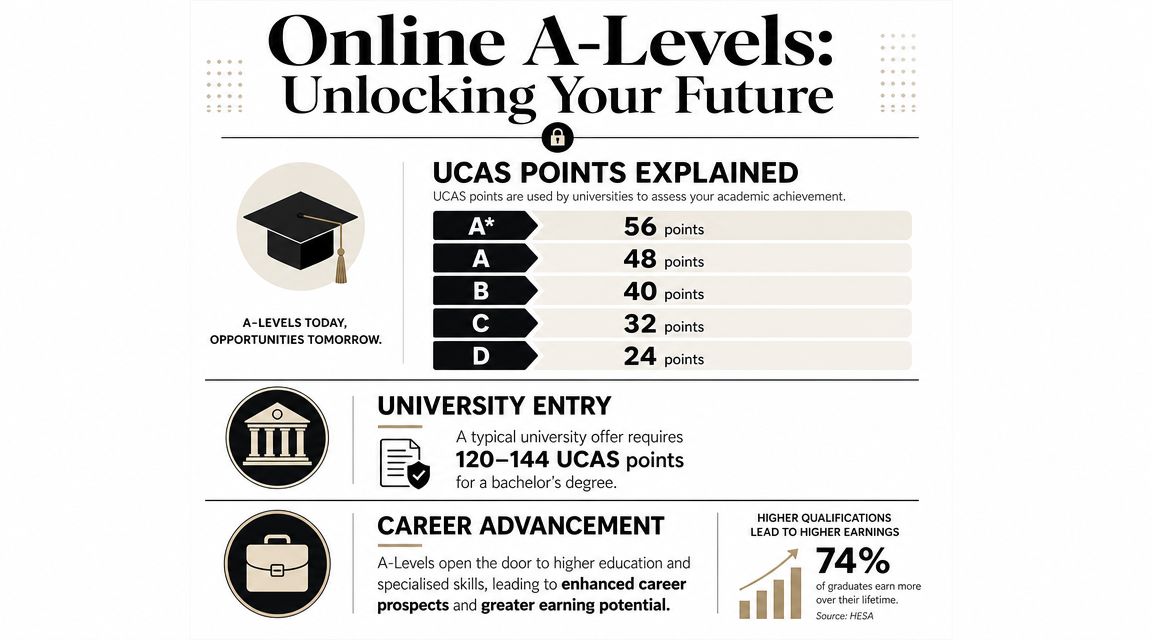
Each grade has a clear UCAS tariff value. According to Open Study College's A Level information, A* is worth 56 points, A is 48, B is 40, C is 32, D is 24, and E is 16. The same source also notes that applicants normally need at least five GCSEs at grades 9 to 4 or A* to C, plus at least grade 6 in the specific subject for A Level study.
What UCAS points mean in real life
UCAS points are part of how universities look at applications. In simple terms, your grades turn into points, and those points help show whether you meet the entry requirements for a course.
That means subject choice isn't only about what sounds interesting. It's also about where you want to go.
If university is your goal, it helps to look at the entry requirements first. Then work backwards. That way, your course choices support your plan instead of leaving you with the wrong subjects later.
If you're aiming for higher education, this overview of how to get into universities can help you think more clearly about the route ahead.
Turning grades into a future plan
A Levels can support many different futures. A science subject may help if you want to move towards healthcare or another technical field. English or history can support degrees linked to teaching, law, media, or public service. Maths can widen your options in many areas.
The right combination depends on your destination.
Here are a few useful questions to ask yourself:
What kind of work do I want in five years
Think about the life you want, not only the next course.Does my chosen degree require specific subjects
Some universities are very clear about this.Am I choosing subjects I can stay committed to
Interest matters because you'll be living with these topics for quite a while.
The best subject choice is the one that keeps a real door open for your future.
Why this journey changes more than your CV
When adults go back to study, the result is often bigger than a university application.
You start speaking about your future differently. You stop saying “people like me don't do that.” You begin to believe you belong in spaces that once felt closed off. That shift can affect your work, your family life, and your sense of what is possible.
A child who sees a parent earn qualifications often learns that ambition is normal. A partner may see your confidence return. You may begin to imagine yourself in a profession that once felt out of reach.
That's why this path can be so powerful. It doesn't only help you qualify for the next stage. It helps you reclaim your direction.
Is This Really the Right Path for You
Online A Levels are a strong route, but they aren't the only route. If you're an adult aiming for university, it's worth pausing and asking a very honest question.
Do I need A Levels, or do I need the best route into my next step?
That question matters because some adults are better suited to an Access to Higher Education Diploma. According to this UK-focused guide to getting into university without A Levels, around 70,000 Access to HE Diplomas are awarded each year, and many universities accept them as equivalent entry routes. The same guidance explains that they are designed for mature students and can offer a faster, more targeted route to a degree.
When A Levels make sense
A Levels are often a strong choice if you need a specific subject for a future degree, or if you want to keep your options broad.
They can suit you well if:
- You need a named subject such as biology, chemistry, maths, or psychology for a future course
- You want a familiar qualification that universities know well
- You prefer subject-by-subject study rather than a diploma focused mainly on one progression route
When Access to HE may suit you better
An Access course may be a better fit if your main goal is university and you want an adult-focused route.
It can be a good option if:
- You want a route designed for mature learners
- You already know the degree area you want
- You need a path that feels more direct and career-focused
Online A Levels vs Access to HE Diploma Which is Right for You?
| Factor | Online A Levels | Access to HE Diploma |
|---|---|---|
| Best for | Learners who need specific subjects or want broad options | Adults focused mainly on university entry |
| Study style | Subject-based learning | Diploma built around progression to higher study |
| Recognition | Accepted by universities and carries UCAS points when awarded by a UK exam board | Widely recognised by many UK universities |
| Flexibility | Flexible study, with exams at approved centres | Adult-focused route, often chosen for a more targeted progression plan |
| Who may prefer it | Adults who need traditional qualifications for a particular goal | Adults wanting a faster-feeling route towards a degree |
A simple way to decide
If your dream course asks for particular A Level subjects, that usually gives you your answer. If it doesn't, and your real goal is to get into university as an adult, Access to HE is worth serious thought.
Neither path is “better” in every case. The right path is the one that matches your life, your timeline, and your destination.
That's not settling. That's being wise.
How to Choose the Right Online Provider
Not all online courses feel the same when you're living with them.
Some look good on a website but leave learners feeling lost. Others give real structure, clear teaching, and the kind of support that keeps you going when confidence drops. That difference matters because A Levels are demanding.
According to Statista's summary of UK A Level results, 9.4% of UK students achieved the top A* grade in 2025, up from 9.3% in 2024. The qualification is respected, but it is also competitive. Adult learners need support that helps them stay organised, keep going, and aim high.
Look beyond the sales page
A provider should do more than sell a dream. It should help you build a routine and finish what you started.
Here's what to look for.
Clear tutor support
You want to know how help works. Can you ask questions easily? Will someone give useful feedback?A sensible course structure
The materials should feel organised, not scattered. You should be able to tell what to do next.Guidance for exams
Online study still leads to formal assessment. You need a provider that explains that route properly.A qualification route you understand
You should know which specification you're following and how it connects to your goals.
Questions worth asking before you enrol
Sometimes the best way to judge a provider is by the questions they answer clearly.
Ask things like:
- How does tutor support work day to day
- What help is there if I lose confidence or fall behind
- How are assignments marked and explained
- What preparation is given for exams
- Is this course suitable for someone returning after a long break
A good provider won't make you feel foolish for asking basic questions. Adult learners need clarity, not pressure.
Choose the provider that makes the path feel possible, not the one that makes the brochure sound impressive.
Trust the way support feels
This is important. If you already struggle with self-belief, a cold or confusing provider can make study much harder than it needs to be.
You deserve a learning environment where support feels human. You deserve teachers and advisors who understand that adult learners are often balancing jobs, children, stress, and old fears about education. Good support doesn't remove hard work, but it does make hard work feel bearable.
That kind of partnership can carry you a long way.
Taking Your First Brave Step Today
You don't need to have everything figured out today.
You don't need to know the perfect subject choice, the full university plan, or how you'll feel a year from now. You only need to be honest about one thing. You want your life to change, and you're ready to stop ignoring that feeling.
Start smaller than your fear is telling you
Self-doubt often says you must be fully ready before you begin. Real life doesn't work like that.
Most adults start while they're still unsure. They begin by asking questions. They look at subjects. They think about where they want to be in a few years. Then they take one practical step.
That first step might be:
- Checking which subject your future course requires
- Realistically assessing your weekly schedule
- Writing down why you want this
- Speaking to someone about your options
Small steps count because they turn hope into movement.
Keep your reason close
There will be days when you feel rusty. Days when the laundry wins, the children need you, work drains you, and your notes make no sense. On those days, marks and modules won't be the thing that keeps you going.
Your reason will.
Maybe your reason is giving your children a better life. Maybe it's proving to yourself that you were never the problem. Maybe it's building a career that gives you stability and pride. Maybe it's all of those things at once.
Hold onto that.
A short reminder can help. Write it somewhere you'll see it. On your phone. In a notebook. On the fridge. “I'm doing this for our future.” Simple words can carry surprising weight.
A little encouragement can also help when your mind feels crowded. This short video is a good pause point if you need a moment to reset before taking action.
The version of you that keeps going
There is a version of you who applies. A version of you who studies after bedtime. A version of you who sits the exam, even with shaking hands. A version of you who gets the result, fills in the university form, and keeps walking forward.
That version of you isn't imaginary. It's built through choices.
You do not become a role model for your children by being perfect. You become one by being brave enough to begin, and steady enough to continue. If you've been searching for a levels online uk, maybe that search is more than curiosity. Maybe it's the moment you stop waiting for confidence and start building it.
Your future family story can change here. At the table. On the laptop. In the middle of ordinary life.
One brave step is enough for today.
If you're ready to explore a flexible, supportive route back into education, Next Level Online College offers online courses designed for adult learners across the UK. Whether you need A Levels, GCSEs, Functional Skills, or an Access to Higher Education Diploma, their team understands how to help busy adults study with confidence around work and family life.