You might be sitting at the kitchen table after everyone else has gone to bed, looking at university courses on your phone and wondering whether you've missed your chance. Perhaps you left school years ago, your confidence has taken a few knocks, or family and work have always needed to come first. Wanting a new career is exciting, but it can also bring a quiet fear: “Am I clever enough to do this?”
Access to higher education can give adults a supported route towards university, even when traditional qualifications aren't part of their past. More than a certificate, it can become a turning point for your whole family. You can show your children that learning doesn't have an expiry date, open the door to more fulfilling work, and prove to yourself that your next chapter can be different.
Why Returning to Education Changes Everything
The first step often happens privately. You search for courses during a work break, save a university page, then close it because the entry requirements look unfamiliar. You may worry about writing essays, using a computer, remembering how to study, or fitting lessons around school runs and shifts.
Those concerns don't mean you're unsuitable for university. They mean you're taking the decision seriously. Adult learners bring patience, responsibility, work experience and an understanding of how hard-earned progress can be. A person who has managed a household, cared for relatives, worked through difficult circumstances or changed jobs has already developed skills that matter in higher education.
A useful reminder: You're not starting from nothing. You're starting with life experience.
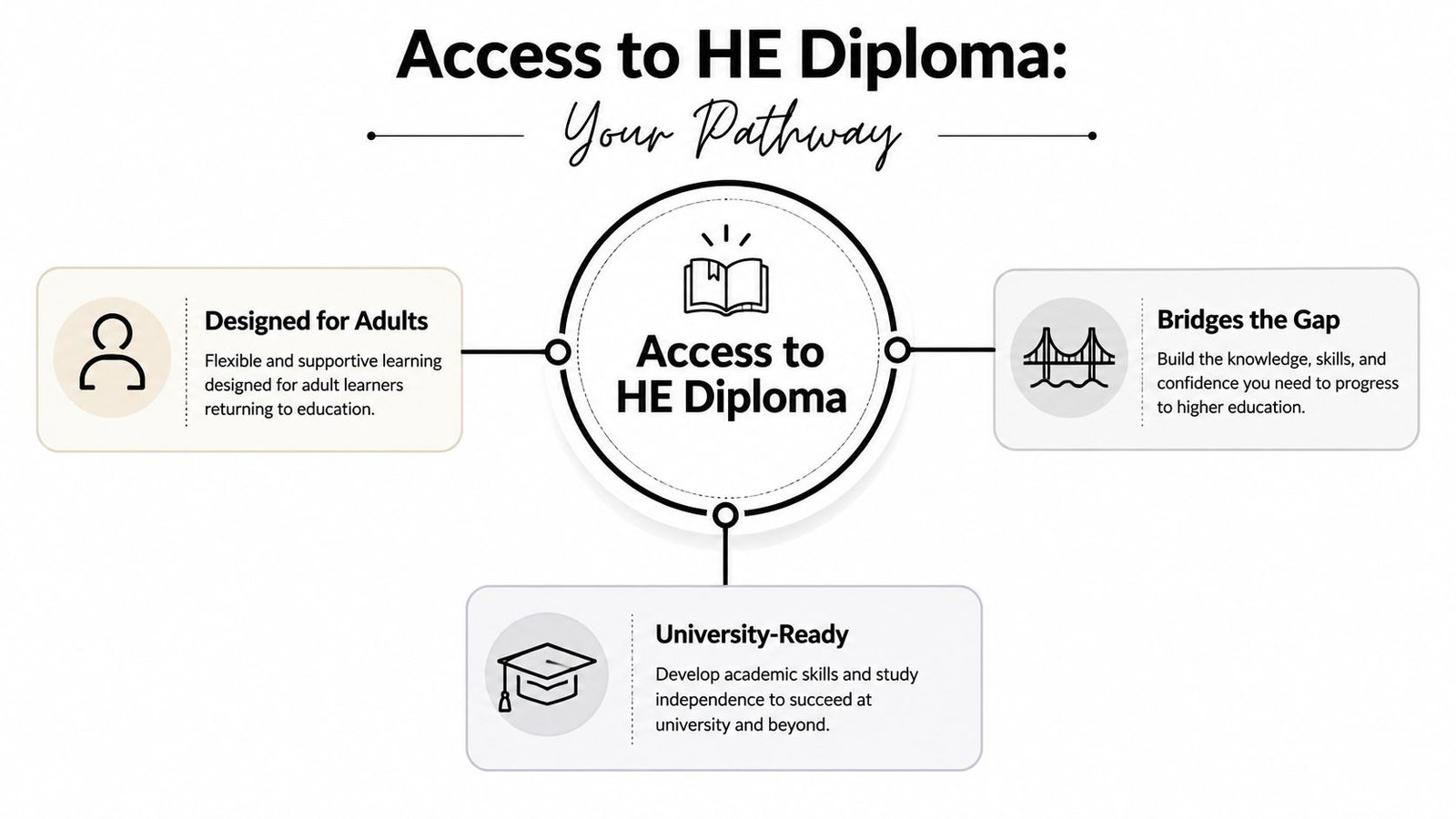
The Access to Higher Education Diploma is designed as a bridge for adults who want to progress to university but may not have the qualifications normally expected from school leavers. The regulated qualification is recognised as a route into higher education, and it lets you build academic skills in a structured setting rather than being expected to know everything on the first day. The official Access to HE statistics describe the diploma as a recognised UK route that supports adults entering and succeeding in higher education.

Your reasons matter
Many adults return to study because they want to become a positive example for their children. Your child may see you reading, attending lessons and finishing assignments, then begin to see education as something people can return to at any stage. That example can be powerful, particularly if you've previously felt that university was meant for other people.
There are practical reasons too. A new qualification may help you move towards healthcare, teaching, social work, business or another career that feels more meaningful. It can support a move away from work that leaves you exhausted or limits your choices, although no qualification can promise a particular salary or job outcome.
Starting will still require planning. You'll need time, support and honest conversations with the people who share your responsibilities. But you don't need perfect confidence before enrolling. Confidence usually grows after you take manageable steps, receive useful feedback and notice that you can do work you once believed was beyond you.
What an Access to Higher Education Diploma Is
An Access to HE Diploma is a Level 3 qualification for adults who want to prepare for university. It offers a structured route for people who may have been away from formal education for years, combining academic preparation with support as they rebuild confidence.
For many learners, the course feels like climbing a staircase. Each assignment is one step, each piece of feedback shows where to place your foot next, and tutors help you reach the higher stages safely. By the time you apply to university, you have practised the skills and routines that once seemed unfamiliar.
What the diploma helps you do
You'll normally choose a subject pathway connected to your intended degree. Available areas can include nursing and healthcare, social sciences, business and humanities, although course titles and content vary between providers. Check the exact pathway before applying, since universities may ask for particular units or grades for competitive courses.
The diploma develops the habits that higher education requires. You may learn to plan an essay, use sources responsibly, structure an argument, prepare a presentation and respond to feedback. These abilities are learned through explanation, practice and repetition, not reserved for people who have always felt confident in academic settings.
Returning to study can also change how you see yourself. Completing work after a long day, meeting a deadline and receiving positive feedback can gradually replace self-doubt with evidence that you belong in education. Your children may notice that progress, too. Your diploma can become a family milestone, showing them that learning and new beginnings remain possible at different stages of life.
The diploma is regulated and quality-assured through the Access to HE framework. This helps universities understand what the qualification represents. Before applying, ask the provider which awarding organisation regulates the diploma and whether your preferred universities accept the specific pathway.
What it isn't
The diploma requires sustained effort. You'll need to attend or engage with learning, complete assessments and meet deadlines. It is designed for adults, so good teaching recognises work, family and other responsibilities while explaining the purpose behind each task.
You may also need GCSE English or maths, or an equivalent such as Functional Skills, depending on your chosen degree and university. Entry requirements differ, so contact admissions teams early rather than guessing. A provider should explain what you need before you commit.
For a visual introduction to the route, this video may help:
An Access Diploma gives you a recognised academic foundation and a clear route towards university. It also gives you repeated chances to prove, to yourself and your family, that your earlier educational path does not define what you can achieve next.
How Access to HE Compares with A-Levels and Other Routes
There's no single correct route into university. The right choice depends on your previous qualifications, the degree you want, how quickly you need to progress and the kind of assessment that helps you show your strengths.
A-levels can be a strong option, particularly if a university specifically asks for certain subjects. They're often structured around formal examinations and may suit learners who want a traditional subject-by-subject route. For an adult with work and family commitments, however, the timetable and assessment style may not fit comfortably.
An Access Diploma is built for adults preparing for higher education. It usually combines subject learning with academic skills and regular assignments. A foundation year is attached to a degree and can be useful when a university offers an extended route into a subject, but it may not be available for every course or institution. An apprenticeship combines employment and training, so it can suit someone who wants to earn while developing skills in a particular occupation.
| Feature | Access to HE Diploma | A-Levels | Foundation Year |
|---|---|---|---|
| Main purpose | Prepare adults for university entry | Build advanced subject knowledge through traditional qualifications | Provide an extended start to a named degree |
| Typical learner | An adult without the usual university entry profile | A learner following a school or college subject route | Someone accepted onto a degree with additional preparation |
| Assessment style | Coursework, projects and possible timed assessments | Often strongly exam-based, depending on the subject | University-style work within the degree programme |
| Course choice | Subject pathways linked to areas such as healthcare, business or social science | Individual subjects chosen to meet entry requirements | Usually tied to one university and degree |
| Flexibility | May be available online, in person or through blended study | Timetables can be less suited to working adults | Depends on the university's delivery model |
| Progression | Apply to university after completing the diploma | Apply after gaining the required grades | Continue into the linked degree if progression conditions are met |
The most important comparison is not speed alone. It's whether the route gives you the preparation and support you need to succeed. If you're unsure whether a degree accepts Access to HE, read this guide on how to get into university without A-levels and then confirm the requirements with the university itself.
Apprenticeships deserve careful consideration if you already know the occupation you want and can find a suitable employer. They may not be the best fit if your goal is a degree that requires broad academic preparation before admission. A foundation year can also be valuable, but you should check the full cost, progression conditions and whether changing degree subjects later would be difficult.
Choose the pathway that matches your life and your destination, not the one that sounds most familiar.
What You Will Study and How You Are Assessed
Your first weeks should make the course feel clearer, not more confusing. Most programmes begin by helping you understand the learning platform, timetable, expectations and support available. You may then move into core academic skills before spending more time on the subject area connected to your intended degree.
A gradual learning journey
Core work can include essay planning, research, referencing, reading, critical thinking and presenting ideas clearly. Subject modules then give you the knowledge needed for your chosen route. Someone preparing for nursing may study health-related topics and human development, while a social science learner may explore society, policy and human behaviour.
A well-designed course doesn't ask you to produce advanced university work immediately. Early tasks may be shorter and closely guided. Later assignments usually expect more independence, because the aim is to help you become comfortable making decisions about structure, evidence and conclusions.
Assessment can take several forms:
- Essays: You answer a question using a clear argument and relevant sources.
- Reports: You organise information for a defined purpose, often using headings and recommendations.
- Presentations: You explain a topic aloud or through recorded work, depending on the provider.
- Projects: You investigate a question, gather information and present your findings.
- Timed assessments: Some subjects include work completed within a set period.
The balance depends on the provider and subject. Ask for an assessment plan before enrolling so you know how deadlines are spread across the course.
Feedback turns uncertainty into progress
Feedback is most useful when it tells you what worked, what needs improvement and what to try next. You might receive comments about your evidence, paragraph structure or use of references, then apply that advice to a later assignment. This process can feel uncomfortable at first, but it gives you a clear route to improvement.
Keep your feedback: Save tutor comments in one folder. Before starting a new assignment, read the last feedback and choose one skill to practise.
You'll still need to manage your time. A weekly study plan can divide reading, notes, drafting and rest into smaller blocks. Tell your tutor early if caring duties, illness or work problems affect your progress. Asking for help isn't a sign that you're failing. It's part of learning responsibly.
Getting into University and Funding Your Studies
University entry becomes much less intimidating when you treat it as a series of actions rather than one enormous decision. Start by checking the course page for your chosen degree. Look for the accepted Access pathway, required units, expected grades, GCSE or Functional Skills requirements and any interview or placement conditions.
You'll normally apply through UCAS. Your provider can help you understand the application, personal statement and reference process, but the final application must reflect your own experience and reasons. Explain why the subject matters to you, what you've learned through work or life, and how your recent study has prepared you.
Access to HE progression is particularly relevant for mature learners. In 2024, learners aged 30 and over represented 25% of higher-education acceptances from Access to HE qualifications, while learners aged 35 and over were the largest single age group. The overall acceptance rate for Access to HE applicants rose to 77.3% from 75.9% in 2023, according to the government's further education and skills statistics. In nursing, adult learners made up nearly 75% of accepted applicants from this route, showing how strongly the diploma can connect mature learners with a high-demand subject.
Make the money question practical
Student finance may cover eligible higher education study through tuition fee and maintenance support. Your exact entitlement depends on your circumstances, course, household situation and the rules that apply where you live. Learners with disabilities or caring responsibilities may also be able to explore additional support, so ask Student Finance and the university's support team for individual guidance.
Funding is becoming more flexible in England. From September 2026, people will be able to access funding for shorter modules as well as full degrees, with applications opening in September 2026 for courses starting from January 2027. The new system is planned to provide funding equivalent to four years of post-18 study, currently worth up to £39,160, as set out in the government's reform announcement. Because this is a future change, check the latest official guidance before making plans.
For course costs and eligibility, you can also read about advanced learner loans. If you're comparing universities from home, a guide on how to create a campus virtual tour can help you explore facilities and student support before travelling.
Choosing the Right Provider for Your Journey
The provider you choose can shape how supported you feel when the work becomes demanding. Don't choose based only on an attractive course page or a quick enrolment process. Ask detailed questions and pay attention to how clearly the team answers.
Use this provider checklist
- Check regulation: Ask which organisation awards and regulates the qualification, then confirm that the diploma suits your intended university route.
- Ask about tutor access: Find out when tutors are available, how feedback is delivered and what happens if you're stuck.
- Inspect the timetable: Online study can offer flexibility, but you still need clear deadlines, lessons and expectations.
- Look for pastoral support: Academic help improves your work. Wellbeing and mentoring support can help you keep going when life becomes difficult.
- Confirm progression guidance: A responsible provider should help you examine university entry requirements rather than promising a place.
- Request the full cost: Ask about tuition, assessment, materials, extensions and any other charges before enrolling.
A provider should respect your responsibilities. Flexible delivery doesn't mean learning without structure. You need a course that gives you a reliable rhythm, clear instructions and someone to contact when a question is too important for a search engine.
Be cautious if a provider promises guaranteed university admission, avoids explaining regulation, hides costs or makes it difficult to speak with a tutor. You should also question any course that gives little information about assessment or progression.
You can compare the support model and qualification details offered by accredited online courses in the UK. Next Level Online College is one UK option that provides online Access to Higher Education diplomas alongside academic, pastoral and progression support. Whichever provider you consider, verify its claims independently and speak directly with the admissions team.
Your Next Steps Towards a Brighter Future
You don't need to solve your entire future tonight. You only need to turn a large hope into a few clear tasks.
- Choose a direction: Write down the subjects or careers that interest you. You don't need a final decision yet, but a starting point will help you compare pathways.
- Check entry requirements: Visit university course pages and note the Access pathway, GCSE or Functional Skills requirements, subject units and grades.
- Speak to providers: Ask about start dates, delivery, workload, tutor contact, assessment and total cost. Notice whether the adviser listens to your circumstances.
- Review funding: Check the latest Student Finance guidance and ask whether your intended course has specific support rules.
- Create a home plan: Discuss study time with your family, identify quiet periods and decide who can help with practical responsibilities.
- Take the first formal step: Complete an enquiry, attend an information session or begin the application. Progress starts when preparation becomes action.
Returning to education may change how your children see you, but it can also change how you see yourself. They'll see you practise, struggle, ask questions and continue. That is a better lesson than pretending success is effortless.
Your experience can also shape the career you move towards. Adults who've cared for others often understand compassion. People who've worked under pressure may bring resilience. Those who've faced barriers may become thoughtful professionals who improve services for their communities. A diploma won't remove every challenge, but it can give your ability a recognised direction.
Access to higher education is not reserved for people who followed a perfect school-to-university path. It's available to adults who are willing to prepare, seek support and keep taking the next sensible step. You may feel nervous and still be ready. You may need to rebuild your confidence and still have everything required to begin.
Next Level Online College offers flexible online Access to Higher Education diplomas, with structured learning, academic guidance and pastoral support for adults balancing study with work and family life. Visit Next Level Online College to explore suitable pathways, check entry guidance and take your first step towards university.