
You might be looking up the average nursing salary because life feels too tight right now. Bills keep coming. Your children are watching. You want a career that means something, but you also need it to pay enough to make the hard work worthwhile.
That's a sensible question to ask.
Nursing is one of those careers where pay can feel confusing at first. You'll see different numbers online, and that can make it hard to know what's real. The good news is that nursing pay in the UK often follows a clear structure, especially in the NHS. That makes it easier to understand what you could earn, how that can grow, and what steps can move you forward.
For many adult learners, that matters as much as the job itself. A career is not only about today's wage. It's also about building a future your family can feel proud of.
Your Guide to the Average Nursing Salary in the UK
Many adults come back to education because they want more than a job that merely gets them through the month. They want steadier money, work with purpose, and a future that looks stronger than the present. Nursing speaks to all of those hopes.
If that sounds like you, start with one simple benchmark. The Annual Survey of Hours and Earnings shows that the median gross annual pay for nursing professionals in the UK was £39,200 in 2024. That gives you a useful national picture of the average nursing salary.

Why one number doesn't tell the whole story
That figure is helpful, but it's only the starting point. Nursing pay in the UK isn't usually one flat number. It changes depending on your role, your level, your employer, your location, and the kind of shifts you work.
That can sound annoying at first, but it's good news.
It means nursing often has a roadmap. You're not left guessing what your next step might bring. In many jobs, pay rises can feel random. In nursing, there's often a clearer path.
Practical rule: Don't ask only, “What is the average nursing salary?” Ask, “What band could I start on, and where could that lead?”
What these numbers can mean in real life
For an adult learner, salary information isn't just data. It helps you answer practical family questions.
- Can I train for something stable? Nursing offers a structured career path.
- Will my pay grow? In many roles, it can rise as you gain experience and move up.
- Can I build a life I'm proud of? Yes. Nursing can offer both income and purpose.
That last point matters. Children notice when a parent keeps going, even when it's scary. They notice when you study at the kitchen table after a long day. They notice when you choose growth.
Nursing can become more than a career choice. It can become proof that your life doesn't have to stay the same.
How Nursing Salaries Work The NHS Pay Bands
If NHS pay has ever looked like a wall of strange terms, you're not alone. Words like Agenda for Change and Band 5 can sound formal and distant. They're much simpler than they seem.
Think of NHS pay like a ladder. Each band is a rung. As your responsibility grows, you move higher.
What Agenda for Change means
Agenda for Change is the NHS pay system used for many staff roles, including most nursing jobs. Instead of every hospital making up completely different salaries, there is a national structure.
That matters because it gives you clarity. You can see the level of a role and get a good idea of the pay attached to it. For many people changing career, that feels far safer than stepping into an unknown private-sector role where pay can vary more widely.
Where most new nurses begin
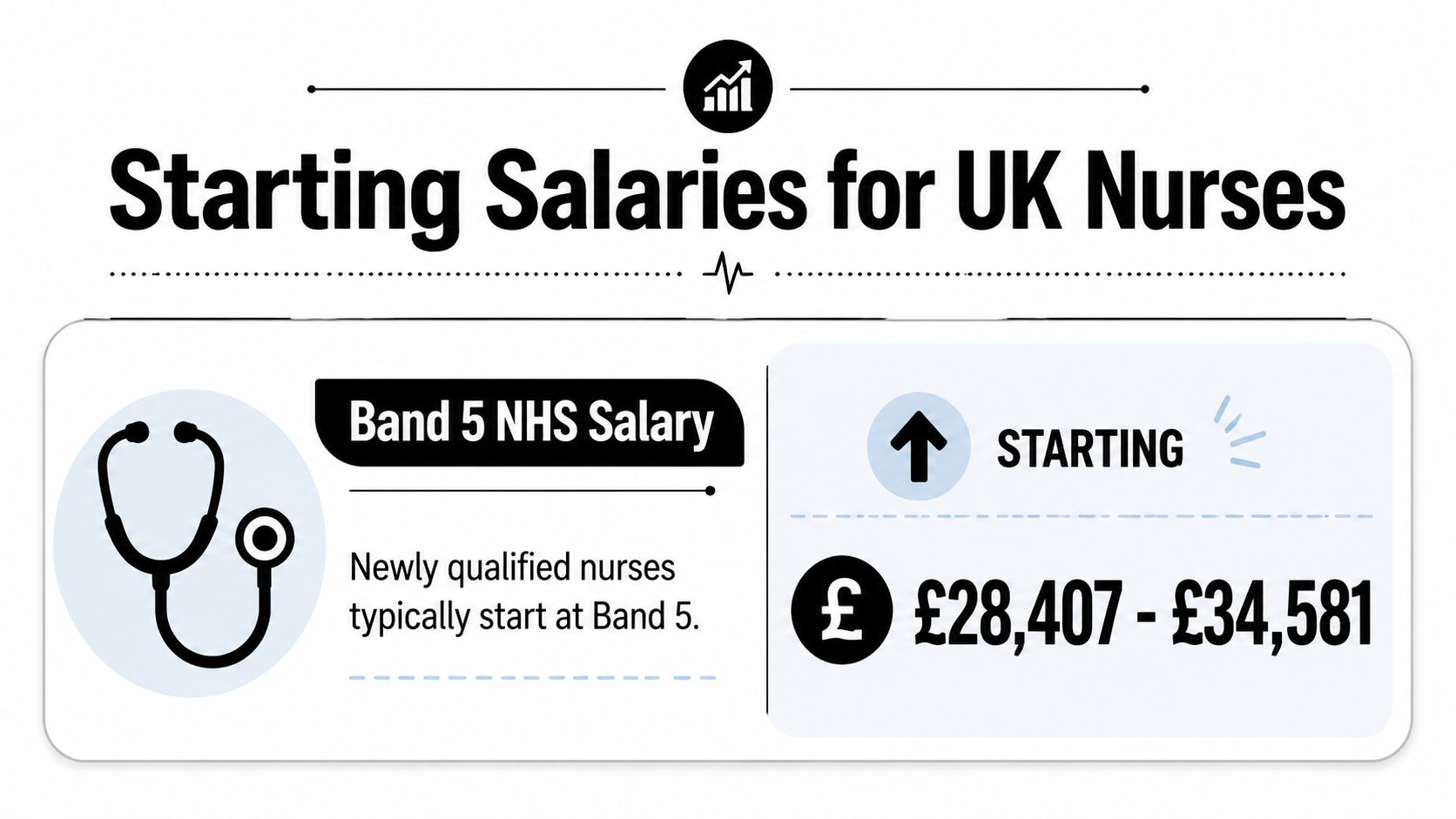
A newly qualified registered nurse usually starts on Band 5. According to the NHS band information cited in this guide, newly qualified registered nurses typically start at Band 5, with a pay range of £29,970 to £36,483.
That tells you something important. Your early pay isn't random. It sits inside a known range.
A simple view of the ladder
| Pay Band | Typical Role | Salary Range (Illustrative) |
|---|---|---|
| Band 5 | Newly qualified registered nurse | Band 5 starting and progression pay applies |
| Band 6 | Senior staff nurse or specialist role | Higher than Band 5 |
| Band 7 | Advanced practice or senior specialist role | Higher than Band 6 |
| Band 8c | Nurse consultant level role | Senior leadership or expert practice pay applies |
This table is a simple guide, not a full pay chart. The key idea is that higher responsibility usually means a higher band.
Why bands help more than they confuse
A lot of learners feel nervous when they first hear about banding. They worry it sounds rigid. But for many families, structure is a strength.
Here's why:
- You can plan ahead. You're able to look at likely starting pay and future progression.
- You can connect study to reward. Qualifications and promotion often lead to movement up the ladder.
- You can see a career path. Instead of wondering what happens next, you can map it.
NHS banding can feel bureaucratic when you first read about it. In practice, it often makes career planning easier.
That predictability is one reason nursing appeals to adults who want a serious career move. You're not only choosing a profession. You're choosing a system with visible steps.
What Your Starting Salary Could Look Like
When people ask about the average nursing salary, they're often really asking something more personal. They want to know, “What could I earn at the beginning?”
For many newly qualified nurses in England, the answer starts with Band 5. For 2024/25, a newly qualified Band 5 nurse in England starts at £29,969 and can progress to £36,483 within the band, while a Band 6 nurse ranges from £37,338 to £44,962.
Why this starting point matters
That Band 5 range gives you something very powerful. It gives you a clear entry point into the profession.
You don't need to wonder if nursing has room for growth. The progression is built into the structure. Within the same band, your pay can rise as you gain experience. Then promotion can take you into the next band.
For someone rebuilding confidence, that matters. You don't have to know everything on day one. You just need to know where the first step is.
What can affect your take-home pay
Base pay is the foundation, but it isn't always the full story. What you take home can vary depending on things such as:
- Your location. Some areas have extra weighting or higher-cost supplements.
- Your shifts. Nights, weekends, and other unsocial hours can change earnings.
- Your role details. Some posts bring extra duties or specialist expectations.
This is why two nurses with the same band might not take home exactly the same amount.
Why many adult learners find this reassuring
A starting salary only matters if it leads somewhere. Nursing does. Your first role is not the end of the journey. It's the platform.
If you're still at the stage of getting the entry qualifications you need, an Access to Higher Education Diploma in Nursing can be the first academic step that opens this route.
Start by understanding the first band, not the whole career at once. Clear next steps build confidence faster than trying to solve everything in one go.
How You Can Increase Your Nursing Salary
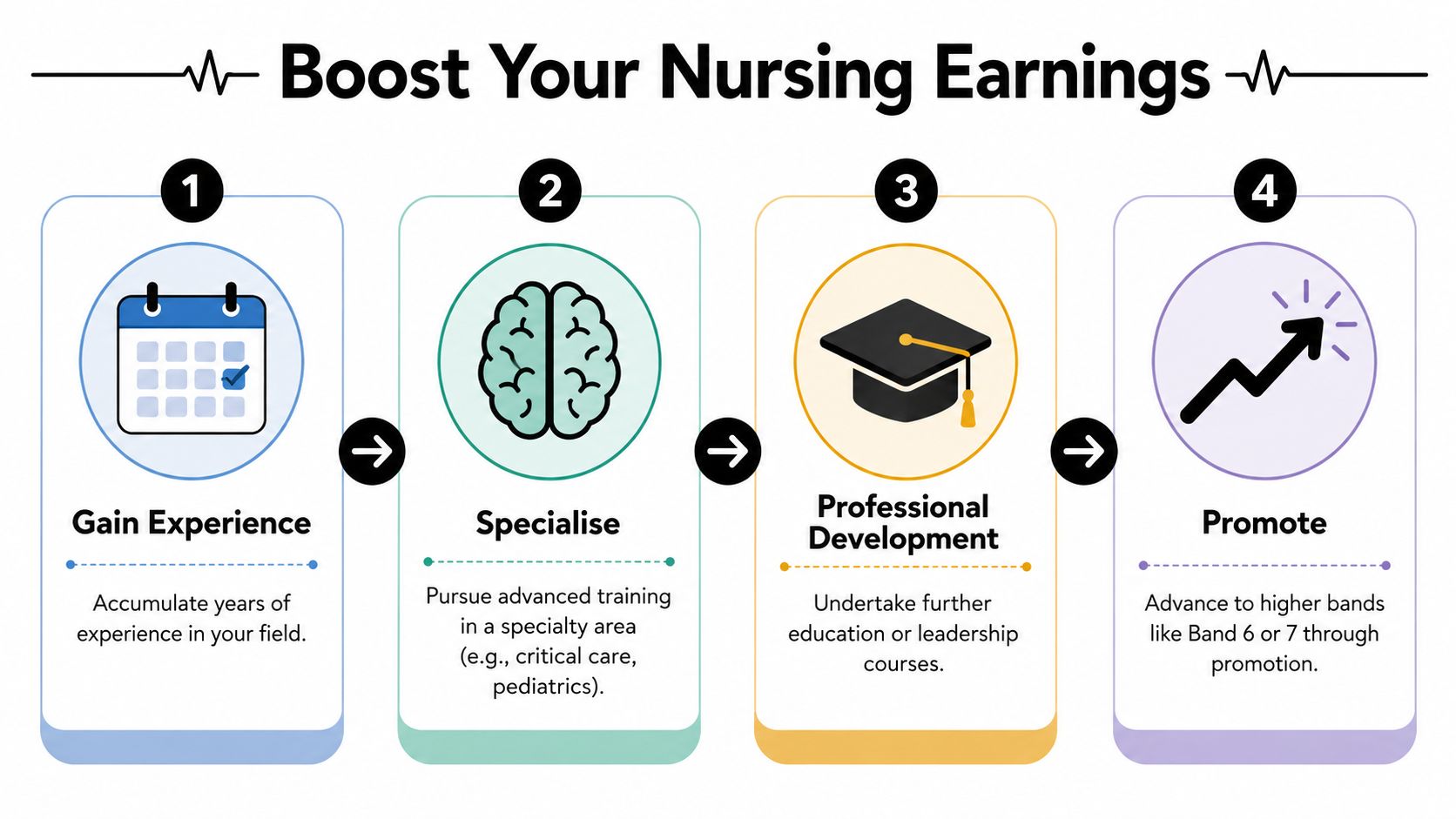
Once you understand the starting point, the next question is usually, “How do I earn more?” That's where nursing becomes especially encouraging. Growth is often linked to things you can work towards: experience, specialist skills, further study, and promotion.
That means salary progress is not just luck. It's connected to development.
Move up through experience and responsibility
A nurse who takes on more responsibility can move into a higher band. That might mean supervising others, handling more complex care, or stepping into a specialist post.
The jump matters financially as well as professionally. The Band 6 range mentioned earlier shows that promotion can make a real difference to earnings.
Some people need to see the journey in action before it feels real. This short video helps bring that pathway to life.
Specialist qualifications can raise your ceiling
General nursing can lead to a strong career. Specialist training can widen the path even more.
The NHS careers information shows that an Advanced Nurse Practitioner at Band 7 can earn between £45,753 and £52,069, while a Nurse Consultant at Band 8c can earn from £69,320 to £79,592.
Those roles don't happen overnight. That's the point. They are goals you build towards.
Four practical ways nurses boost earnings
Stay and grow in practice
Experience helps you become more capable and more competitive for stronger roles.Choose a specialism
Areas like critical care, paediatrics, community nursing, or advanced practice can open doors to higher bands.Keep learning
Extra study often supports career progression. Formal learning can help you qualify for the next stage.Apply for promotion
Moving to a higher band usually comes through stepping into a new post with greater responsibility.
Some of the best salary growth in nursing comes from becoming more skilled, not from chasing quick wins.
Education is often the first unlocked door
If you're not in nursing yet, the route starts earlier than Band 5. It starts with becoming eligible for nurse training. For many adult learners, especially those who don't already have the standard entry qualifications, an online Access to HE diploma can help create that bridge.
That's worth holding onto if your confidence is low. You don't need to leap from where you are now straight into an advanced nursing role. You move in stages. One course. One application. One success at a time.
And every stage builds both your earning power and your belief in yourself.
More Than Just Your Basic Pay Benefits and Overtime
When people talk about the average nursing salary, they often focus only on base pay. That's understandable, but it misses part of the picture. Nursing income and job value can include more than the number attached to your band.
For many families, those extra parts matter because they add security.
What can sit on top of basic pay
In many nursing roles, base salary is only one part of what work gives you. Other financial elements may include:
- Unsocial hours payments. Nights, weekends, and some holiday shifts can increase what you earn.
- Overtime or extra shifts. Some nurses choose additional work when it suits their schedule and energy.
- Location-related additions. In higher-cost areas, pay may include supplements.
- Pension value. NHS pension arrangements are often an important long-term benefit.
These extras won't be the same for everyone. They depend on your post, your rota, and your employer.
Why this matters for adult learners
If you've spent years in jobs where income feels uncertain, the wider nursing package can feel more solid. You're not only asking, “What's my wage?” You're also asking, “How stable is this career?”
That's an important shift in thinking.
A stable profession can help with everyday life in ways that don't show up in one headline number. It can support planning, reduce some money stress, and give you a better sense of control.
Questions worth asking when comparing roles
If you later compare nursing jobs, don't look only at the basic salary figure. Ask questions like these:
- What shifts would I be expected to work?
- Are there regular weekend or night patterns?
- What pension arrangements come with the role?
- Is there room for overtime or bank work if I want it?
A lower-looking basic figure can sometimes sit inside a stronger overall package, especially when pension and shift patterns are considered.
That doesn't mean every nursing role is identical. It means you should look at the whole offer, not just the first number you see.
Your Journey to a Rewarding Nursing Career Starts Today
By now, the average nursing salary should feel less mysterious. It isn't one magic number that tells you everything. It's a journey with stages, and that's what makes nursing so powerful as a career choice.
You can begin at a clear starting point. You can build experience. You can move up. You can specialise. You can create a better income over time while doing work that matters to other people.
That combination is rare.

A future your family can see
For many adult learners, the biggest change isn't only financial. It's personal.
Studying again takes courage. Starting over takes courage too. When you choose a path like nursing, you're showing your children and your family that growth is still possible. You're proving that a difficult chapter doesn't have to be the final one.
That matters.
What makes nursing worth serious thought
Here's the clearest takeaway from all of this:
- The pay structure is easier to understand than many people think
- There is room to progress
- Higher responsibility can lead to higher earnings
- The work itself has meaning, respect, and purpose
If you've been doubting whether education is still for you, remember this. Plenty of successful learners began with the same fear. They worried they'd left it too late. They worried they weren't academic enough. They worried about money, time, and confidence.
Then they took the first step.
If nursing is the future you want to build, exploring nursing access courses is a practical place to begin.
You don't need to have your whole future sorted today. You just need to be willing to start.
If you're ready to turn hope into a plan, Next Level Online College offers flexible online learning designed for adults who are returning to study around work, family, and everyday life. With supportive tutors, clear progression routes, and recognised qualifications, it can help you take that first real step towards nursing, university, and a future you can feel proud of.