
You might be reading this after work, with the kettle on, your phone buzzing, and a long list of things still left to do. Part of you wants more. A better job. Better pay. A stronger future for your family. Another part of you might be thinking, “I’m too old for this,” or “What if I’m not clever enough anymore?”
If that sounds like you, take a breath. You are not behind. You are not out of chances. And you are not the only adult thinking about going back into education.
A business a level can be a strong next step if you want a qualification that opens doors to university, career change, or promotion at work. It gives you practical knowledge about how organisations work, how decisions are made, and how businesses grow. Equally, it can help you prove something to yourself. You can start again. You can finish something important. You can show your children that learning doesn’t stop when school ends.
Your Time to Shine with a Business A Level
You may have spent years putting everyone else first. Work. Children. Bills. Family. Life gets full quickly. Your own goals often get pushed to the back.
That’s why choosing to study now matters so much. It isn’t selfish. It’s an investment in your future and in the people who depend on you. When you build your confidence, your whole household feels it.

Why adult learners often hesitate
Many adults want to return to study, but worry about time more than ability. That concern is real. The Office for Students notes that adult learners over 25 often face unique challenges, with many citing time conflicts as a barrier. If you've ever looked at a course and thought, “How would I fit that into my week?”, you're thinking like many other adults.
That doesn't mean you can't do it.
With flexible study and the right support, learning can fit around real life. It can sit beside your job, your parenting, and your responsibilities. If you're exploring options designed for adults, A Levels for mature students can help you see what that path can look like in practice.
Practical rule: You don't need a perfect life to start studying. You need a realistic plan and the courage to begin.
What this step can mean for your future
Think about what a new qualification could change. You may want to apply for university. You may want to move into office work, management, finance, marketing, or administration. You may want proof that you can achieve more than your current role allows.
A business a level works well for adults because the subject already connects to everyday life. If you've managed a household budget, dealt with customers, organised staff rotas, or solved problems at work, you already understand more business than you think.
That matters when confidence is low. You are not starting from nothing. You are building on life experience.
- For your family: Your study shows your children that effort matters.
- For your career: A recognised qualification can help you move forward.
- For yourself: Finishing a serious course can rebuild self-belief in a way few other things can.
Plenty of adults return to education, with nerves and doubts. Then one assignment turns into another, one topic starts to make sense, and the fear begins to shrink. That could be you too.
Understanding the Business A Level Qualification
A business a level is a Level 3 qualification. In simple terms, that means it sits at an advanced level and is widely accepted for university entry and valued by employers. It is not a small short course. It is a respected qualification that shows you can learn, analyse, write clearly, and apply ideas to real situations.
A useful way to think about it is this. A business a level is a master key. It doesn’t open only one door. It can lead to university options, professional training, and jobs where employers want evidence of strong thinking and commitment.
Why it carries weight
This subject is popular because it connects to the world around us. Businesses are everywhere. Shops, schools, hospitals, cafés, banks, online brands, trades, charities, and large companies all make decisions about money, staff, customers, and growth. Business studies helps you understand those decisions.
That relevance is one reason the qualification is so well known. Around 30,000 students take Business Studies A Level each year in the UK. That shows it is a recognised choice with clear value in today’s economy.
What you are actually proving
When you complete this qualification, you are showing more than subject knowledge. You are showing that you can:
- Read and understand information from business scenarios
- Make judgements instead of just repeating facts
- Use evidence to support your view
- Handle numbers in a practical business context
- Communicate clearly in written answers
Those are useful skills in higher education and at work.
Studying business isn't only about learning how companies operate. It's also about learning how to think in a calm, structured way when decisions matter.
Why adults often suit this subject well
Teenagers may come to the subject fresh from school. Adults often bring something extra. You may already understand workplace pressure, customer service, budgeting, teamwork, or leadership. Even if your experience comes from raising children, caring for relatives, or running a home, you have used planning and decision-making skills.
That experience can make business ideas feel less abstract. You can often connect a topic straight to real life. For many adult learners, that makes the subject feel less intimidating than expected.
Here’s a simple way to view the qualification:
| What it is | What it means for you |
|---|---|
| A Level 3 qualification | A serious, advanced course respected across the UK |
| A nationally recognised subject | Useful for university applications and career progression |
| A course about business decisions | Practical knowledge you can apply to work and life |
| A proof of academic ability | Evidence that you can commit, learn, and succeed |
If you’ve been doubting whether this qualification is “good enough” to change your future, it is. The central question is whether you’re ready to claim that opportunity.
Exploring the Topics You Will Learn
A lot of adult learners worry about the content before they even start. You might be wondering whether the subject will feel too academic, too broad, or too far removed from your everyday life. In practice, Business A Level is usually much more familiar than it first appears, because it studies decisions you already see at work, in shops, in services, and even at home.
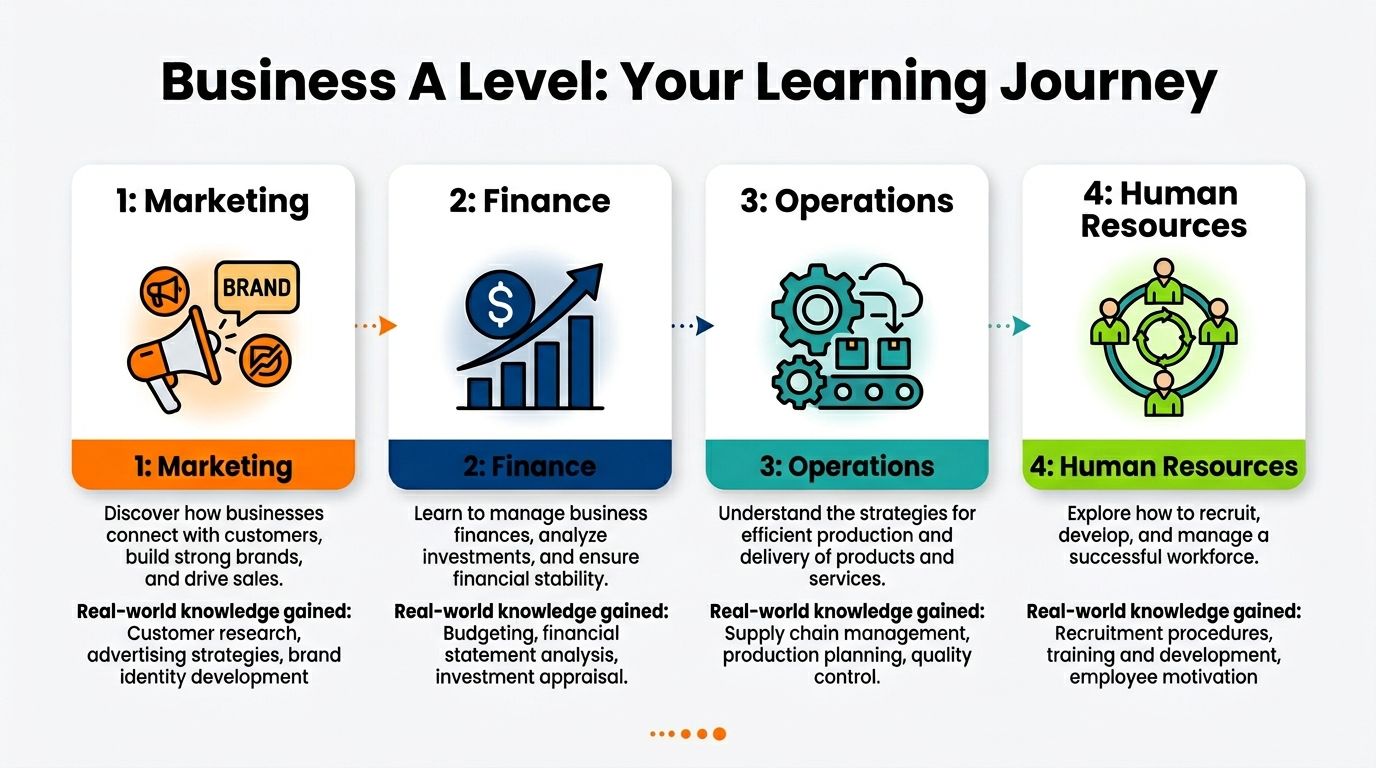
Most courses are built around four core areas. Marketing, finance, operations, and human resources. You also study how leaders make decisions, how businesses grow, and how they respond when conditions change.
The big ideas in plain English
These topic names can sound formal, so it helps to translate them into everyday situations.
- Marketing is about getting customers interested and giving them a reason to choose one business over another. You study pricing, promotion, branding, market research, and customer behaviour.
- Finance is about how money moves through a business. You look at costs, revenue, profit, cash flow, and the choices a business makes when it wants to invest or expand.
- Operations is about how work gets done. That includes producing goods, delivering services, managing stock, maintaining quality, and making day-to-day activity efficient.
- Human resources is about managing people well. You learn about recruitment, training, motivation, leadership, and performance.
If you have ever compared supermarket prices, noticed a business cutting staff, seen a restaurant change its menu, or worked somewhere short on stock, you have already seen these topics in real life.
That matters more than many adults realise.
Your life experience gives you reference points that younger students often do not have yet. A parent managing a household budget already understands trade-offs. A care worker already understands staffing pressure. A retail worker has seen customer service, targets, and team morale up close. The course gives names and structure to things you may already recognise.
How the topics connect
One reason business starts to make sense quite quickly is that the topics do not sit in separate boxes. They affect each other all the time.
A simple example helps. A business lowers its prices to attract more customers. That is marketing. Lower prices might reduce profit margins. That is finance. More customers may create pressure on stock or delivery times. That is operations. The business may need extra staff or better training. That is human resources.
Once you start spotting those links, exam questions feel less random. They start to look like connected business stories.
Why the course feels relevant to adult life
Business is not only about large corporations. It is about choices, consequences, and priorities. That is one reason many adult learners find the subject more practical than they expected.
AQA explains on its Business subject page that modern courses include current issues such as digital business, ethics, and sustainability. So you are not studying ideas frozen in the past. You are learning how businesses respond to online selling, public trust, environmental pressure, and changing customer expectations.
For adults returning to study, this can build confidence. You are learning concepts you can discuss at work, notice in the news, and apply to your own goals.
AQA and Edexcel compared simply
Different exam boards organise the same broad subject in slightly different ways. The content overlaps a lot, but the route through it can feel different.
A quick look at A Level Business exam boards
| Feature | AQA Business A Level | Edexcel Business A Level |
|---|---|---|
| Main structure | Built around managers, leadership, decision-making, and improving performance across marketing, operations, finance, and human resources | Built around four themes that move from core ideas into strategy and global business |
| Assessment style | Mix of shorter questions and longer essay responses | Three papers with ideas developed across progressive themes |
| Quantitative focus | Includes numerical skills within business contexts | Also includes numerical work within business decision-making |
| Overall feel | Strong focus on applying knowledge to business scenarios and judging between options | Clear themed route from foundations to wider strategic thinking |
What AQA looks like
AQA’s specification at a glance for Business 7132 shows how the course is structured and assessed. It includes multiple-choice questions, short answers, longer essays, and quantitative skills across the papers.
That gives many adult learners useful reassurance. You are not being tested on memorising definitions alone. You are being asked to read a business situation, use evidence, and explain your judgement clearly.
What Edexcel looks like
Edexcel organises the course into four themes. Marketing and People, Managing Business Activities, Business Decisions and Strategy, and Global Business.
Many adults like this layout because it builds in stages. You begin with the foundations, then move towards bigger questions about growth, competition, and international business. If you want a clearer picture of how results are judged later on, this guide to A Level grade boundaries and outcomes can help you see how performance is measured.
Where adults often get stuck
Two worries come up again and again.
The first is maths. You do need to handle numbers confidently enough to read data, calculate basic business figures, and comment on what the results mean. You do not need advanced pure maths. In business, numbers are tools for decision-making, not the whole subject.
The second is experience. Some adults worry that they have never worked in an office, managed a team, or run a company. That does not shut you out. The course teaches the concepts from the ground up, and your own experience of work, family life, budgeting, caring, or dealing with services still gives you useful insight.
If you have been out of education for years, this section of the course can be encouraging. It shows you that business is not a secret language for other people. It is a way of understanding choices, pressures, and results, one topic at a time.
Understanding Your Exams and Grades
Exams can sound scary when you’ve been away from study for a while. Most of the fear comes from not knowing what the paper will look like. Once the format is clear, the pressure often feels smaller.
The key thing to remember is that business exams test how you use knowledge, not just whether you can memorise a page of notes. You’ll be asked to look at business situations, spot problems, weigh up choices, and explain what should happen next.
What you might see in the exam
One clear example comes from AQA. AQA’s assessment structure includes multiple-choice questions, essay questions, and at least 10% of marks for quantitative skills like data interpretation.
That means you may face different styles of task:
- Multiple-choice questions test quick recall of key ideas.
- Short-answer questions ask you to apply a concept to a business example.
- Longer essay questions ask you to analyse, evaluate, and reach a reasoned judgement.
- Quantitative tasks ask you to interpret figures, tables, or business calculations.
This is good news for many adults. If one question type doesn’t feel like your strongest area at first, another might suit you better while you build skill and confidence.
What examiners want from you
Examiners usually reward clear thinking. They want to see that you can answer the actual question, use business terms correctly, and explain your reasoning.
A strong answer often does three things:
- Makes a point clearly
- Applies it to the business in the question
- Explains the likely result or weighs both sides
A business exam answer doesn't need fancy language. It needs a clear idea, linked to the case, with a sensible reason.
Understanding grades without panic
A Levels are graded from A to E* for passing grades. Different universities and career routes ask for different results, so your target grade depends on what you want to do next.
If you’re worried about grades, try not to think of them as a judgement on your worth. They are a measure of how well you answered the exam on the day. With practice, your performance can improve a lot.
If you want a plain-English guide to what results mean, A Level grades explained can help you understand the system more calmly.
A helpful way to prepare
Instead of asking, “Am I smart enough for the exam?”, ask, “What does this exam reward?” Then practise those skills.
For business, that usually means:
- Learning key terms well
- Practising short timed answers
- Building essay structure
- Getting used to reading data carefully
That’s a much more manageable challenge than trying to feel magically confident all at once.
Finding a Study Path That Fits Your Life
For most adult learners, the biggest problem isn’t motivation. It’s logistics. You may want the qualification badly, but your week is already full. Work shifts change. Children need lifts. Family life doesn’t pause because you’ve enrolled on a course.
That’s why the way you study matters almost as much as what you study.

Why flexible learning suits adults
Online learning can make a business a level far more realistic. Instead of building your life around fixed classroom times, you can fit study around the life you already have. That could mean reading notes before work, watching a lesson in the evening, or revising at the weekend.
For adults, that control can make all the difference.
Some people study best early in the morning. Others work better once the children are asleep. Flexibility gives you room to learn in the way that suits your home, your energy, and your routine.
What a workable week can look like
A successful study plan doesn’t need to be dramatic. It needs to be repeatable.
A realistic week might include:
- Two short weekday sessions for reading or note-making
- One longer session at the weekend for deeper work
- Small spare moments for flashcards, definitions, or checking feedback
- A set catch-up slot in case life gets messy
Adult study is rarely smooth. A child gets ill. Work runs late. You miss a session. That doesn’t mean failure. It means you need a study path built for real life, not an imaginary perfect week.
Support still matters when you study from home
Flexibility doesn’t mean being left alone. Good online learning should still give you structure, guidance, and someone to ask when you’re stuck. Adult learners often do best when they know where to find help quickly and when the course materials are easy to follow.
If you're comparing options, distance learning for A Levels can show how home study can work around jobs, children, and other commitments.
Some learners also find it helpful to see what online study feels like in practice. This video gives a useful sense of that learning style.
Give yourself permission to study differently
You do not have to copy the way teenagers revise in school. You are an adult with adult responsibilities. Your method can look different.
You might prefer:
| Study situation | A practical approach |
|---|---|
| Busy work week | Focus on short sessions and simple tasks |
| Family-heavy evenings | Use early mornings or lunch breaks |
| Low confidence | Start with one topic and build routine first |
| Long gap since study | Spend time learning how exams work before pushing speed |
Many adults think they must “go all in” from day one. That idea puts people off. A better approach is steadier. Build a rhythm you can keep. Progress comes from consistency, not from trying to be perfect for one week and burning out the next.
How to Study Effectively and Stay Motivated
Motivation often fades when life gets noisy. That’s normal. The answer isn’t to wait until you feel inspired every day. The answer is to build habits that keep you moving even when your confidence dips.
A good study routine should feel simple enough to repeat. If your plan is too big, you won’t stick to it. If it’s realistic, you can keep going even in a difficult week.
Build a study setup that helps you
You don’t need a fancy office. A small corner can do the job. What matters is that your brain starts to connect that space with focus.
Try these simple changes:
- Choose one regular spot so you don’t waste energy deciding where to work.
- Keep your materials together in a folder, tray, or bag.
- Remove easy distractions by putting your phone out of reach when you study.
- Use headphones or quiet background sound if your home is busy.
A stable setup reduces friction. That makes it easier to begin.
Use shorter sessions well
Long revision marathons sound impressive, but many adults learn better in smaller chunks. A short focused session is often more useful than staring at a book while tired.
A simple pattern can help:
- Pick one small task
- Work on it for a short block of time
- Stop and check what you understood
- Write one note about what to revisit next time
This creates a sense of progress. It also stops the course from feeling huge and overwhelming.
Small-win reminder: A completed 30-minute session counts. A finished flashcard set counts. One strong paragraph counts.
Let your family support your goal
Adult learners sometimes keep study private because they feel embarrassed. But telling your family can help. If the people around you understand why this matters, they are more likely to protect your study time and encourage you when things feel hard.
You don’t need a big speech. You can say something simple: “I’m doing this because I want a better future, and I need your help to keep going.”
That can change the atmosphere at home. Your children may even feel proud seeing you work towards something important.
Make revision active, not passive
Reading notes again and again can feel safe, but it often gives a false sense of progress. Active study is generally more effective.
You could try:
- Answering practice questions instead of only reading
- Explaining a topic out loud as if you were teaching someone else
- Creating flashcards for key terms
- Planning essay answers before writing full ones
- Using real businesses as examples from shops, services, or workplaces you know
Business is easier to remember when you attach ideas to real situations.
Protect your confidence on hard days
There will be days when a topic doesn’t click. There will be weeks when you feel behind. That doesn’t mean you’re failing. It means you’re learning.
When confidence drops, do these three things:
| Problem | Helpful response |
|---|---|
| “I’m too slow” | Slow learning is still learning |
| “I’ve forgotten everything” | Review one topic, not the whole course |
| “I missed a week” | Restart with one task today |
Your progress will not be a straight line. That’s true for almost every adult learner. Keep returning. That matters more than having a perfect run.
Your Progression Pathways After You Qualify
You finish your final exam, close your laptop or leave the exam room, and realise something important. You are no longer someone who only meant to go back to education. You are someone who did it.
That matters more than a grade on paper alone.
For adult learners, a Business A Level often changes what feels possible. It can help you apply for higher education, strengthen your position at work, or give you a credible starting point for a career change. If your confidence has been low for years, this qualification can act like a bridge between the life you have managed bravely and the life you now want to build.
A route into higher education
Business is one of those subjects that keeps several doors open. If you decide university is your next step, it can support applications for degrees such as:
- Business Management
- Marketing
- Accounting and Finance
- Human Resource Management
- International Business
- Business and Enterprise
That flexibility helps if you are still working out your long-term plan. Many adults do not return to study with a perfectly mapped future. You may know that you want better prospects, more stability, or work that suits your strengths. That is enough to begin.
University can feel intimidating if you have been out of education for a long time. But adult learners often bring something younger applicants are still developing. You have real experience of work, responsibility, pressure, and time management. A Business A Level gives that experience an academic framework, which can make your application stronger and help you feel that you belong there.
Career doors it can help open
You do not have to go to university for this qualification to matter.
A Business A Level can support progression into roles connected to:
- Administration and office support
- Sales and customer service
- Marketing support
- Team leadership
- Project coordination
- Human resources support
The qualification will not replace experience, but it can add weight to it. If you already work in an office, retail setting, customer-facing role, or supervisory position, Business can help you explain what you know in a clearer and more professional way. It gives names to the ideas you may already use every day, such as budgeting, operations, motivation, recruitment, and decision-making.
That can help in interviews too. Instead of saying, “I’ve picked things up as I go,” you can speak with more structure and confidence about how businesses work and where you fit within them.
When you qualify, you gain more than a certificate. You show that you can commit to a serious goal and complete it, even while balancing adult responsibilities.
A stepping stone, not a final label
Some adults use a Business A Level straight away. Others use it later.
You might earn the qualification, stay in your current job for a while, then apply for a promotion when the timing is right. You might use it to access a degree after your children are older or your work schedule changes. You might decide it has given you enough confidence to train in a different area altogether.
That is one of the strengths of this course. It does not force your future into one narrow path. It gives you a stronger base, and then you choose what to build on it.
A future your family can feel
Your family may see the result before they understand the qualification itself. They may notice that you speak with more confidence. They may see you aiming higher. They may hear you talk about options instead of limitations.
Children notice that.
If you have ever worried that going back to study is selfish, it may help to look at it another way. Building your education can support your family financially, but it can also change the example they grow up with. They see that setbacks do not have to be final. They see that adults can start again. They see that learning is part of creating a better life.
That is a powerful message to bring into a home.
A Business A Level can help you work towards better pay, more satisfying work, and more choice in the years ahead. For many adult learners, that is the progression pathway. Not just the next course or the next job, but a steadier and more hopeful future for you and the people who rely on you.
Frequently Asked Questions for Adult Learners
When adults think about returning to study, the questions are often emotional as well as practical. That’s completely normal. Here are some of the worries people bear privately.
| Question | Answer |
|---|---|
| Am I too old to take a business a level? | No. Adult learners return to education at many different ages. What matters is your commitment and having a study plan that fits your life. |
| What if I’ve been out of education for years? | Many adults feel rusty at first. Skills come back with practice. Clear materials, steady routines, and patience make a big difference. |
| Is business a level too hard if my confidence is low? | It can feel challenging, but challenge is not the same as impossibility. Business is a subject that often becomes easier once you connect it to real life and work examples. |
| Do I need business experience first? | No. Experience can help, but it isn’t required. The course teaches the concepts from the ground up. |
| Will employers respect this qualification? | Yes. It is a recognised A Level and is widely understood across the UK. It shows academic ability and useful workplace thinking. |
| Can I study around work and children? | Yes, if your course structure is flexible and you build a realistic weekly routine. Adults often succeed by studying in short, regular sessions. |
| What if I’m scared of exams? | Many adults are. Exam fear usually drops when you understand the paper format and practise the question types. Preparation builds confidence. |
| Could this really lead to university? | Yes. A business a level is commonly used as part of university entry and can support progression into several business-related degree courses. |
A few final worries, answered honestly
Some adults worry they will look foolish for trying. They won’t. Choosing to study while managing adult responsibilities takes courage.
Some worry they won’t finish. Most success comes from getting back on track after interruptions, not from never having interruptions at all.
Some worry they’re doing it too late. But a later start can still lead to a better future. Next year will come either way. You can meet it with the same doubts, or with a qualification in progress.
You do not need to feel fearless to begin. You only need to believe that your future is worth effort.
If you're ready to take that first step, Next Level Online College offers flexible online courses designed for adult learners who are balancing study with work, family, and everyday life. With supportive guidance and a structure built around real responsibilities, it can help you turn the goal of earning a business a level into something practical, achievable, and life-changing.