
You're sitting at the kitchen table after the children have gone to bed. Your workday is finished, the house is finally quiet, and you're looking at a science course wondering whether returning to education after years away is realistic. Perhaps you need a qualification for nursing, teaching, university, or a new career. Perhaps you want to prove to yourself and your family that you can do something you once thought was out of reach.
Combined Science GCSE can be a practical route back into education. It brings biology, chemistry, and physics together into one qualification that counts as two GCSEs. With a structured plan, patient support, and study sessions that fit around real life, you don't need to become a different person to succeed. You need a clear route, regular practice, and someone to help when the work feels difficult.
What Combined Science GCSE Really Means for You
Combined Science GCSE is a double-award science qualification. You study biology, chemistry, and physics, then receive a paired result rather than one separate grade for each subject. In England, Wales, and Northern Ireland, the qualification is graded from 9-9 down to 1-1, with equal and adjacent combinations such as 8-8 and 8-7 available under the official grading structure. Ofqual explains the grading structure for reformed GCSE science qualifications.
The qualification is not “half a science GCSE”. It's a recognised GCSE pathway worth two GCSEs. The two grades reflect your overall performance across the three sciences, so you aren't judged only on the subject you find easiest.

Why adults choose this route
For an adult returner, Combined Science can meet science requirements for routes such as nursing, teaching, and many Access to Higher Education courses. You should always check the exact entry rules for the college or university you're considering, but the qualification can provide a useful foundation for people who need science before moving into further study.
It's also a large and established pathway. Provisional summer 2026 data recorded 951,510 combined science entries, compared with 934,500 in summer 2025, an increase of 1.8%. The 2025 England results release recorded 925,800 results issued, with results double-counted because Combined Science is the size of two single GCSEs. The UK Government's provisional entries data explains the scale and double-counting.
That scale tells you something important. You won't be taking an unusual or lesser qualification. You'll be following one of the main science routes used in the UK secondary curriculum.
A qualification isn't less valuable because it took you longer to reach it.
You may feel rusty with formulas, diagrams, or scientific words. That doesn't mean you're incapable. Adults bring useful experience to science. You already understand cooking, medication, household energy, work processes, health, safety, and problem-solving. Your course helps you connect that experience to the knowledge and exam skills you need.
If you're looking for support designed around adult learners, you can explore this science GCSE for adults guidance. The right course should make the qualification feel organised rather than overwhelming, with help available when confidence drops.
The Three Sciences and What You Will Study
Combined Science gives you a broad view of biology, chemistry, and physics. The subjects connect, but each one asks different questions about the world.
Biology explains living systems
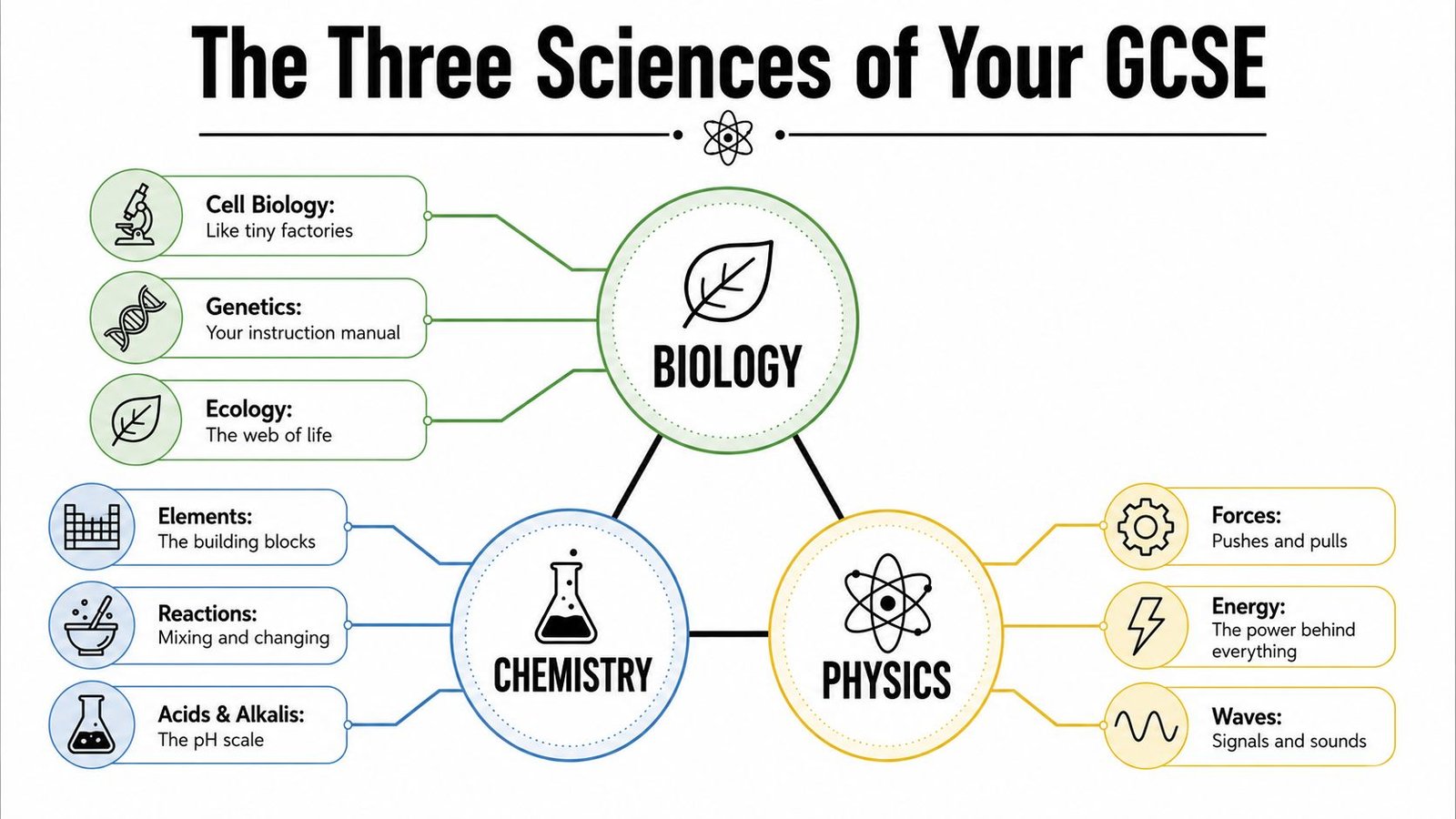
Biology looks at how living things are built and how they work. You'll meet cell biology, organisation, infection and response, bioenergetics, homeostasis, inheritance, evolution, and ecology. A cell can be understood as a tiny working unit, rather like a small factory with different parts carrying out different jobs.
You may study why the body heals, how pathogens cause disease, and why antibiotics work against bacteria but not viruses. Genetics can feel like an instruction manual passed through generations, while ecology shows how plants, animals, and environments depend on one another.
Chemistry explains materials and change
Chemistry asks what substances are made from and what happens when they change. Topics include atomic structure, the periodic table, bonding, quantitative chemistry, chemical changes, energy changes, organic chemistry, chemical analysis, the atmosphere, and using resources.
These ideas appear in everyday life. Cooking involves chemical reactions. Cleaning products depend on chemical properties. Water treatment relies on understanding substances, mixtures, and reactions. Once you see chemistry as the study of materials changing, the subject becomes less distant.
Physics describes forces and energy
Physics covers energy, electricity, the particle model, atomic structure, forces, waves, magnetism, and electromagnetism. Forces help explain braking, balance, movement, and what happens when you drive. Energy helps you understand household bills and how appliances transfer power. Waves explain sound, signals, and some medical technologies.
The course content is balanced across the three sciences. GCSE Combined Science subject content requires a minimum 30% coverage of biology, chemistry, and physics. The official Combined Science subject content sets out this balance.
For private candidates, required practical work still matters. OCR states that learners must cover at least 16 practical activities across the three sciences, although practical skills are assessed through written exam questions rather than requiring every private candidate to work in a school laboratory. OCR lists the required practical activities for GCSE Combined Science B.
A structured course breaks the content into small topics. You don't need to understand everything in one sitting, and you don't need to memorise an entire textbook before attempting questions. If you want to build confidence in one subject first, an online GCSE Biology course can help you practise the learning style before tackling the full science programme.
Understanding Your Grades and Exam Structure
The paired grade is one of the first things that confuses adult learners. Combined Science gives you two GCSE grades, such as 5-5 or 7-6, because it's a double-award qualification. The two digits aren't chosen independently. Only equal or adjacent combinations are valid, reflecting your combined performance across biology, chemistry, and physics. The official Combined Science grading document explains how paired grades work.
A result of 4-4 represents two standard passes under the current grading system. A 5-5 shows stronger performance across both parts of the award. On Higher tier, students can receive grades from 4-4 to 9-9. On Foundation tier, the available range is 1-1 to 5-5. Students who narrowly miss the main Higher threshold can receive a safety-net grade of 4-3 under the official arrangements. Pearson's Combined Science specification describes the tier ranges.
Choosing the right tier
Foundation may suit you if you're rebuilding basic knowledge, feel uncertain with maths, or need a secure route towards the pass range. Higher gives access to the top grades, but it includes more demanding questions and requires stronger confidence with calculations and unfamiliar situations.
Your decision should be based on your target course, current knowledge, practice results, and advice from your tutor or exam centre. Don't choose Higher just because it sounds more impressive. Don't choose Foundation because you've had a long break from education. Choose the tier that gives you a realistic chance to show what you know.
Most major specifications assess Combined Science through six papers, with two papers for each science. Pearson Edexcel has a total mark allocation of 360, while AQA Trilogy has 420 marks. A published comparison of Combined Science grade boundaries identifies these awarding-body totals. Papers use a mixture of multiple-choice, short-answer, calculations, practical questions, and extended responses.
| Combined Grade | Old Grade Equivalent | Meaning | Typical Use Case |
|---|---|---|---|
| 4-4 | Two standard passes | A secure basic pass across the qualification | Some further education, Access, and career routes |
| 5-5 | Two stronger passes | A stronger result with wider progression options | Many Access courses and some health or education routes |
| 7-6 | High paired result | Strong understanding across the sciences | Competitive further study, depending on course rules |
| 9-9 | Highest paired result | Exceptional performance across the qualification | Advanced progression where high grades are requested |
Grade boundaries change between exam series because exam boards set them after reviewing the difficulty and performance of the papers. Your revision should therefore focus on answering questions accurately, showing working, using units, and explaining scientific ideas clearly, rather than chasing one fixed raw-mark target.
You can also use this guide to understand what GCSE grades mean before discussing entry requirements with a college or university.
Combined Science Versus Triple Science
The choice between Combined Science and Triple Science should follow your future plans, available study time, and confidence, not pressure from other people. Combined Science covers biology, chemistry, and physics as one double award. Triple Science, also called Separate Sciences, awards three individual GCSEs, one in each discipline.
The Combined route covers roughly two-thirds of the content found in Triple Science. Some detailed course comparisons describe Combined Science as requiring around 350 guided learning hours, while Triple Science can require 500 or more, although the exact arrangement depends on the provider and exam board. Treat those figures as planning guidance rather than a promise about every course.
| Feature | Combined Science | Triple Science |
|---|---|---|
| GCSEs awarded | Two paired grades | Three separate grades |
| Content volume | Broad coverage of biology, chemistry, and physics | Greater depth in each science |
| Exam papers | Six papers in many major specifications | Six papers in the common separate-science structure |
| Grading | A paired result such as 5-5 or 7-6 | Separate Biology, Chemistry, and Physics grades |
| Suitable for | Nursing, teaching, many Access routes, and general progression | Students needing or strongly preferring separate sciences |
| Study demand | More manageable alongside work and family | Larger commitment and deeper subject coverage |
Which route fits your goal
Combined Science is a fully recognised double award. It isn't a qualification employers or universities automatically dismiss. Many adult learners need science for a particular progression route, rather than for a career as a laboratory scientist, and the double award can be the sensible option.
Triple Science may be necessary for medicine, pharmacy, or a course that specifically asks for separate Biology, Chemistry, and Physics. Check the published requirements before enrolling. Entry rules vary, and a qualification adviser can help you avoid spending extra time on a route you don't need.
For nursing, teaching, and many career-change pathways, Combined Science can offer the right balance between recognition and workload. You keep the science foundation while leaving more space for English, maths, work, caring responsibilities, or an Access diploma.
Choose the qualification that serves your destination, not the one that sounds hardest.
If you're unsure, write down the course or job you want, check its exact science requirement, and then compare that requirement with your available time. A realistic qualification completed successfully is more useful than an ambitious route that leaves you exhausted and discouraged.
A Realistic Revision Plan for Adult Learners
A good revision plan respects the fact that adult learners have full lives. You may study after work, before the school run, during a lunch break, or at the weekend. The important habit is not studying for hours every day. It's returning to the work regularly and checking whether you can recall and apply what you've learned.
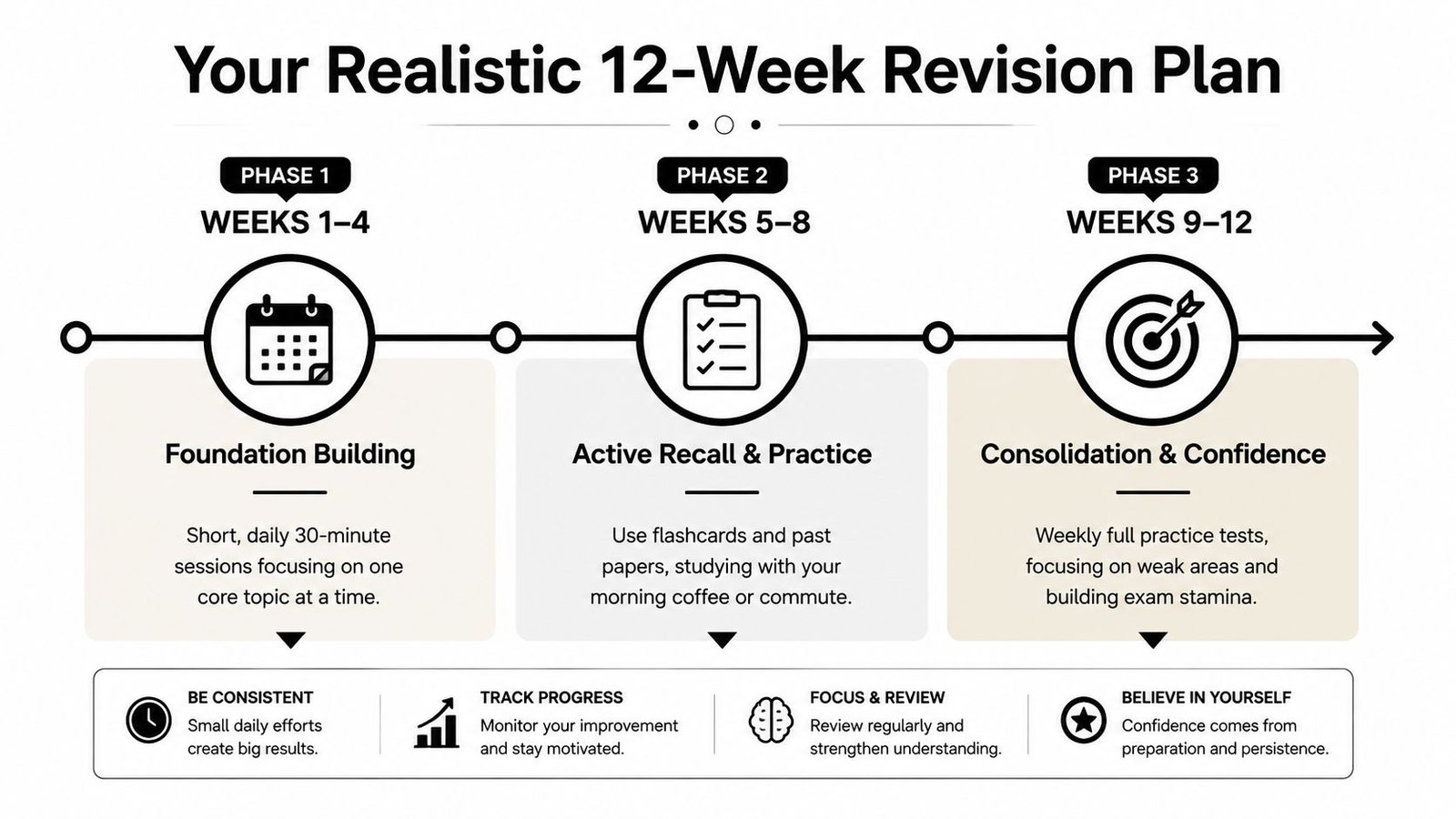
The longer plan below uses three stages. If your exam date differs, keep the order and adjust the calendar.
Foundation building
In the first stage, learn one core topic at a time. Use short 30 to 45 minute blocks, write simple summaries, create flashcards for key terms, and practise basic calculations as soon as they appear.
Don't spend all your time rereading. Close the book and ask yourself what a term means, how a process works, or why an equation is used. Retrieval practice feels harder than reading, but it shows you what you can remember.
Active practice
Next, add exam-style questions. Use BBC Bitesize and Seneca Learning for explanations and quizzes, then use Physics & Maths Tutor for past papers and mark schemes. A CGP revision guide can help you review a topic quickly, but the mark scheme should teach you how examiners award credit.
Practise six-mark extended responses early. Plan the answer, include scientific vocabulary, link each point logically, and check whether the question asks you to explain, evaluate, compare, or calculate. A useful practical study guide advice resource can help you organise revision without turning every evening into a marathon.
Exam readiness
During the final stage, complete timed sections and then full practice papers. Keep an error log with three columns: the question, why you lost the mark, and what you'll do differently next time. This turns mistakes into a personal revision list.
| Study time | Suggested focus |
|---|---|
| Monday evening | Biology recall and one short question set |
| Tuesday evening | Chemistry concepts and equations |
| Wednesday | Rest, family time, or catch-up |
| Thursday evening | Physics calculations and units |
| Saturday | Practical questions and an extended response |
| Sunday | Mixed quiz, review, and plan the week |
Missed sessions don't mean you've failed. Move the work, reduce the task, and continue. Consistency beats cramming because each return to the topic strengthens your memory.
You can also use this short video as a visual reminder of how to organise a manageable revision routine.
Why Online Study Changes Everything
Traditional evening classes can create problems for adults before the first lesson begins. You may need to travel after work, arrange childcare, find parking, and arrive in a classroom where most learners are much younger. A rigid timetable can make one missed lesson feel like a crisis.
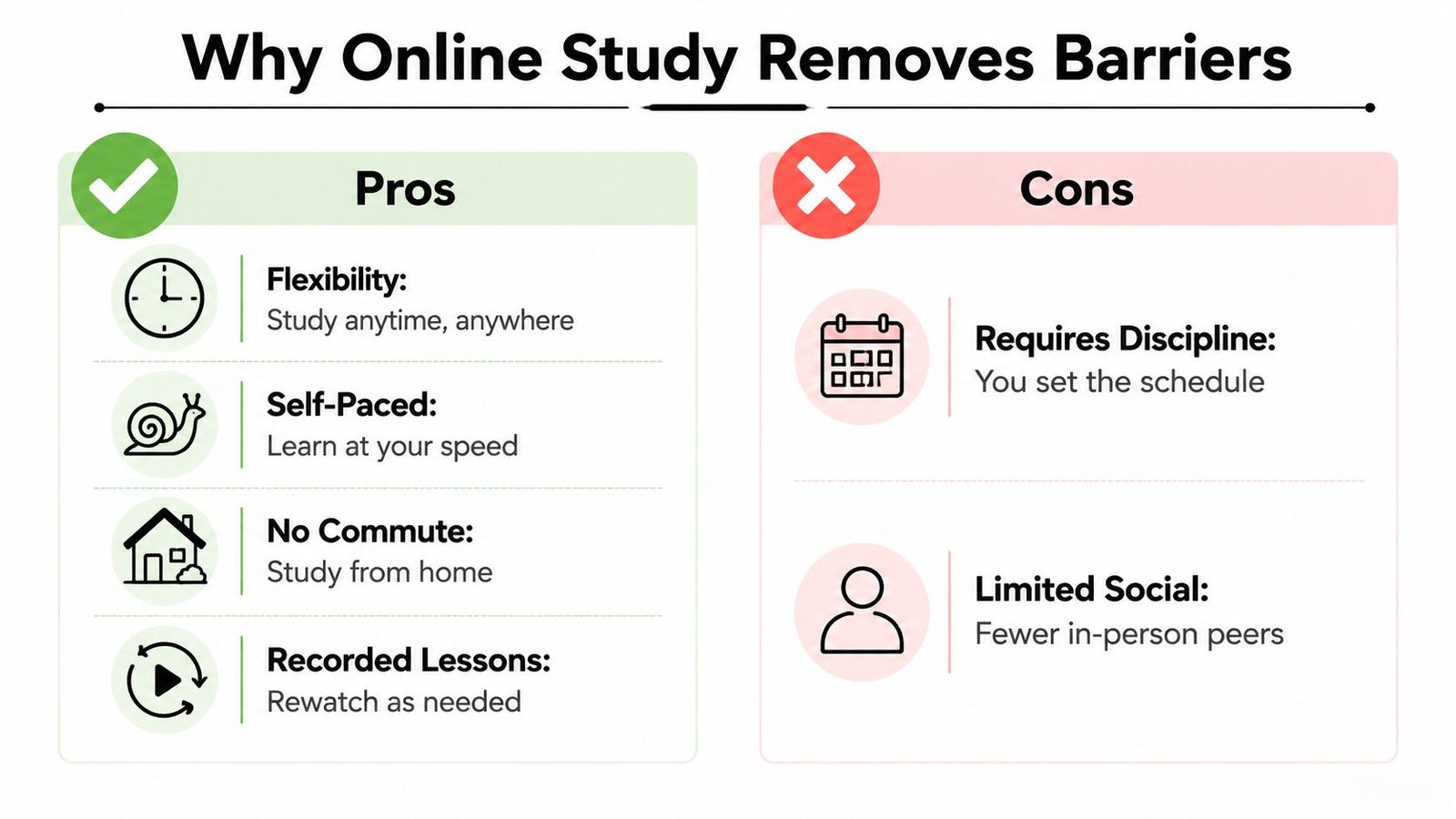
Online study changes the shape of the commitment. You can watch a lesson at home, pause a difficult explanation, and return to it when the house is quiet. You don't have to commute, and you can fit a science session around work and family rather than putting your whole life on hold.
What proper support looks like
Flexible learning works best when it still has structure. A quality online GCSE course can include:
- Recorded lessons: Rewatch explanations about equations, infection, bonding, or forces until the idea makes sense.
- Interactive quizzes: Check your understanding immediately instead of waiting for a classroom test.
- Tutor-marked assignments: Receive feedback on how to improve scientific explanations and exam technique.
- Progress tracking: See which topics you've completed and which need another attempt.
- Live support: Ask questions when a calculation or practical scenario refuses to make sense.
- Peer communities: Share encouragement with other adults who understand work, parenting, and returning to study.
Science benefits particularly from on-demand learning. You may need to see a particle model several times, practise a circuit question slowly, or revisit how to identify variables in an experiment. Online resources let you control the pace instead of pretending you understood because the lesson moved on.
The main challenge is discipline. Without a school bell, you must protect your study time. Put sessions in your calendar, tell your family when you're unavailable, and use small targets such as “complete one topic quiz” rather than “revise science”.
Good online learning also depends on clear digital design. If you're curious about how a learning platform can organise courses and learner journeys, this overview of e-learn management website design gives useful context.
Online study doesn't remove every difficulty, but it removes barriers that stop many adults from starting. With tutor check-ins and a sensible weekly routine, you can build a qualification around your existing responsibilities and show your children that education remains possible at any age.
Your Next Steps After Passing
Passing Combined Science GCSE can be the start of a new plan rather than the end of one. A result such as 4-4 or 5-5 may support applications to further education, Access to Higher Education courses, and some college programmes, depending on the provider's full entry requirements.
Routes into health and education
An adult learner interested in nursing, midwifery, or an allied health profession may use Combined Science as part of a wider application. Some routes also ask for English and maths, work experience, an interview, or an Access diploma. Check each institution carefully because “science required” can mean different things.
Primary teaching applicants often need GCSE English, maths, and science, while nursing applicants may need particular grades in science alongside other qualifications. Typical thresholds can include 4-4 or 5-5, but you must confirm the current requirement with the course provider before choosing your tier or exam plan.
You might continue through one of these routes:
- A Level science: Build deeper knowledge in biology, chemistry, or physics before applying for higher education.
- Access to Higher Education: Prepare for university study in nursing, midwifery, allied health, or another subject.
- Career-focused training: Use the GCSE as one part of a move into a new role where science knowledge matters.
- Further science study: Treat Combined Science as a confidence-building stage before considering separate sciences.
The timeline depends on your course, entry requirements, finances, and available study time. A GCSE may be followed by an A Level or Access course, then a university degree or professional training. Some learners will take a more direct route into work, while others will build qualifications gradually around employment and family life.
Your grade doesn't define your intelligence. It records what you demonstrated in a particular set of exams. The deeper achievement is that you returned, kept going through difficult topics, and created a new option for yourself.
Every study session is also a message to your children. You're showing them that setbacks don't have to become permanent, that adults can learn new skills, and that a future career can begin with one small decision at the kitchen table.
Next Level Online College offers a flexible, tutor-supported Combined Science GCSE course for adults, with structured online learning, assessment preparation, and progression guidance. Visit Next Level Online College to explore a study route that can fit around your work, family, and plans for further education.