You're sitting beside your child as they work through their homework. You know the answer, but the words on the page still make you hesitate. Perhaps you left school without the English result you wanted, or perhaps life became busy with work, family and responsibilities. Then a quiet thought arrives: this time, I'll study too.
Functional Skills English Entry Level 3 can be the practical first step that helps you read with more confidence, write clearly and speak up at work or in everyday life. It's a real UK qualification with a clear assessment structure, not an informal literacy class. It can help you become the role model your children see when they learn that it's never too late to begin again.
A New Beginning for You and Your Family
One evening, a parent watches their child read a school book. The child asks for help with a difficult paragraph, and the parent pauses. They want to help, but old memories of school return, along with the fear of getting the answer wrong. Instead of closing the book, they make a decision. They'll improve their own English, one small step at a time.
That decision can change more than a result on paper. Better reading may help with school letters, appointment information and workplace instructions. Clearer writing can make emails, applications and forms less stressful. Speaking practice can help you share an opinion in a meeting instead of keeping quiet because you're worried about making a mistake.
Functional Skills English Entry Level 3 is part of England's reformed Functional Skills suite, which became available from 1 September 2019. The official qualification is designed around practical reading, writing, speaking, listening and communication for everyday life and work, as set out in the official Functional Skills English subject content. It's regulated qualification learning, with defined skills and assessments, rather than a vague course with no recognised endpoint.
Your starting point doesn't decide your destination. It only tells you where to begin.
You might be returning to education after years away. You might be studying because your children are growing older and you want to help them more. You might need English evidence for work, training or a future career. Studying Functional Skills English online can make that first step easier to fit around family life.
Entry Level 3 is a firm beginning on a qualification ladder. You don't have to feel ready before you enrol. Confidence often comes after you practise, receive kind feedback and notice that tasks which once felt frightening are becoming familiar. Every completed activity tells your family, and yourself, that your goals matter too.
What Functional Skills English Entry Level 3 Actually Is
In simple terms, Functional Skills English Entry Level 3 is practical English for real situations. You learn how to understand straightforward texts, find important information, write clearly, and take part in discussions. The official criteria expect learners to identify main points and ideas, extract relevant information, make relevant contributions and respond appropriately to other people.
Think of qualifications as a ladder:
Entry Level 1 → Entry Level 2 → Entry Level 3 → Level 1 → Level 2 → GCSE or further study
Entry Level 3 is higher than Entry Level 1 and Entry Level 2, but it remains below GCSE level. It's a useful stage for learners who can manage familiar written and spoken English but still need support before moving to more demanding study. If you're comparing different descriptions of language ability, a guide to language proficiency levels can also help you understand why course levels aren't always described in exactly the same way.
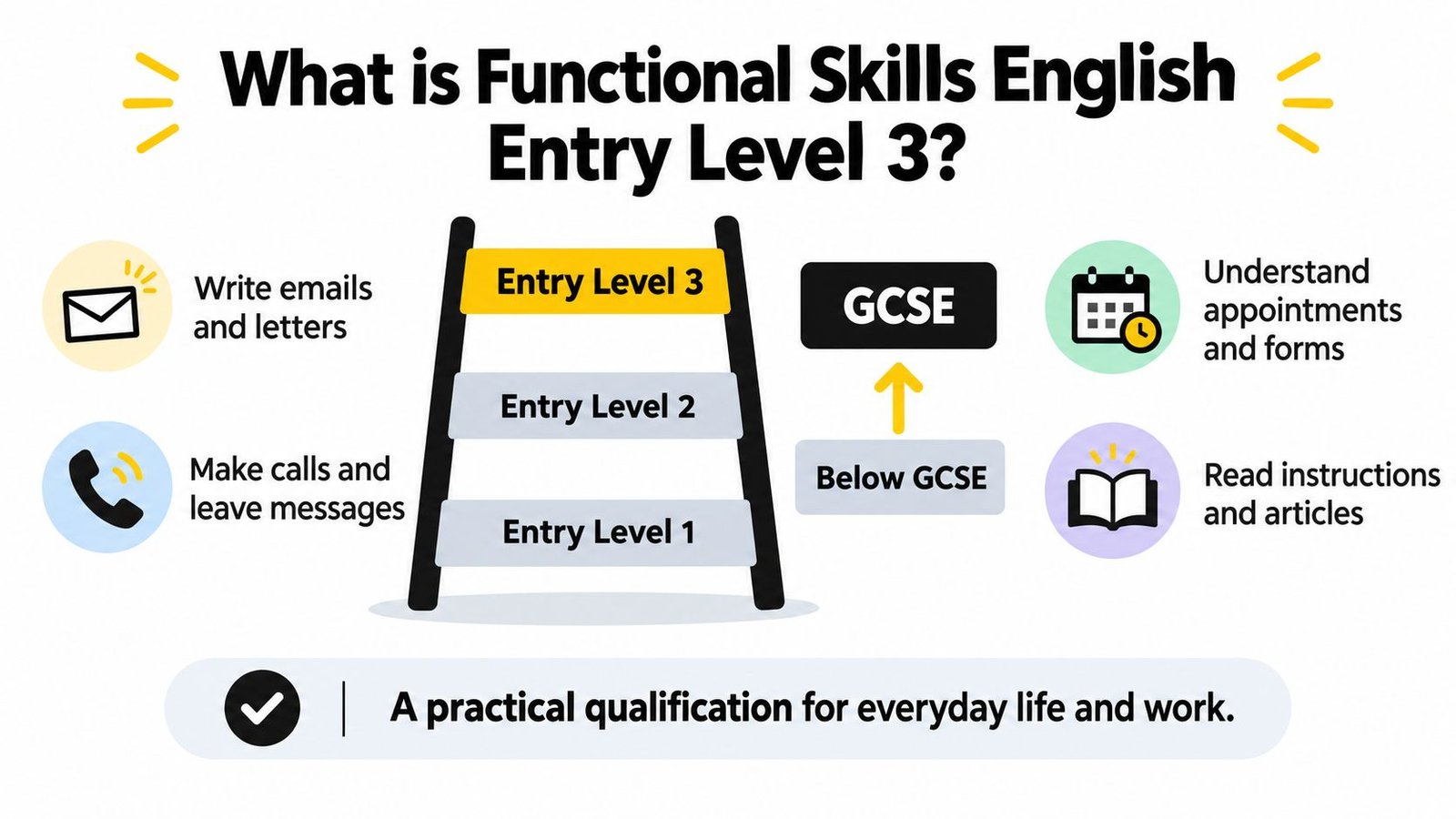
The qualification focuses on what you can do with English. You may work with emails, forms, notices, leaflets, instructions and short articles. You'll practise writing messages, letters or short pieces of information for a clear reader and purpose. You'll also learn how to listen carefully, explain your view and respond during a discussion.
Functional Skills and GCSE English are different
GCSE English is generally more academic. It can include detailed analysis of literature, language choices and longer exam responses. Functional Skills English puts more attention on using English in daily life, employment and further learning.
That doesn't make one qualification better than the other. They serve different purposes. Functional Skills English Entry Level 3 gives you a practical foundation, while later Functional Skills levels or GCSE English may support your next academic or career goal. Before choosing a course, check the exact entry requirement for the job, college or university you're interested in. You can learn more about the qualification through this guide to what Functional Skills English means.
The Three Building Blocks of the Qualification
Planning a journey is a helpful way to understand the assessment. Speaking, Listening and Communicating is the conversation in the car. Reading is using the map and noticing road signs. Writing is recording the plan so another person can follow it.
These are separate parts of the qualification, and you need to prepare for each one.
| Component | What's assessed | Typical format |
|---|---|---|
| Speaking, Listening and Communicating | Following discussions, clarifying understanding, giving a point of view and responding appropriately | A controlled discussion, exchange or speaking task observed or recorded |
| Reading | Finding relevant information, recognising main points and understanding straightforward texts | A reading assessment using practical written material |
| Writing | Producing clear responses with suitable spelling, punctuation and grammar | A controlled writing task with a specific purpose and audience |
Speaking, Listening and Communicating
This component isn't about giving perfect speeches. It's about joining a familiar formal or informal discussion in a useful way. You may need to follow the main points, check that you've understood, explain your opinion and allow other people to contribute.
For example, a discussion about improving a workplace break room might require you to suggest an idea, explain why it could help, listen to another person's concern and respond politely. Short answers alone may not show all the skills required, so practise adding a reason or example to your view.
Reading
Reading tasks use the kind of material you may meet outside a classroom. You might read a leaflet, email, notice, article or set of instructions. The important habit is to separate the main message from smaller details.
Read the question first. Then scan the text for names, dates, reasons or instructions that match it. If the question asks for the main idea, don't copy the first sentence automatically. Ask yourself what the whole text is trying to tell you.
Writing
Writing may involve a letter, article, report, message or narrative. The task normally gives you a purpose and a reader, so your tone and detail should match the situation.
Accuracy matters greatly. Official requirements state that between 50% and 70% of Writing marks at entry level assess accurate spelling, punctuation and grammar, as explained in the Functional Skills English conditions and requirements. That means a clear idea can lose value if sentences are difficult to follow or common words are repeatedly misspelt.
Awarding organisations set their own assessment details, including pass requirements and arrangements for another attempt. Always check the current specification for the awarding body you'll use, such as Pearson, City & Guilds or NCFE, rather than relying on advice meant for a different exam.
Who This Qualification Is Designed For
This qualification suits people with different stories but a shared need. You may have left school without GCSE English, taken time away from learning to raise children, or reached a point at work where stronger literacy would help you apply for training or promotion.
There are no pre-entry requirements for the NCFE Entry Level 3 English qualification, according to its qualification information. Some awarding-body routes may also have their own registration rules, so your chosen provider should confirm the details before you begin. You don't need to feel embarrassed because you can't remember what you studied at school. An initial assessment exists to find a sensible starting point, not to judge your worth.
Your life experience is part of your preparation
Adults often bring useful skills that aren't written on a certificate. You may already compare prices, explain instructions to a child, speak to customers, organise appointments or write messages at work. Lessons help you recognise those abilities and transfer them into assessment tasks.
An online course can suit a parent who studies after the children are asleep, or a worker who learns before an early shift. The important part is support. You should be able to ask questions, receive feedback and understand what to practise next, rather than working alone with a pile of confusing pages.
Needing support isn't a weakness. It's a normal part of learning something important.
Your reason for starting may be personal, practical or both. You might want to help your child with reading today and apply for a better-paid role later. You might hope to reach Level 2, an apprenticeship, college or university. Entry Level 3 gives you a structured place to begin while respecting the responsibilities you already carry.
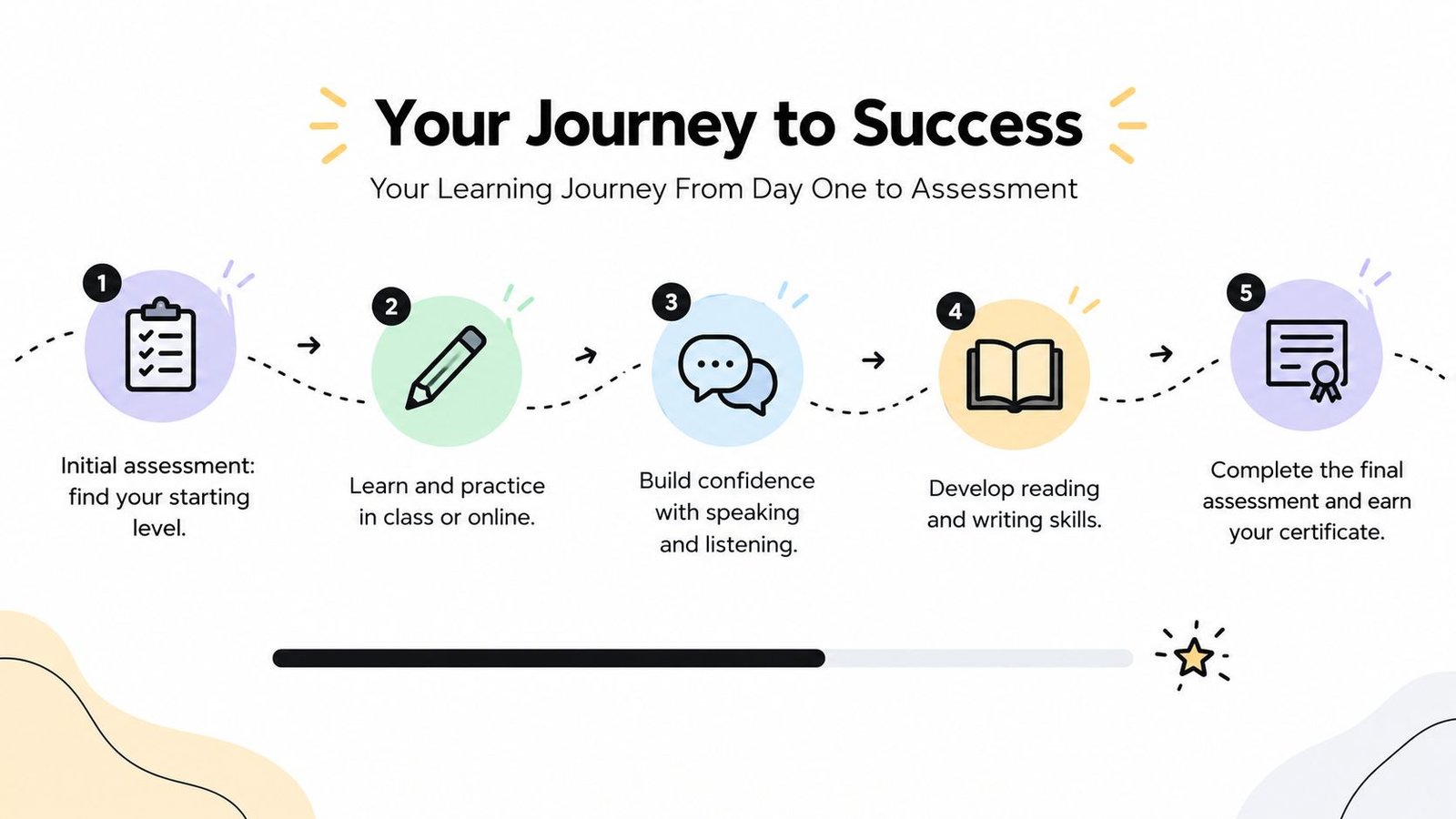
Your Learning Journey From Day One to Assessment
A good course turns the qualification into a path with visible steps. You don't need to understand everything on your first day. You need to know what comes next and have someone who can explain it when you're unsure.
Start with the right level
Most providers begin with an initial assessment. It may include reading, writing and questions about your learning goals. The result helps your tutor decide whether Entry Level 3 is suitable or whether you'd benefit from an earlier level first.
That isn't a setback. Starting at the right point protects your confidence and helps you build skills in the correct order.
Learn, practise and review
Awarding-body information commonly identifies around 55 Guided Learning Hours and 60 Total Qualification Time for Entry Level 3, although you should check your provider's current course plan and awarding-body specification. You might spread study across flexible modules covering reading, writing and speaking, listening and communication.
Practise with realistic questions, not just notes. Draft a message, read a short article and explain its main point, or take part in a discussion about a familiar issue. Resources on effective reading techniques for writers can offer extra ideas for reading carefully and shaping clearer writing.
Prepare for assessment
Your tutor may mark drafts, discuss your answers and use practice papers to show where marks are available. Reviewing feedback is more valuable than completing lots of questions. Look for one pattern at a time, such as missing full stops, unclear paragraphs or answers that don't fully address the question.
You can also use Functional Skills English past papers to become familiar with the style of tasks. When you're ready, your provider helps you book the externally set assessment. Some routes offer online assessment under controlled conditions, while others use an approved centre, so confirm the arrangement before enrolment.
Here's a short visual introduction to the learning journey:
Your progress should be recorded step by step. A completed practice task, a corrected paragraph and a confident contribution in discussion are all evidence that you're moving forward.
Where Entry Level 3 Can Take You Next
Entry Level 3 is a launchpad, not a label that limits you. Once you've passed, you can discuss the next suitable stage with your tutor or provider. For many learners, that means Functional Skills Level 1, followed by Level 2. Others may choose GCSE English, an apprenticeship or another vocational route.
The right destination depends on your goal. A university may ask for a particular qualification and grade, while an employer may focus on practical ability or a Level 2 English requirement. Always check directly with the organisation you're applying to, because entry rules can differ.
| From | To | Typical next step | What it can unlock |
|---|---|---|---|
| Entry Level 3 | Functional Skills Level 1 | Build longer responses and more independent reading | Greater confidence in work and study tasks |
| Functional Skills Level 1 | Functional Skills Level 2 | Prepare for the higher practical standard | A qualification often requested for employment and training |
| Functional Skills Level 2 | GCSE English or further study | Compare the exact requirement for your goal | Progress towards college, university or career training |
| Entry Level 3 | Apprenticeship preparation | Ask the apprenticeship provider about English conditions | A route into practical workplace learning |
The official Entry Level 3 content focuses on communication that people use in ordinary situations. That foundation supports later learning because you'll need to understand instructions, follow written information, explain ideas and respond to other people in almost every course or workplace.
Better pay isn't guaranteed by one certificate, and no responsible provider should promise a particular salary. However, stronger qualifications can help you meet requirements for roles and training that were previously closed to you. Your first pass can become the evidence that you're ready to take the next step.
For a parent, the effect can be especially meaningful. Your child sees you setting a goal, practising through difficult moments and continuing after a mistake. That example may stay with them longer than any speech about the value of education.
Why Entry Level 3 Is More Important Than You Think
Myth: Entry Level 3 is too basic to matter.
Reality: It can be the stage where a learner builds the foundation needed for every higher qualification.
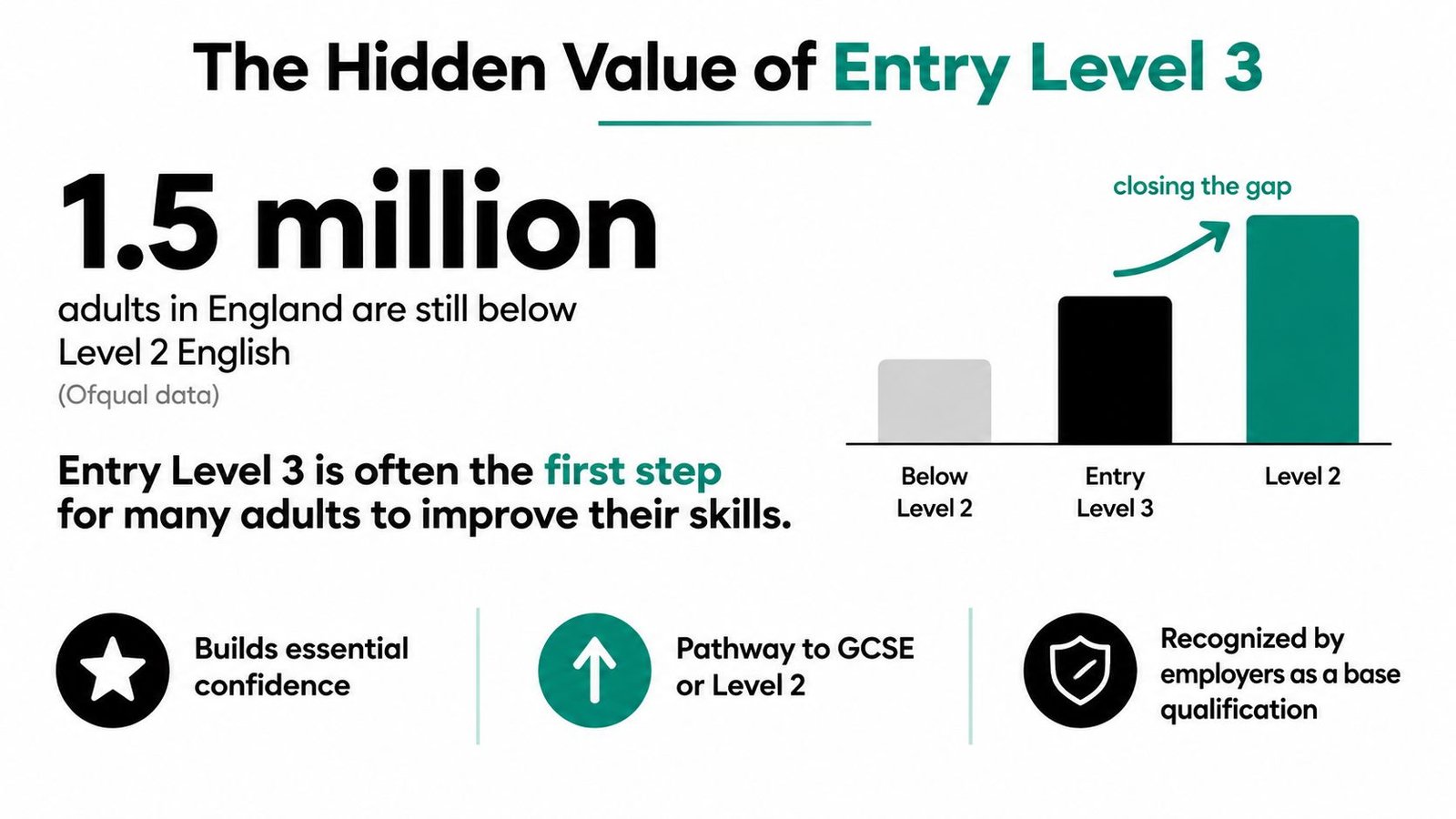
England's qualification market shows continued activity at Entry Level. Entry Level certificates rose from 129,450 in 2021 to 2022 to 150,740 in 2022 to 2023, then stood at 140,515 in 2023 to 2024, according to the annual qualifications market report. The same report recorded 351,895 Functional Skills certificates across English, maths and ICT in 2022 to 2023, followed by 337,450 in 2023 to 2024. These figures show that Entry Level learning remains an active route, even after the reformed qualifications were introduced.
Foundations are not wasted time
Skipping a foundation can create problems later. If punctuation is uncertain at Entry Level 3, a longer Level 1 response may feel overwhelming. If you struggle to identify the main idea in a short text, a more demanding document can become exhausting before you've even started answering questions.
The qualification's value appears in ordinary tasks:
- Following instructions: Understand what a form, notice or workplace message asks you to do.
- Finding information: Locate the detail that matters instead of reading every line with equal effort.
- Joining conversations: Explain your view, listen to another person and clarify what you've heard.
- Writing for a reader: Choose words, sentences and details that make your message easy to understand.
The broader below-Level-3 pipeline includes learners who need very foundational English support. Department for Education data for England FE sector colleges recorded 418 Functional Skills English Entry 1 entries in 2024/25 and 405 in 2023/24, with pass rates of around 4.9% to 5.1%, as shown in the FE data catalogue. Those figures relate to Entry 1, not Entry Level 3, but they help show why a simple “just move straight to Level 2” message doesn't fit every adult learner.
Entry Level 3 isn't a consolation prize. It's a regulated, practical stepping stone that can help you strengthen confidence before aiming higher. A stable foundation gives your next qualification somewhere solid to stand.
Common Questions Adult Learners Ask Before Starting
Can I enrol if I don't have previous grades?
Often, yes. The NCFE qualification information states that there are no pre-entry requirements for its Entry Level 3 Functional Skills English qualification. Your provider may still use an initial assessment to recommend the most suitable starting point, and that protects you from being placed on work that is too easy or too difficult.
You don't need to prove that you already feel confident. You need to be willing to practise and ask for help.
How long will it take?
There isn't one honest answer for every learner. Your pace depends on your current skills, available study time, tutor support and the assessment route. Awarding-body specifications commonly refer to 55 Guided Learning Hours and 60 Total Qualification Time, but those figures should be treated as a course-planning guide rather than a promise about how quickly you'll finish.
Ask the provider how lessons, practice work and assessment preparation are arranged. A parent studying in short evening sessions may follow a different timetable from someone who can study during the day.
What happens in the assessment?
You'll complete the three required components, Speaking, Listening and Communicating, Reading, and Writing. The exact tasks depend on the awarding organisation, but preparation should help you understand the instructions, timing and controlled conditions before the assessment day.
Download a sample paper if one is available. Try one task without rushing, then review your answer for the main idea, relevance, spelling, punctuation and grammar. For speaking practice, explain an opinion aloud and ask someone to respond so you can practise listening as well as talking.
Can I study for free?
Funding depends on your circumstances, local college, training provider and the rules attached to the particular course. Some learners may find funded places through a college or adult education service, while others may choose a paid online course for flexibility and tutor support. Ask local providers what help is available before assuming that cost makes study impossible.
This week, contact a local college or flexible online tutor, request an initial assessment and ask which awarding body and assessment route they use. You can also write down the longer-term goal behind your English course, whether that's helping your children, applying for work, entering an apprenticeship or moving towards university.
Next Level Online College offers supported online Functional Skills English study that can fit around work and family responsibilities, with structured learning, tutor guidance and assessment preparation. Visit Next Level Online College to explore the Entry Level 3 route and take the first practical step towards your next qualification.