
You may be reading this after a long shift, with your children nearby and a course application open on your phone. Perhaps a job, apprenticeship or university route asks for an English qualification, and the thought of returning to study brings back memories you'd rather forget. The Functional Skills English exam can feel like a test of your past, but it isn't. It's a practical step towards more choices, stronger career options and the pride of showing your family that learning can begin again at any age.
Why This Exam Feels Like a Turning Point
Returning to education takes courage. You may have spent years working, caring for relatives, raising children or managing responsibilities that never appeared on a school timetable. If English lessons at school left you feeling behind, opening a workbook now can bring those feelings back quickly. Feeling nervous doesn't mean you can't succeed. It means this goal matters to you.

A learner might start with a simple aim, such as applying for a better-paid role. After gaining confidence, that same learner may begin thinking about an apprenticeship, a promotion or university. The qualification becomes more than a certificate. It becomes proof that one difficult chapter doesn't decide the rest of your life.
Remember: Your previous school experience is part of your story, not a prediction of your result.
Functional Skills English is practical. You aren't being asked to remember every lesson from childhood or write like a novelist. You'll work with everyday communication, such as understanding information, writing for a clear purpose and taking part in a discussion. Those are skills adults use at work, at home and in the community.
Level 2 is often compared with a GCSE grade 4 pass, although you should check the exact requirement for your chosen course, employer or university. A clear explanation of the relationship between the qualifications is available in this guide to Functional Skills and GCSE equivalents.
Your first small win might be identifying the level you need. The next could be writing a short, organised paragraph. Then you may complete a practice task without avoiding it. Each win weakens the fear that says you're “not academic”. When your children see you study, ask questions and keep going, they learn that progress doesn't belong only to people who found school easy.
Navigating Functional Skills Levels
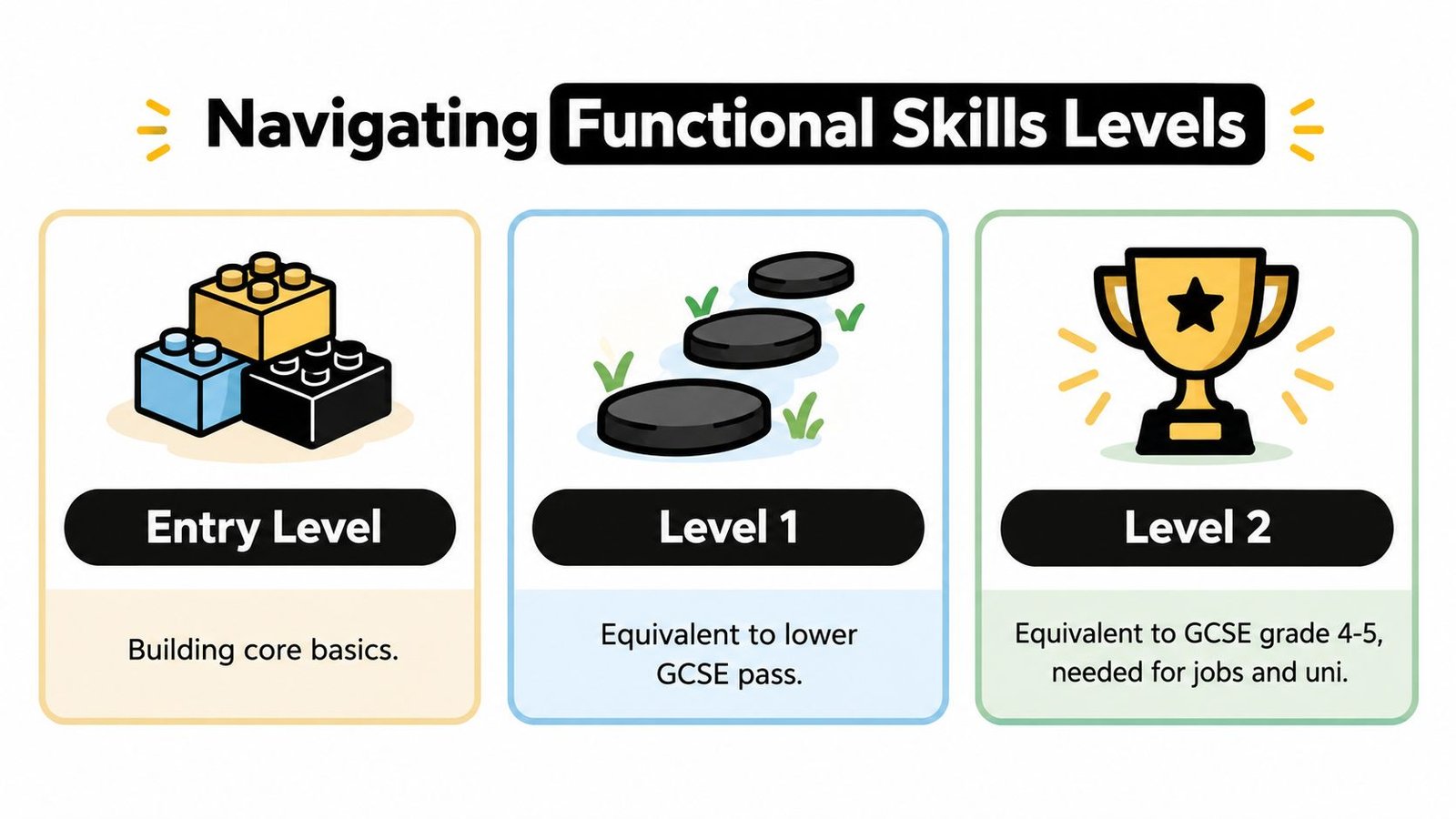
The right starting point depends on both your current skills and your destination. Functional Skills English is available from Entry Level through Level 2, with Entry levels below GCSE level and Level 2 commonly compared with a GCSE grade 4 pass, as described in the official English Functional Skills criteria.
Finding your starting point
Entry Level is suitable when you're building core reading, writing and communication skills. You might be working on understanding short information, completing everyday forms or expressing an idea clearly. Starting here isn't a sign of failure. A strong foundation can make later study less stressful.
Level 1 builds independence. You may need to understand longer information, write for a familiar purpose and contribute more confidently to conversations. It can be a sensible stage for learners who need practice before attempting the qualification usually requested for wider work or study progression.
Level 2 is the main target for many adults. It's often the level requested for progression into employment, further study and apprenticeships. If a university, college or employer asks for GCSE English at grade 4 or an equivalent, Level 2 may be relevant, but always confirm the exact entry rule.
You might already hold a suitable GCSE or equivalent qualification. Check your certificates and ask the organisation that set the requirement before enrolling. This can save time and prevent you from studying at the wrong level.
| Your situation | A sensible next step |
|---|---|
| You're rebuilding basic confidence | Ask about Entry Level support |
| You can manage familiar reading and writing but need development | Explore Level 1 |
| You need the usual practical equivalent for progression | Check whether Level 2 is required |
| You already have a GCSE or similar qualification | Confirm whether it meets the destination requirement |
A Functional Skills English Level 2 course can be one route for adults who need a flexible way to prepare, but the important decision comes first: identify the qualification your next step accepts.
The Three Core Skills You Will Be Assessed On
The qualification has three components, and you need a Pass in all three at the same level before the full qualification can be awarded. The Ofqual conditions for Functional Skills English describe the components as speaking, listening and communicating, reading, and writing.
Reading
Reading assesses how well you can understand and use information. You may need to identify the main point, find details, compare ideas or recognise the purpose and tone of a text. The material can feel more manageable when you read it as a real-life message rather than as an intimidating exam page.
For example, a workplace notice might explain a change to opening arrangements. A good approach is to read the question first, underline key words and then return to the text for evidence. Don't choose an answer just because it contains a word you noticed. Ask what the whole sentence means.
Writing
Writing asks you to communicate clearly for a stated audience and purpose. The task could involve an email, letter, article, report or review. Strong answers usually have a clear structure, accurate sentence control and details that respond directly to the task.
Suppose you're asked to write a review of a local activity. You'd need to explain what it is, give specific positive and negative points, and reach a useful judgement. “It was nice” tells the reader very little. “The staff explained the activities clearly, but the waiting area was crowded” gives a reasoned view.
Before submitting, check the basics:
- Purpose: Have you answered the exact task?
- Audience: Does your tone suit the reader?
- Organisation: Do your paragraphs follow a sensible order?
- Accuracy: Have you checked spelling, punctuation and sentence endings?
Speaking, listening and communicating
This component is closer to everyday life than many learners expect. You may need to listen carefully, respond to another person, share your view and help a discussion move forward. You don't need a grand speech or an unusual vocabulary.
A useful contribution might be, “I agree that the change could save time, but we should also consider people who don't have access to the online system.” That response shows listening, a clear opinion and awareness of another point of view.
Practising aloud can help. You could explain a news story to a family member, discuss a workplace decision or record yourself answering a question. If you want extra support with spoken communication and language practice, language test preparation with Myaigi may provide useful preparation activities.
Booking Your Assessment and Understanding Formats
Booking becomes easier when you separate learning from administration. Your provider should explain which awarding organisation you're using, which components you need and how the booking process works. You shouldn't have to guess whether a date, format or arrangement is suitable.
Follow the booking path
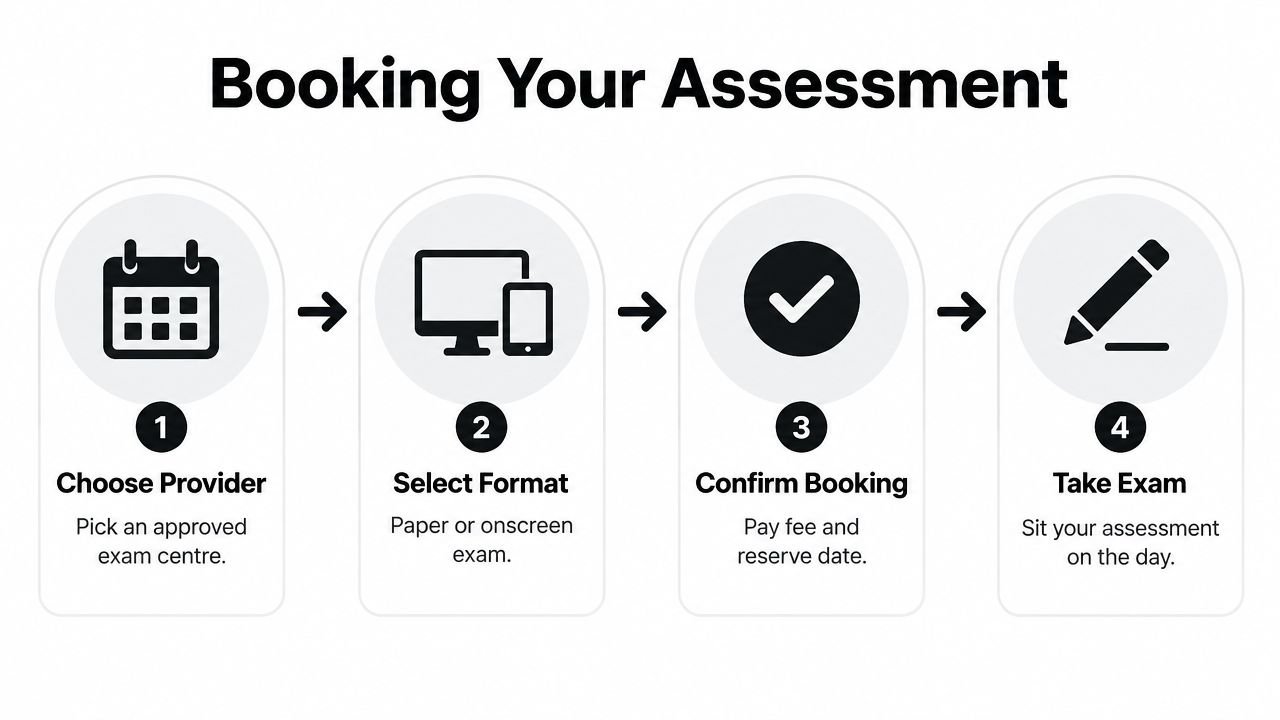
Choose an approved provider. Ask how the provider handles each component, what identification you'll need and how results are issued.
Discuss the format. Pearson's specification confirms that Level 1 and Level 2 English assessments can be taken as paper-based or onscreen, on-demand assessments. Choose the format that lets you work accurately. Some learners prefer handwriting, while others find it easier to edit on a computer.
Check every component. Speaking, listening and communicating may follow a different process from reading and writing. Ask whether it's arranged through the provider and whether you need a separate booking.
Confirm the practical details. Make sure you know the date, time, location or remote arrangements, equipment requirements and deadline for any paperwork. Put these details somewhere visible at home.
Tell the provider about support needs. If you have a disability, a learning difficulty or another reason you may need reasonable adjustments, raise it early. The provider can explain the evidence and approval process.
Practical rule: Never assume that “online course” means every assessment is completed in exactly the same way. Ask how each component is delivered.
On-demand assessment can help adults fit study around shifts, school runs and caring duties, but flexibility still needs organisation. Provider systems manage booking workflows and verification requirements, so keep copies of messages and ask for confirmation when your booking is complete.
Demystifying the Pass Mark and Results
Functional Skills English uses a single attainment standard called Pass, rather than a set of grades running from failure to the highest mark. Reading and Writing have separate boundary marks, and all three components must be passed at the same level before certification.
That rule changes how you should prepare. A strong Reading result cannot cancel out an unfinished Writing component, and confident discussion skills can't replace a missed assessment. Treat each component as its own small bridge to the final qualification.
What the results tell you
Published results show why one general idea of “English ability” isn't enough. Pearson's 2024/25 data reports a 63% Level 2 Writing first-time pass rate, a 56% overall assessment pass rate and a 74% individual learner pass rate, as listed in the Ofqual Functional Skills qualifications requirements collection.
NCFE's 2024/25 release reports 75% for Level 2 Reading and 50% for Level 2 Maths. The Maths figure isn't an English result, but it helps show that outcomes can differ across components and qualifications. Pearson also reported overall assessment pass rates of 70% for Level 1 Reading, 60% for Level 2 Reading, 55% for Level 1 Writing and 56% for Level 2 Writing, while NCFE reported 67% for Level 1 Reading, 75% for Level 2 Reading, 68% for Level 1 Writing and 81% for Level 2 Writing in its published 2024/25 data, available through its Functional Skills pass-rate information.
These figures aren't a prediction of your result. They show why your tutor should look at your Reading and Writing separately. If your writing is weaker, practise planning, paragraph order and task purpose. If Reading causes difficulty, work on locating evidence and understanding what questions really ask.
If you don't pass first time
A first attempt that doesn't go your way is information, not a verdict. Ask for feedback, identify the component that needs attention and make a focused resit plan. Since components can be passed over time, you may not need to repeat every part, although your provider will explain the rules that apply to your qualification.
A Practical Study Plan for Busy Lives
You don't need a perfect study room. You need a repeatable habit that respects your energy. Choose a regular place, keep your notebook and practice materials together, and tell your family when you need a quiet block.
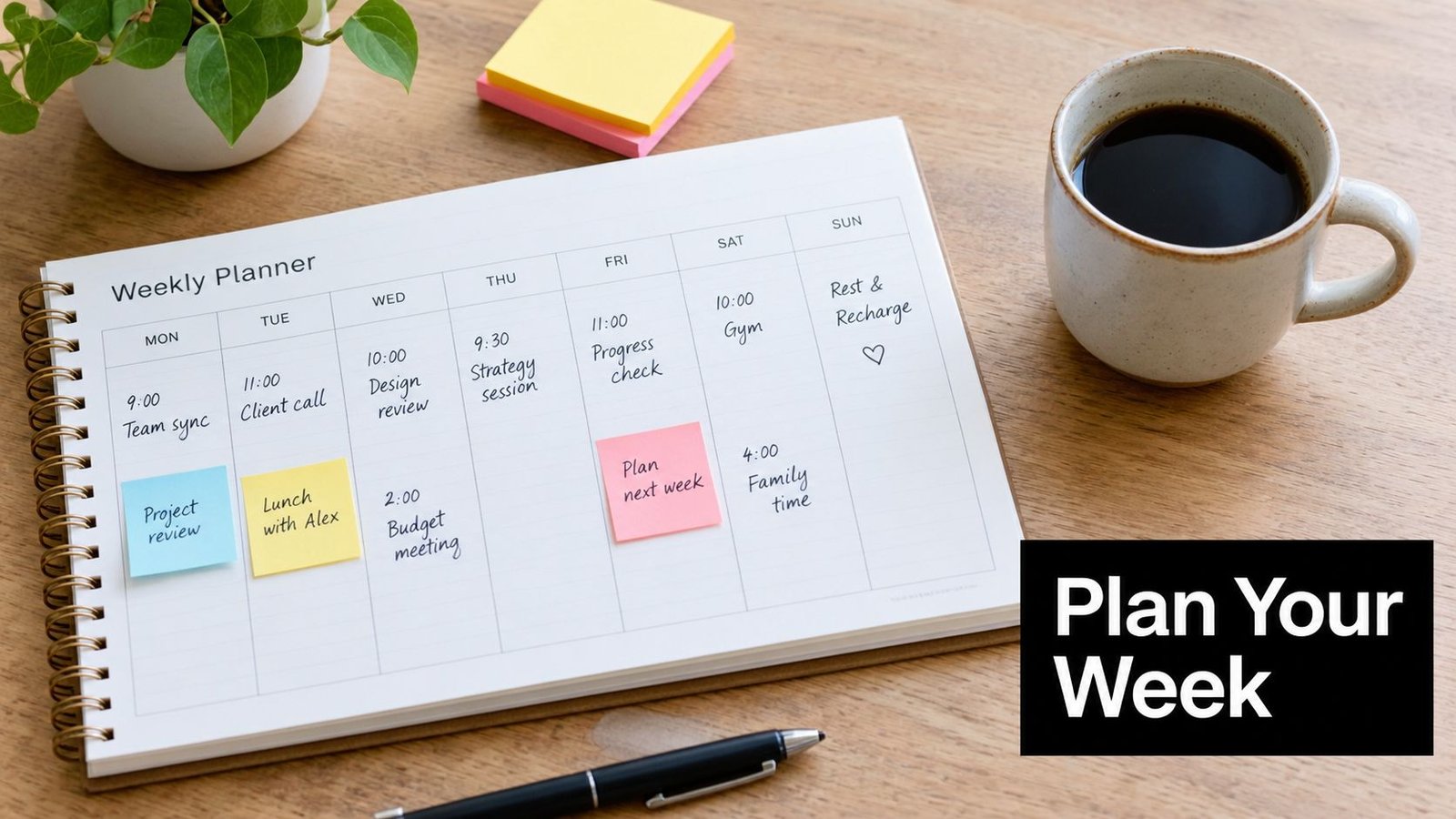
Start with small targets. One session might focus on finding evidence in a reading text. Another could involve planning an email before writing it. A third might be a short spoken discussion with a friend or tutor. Short, regular practice helps you notice improvement before exam day.
Use a simple weekly rhythm
- Reading practice: Read a workplace notice, public information page or short article. Write down its purpose and two important details.
- Writing practice: Choose one task and plan the audience, purpose, key points and paragraph order before drafting.
- Communication practice: Explain an opinion aloud, then respond to a different point without interrupting.
- Review time: Look at one mistake and rewrite the sentence or paragraph correctly.
Use a timer when you're ready, but don't begin every session under pressure. First build accuracy, then build pace. A Functional Skills English past paper resource can help you become familiar with task styles and review your answers.
This video can add another explanation when you're studying independently:
Keep a “proof of progress” page. Write down the tasks you've completed, the errors you've corrected and the questions you can now answer. On a difficult day, that page gives you evidence that you're moving forward.
Your Life After Success and Progression Pathways
The result matters, but the life attached to it matters more. You may use Functional Skills English to apply for a role, meet an apprenticeship requirement, move towards further study or prepare for a university application. The qualification can give you a clearer route where an old school experience once felt like a closed door.
Your family may notice the change before anyone else. They'll see you making time for study, asking for help and returning after a difficult practice task. That example can shape how your children think about mistakes, effort and their own future.
A learner who once avoided forms may begin writing applications. Someone who felt unable to speak in a meeting may share an idea at work. These changes start with small actions, but they can lead towards more fulfilling work, greater financial security and the chance to contribute in a way that feels meaningful.
You're allowed to be proud before the result arrives. Enrol, complete your first learning activity, ask what level you need and book support before fear grows. Your next step doesn't need to be dramatic. It needs to be real.
Next Level Online College offers flexible online Functional Skills English Level 1 and Level 2 courses with structured learning, assessment preparation and support for adult learners balancing work and family. Visit Next Level Online College to explore the course options and choose a practical starting point for your education and career plans.