
Some evenings end with washing up, school bags, and tired silence. Then the laptop opens. You start searching for a better way forward.
Maybe you want a job that pays more. Maybe you want to apply for university one day. Maybe you’re tired of feeling held back by one missing qualification. A lot of adults carry that feeling in silence. They’re capable, hardworking, and full of potential, but they still hear an old voice saying, “I’m not academic” or “I’ve left it too late.”
You haven’t left it too late.
Functional skills level 2 english can be the step that changes things. Not because it’s magical, but because it’s practical. It helps you build the reading, writing, speaking, and listening skills that matter in real life. The kind you use at work, at home, and when you’re building a future for yourself and your family.
Your Time for a Fresh Start Is Now
Maria sits at her kitchen table after the children are asleep. The house is finally quiet. She looks at a job advert on her phone and sees the same line again. English qualification required.
She feels frustrated because she knows she could do the job. She already manages people, solves problems, and keeps everything moving at home and at work. But one missing qualification keeps closing the door.

That moment is familiar to many adult learners. You might want to support your children with homework and feel more confident doing it. You might want to apply for a course, go for a promotion, or finally stop avoiding forms, emails, and interviews that make you feel unsure.
The dream is bigger than the exam
For adults, this qualification often means much more than passing a test.
It can mean:
- More confidence at work when you need to write clearly, read instructions, or speak up in meetings
- A better example for your children because they can see you learning, trying, and growing
- A route into further study when you want to move towards college, university, or training
- A stronger sense of self-belief after proving to yourself that you can do hard things
You don't need to become a different person to succeed. You need a path that fits the life you already have.
Functional skills level 2 english gives many adults that path. It isn’t about going back and becoming your school-age self again. It’s about moving forward as the person you are now. Someone with responsibilities, experience, and a clear reason for studying.
Why this fresh start matters
Starting again takes courage. Adult learners often carry old school memories that still hurt. A bad teacher, a low grade, a moment of embarrassment. Those experiences can make study feel heavier than it needs to be.
But adult learning is different. You now know why you want this. That matters.
When your reason is strong, your effort has direction. You’re not revising for the sake of it. You’re building a better future, one step at a time.
What Is Functional Skills Level 2 English Really
You might read the words “Level 2 English” and wonder what you are signing up for. Will it feel like being back in school, sitting with poems and essays that never seemed to connect to real life? For most adults, the answer is no. This qualification is built for practical use, so the skills you learn can help at work, at home, and in further study.
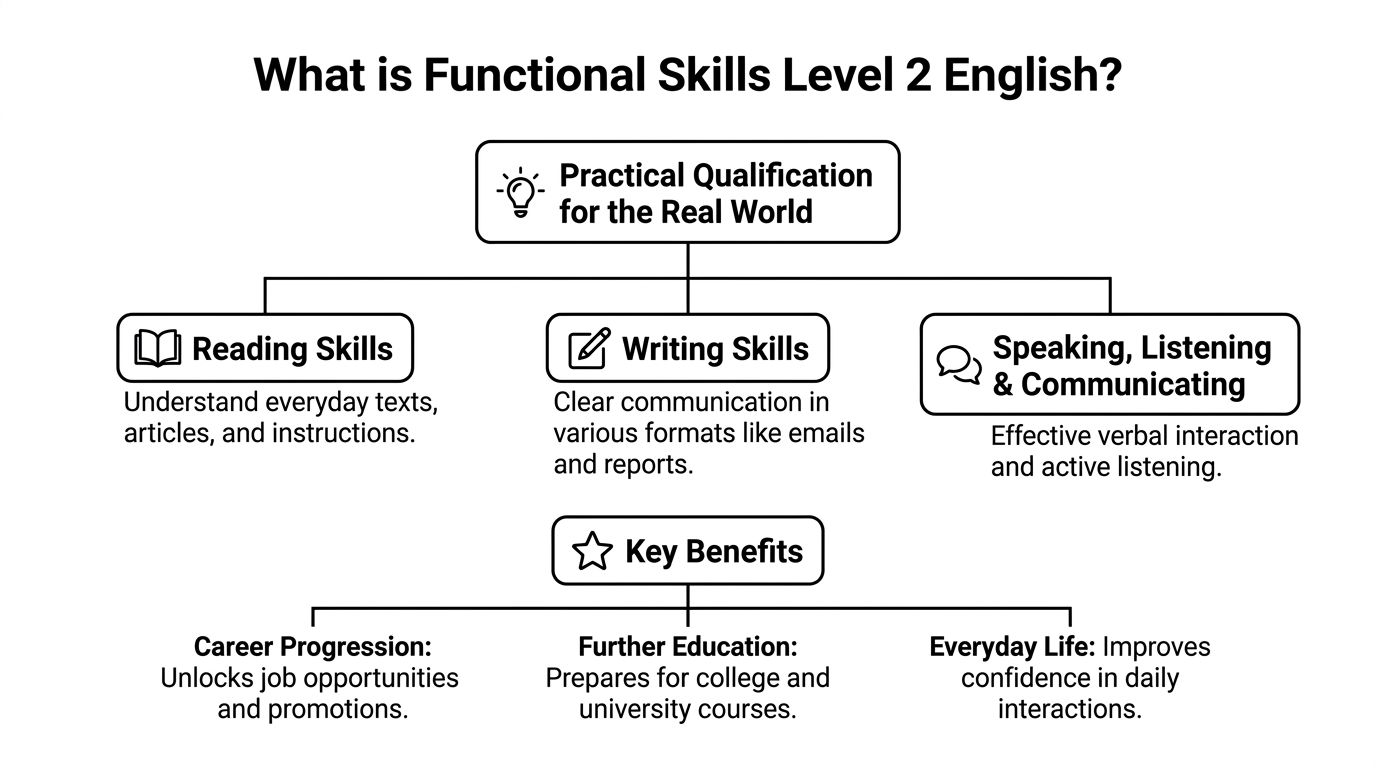
Functional skills level 2 english is a practical English qualification that focuses on communication you can use straight away. It covers reading, writing, and speaking and listening in everyday situations. It works like a driving test for English. The aim is to show you can use the skills safely, clearly, and confidently in real life.
The key fact many adults need to hear
Functional Skills Level 2 English is widely recognised as equivalent to a GCSE grade 4, formerly C, according to the official Functional Skills English subject content on GOV.UK.
That matters for a simple reason. Many adults worry that taking a different route means choosing a qualification with less value. This one is recognised and respected, and many employers and education providers accept it as meeting their English entry requirement.
The qualification is made up of three parts: Reading, Writing, and Speaking & Listening. If you have been away from study for a while, that structure can feel more manageable because you are working on clear, useful skills instead of trying to master everything at once.
What it helps you do in real life
The best way to understand this course is to look at where it shows up in ordinary life.
| Skill area | What it can look like in daily life |
|---|---|
| Reading | Understanding a workplace email, a policy, a leaflet, or an article |
| Writing | Sending a professional message, writing a letter, or structuring information clearly |
| Speaking and listening | Joining a discussion, explaining your ideas, or giving a short presentation |
These are the kinds of tasks busy adults already face. Reading instructions correctly. Writing a message that sounds clear and professional. Explaining your point in a meeting, interview, or conversation with confidence.
That is why many adult learners find this route easier to connect with. The course is designed around real communication, not abstract school-style study.
Why adults often prefer this route
Many adults had a difficult experience with English at school. They were told they were “bad at it,” when often the actual problem was that the learning did not fit them at that stage of life.
Functional Skills takes a more practical approach. GCSE English often feels like studying English as a subject. Functional Skills focuses more on using English as a tool. If your life is already full of work, family, and responsibilities, that difference can make the qualification feel far more achievable.
You do not need to put everything on hold to work toward this. You need a course that respects your time, builds confidence step by step, and shows you that progress is possible as an adult.
What You Will Learn on the Course
The course is built around three main areas. Each one connects to everyday life. That’s one reason adults often find it easier to relate to than traditional school study.
The syllabus has 55 Guided Learning Hours, and it covers practical skills such as finding information in complex texts, writing clearly for different audiences, and expressing opinions with supporting evidence in discussions, as outlined in the Functional Skills Level 2 English syllabus.
Reading that helps you in the real world
Reading in this course isn’t about reading novels for pages and pages. It’s about understanding meaning clearly.
You may practise how to:
- Find the main point in a long piece of writing
- Spot useful details in instructions, notices, or articles
- Compare ideas across more than one text
- Understand tone and purpose so you know what a writer is trying to do
This helps at work when you need to read a message quickly and respond properly. It helps at home when you need to make sense of forms, letters, or information from school.
Writing that sounds clear and confident
Many adults worry about writing because they remember being marked down at school. The course approaches writing more practically.
You learn how to organise ideas, use paragraphs, choose the right tone, and improve spelling, punctuation, and grammar. You’re writing for real purposes, not just filling a page.
A good way to think about it is this:
- A message to a friend sounds one way.
- A complaint email sounds different.
- A workplace report needs another tone again.
The course helps you understand those differences.
Speaking and listening that builds confidence
This part is often the most misunderstood. Adults hear “speaking assessment” and imagine standing on a stage. It’s usually much more manageable than that.
You practise speaking clearly, listening carefully, asking questions, and sharing your view with reasons. Those skills matter in meetings, interviews, customer-facing work, and family life too.
A useful reminder: confident communication doesn't mean sounding perfect. It means getting your point across clearly.
For many learners, this part becomes a confidence boost. They realise they already have ideas worth hearing. They just need practice saying them in a structured way.
How Your English Skills Will Be Assessed
A lot of fear disappears once you know what the assessment looks like. Functional skills level 2 english is split into separate parts, so you can focus on one skill area at a time.
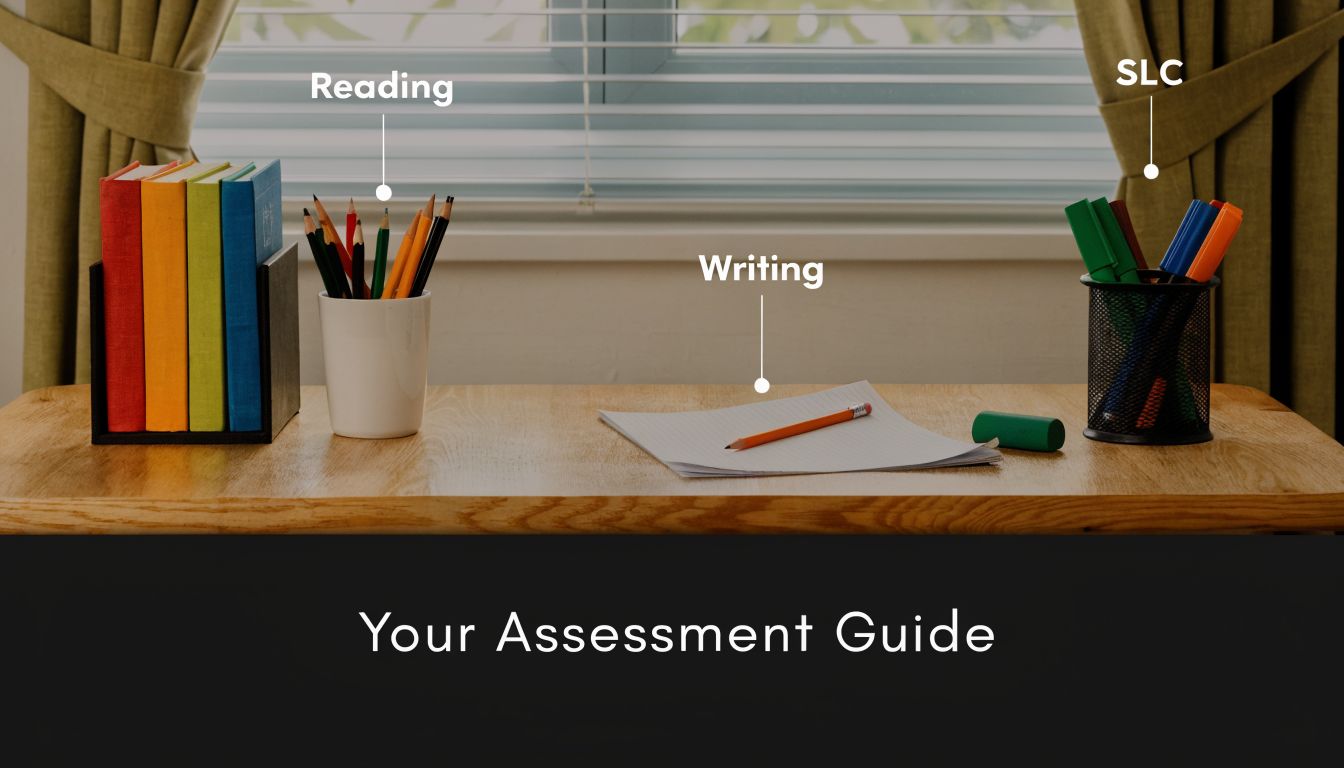
The assessment has three parts. Reading involves answering questions on texts. Writing involves producing two documents. Speaking, Listening & Communicating usually includes a presentation and discussion, according to this guide to Functional Skills Level 2 English assessment structure.
Reading assessment
In the reading part, you read texts and answer questions about them. The texts are usually non-fiction. That means the focus is on understanding information, ideas, tone, and meaning.
You may be asked to spot facts, identify opinions, or compare what two texts are saying. This is much closer to reading things you might meet in daily life.
Writing assessment
In writing, you produce two pieces of extended writing. That sounds formal, but the tasks are practical.
You might write something informative, persuasive, or formal. The assessor looks at how well you organise your ideas and how accurately you use spelling, punctuation, and grammar.
A simple checklist helps many learners here:
- Read the task carefully so you know who you're writing for
- Plan before you write so your ideas stay organised
- Leave time to check spelling, punctuation, and missing words
Here’s a quick look at the format:
| Assessment part | What you do |
|---|---|
| Reading | Answer questions based on written texts |
| Writing | Produce two written responses |
| Speaking, Listening & Communicating | Give a short presentation and join a discussion |
This short video can help make the process feel more familiar.
Speaking, listening and communicating
This part often sounds scarier than it is. In reality, it’s a chance to show that you can explain an idea, listen to others, and take part in a discussion.
It’s not about using fancy words. It’s about showing practical communication. That’s why many adults do better than they expect once they’ve had time to prepare.
Practical rule: treat the assessment as a structured conversation, not a performance.
A Study Plan That Fits Your Busy Life
Busy adults don’t need lectures about getting organised. They need a plan that works around work, children, tiredness, and real life. That’s the difference between a study idea and a study routine.
A 2025 guide to Functional Skills English for adult learners says 68% of Functional Skills enrollees are over 25 and working. It also says pass rates are 42% for working adults and 55% for full-time students, which shows why flexible study plans and personalized support matter so much.
Use small blocks, not giant sessions
Many adults think they need a whole free evening to study. They don’t. Short, steady sessions often work better.
Try this kind of weekly rhythm:
- Twenty minutes before work to read a short article and pull out the main points
- Half an hour after dinner to practise one writing task
- A weekend slot to speak your ideas out loud and prepare for discussion tasks
Small sessions are easier to repeat. Repetition builds confidence.

Build study into the life you already have
You don’t always need a perfect desk and complete silence. You need useful habits.
A realistic plan might look like this:
During the school homework hour
Sit with your own work while your children do theirs. You model learning and keep each other focused.On your lunch break
Read a practice text on your phone and note the main idea.On one set evening each week
Write one formal response, such as an email or letter, and review it calmly.At the weekend
Practise speaking out loud. Record yourself if it helps.
One strong option for adults who need flexibility is an online Functional Skills English course built around real life.
Make your plan kind, not perfect
The best study plan is one you can keep going. If a child gets ill or work runs late, it doesn’t mean you’ve failed. It means life happened.
Use this quick reset table when a week goes off track:
| If this happens | Try this instead |
|---|---|
| You miss a study day | Start again the next day, without trying to catch up on everything |
| You feel tired | Do a shorter task, such as reading one page or correcting one paragraph |
| You lose confidence | Go back to a task you can do well and build from there |
One missed evening doesn't ruin your progress. Giving up does.
Your Future After Passing Your Exam
Passing changes more than your CV. It changes how you see yourself.
You may finally feel ready to apply for the course you’ve been putting off. You may feel more confident asking for a new role or a promotion. You may stop shrinking back from situations where reading, writing, or speaking used to make you anxious.
Doors that can open
Functional skills level 2 english is often a stepping stone. For some adults, it leads towards further study. For others, it helps with work, training, or career change.
If you’ve ever wondered how this compares with other qualifications, this guide on what Functional Skills Level 2 is equivalent to gives useful context.
People often use this qualification to help them move towards:
- University pathways such as Access to Higher Education routes
- Career progression when employers ask for Level 2 English
- New confidence in professional settings like interviews, meetings, and written communication
Why this route suits many learners
For many people, this route is more achievable than returning to GCSE English. Pearson reported a 19.3% success rate for Functional Skills English Level 2 among 17 to 19-year-olds in 2023/24, and it was higher than GCSE Level 2 English outcomes in the same group, according to Pearson’s 2023/24 Functional Skills pass rates overview.
That matters because it shows a new approach can work better for some learners. If the traditional path didn’t suit you, that doesn't mean success is out of reach.
The pride you carry home
The emotional reward matters too. Many adults remember the exact moment they realise they’ve done something they once thought was beyond them.
It might be:
- helping your child with homework and feeling calm instead of embarrassed
- putting your certificate somewhere visible at home
- filling in an application form without asking someone else to check every line
Passing isn't only about proving something to employers. It's also about proving something to yourself.
When children see a parent study, struggle, continue, and succeed, they learn a powerful lesson. Growth doesn’t stop when school ends.
Enrolling and Succeeding with Next Level Online College
Adult learners need more than course materials. They need support that respects their nerves, responsibilities, and goals. That’s where the learning experience matters.
Some learners need extra help with writing structure. Others need calm support with speaking tasks. Many need both encouragement and accountability, because confidence can wobble even when motivation is strong.
Support for the areas adults worry about most
One area that often needs careful support is Speaking, Listening, and Communication. A guide discussing Functional Skills English for adult learners notes that pass rates for non-UK born residents are often 15% lower, partly because the SLC component doesn’t always get enough attention in preparation, as discussed in this overview of Functional Skills English Level 2 support needs.
That matters for career changers, adults returning to study, and learners who feel nervous about speaking formally. Confidence-building practice can make this part feel far more manageable.
What a strong learning environment should give you
A good online college should help you feel guided, not left alone. Look for support that includes:
- Clear teaching so tasks make sense in plain English
- Tutor feedback so you know what to improve
- Flexible access so study can fit around work and family
- Focused preparation for each assessment part, especially speaking and listening
If you’re ready to explore a flexible route, you can look at the Functional Skills English Level 2 course at Next Level Online College.
You don't have to do this on your own
Many adults delay starting because they think they must feel confident first. Usually, confidence comes after you begin.
The right support can help you keep going on the days when doubt gets loud. It can remind you that struggling with a topic doesn’t mean you’re failing. It means you’re learning.
Your Questions Answered
Am I too old to take functional skills level 2 english
No. Adult learners take this qualification every year. In fact, as noted earlier, many learners are already over 25 and balancing work with study. This route is designed to work for real adult lives.
Is it really accepted like a GCSE
Yes. It is widely recognised as equivalent to GCSE grade 4. That’s one of the most important facts to understand because it shows this qualification has real value for progression.
What if I’ve been out of education for years
That’s very common. Being out of education doesn’t mean you can’t succeed. It usually means you need clear teaching, patient support, and time to rebuild confidence.
Is the speaking part scary
It can feel scary at first, especially if you haven’t done anything like it in a long time. But it’s designed to assess practical communication, not perfection. Preparation makes a big difference.
How long will it take me
That depends on your routine, confidence, and starting point. The course has 55 Guided Learning Hours, as noted earlier, but adult learners often spread that time in a way that fits their own schedule.
What if I’m not good at spelling and grammar
That’s exactly why many people study this course. You don’t need to arrive fully polished. You need to be willing to practise and improve.
Can this help me become a better role model for my children
Yes. Children notice effort. They notice determination too. When they see you learn, keep going, and aim higher, they learn that education belongs to them for life.
What should I do if I feel nervous about starting
Start small. Read about the qualification. Look at the course options. Ask questions. You don’t need to have everything sorted before you begin. You just need to take the first step.
If you’re ready to build confidence, gain a recognised qualification, and move towards a better future, Next Level Online College offers flexible online learning designed for adult learners across the UK. You can study around work and family life, get the support you need, and take a practical step towards university, career progression, and making your family proud.