
Functional Skills Level 3 does not exist as an official qualification in England. Functional Skills qualifications stop at Level 2, so learners seeking Level 3 equivalence should look towards Access to Higher Education diplomas or A Levels instead.
That answer may surprise you, especially if you've searched college websites and seen phrases such as “Functional Skills Level 3 pathway”. The wording can make it sound as though a formal qualification exists, when the official framework says otherwise. You haven't searched badly, and your plans haven't come to an end. You've found a confusing label for a very real next step.
Many adults reach this point after gaining Functional Skills English or maths and asking, “What comes next?” Perhaps you want to apply for university, move into a better-paid career, qualify for a professional role, or show your children that learning doesn't stop when school ends. The important thing is to choose the qualification that matches your goal, rather than chase a title that isn't officially available.
The Truth About Functional Skills Level 3
The clearest answer is also the one many websites leave out: there is no official Functional Skills Level 3 qualification in England. Functional Skills are available at Entry Level 1, Entry Level 2, Entry Level 3, Level 1 and Level 2, with each qualification assessed independently. The official criteria confirm that the suite doesn't include a Level 3 award. You can check the official Functional Skills qualification criteria for the recognised levels.
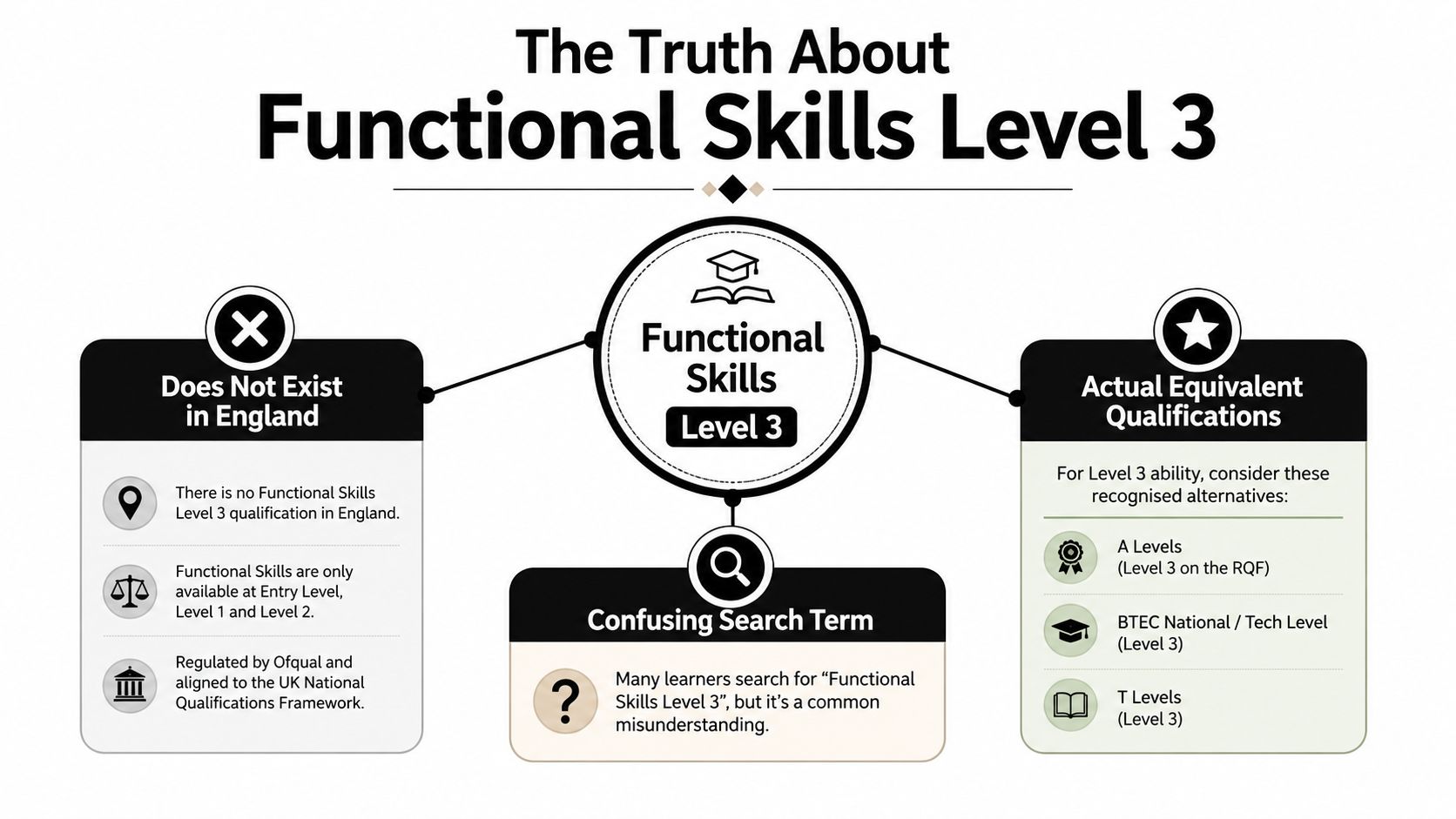
You may have seen the phrase because people use “Level 3” to describe progression after Functional Skills Level 2, rather than a Functional Skills qualification itself. A training provider might talk about a Level 3 pathway, a Level 3 course, or preparation for Level 3 study. Those phrases can be useful, but they don't create a Functional Skills Level 3 certificate.
The practical rule: treat Functional Skills Level 3 as a search phrase, not the name of an official qualification.
The confusion is understandable. Functional Skills help adults build practical English and maths, while Level 3 qualifications are the next major step in the regulated framework. The two ideas sit close together in a learner's journey, so they're often blended in online advice.
What learners usually mean by Level 3
When someone asks about Functional Skills Level 3, they normally want one of three things:
- A university route: often an Access to Higher Education diploma or A Levels.
- A career route: a vocational Level 3 qualification or an advanced apprenticeship.
- A confidence route: support after Level 2 before starting more demanding study.
That distinction matters. Functional Skills are built around practical communication and numeracy. Level 3 study expects you to work towards a broader qualification with its own subject content, assessments and progression purpose.
England's current Functional Skills guidance sets out applied English outcomes such as reading, writing, speaking, listening and responding in straightforward contexts. These skills can prepare you for further learning, but they aren't the same as completing an advanced qualification. If you're comparing your current position with GCSEs, the explanation in this guide to Functional Skills and GCSE equivalents can help you understand the difference.
The good news is simple. You don't need a Functional Skills Level 3 certificate to move towards Level 3 study. You need the right recognised route for your destination, plus support that helps you meet its entry requirements.
What Functional Skills Currently Offers for Adult Learners
Functional Skills give adults a practical way to strengthen English and maths. They're especially helpful if school feels like a long time ago, if exams affected your confidence, or if you need a recognised qualification for work or further study.
The official suite contains five stages, from Entry Level 1 through to Level 2. These stages don't work like a single ladder where everybody follows the same timetable. A college may assess your current skills and place you at the level that suits your starting point.
The levels in plain language
At Entry Level, learners build essential foundations. In maths, Entry Level 3 content includes using numbers up to 1,000, adding and subtracting three-digit whole numbers, dividing three-digit whole numbers by single- and double-digit numbers, and multiplying two-digit whole numbers by single- and double-digit numbers. These tasks connect learning to everyday life, such as handling money, checking quantities or understanding information.
Level 1 develops more secure practical skills. You might use English to understand workplace information, write for a clear purpose or communicate with other people. In maths, you'll work with problems that require more confidence and careful reasoning.
Level 2 is the highest Functional Skills level. English assessment includes separate reading, writing and speaking, listening and communicating components, while maths assessment follows its own regulated conditions. For maths, 25% of total marks must come from questions completed without a calculator and 75% from questions where calculators are allowed, as set out in the official mathematics assessment requirements.
Functional Skills levels at a glance
| Level | Equivalent To | Typical Outcome |
|---|---|---|
| Entry Level 1 | Foundation Functional Skills study | Building confidence with essential English or maths |
| Entry Level 2 | Foundation Functional Skills study | Applying basic skills in familiar situations |
| Entry Level 3 | Foundation Functional Skills study | Handling more developed everyday tasks |
| Level 1 | Below Level 2 study | Preparing for work, training or further learning |
| Level 2 | Often used where GCSE-level English or maths is required, subject to provider rules | Meeting a practical English or maths requirement and preparing for progression |
The table shows why Level 2 matters, but it also shows the boundary. The government's qualification levels guide for England places Level 3 alongside A Levels, T Levels, Access to Higher Education diplomas, advanced apprenticeships and other advanced awards. That's a different policy tier from Functional Skills.
If you're ready to build your foundations online, you can explore online Functional Skills courses and ask the provider which level fits your target course.
Real Level 3 Pathways That Replace Functional Skills Level 3
Once you understand that Functional Skills stop at Level 2, the choice becomes much easier. You're not looking for a missing qualification. You're choosing a genuine Level 3 route based on what you want to do next.
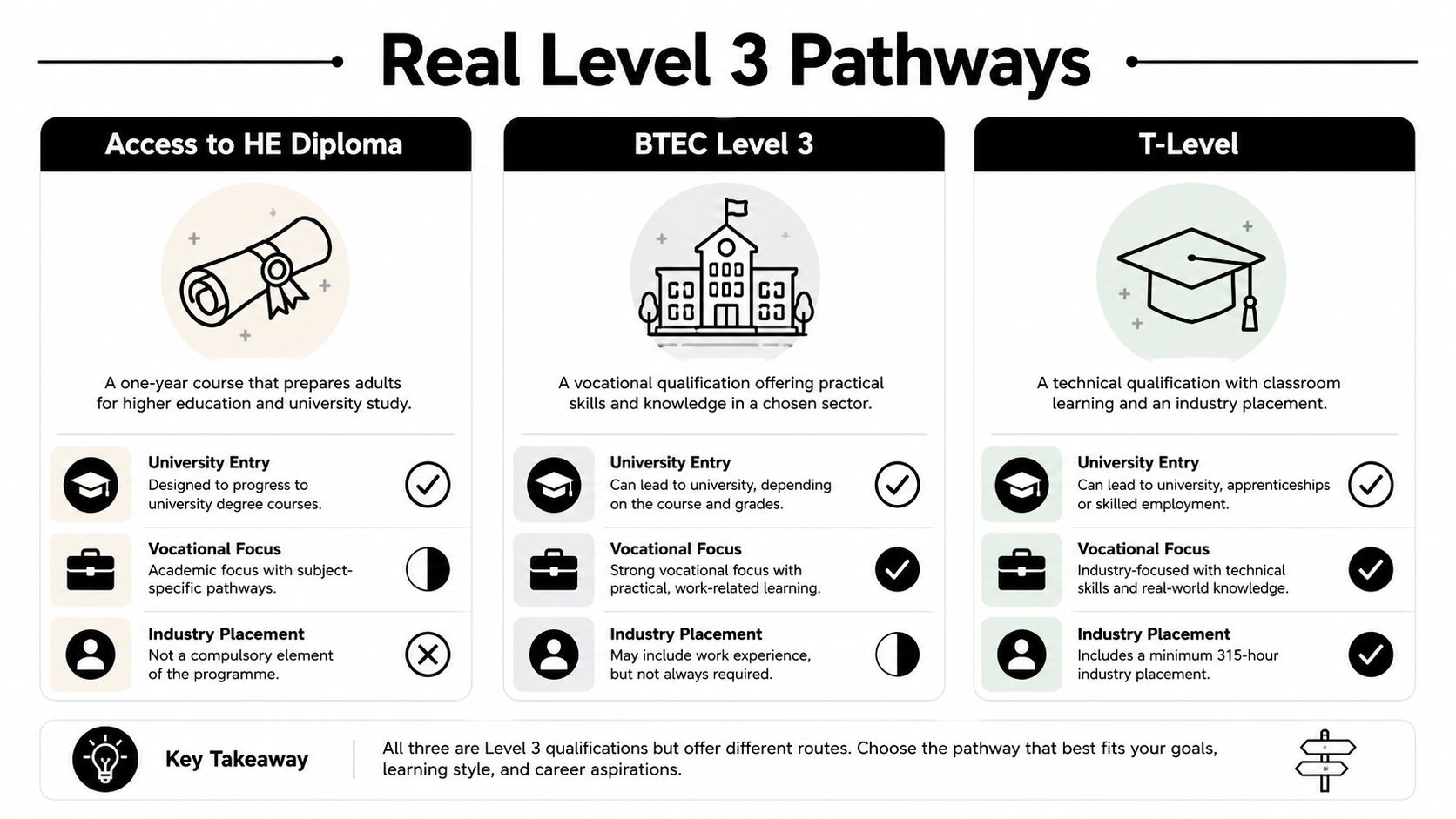
Access to Higher Education diplomas
An Access to Higher Education diploma is usually the most natural option for adults who want to enter university but don't have the traditional qualifications expected of school leavers. Courses are designed around preparation for higher education, often in areas such as nursing, social work, teaching, health science or humanities.
You'll complete subject learning, written work and assessments that help you develop academic habits. That may include reading sources, planning assignments and managing deadlines. It can feel challenging at first, but the course is designed for people returning to education, not for learners who have never had responsibilities outside a classroom.
You can learn more about an online Access to Higher Education diploma and compare its subject options with your intended university course.
A Levels
A Levels offer a more traditional academic route. You choose subjects and study them in depth, then complete the assessments required by the relevant awarding body. This option can suit adults who know the exact subjects needed for a university application or who want a strong academic foundation in a particular area.
A Levels can require consistent independent study. They're a good fit if you enjoy theory, detailed reading and subject-focused learning. Before applying, check the entry requirements for both the A Level provider and the university or career you're targeting.
Advanced apprenticeships and vocational routes
An advanced apprenticeship combines paid employment with structured learning. You develop workplace skills while working towards an apprenticeship standard and, depending on the programme, other recognised qualifications.
Vocational Level 3 options can suit learners who prefer practical projects and career-focused content. BTEC and T Level programmes are examples that may appear in provider searches, although availability, assessment and entry requirements differ by course.
| Pathway | Best For | University Entry | Study Format |
|---|---|---|---|
| Access to Higher Education diploma | Adults preparing for university | Designed for progression to higher education, subject to university requirements | Structured study with academic assignments |
| A Levels | Learners seeking traditional subject-based preparation | Often used for university applications, subject to course requirements | In-depth academic study and assessment |
| Advanced apprenticeship | Learners who want paid work alongside training | Can support further progression, depending on the standard and destination | Employment combined with guided learning |
| Vocational Level 3 qualification | Learners focused on a practical career area | May support higher education, depending on the provider and university | Practical, assignment-based or work-related study |
The right choice depends on your destination. If you want university, compare the exact entry requirements for your chosen degree. If you want to earn while learning, investigate apprenticeships. If you want a career-focused course with applied assessment, explore vocational options.
Entry Requirements and Funding for Level 3 Study
Entry requirements vary by provider and course, so don't assume that one rule applies everywhere. A university course may ask for specific subjects, while an Access to Higher Education provider may assess your previous learning, experience and readiness through an application or discussion.
What you may need before applying
For an Access to Higher Education diploma, providers commonly want evidence that you can manage written work, attend or engage with learning consistently and meet the requirements of your chosen subject area. Functional Skills Level 2 English or maths may help satisfy a course condition, but it isn't automatically accepted for every university degree or profession.
A Levels usually have subject-specific expectations. A science pathway may require evidence of appropriate science or maths learning, while another subject may focus more on English and general academic readiness. Always check the provider's published requirements and ask what they accept if your previous qualifications use a different name.
Before you enrol: write down the exact university course, apprenticeship or job you're aiming for, then check its requirements first.
Functional Skills can strengthen your application by helping you demonstrate practical English and maths. They can also make later study feel less intimidating because you've practised reading information, writing clearly, solving problems and communicating your ideas.
Understanding adult funding
For the 2026 to 2027 period, the Adult Skills Fund rules retain a fully funded entitlement for a learner's first full Level 3 qualification, alongside separate entitlements for English, maths and digital skills. The Adult Skills Fund funding rules for 2026 to 2027 explain the policy framework, but your eligibility depends on your circumstances, the course and the provider.
That means funding may be available, but you shouldn't rely on a general advert alone. Ask the college to check your eligibility, whether the qualification counts as your first full Level 3 and whether any conditions apply.
Prepare these details before contacting admissions:
- Previous qualifications: Include Functional Skills, GCSEs and any other certificates.
- Your target: Name the degree, career or apprenticeship you're working towards.
- Your circumstances: Be ready to discuss employment, age, location and previous study where relevant.
- Funding questions: Ask whether the course is fully funded, supported through another finance option or subject to an eligibility check.
A short conversation can replace weeks of uncertainty. Colleges expect adults to ask these questions.
Studying Your Level 3 Qualification Online with Next Level Online College
Returning to education often starts with a quiet decision. You open a course page after work, while the house is finally calm, and wonder whether you're capable of studying again. That doubt doesn't mean you're unprepared. It means the decision matters to you.
Online learning can remove some of the pressure that makes adult education feel unreachable. You don't have to travel to a campus for every session, and you can plan study around shifts, school runs and caring responsibilities. You still need a routine, but the routine can fit your life instead of forcing your life to fit a timetable.
Next Level Online College offers recognised courses including Functional Skills in English and maths, GCSEs, A Levels and Access to Higher Education diplomas. Its model combines online curriculum materials with academic guidance, assessment preparation and pastoral support. That combination matters because adults often need more than content. They need someone to explain a task, help them plan their week and remind them that one difficult assignment doesn't define their ability.
Support that meets you where you are
A supportive online course should make the next action clear. You might begin with a conversation about your previous study and your goal. From there, a tutor or adviser can help you understand the qualification, likely entry requirements and the work involved.
The emotional side matters too. You may be studying after a long break, managing childcare or worrying about making mistakes in front of other learners. Structured feedback gives you a way to improve without guessing. Pastoral support can help when stress, confidence or competing responsibilities affect your progress.
Here's a short introduction to the college's online learning approach:
A realistic study plan might involve a regular evening for reading, a shorter session for notes and another period for completing an assignment. You can break large tasks into smaller actions, such as finding the question, choosing your evidence, writing a rough paragraph and checking your work.
You don't need to feel confident before you begin. Confidence often grows after you complete a task you once thought was beyond you. Each finished activity gives you evidence that you can learn, adapt and keep going.
Putting It All Together and Choosing Your Personal Next Step
Your next move should begin with the destination, not the qualification name. “Functional Skills Level 3” describes what many learners hope to achieve, but the recognised route depends on whether you want university, paid training or a practical career qualification.
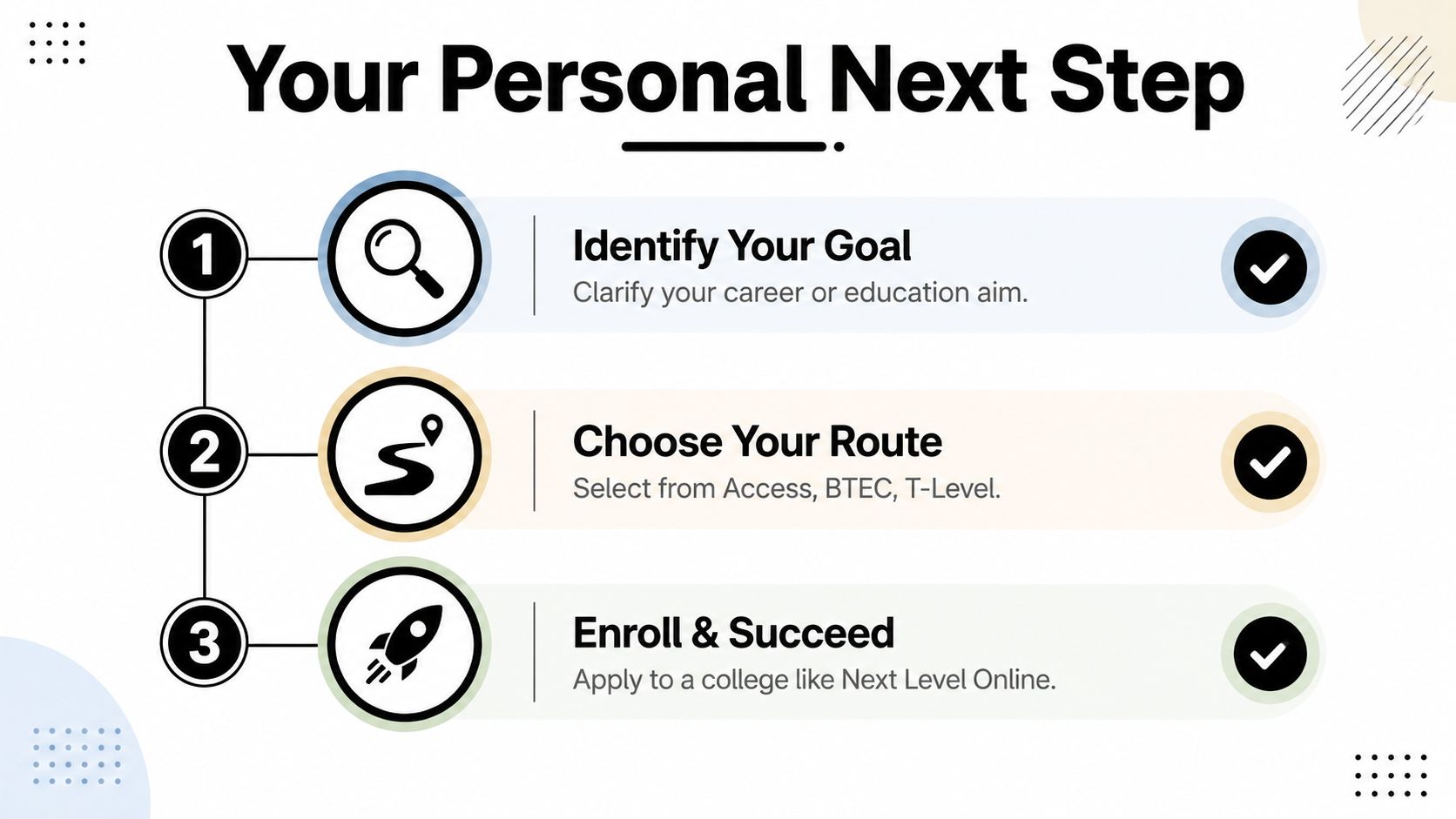
Start with your destination
Choose an Access to Higher Education diploma if you're an adult aiming for university and want a course designed around returning learners. Consider A Levels if you need traditional, subject-specific academic preparation. Explore an advanced apprenticeship if earning while learning and gaining workplace experience are central to your plan.
If your English or maths confidence is still developing, complete the Functional Skills level that matches your starting point before moving into more advanced study. That isn't a delay. It's a sensible way to build the foundation you'll use later.
Use this simple action plan
- Write down your goal. Name the degree, profession or job you want.
- Check the destination requirements. Look at the university, employer or apprenticeship provider's exact conditions.
- Compare routes. Ask whether Access to HE, A Levels, vocational study or an apprenticeship fits your responsibilities and learning style.
- Review funding. Contact providers about the 2026 to 2027 Adult Skills Fund rules and your personal eligibility.
- Speak to an adviser. Ask what qualification you need, how assessment works and what support is available.
- Set a starting date. Choose a manageable study routine and protect that time.
A useful question to ask: “Which qualification will this university, employer or apprenticeship provider accept for my exact goal?”
Take one action this week. You could save the entry requirements, request a course guide or book an advice call. Small actions turn an uncertain ambition into a plan you can follow.
Why Starting Now Changes Everything for You and Your Family
Your previous school experience doesn't get to decide what happens next. Perhaps you struggled with exams, left education early or spent years believing that university and professional careers belonged to other people. Those experiences explain where you're starting, but they don't define how far you can go.
A Level 3 qualification can support progression into higher study, skilled employment or a new direction. It can also change how you see yourself. You become the person who kept learning after work, who completed the assignment after a difficult day and who proved that a past setback wasn't a permanent limit.
Your children notice those choices. They see that education isn't only for a certain age or background. They see someone in their family setting a goal, asking for help and finishing what they started. That example can create pride at home, while the qualification may help you pursue more fulfilling work and improve your earning opportunities over time.
You don't need to have every answer today. You need an accurate route, honest advice and a first step that feels possible. Functional Skills Level 2 can be a strong foundation, but your Level 3 future will come through the qualification that matches your destination.
Next Level Online College offers flexible online Functional Skills, GCSE, A Level and Access to Higher Education courses with academic and pastoral support for adult learners. Visit Next Level Online College to discuss your goal, check the right progression route and take the first step towards a future your family can be proud of.