
Adult GCSEs in the UK are regulated Level 2 qualifications graded 9 to 1, and many adults can study them online, part-time, and sometimes for free if they need a grade 4 or above in English or maths. That makes GCSE for adults a real route back into education, not a second-best option.
You might be reading this after a long shift, with homework still on the table and a quiet worry that school passed you by. Maybe you want a better job, maybe you want to get into college or university, or maybe you want your children to see you finish something important. Either way, this is a common place to start, and it's a place many adults move on from successfully.
Why Adult GCSEs Are Worth Your Time in 2026
A lot of adults return to learning carrying old baggage. They remember missed grades, difficult school experiences, or years spent telling themselves it is too late. Then life changes. The children get older, work starts to feel less secure, or a promotion asks for a qualification they never quite finished.
GCSEs still matter because Level 2 is the education threshold that includes GCSE grade 4/C and above. Government data shows that 84% of adults aged 19 to 64 in the UK were qualified to at least NQF Level 2 in Q4 2024. A sizeable minority is still working towards that level, so adult GCSEs remain one of the clearest routes to it. The same dataset shows 68% at Level 3 or above and 50% at Level 4 or above, which helps show why GCSEs still sit at the doorway to jobs, apprenticeships, and higher study. UK education and training statistics
What that means in real life
For adult learners, GCSEs are not about going back to childhood. They are about opening a door that employers and colleges already recognise. A parent can study after the school run, a shift worker can log in at night, and someone in their thirties, forties, or fifties can still build a clearer path into better pay, steadier work, and more choice.
A simple rule helps here. If your next step needs a recognised academic baseline, GCSEs are still one of the safest options.
Adult learners also do not have to guess whether people like them succeed. National figures for England show adult GCSE participation is large enough to be tracked properly, and the 2021/22 data records 80.7% overall achievement for adult learners in GCSE English in general FE colleges, with 42.1% achieving grades 9 to 4. In sixth form colleges, the overall achievement rate was 81.6%, with 42.9% at grades 9 to 4. Those results are not tiny or unusual, they show that adults do complete GCSEs when the course is built around their lives. Adult GCSE outcomes data
In 2026, that matters even more because flexible study is now normal for adult learners. You are not late. You are arriving with responsibilities, and that is different, but it does not make success any less possible.
Understanding the GCSE Grading System and What It Means for You
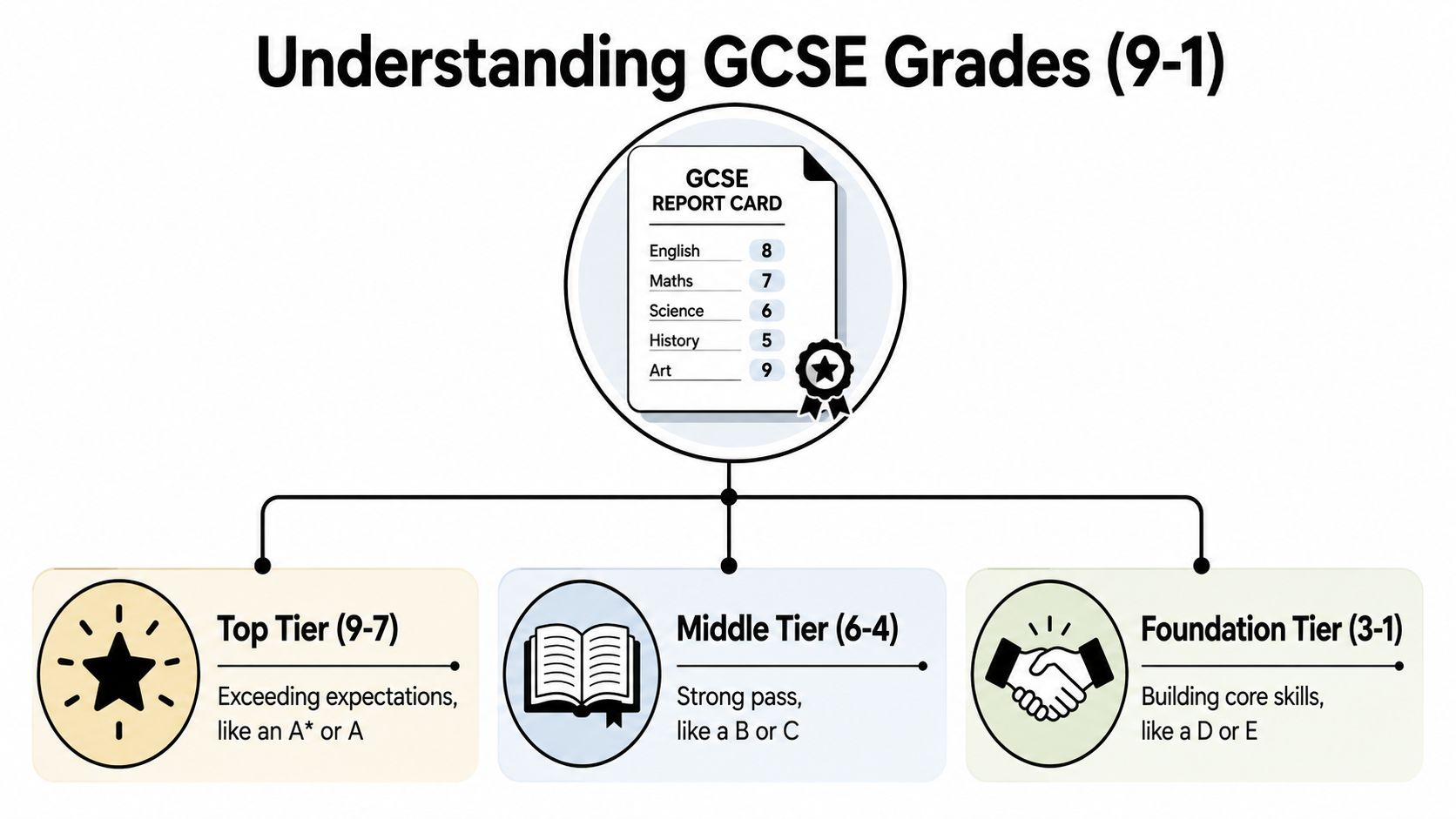
The GCSE grading scale can look confusing at first, especially if you remember the old A to G* system. The easiest way to think about it is like a ladder. 9 sits at the top, 1 sits at the bottom, and each step shows a level of performance within the same qualification.
A grade 4 is generally treated as a pass, while grade 5 is often called a strong pass. On the RQF, GCSEs in England are regulated as Level 1 / Level 2 qualifications, and grades 9 to 4 generally correspond to Level 2 outcomes. That matters because a “GCSE pass” for an adult usually means a real regulated benchmark, not just a certificate saying you attended. GCSE grades explained and GCSE regulation overview
A simple way to read the scale
Think of the grades like school report bands.
- Top band, 9 to 7: You're working above the expected standard.
- Middle band, 6 to 4: You've reached the pass range most employers and universities care about.
- Lower band, 3 to 1: You're still building the core skills that lead towards a pass.
That's the part many adults need to hear clearly. If you're aiming for work, apprenticeships, or university entry, the key question is usually not “Can I do GCSEs?” but “What grade do I need, and in which subject?”
You don't need to understand every grade before you start. You do need one target grade in one subject, then a plan that fits your week.
If you learned under the old system, the main bridge is simple. Level 2 is the line employers often want, and the familiar pass zone sits in the same part of the qualification, even though the letters changed to numbers. The subject content and assessment style can vary by exam board, but the regulated standard stays national.
Choosing Between GCSEs and Functional Skills
This is the choice that confuses many adults most. You know you need English or maths, maybe both, but the two routes can feel similar until you look at what each one provides. Picking the wrong one can waste time, so the decision should start with your goal, not with what sounds easiest.
GCSEs are the stronger choice when you want a recognised academic Level 2 benchmark, especially for university entry or for employers who ask for a specific grade 4. Functional Skills are often more practical and may feel quicker for people who need a qualification for a job, an apprenticeship, or a short-term requirement. Government subject-content guidance keeps GCSEs as the standard subject framework, while adult pathways often centre English and maths as the core progression subjects. GCSE subject content guidance
| Feature | GCSE | Functional Skills |
|---|---|---|
| Purpose | Academic benchmark for jobs, college, and university routes | Practical skills for work and everyday use |
| Study depth | Broader subject coverage and more exam content | Narrower focus on essential skills |
| Typical fit | Best if you need a grade 4 or a stronger academic route | Best if you need something more applied and direct |
| Recognised outcome | Regulated Level 2 benchmark | Often accepted for employment and apprenticeship needs |
If you're comparing them for English or maths, ask one blunt question: What does the next stage require? If a college course, university, or employer specifically wants GCSE English or maths, Functional Skills may not do the same job. If you mainly need proof you can use the skill at work, Functional Skills may be enough.
Practical rule: choose the qualification that matches the gate you're trying to open, not the one that sounds less scary.
A useful example is an adult who wants to train as a nurse, teacher, or social worker. Those routes can involve academic entry expectations, so GCSEs may make more sense. Someone who needs to move quickly into a role with a practical English or maths requirement may be better served by Functional Skills. The right route is the one that gets you where you want to go with the least wasted effort.
Functional Skills and GCSE equivalence explained
Where and How to Study Your Adult GCSE
Adult GCSE study works best when the route fits your real life. If you are balancing shifts, childcare, or an unpredictable home routine, a fully online course can give you the breathing space to keep going. If you do better with set times and face-to-face support, a classroom may help you stay on track. A blended course sits between the two, giving you some structure without asking you to travel every week.
Study modes adult learners use
Fully online study gives you the most flexibility. You can watch lessons after work, fit assignments around family life, and keep moving even when the week is crowded. College-based classes can feel steadier because you get live teaching and a classroom rhythm, while blended learning gives you a mix of both. The right choice often depends less on the subject itself and more on the kind of routine that helps you learn without burning out.
The exam board matters too. AQA, Pearson Edexcel, and OCR all set GCSEs in the UK, and the subject list or assessment style can differ slightly between them. That does not change the qualification's regulated status, but it does affect how you prepare, which past papers you practise, and how the final exams are organised. If you are comparing providers, check the board before you enrol so your revision matches the papers you will sit.
How GCSE English Language is assessed
For adult learners taking GCSE English Language with AQA, the structure is fixed. There are two written papers, each 1 hour 45 minutes, and each paper is worth 80 marks. Reading and writing each count for 50% of the qualification, and the spoken-language component is a separate endorsement with 0% weighting. That means your written exam technique matters hugely, especially under timed conditions. AQA GCSE English specification at a glance
That layout can feel demanding at first, especially if you have been out of formal study for years. The good news is that it is predictable. Once you know the paper format, revision becomes more like training for a race route you can study in advance, rather than facing a surprise test on the day.
How to start without feeling lost
- Choose the subject first. English and maths are the most common starting points, but some adults also need science or another subject for progression.
- Pick your study mode. Match it to your work pattern, childcare, and confidence level.
- Check the exam board. Make sure the provider prepares you for the board's papers.
- Find a recognised exam centre. Your provider should tell you where you will sit the final exams.
- Register with the right details. You will usually need basic ID information and subject choices.
A good provider will also explain how revision, mocks, and exam booking work. If they do not, keep asking until it is clear. If you are still comparing routes, it can also help to read about advanced learner loans and other funding routes before you commit, because cost and study style often need to be worked out together.
Understanding GCSE Costs and Available Funding
Money worries stop a lot of adults before they even begin. That's understandable. If you're balancing rent, bills, and family costs, the idea of paying for another course can feel heavy before you've opened a single workbook.
The key funding rule is straightforward. In England, adults aged 19 to 23 can get their first GCSE English and/or maths course funded if they have not yet achieved grade 4 in that subject. Adults outside that age band usually need to look at alternative funding routes or pay fees themselves. Adult funding rule overview
What costs can look like
Course fees depend on the provider, the study mode, and whether the package includes tutor support, mocks, and exam entry. Online courses are often more flexible, while college-based options may feel more structured if you learn better in a classroom. Some providers also offer payment plans, and employers may support staff who need qualifications for a role.
Ask one direct question before enrolling. What exactly is included in the fee, and what costs extra?
That question matters because the headline price is not always the full price. You want to know about exam fees, books, resits, and any admin charges before you commit.
Funding routes to ask about
- Government funding: check whether your age and current grade make you eligible.
- Employer sponsorship: some workplaces help if the qualification supports your role.
- Bursaries or hardship support: some colleges keep small support pots for learners in need.
- Payment plans: these can help spread the cost if you're self-funding.
If you want a route that combines flexible study with recognised qualifications and adult support, a provider such as Next Level Online College can be one option to compare alongside local colleges and other online schools. It offers adult-focused online learning across GCSEs, Functional Skills, A Levels, and Access to Higher Education, with study designed around work and family life.
Advanced Learner Loans explained
Building Confidence and Sticking with Your Studies
The hardest part for many adults is not the subject itself. It's walking back into learning after years away and feeling like everyone else will know more than you. That feeling is real, and it's exactly why confidence support matters as much as revision notes.
A UK government-funded randomised trial on preparation for Maths GCSE for adult learners included growth mindset sessions, study skills training, and calculator use in the intervention. That's a strong clue that adults often need help with belief, routine, and exam habits, not just the maths content itself. If you've been out of education for a long time, the barrier is often the return to study, not your intelligence. Adult numeracy trial on GCSE preparation
A realistic weekly rhythm
You don't need a perfect timetable. You need one you can repeat.
- Set one study block: even a short, regular session is better than a big plan you never start.
- Use one notebook or folder: keep your notes in one place so nothing gets lost.
- Do small revision jobs: one topic, one question set, one mistake review.
- Practise under timed conditions: exam pressure feels less scary when it becomes familiar.
- Rest on purpose: tired brains make more mistakes, especially in English and maths.
Parents often tell me the same thing. Their children are watching more closely than they think. When a mum or dad keeps going, even after a bad mock or a difficult week, that effort speaks loudly at home.
Practical rule: don't wait to feel confident before you begin. Confidence usually comes after a few completed tasks, not before them.
Support matters too. Good tutors, pastoral help, and clear feedback can turn a rough start into steady progress. When adults know they are allowed to ask for help, they tend to stick with the course longer and recover faster after setbacks.
Progression Routes After You Pass Your GCSEs
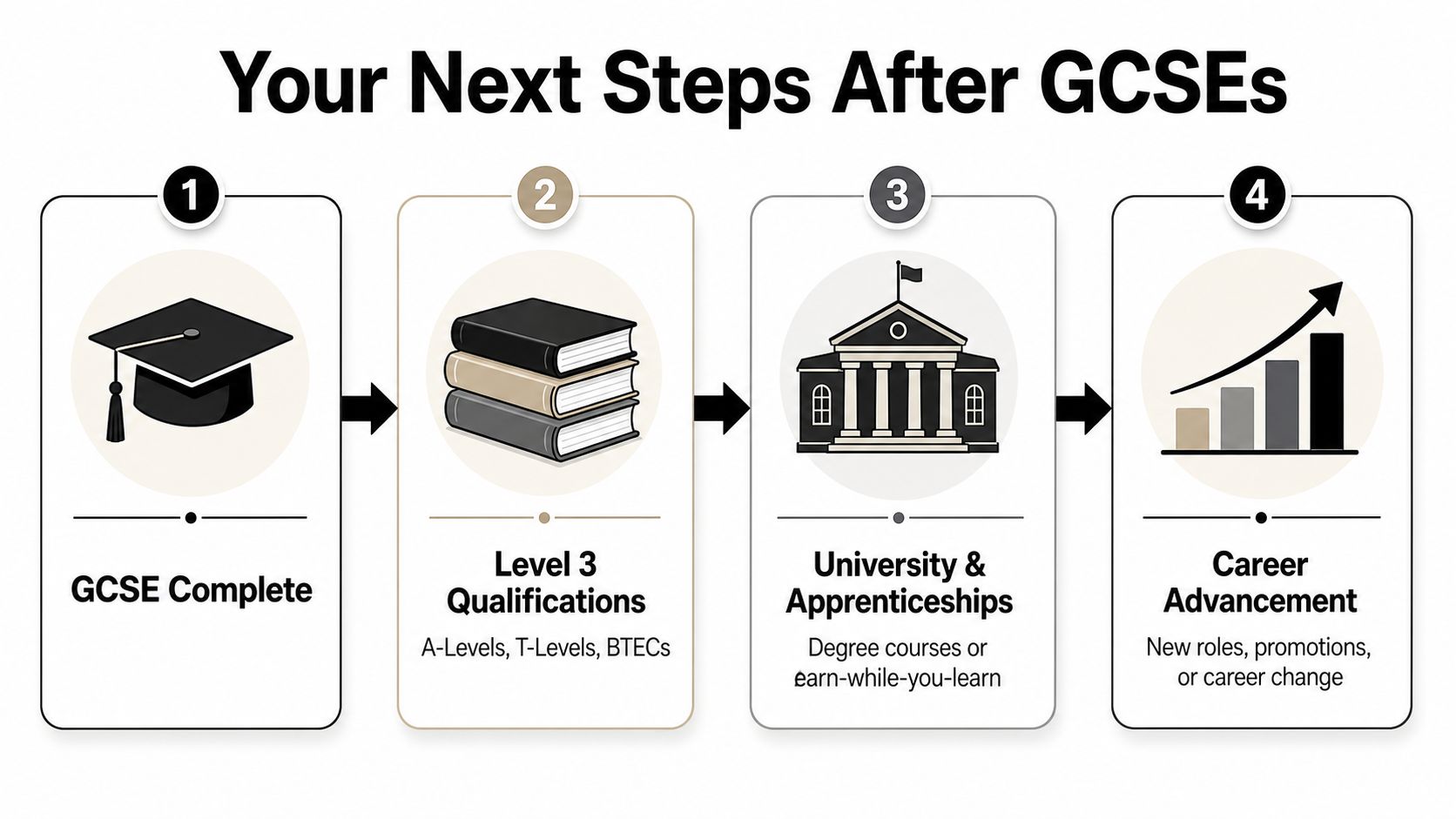
A GCSE pass is not the finish line. For many adults, it is the point where the next part of the path becomes clearer. Once those grades are in place, the next move might be academic, vocational, or a mix of the two, depending on what you want your life to look like after study.
The most common routes forward
If you want university, you can move on to A Levels or, more often, an Access to Higher Education diploma, which is designed for adult learners aiming for degree study. If you want to change careers, your GCSEs can help you meet the entry requirements for an apprenticeship or a vocational course that asks for English and maths. The best route is the one that fits the job, course, or qualification you want next, not the one other people happened to choose.
A common pattern looks like this. An adult retakes GCSE English and maths, uses those results to get onto an Access course, and then progresses towards nursing, teaching, social work, or another professional field. That route is especially familiar for people who left school early, went straight into work, and later decided they want work that feels more meaningful or offers better pay.
There is also reassurance in the national picture. As noted earlier, adult GCSE achievement in England shows that steady progress is very possible when learners keep going and get the right support. Adult GCSE achievement data
What this can mean for your family
For many learners, the gain is bigger than the qualification itself. It is the confidence of being able to say, “I did it.” It is also the example you set for your children, because they see that learning does not stop when school ends. On a practical level, it can open the door to better pay, steadier work, and a role that feels more useful and respected.
Your Next Steps Towards a Brighter Future
You don't need to solve everything today. You just need to take the next sensible step.
- Decide between GCSEs and Functional Skills based on the outcome you need.
- Check funding first, especially if you're in the 19 to 23 age group and need English or maths.
- Choose a study format that fits your work, family, and confidence level.
- Ask about exam centres, support, and mock tests before you enrol.
- Start with one subject, then build from there if you need more.
Adult learners succeed every year because they build study around real life, not fantasy schedules. If you've been worrying that you left it too late, set that thought aside. You're allowed to begin now, and the effort you put in can change your job options, your self-belief, and the example you set at home.
Next Level Online College supports adult learners with flexible online GCSEs, Functional Skills, A Levels, and Access to Higher Education courses that fit around work and family life. If you're ready to turn your goal into a plan, visit Next Level Online College and explore the route that matches your next step.