
Some evenings feel heavier than others. You finish work, sort tea, answer messages, help with homework, and then that thought comes back again. You want more from life, but GCSE maths keeps showing up like a locked door.
Maybe you’ve seen a job you’d be good at, only to spot “GCSE Maths grade 4 or above” in the requirements. Maybe your child asks for help with fractions and you smile, then wish you felt more sure of yourself. Maybe school made you believe maths “just wasn’t for you”.
If that sounds familiar, you’re not behind. You’re not too old. And you’re definitely not the only adult thinking about starting again.
Gcse maths for adults isn’t about going backwards. It’s about moving forward with purpose. You’re not returning to the classroom as the person you were at 16. You’re showing up as someone with life experience, grit, and a real reason to succeed.
That matters.
Adults often do better than they expect because they know why they’re doing it. You’re not revising because someone told you to. You’re doing it for a better future, for your confidence, for your family, and maybe for a dream you put on hold years ago.
You don’t need to be naturally “good at maths” to pass. You need a calm plan, steady support, and the belief that you can learn step by step.
A lot of people think GCSE maths is one giant mountain. It isn’t. It’s a series of small skills, built one at a time. Add, subtract, percentages, graphs, shapes, algebra. You learn one piece, then the next, then the next. Before long, the subject that once felt scary starts to make sense.
And the feeling that comes with that is powerful.
You stop saying, “I can’t do maths.”
You start saying, “I’m getting there.”
Your Time to Shine Is Now
You might be reading this after years of putting yourself last.
Work needed you. Your children needed you. Life got busy. Somewhere in the middle of all that, your own goals were pushed to the side. That happens to many adults, and it can leave you feeling stuck, even when you know you’ve got more to give.
A missing qualification can affect more than applications. It can chip away at confidence. You know you’re capable, but every time maths comes up, it can feel like an old wound being touched again.
The moment many adults recognise
A common moment looks like this. Your child is doing homework at the kitchen table. They ask for help with percentages or averages. You want to step in confidently, but instead you hesitate.
Or maybe it happens at work. A better role opens up. You read the details. You know you could do the job, but the maths requirement stops you before you even apply.
Those moments hurt because they don’t just feel practical. They feel personal.
This is a fresh start, not a replay
Studying gcse maths for adults is different from school. Very different.
At school, you may have felt rushed, embarrassed to ask questions, or left behind when the class moved on too fast. As an adult, you can learn in a way that suits you. You can pause. Repeat. Practise. Ask. Breathe. Try again.
That changes everything.
Here’s what often helps adult learners most:
- Clear reasons to study. You know what this qualification could open up.
- Real-life examples. Budgeting, bills, time, travel, and shopping all connect to maths.
- A stronger mindset. You’ve handled hard things before. That resilience counts.
- A deeper sense of purpose. You’re not just doing this for a grade. You’re doing it for your future.
Practical rule: Don’t ask, “Am I clever enough?” Ask, “What’s my next small step?”
That small step could be finding out what’s in the course. It could be choosing a study route. It could be deciding that this year will be different.
There’s something special about an adult learner who keeps going. Your children see it. Your family feels it. You become proof that it’s possible to change your story.
And when you pass, the grade matters. But so does the person you become on the way there.
Why GCSE Maths Is Your Key to a Brighter Future
A pass in GCSE maths can open up opportunities that have stayed shut for too long. For many adults, it isn’t just another certificate. It’s a turning point.
When employers, colleges, universities, and training providers ask for GCSE maths, they’re often looking for proof that you can work with numbers, solve problems, and think clearly. That’s why this qualification comes up so often.
Better options at work
A maths grade can help you apply for roles you may have skipped in the past. It can also support promotion if your current job has entry rules for training or progression.
Think about what changes when you no longer have to say, “I can’t apply because I don’t have the maths.” You read the advert differently. You carry yourself differently. You start seeing choices where before you saw barriers.
That matters in practical ways, but also emotionally. Earning a qualification as an adult can rebuild self-belief in a way very few things can.
Some adults study because they want a new career. Others want more stable work, better pay, or a role with more meaning. Some want to show their children that learning doesn’t stop at school. All of those reasons are strong enough.
A path towards further study
GCSE maths can also be a stepping stone to more learning. If university, teacher training, nursing, an Access course, or another professional route is on your mind, maths is often part of the journey.
That can feel big at first. But big goals are built from small wins.
You don’t have to solve your whole future today. You only need to recognise that this qualification can move you closer to it.
Here’s a short video that may help you see that next step more clearly.
The pride runs deeper than a grade
This is the part people often underestimate.
When an adult passes GCSE maths, they don’t just gain a qualification. They often gain a new voice in their own head. A kinder one. A stronger one.
You may notice changes like these:
- More confidence at home. You feel calmer helping with homework or talking about education.
- More belief at work. You put yourself forward instead of holding back.
- More pride in yourself. You finish something that once felt impossible.
- More hope for the future. New plans start to feel real.
Sometimes the biggest result isn’t the number on the paper. It’s the moment you realise you were capable all along.
If you’ve spent years doubting yourself, gcse maths for adults can be about much more than maths. It can be the first solid proof that your life can still change in a big, meaningful way.
What You Will Actually Learn in GCSE Maths
You might be sitting at the kitchen table after work, looking at the words "GCSE maths" and feeling your stomach tighten. That reaction is common. The good news is that the course is not one giant wall of hard questions. It is a set of manageable skills, built one layer at a time, like adding bricks to a path until you can walk forward with confidence.
That matters for adult learners. Every topic you learn gives you something useful in daily life, and every small win helps rebuild trust in yourself. If you want to see what a flexible adult course looks like, our GCSE Mathematics course for adult learners shows how these topics are taught in a clear, supportive way.
Number and arithmetic
Many people begin here, and for good reason. Number skills are the basics that support everything else.
You will practise:
- Whole numbers and decimals. Adding, subtracting, multiplying, and dividing with confidence.
- Fractions. Helpful for recipes, bills, measurements, and splitting amounts fairly.
- Percentages. Useful for sales, interest, wage changes, and comparing deals.
- Negative numbers. Common in temperatures, bank balances, and changes up and down.
A lot of adults feel relief here. These topics often connect straight away to real life, so progress can feel visible early on.
Algebra without panic
Algebra uses letters, which can make it look harder than it is. In truth, the letters stand in for numbers you do not know yet.
Algebra works like filling in a missing part of a sentence. If x + 4 = 10, you are finding the number that makes the statement true. From there, you build up slowly.
You may learn to:
- solve simple equations
- spot patterns
- use formulas
- draw and read graphs
Graphs can sound technical, but they are just pictures of change. If your childcare costs rise as hours increase, a graph shows that pattern clearly.
Ratio and proportion in everyday decisions
This topic is more familiar than it first appears.
Ratio and proportion help with recipes, shopping, scaling quantities, comparing prices, and sharing costs. If you have ever checked which pack gives better value or worked out how much food to make for extra people, you have already used this skill.
Questions in this area often ask:
- If 3 items cost one amount, what would 5 cost?
- If a recipe serves 2 people, how much do you need for 4?
- If a drawing is to scale, what would the measurement be?
Many adult learners enjoy this part because it feels practical from the start.
Geometry and measures around the home and workplace
Geometry is about shape, space, size, and movement. The name can sound formal, but the ideas are very down to earth.
You may study:
- Perimeter and area. The distance around a shape and the space inside it.
- Volume. How much a container or room can hold.
- Angles. Used in shape rules, diagrams, and construction.
- Transformations. Sliding, turning, or flipping shapes.
- Units of measure. Length, weight, capacity, and time.
If you have measured flooring, packed boxes, read a map, or worked out how much paint to buy, you have already met this kind of maths.
Probability and statistics
This part helps you make sense of information instead of just looking at numbers and hoping they mean something.
You might work with:
- tables
- charts
- averages
- range
- probability
- data interpretation
That can help in everyday life, from reading news stories more carefully to comparing products, tracking spending, or understanding reports at work.
Some parts may feel unfamiliar at first. Interquartile range, often called IQR, is one example. It sounds complicated, but a good teacher breaks it into small steps, shows you the pattern, and gives you time to practise until it feels steady.
You build this step by step
No adult learner is expected to know all of this on day one.
A good course teaches maths in pieces you can absorb, practise, and return to. One skill leads to the next. Over time, those skills start to connect, and the subject feels less like a threat and more like something you can handle.
Here is a simple way to view the course:
| Area | What it really means |
|---|---|
| Number | Working accurately with everyday calculations |
| Algebra | Finding missing values and spotting patterns |
| Ratio | Comparing amounts and scaling things up or down |
| Geometry | Understanding shapes, space, and measures |
| Statistics | Reading data and making sense of information |
This is one reason GCSE maths for adults can change more than your qualifications. As you learn topics you once thought were beyond you, you begin to see yourself differently. Your children may notice it. Your family may notice it. Above all, you notice it.
One topic this week is enough. Then another next week. That is how confidence grows, and that is how adults pass.
Finding the Right Study Path for Your Life
It is 9:20 at night. The kitchen is finally quiet, your phone has stopped buzzing for a moment, and you are wondering whether there is any realistic way to fit maths into a life that already feels full.
There is.
Adult learners rarely struggle because they are not capable. The primary challenge is finding a study route that fits around work, children, caring duties, and tired evenings. Once your course fits your life, studying starts to feel possible instead of overwhelming.
That matters for more than a qualification. Choosing the right path gives you a chance to prove something to yourself. It shows your children, partner, or family that starting again takes courage, and that progress still counts even in a busy adult life.
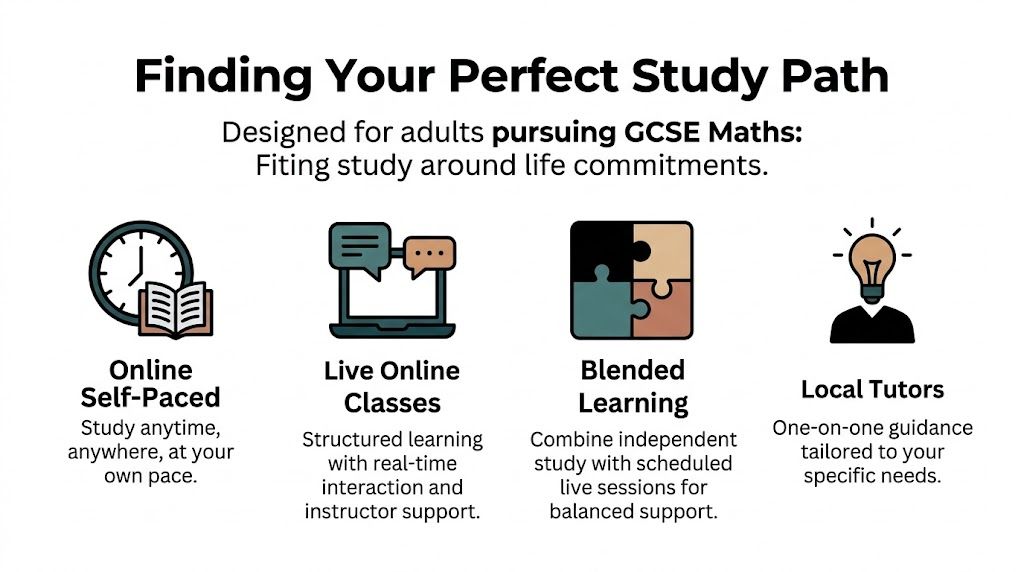
Four common ways to study
Each route suits a different kind of learner. The best one is usually the one you can keep showing up for, even on a difficult week.
Online self-paced learning
This option gives you the most freedom. You can study before work, after the school run, during a lunch break, or in short evening sessions.
It works well for adults who need to pause, replay, and revisit topics without feeling rushed. If your routine changes from week to week, self-paced study can feel like a pressure valve. It bends with your life instead of forcing your life to bend around it.
Live online classes
Some adults learn better with a set lesson time and a teacher there to guide them. Live online classes bring that structure without the travel.
This can be a good fit if routine helps you stay focused. You know when to log in, what to cover, and where to ask questions when something does not click first time.
Adult education college
A local college can suit learners who prefer face-to-face teaching and being in a classroom with other adults. For some people, leaving home for a lesson helps them switch into study mode.
The downside is timing. Fixed classes can be hard to manage if your job changes week by week or family responsibilities are unpredictable.
Evening classes or local tutors
Evening classes can give you a steady weekly rhythm. A local tutor can offer close personal support, which often helps if you feel anxious about maths or want one-to-one explanation.
The trade-off is flexibility. If your schedule is often interrupted, missing sessions can knock your confidence.
Which GCSE Maths Study Route is Right for You?
| Feature | Online Course (e.g., Next Level) | Adult Education College | Evening Classes |
|---|---|---|---|
| Flexibility | Very high. Study around work and family | Lower. Fixed timetable | Medium. Usually fixed weekly sessions |
| Pace | Often self-paced | Group pace | Group pace |
| Support style | Online tutor help, feedback, digital resources | In-person teaching and peer support | Teacher-led sessions |
| Best for | Busy adults needing freedom | Learners who prefer classroom learning | Adults who like a weekly routine |
| Travel needed | No | Yes | Usually yes |
GCSE or Functional Skills
Some adults need GCSE Maths because an employer, college, apprenticeship, or university asks for that exact qualification. Others may have more flexibility and can start with Functional Skills first.
A simple question can clear this up. What qualification does your next step require?
- If it says GCSE maths, study GCSE maths.
- If it says equivalent qualification or Level 2 maths, Functional Skills may be accepted.
- If you are unsure, check with the employer, training provider, or university before enrolling.
If you want to compare what the course includes, this page on online GCSE Mathematics courses for adult learners explains the route clearly.
A study plan that respects your life
Many adults picture studying as needing long, quiet blocks of time at a tidy desk. Real life is usually messier than that.
Short sessions often work better. Ten minutes on fractions while the pasta cooks. Fifteen minutes on percentages before bed. Twenty minutes answering one exam-style question on a lunch break. Those small pieces add up, rather like saving coins in a jar. One coin does not look like much, but keep going and the jar fills.
Try a rhythm like this:
- Choose three small study slots each week that already fit your routine.
- Keep your notes, login, and calculator ready so you can start quickly.
- Focus on one topic at a time so your brain has a fair chance to settle into it.
- Write down each small win to remind yourself that you are moving forward.
One finished topic can change how you see yourself.
A study plan works best when it matches the life you really have. That is how adults keep going, build confidence, and become the person their family sees trying, learning, and succeeding.
Understanding the Exams and How You Will Succeed
It is 8:30 at night. The kitchen is finally quiet, your phone is face down, and you are looking at a maths paper wondering if you have left it too late.
You have not.
The exam can feel intimidating because it puts a finish line in front of you. Once you know what to expect, it stops feeling like a mystery and starts feeling like a plan. For many adults, that is the moment confidence begins to grow again. You are not only preparing for a qualification. You are showing yourself, and the people around you, what steady effort can achieve.
What the exam is like
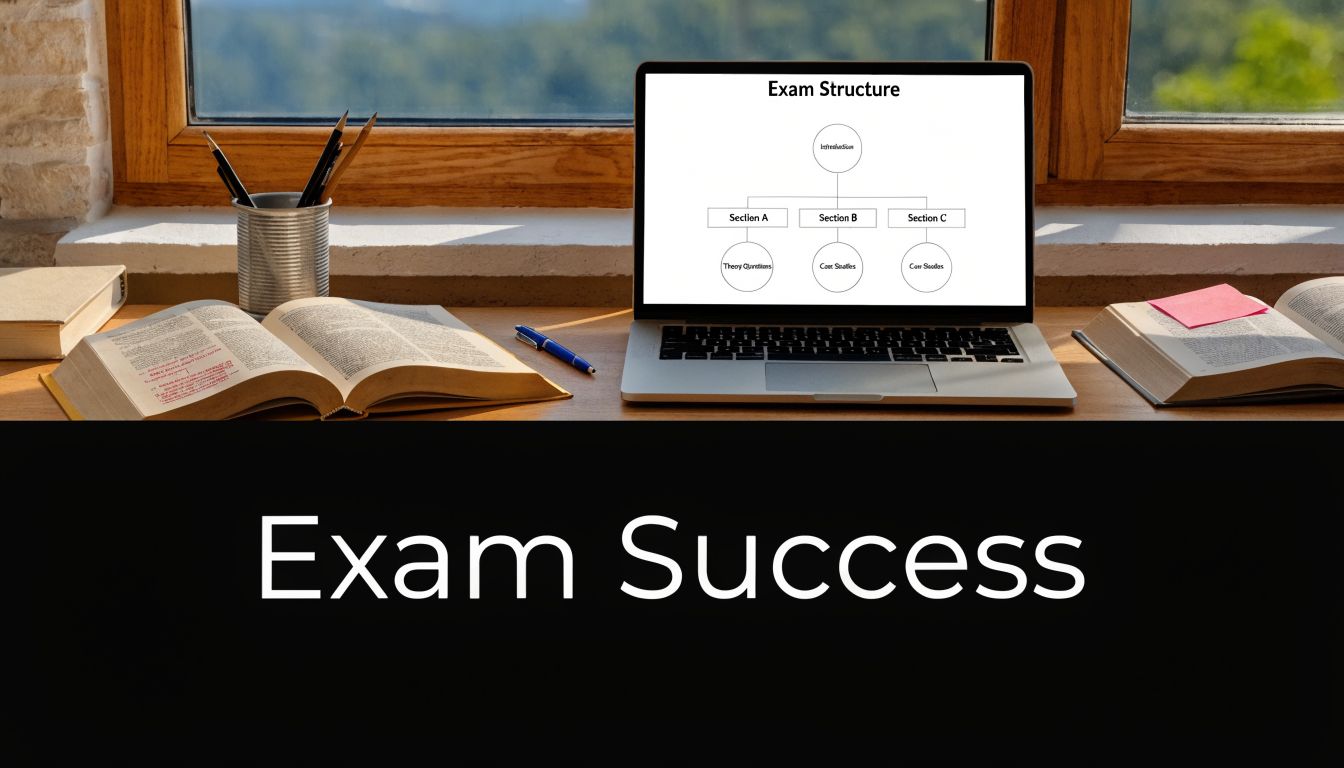
GCSE maths is usually assessed through exam papers at the end of the course. You will normally be entered for either Foundation or Higher tier, based on your current level and the grade you are aiming for.
Foundation suits learners working towards a secure pass. Higher includes more difficult topics and gives access to the top grades. Your tutor or course provider will usually help you choose the tier that fits you best, so you are working at a level that stretches you without knocking your confidence.
Grades use numbers rather than the old letters. Many adult learners aim for grade 4 or 5 because employers, colleges, and training providers often ask for these.
If GCSE feels a little too big right now, some adults start by building confidence with Functional Skills Maths online courses for adult learners. That can be a good stepping stone before taking on GCSE.
How adults revise in a way that works
Adults usually do better with a steady routine than with last-minute cramming. That is good news, because a steady routine also fits real life better.
Revision works like laying bricks. One brick on its own does not look impressive. Keep placing them carefully, and you build something strong. A ten-minute recap of fractions, one practice question on percentages, and a short review of mistakes can do more for your grade than one long, stressful session.
A simple pattern often works well:
- Learn the method.
- Watch it being used.
- try a question with support.
- Try a similar question on your own.
- Revisit it later in the week.
That turns revision into a repeatable habit. It also lowers panic, because you always know what the next step is.
Useful revision habits include:
- Short, regular study sessions that fit around work and family life
- Plenty of practice questions, not just reading notes
- Focusing on one weak topic at a time
- Using everyday examples such as bills, shopping, travel times, and budgeting
- Going back over mistakes until the method feels familiar
Hard topics usually need slower teaching, not a smarter brain
Many adults decide a topic is “not for them” after one confusing lesson years ago. That old experience can feel very powerful. It is also often misleading.
Take interquartile range from grouped data. The name sounds heavy and technical. Yet once it is broken into small steps, it becomes much more manageable. You find the total frequency, work out the quartile positions, read the grouped values carefully, and practise the same style of question again. That is all.
The same pattern helps with algebra, graphs, probability, and angles.
The official exam content sets out the kinds of knowledge and skills learners are expected to build, as reflected in the earlier reference to the official GCSE mathematics subject content guidance. What matters most day to day is much simpler. Clear explanation, patient practice, and revisiting tricky areas help adults improve.
Hard topics often felt impossible in the past because they were rushed, not because you were unable to learn them.
That is an important difference.
Exam habits that help you stay calm and pick up marks
Success in maths exams is not only about knowing the answer. It is also about using good habits under pressure.
Before the exam, practise with past paper style questions so the wording feels familiar. Revise methods, not just final answers. Keep a short list of mistakes you tend to make, such as missing negatives, copying a number wrongly, or forgetting to convert units.
During the exam, slow yourself down at the start of each question. Read it twice. Underline key words and numbers. Show your working, because method marks can still help even if the final answer is wrong. If one question stalls you, leave a little space and come back later.
After practice papers, spend time asking why a mistake happened. Did you rush? Misread a word? Forget a rule? Use the wrong method? That short reflection is where a lot of progress happens.
Adult learners often do well here because they are more thoughtful. You are not trying to impress a classroom. You are building a qualification that can change your options, strengthen your confidence, and give your family a clear example of what persistence looks like. That is a powerful reason to keep going.
How We Support Your Journey at Next Level Online College
Returning to study takes courage. Keeping going takes support.
That’s why adult learners need more than worksheets and video lessons. They need a learning environment that understands real life. Tired evenings, work shifts, school runs, self-doubt, and days when motivation dips all need to be part of the plan.

Support that fits adult life
At Next Level Online College, the focus is on making study feel achievable.
That means learning is designed around adult responsibilities, not around a school-style timetable. If your week changes often, you need flexibility. If your confidence has taken knocks, you need calm guidance. If you’ve been out of education for years, you need clear next steps.
The right support can include:
- Dedicated tutors who explain maths in plain language
- Structured lessons so you know what to do next
- Flexible online access that fits around busy routines
- Encouragement and check-ins when your confidence drops
A human approach to confidence
Many adult learners don’t need pressure. They need reassurance, honesty, and someone who won’t make them feel silly for asking basic questions.
That’s especially important in maths.
A caring tutor can help you untangle topics that once felt impossible. A supportive team can help you stay on track when life gets messy. Pastoral support matters too, because confidence and learning are closely linked.
The best support doesn’t just teach the subject. It helps you keep believing you can finish.
Progress that feels clear
One of the hardest parts of studying alone is not knowing whether you’re doing the right things in the right order.
A strong online college should remove that confusion. You should be able to see where you are, what comes next, and what to focus on this week. That sense of order lowers stress and helps you build momentum.
Adults often thrive when learning feels:
- Organised, not chaotic
- Supportive, not intimidating
- Flexible, not rigid
- Purposeful, not endless
If you’ve been putting this off because you feared feeling lost, the right support can change the whole experience. With proper guidance, gcse maths for adults becomes less about struggle and more about steady progress.
Your Questions About GCSE Maths for Adults Answered
A lot of adults are close to starting, but one or two worries keep holding them back. These are some of the most common questions.
Am I too old to do GCSE maths
No. Adults return to maths at many different ages.
What matters most isn’t your age. It’s your reason for doing it and the support around you. In many ways, adult learners bring strengths that younger students don’t yet have, such as patience, determination, and a clear goal.
What if I was bad at maths at school
That doesn’t decide what happens now.
School may have moved too fast. You may have had poor teaching, low confidence, anxiety, or things going on at home. Adult study is different because you can learn at your own pace and ask questions without trying to keep up with a whole class.
How long will it take
That depends on your starting point, your study routine, and the route you choose.
Some adults need longer because they’re rebuilding from the basics. Others move more quickly because parts of the course come back once they start practising. The main thing is not to compare your pace with anyone else’s.
Do I need GCSE maths or would Functional Skills be enough
It depends on your goal.
If your employer, university, or training course asks specifically for GCSE maths, then GCSE is usually the safest route. If they accept an equivalent qualification, Functional Skills may be a good option.
Always check the exact wording. This guide to what GCSE grades mean can help you understand the system more clearly.
What if I fail
Failing an exam would be disappointing, but it would not mean the end of your journey.
It would mean you need more time, a different revision plan, or stronger support in certain topics. Many adults succeed after a setback because they come back with a better understanding of what to work on next.
How can I study when my life is already full
Keep it small and realistic.
Try short sessions. Leave notes where you can see them. Use one notebook for key methods. Study at times that already fit your routine, rather than waiting for a perfect free evening that may never arrive.
A simple approach works best:
- Choose a regular time you can protect
- Focus on one topic per session
- Use practice questions early
- Celebrate progress even when it feels small
Will I feel embarrassed being an adult learner
You might at first. That feeling is common.
But embarrassment often fades once you begin, because action changes the story you tell yourself. Studying as an adult is something to respect, not hide. You’re doing something brave and useful. You’re building a future with intention.
Can I really become a role model through this
Yes.
Not because you’ll suddenly become perfect, but because your family will see you trying, learning, and refusing to give up. That example is powerful. Children remember effort. They remember courage. They remember seeing someone they love choose growth.
And you’ll remember it too.
If you’re ready to turn doubt into progress, Next Level Online College can help you take that first step with flexible online learning, caring support, and clear pathways for adult learners across the UK. Your future doesn’t need to wait for the perfect moment. You can start building it now.