
You might be reading this after a long day, with the kettle on, the kids finally quiet, and that same thought circling in your head, “Could I really go back and do this now?” If that's where you are, you're not behind, and you're not alone. GCSEs for adults are a real path back into education, and for many people they become the moment everything starts to feel possible again.
A lot of adults feel awkward saying they want to study. Maybe school knocked your confidence. Maybe life got in the way. Maybe you need a qualification for work, university, or just to show your children that learning doesn't stop when you grow up. Whatever brought you here, the important thing is this: you can start again.
Why GCSEs for Adults Feel Like a Fresh Start
The first step often feels the hardest. You open a course page, then close it again. You wonder if you've left it too late, or whether school people will be quicker, younger, and better at everything. Those thoughts are common, but they're not the whole story.
Adult learning is still a major part of the picture in England. The latest government statistics show 1,174,940 adults took part in education and training in 2024/25, and the largest age band was 25 to 49, at 59.0% of participants, with people aged 50 and over making up 22.9% (further education and skills statistics, 2024/25). That means plenty of adults are already taking a step like this, often while juggling work, family, and everything else life throws at them.
What a GCSE actually is
A GCSE is a recognised qualification in a subject such as English, maths, biology, or history. In England, GCSEs use the 9 to 1 grading system, and the qualification is built so that each subject has a clear structure and fixed grade boundaries set by awarding organisations under Ofqual's conditions (Ofqual GCE conditions). That technical design matters because it helps keep the qualification consistent and trusted.
For an adult, that consistency is reassuring. You're not guessing what the qualification means. You're working towards something employers, colleges, and universities already understand.
Practical rule: If you've been out of education for years, start by treating GCSEs as a fresh skill-building project, not a test of your worth.
The older government record also shows how large adult learning has been over time. In 2015/16, participation in government-funded adult further education fell to 2,324,700 learners, and adult qualification achievements fell to 1,694,500 (government release). That history matters because it shows adult learning has always shifted with policy and funding, yet it has remained part of the UK system. GCSEs for adults sit inside that bigger story.
For many people, the fresh start isn't only academic. It's emotional. It's the first time in years they've said, “I can do this,” and meant it.
What GCSEs Can Lead to for Your Future
A GCSE can look like a small piece of paper, yet it can change what feels possible. For many adults, English and maths are the first barriers to clear, because universities and training routes often look for GCSE English Language and Mathematics at grade 4/C equivalent as the baseline for literacy and numeracy (adult GCSE guidance). If a course, promotion, or apprenticeship has ever stalled because of one missing qualification, you already know how much weight that can carry.
The doors people usually want to open
Some adults want a place at university. Others want better pay, a new field, or the quieter victory of helping a child with homework without doubting every answer. A GCSE supports each of those aims because it shows that you can manage structured study and timed assessment. Employers and further study providers both recognise that as a clear benchmark.
The value goes beyond the certificate itself. Passing as an adult can rebuild confidence in ways that show up elsewhere, speaking up at work, completing forms, reading school letters, or applying for jobs you once avoided. Many adults find that the qualification gives them evidence that an old story about their ability was incomplete.
Why the effort feels worth it
When a child sees you revising after dinner or studying on a Sunday morning, they see perseverance in real life. They learn that hard work has value, and that progress often comes through repetition, patience, and sticking with something that matters.
A strong GCSE pass can change how a family thinks about learning.
It shows what steady effort can do, and it gives everyone around you a more hopeful example to follow.
The practical return matters too. A qualification can support higher earning potential, more satisfying work, and a chance to keep moving instead of feeling stuck. For many adults, that makes the effort feel worthwhile, because the future starts to look open again.
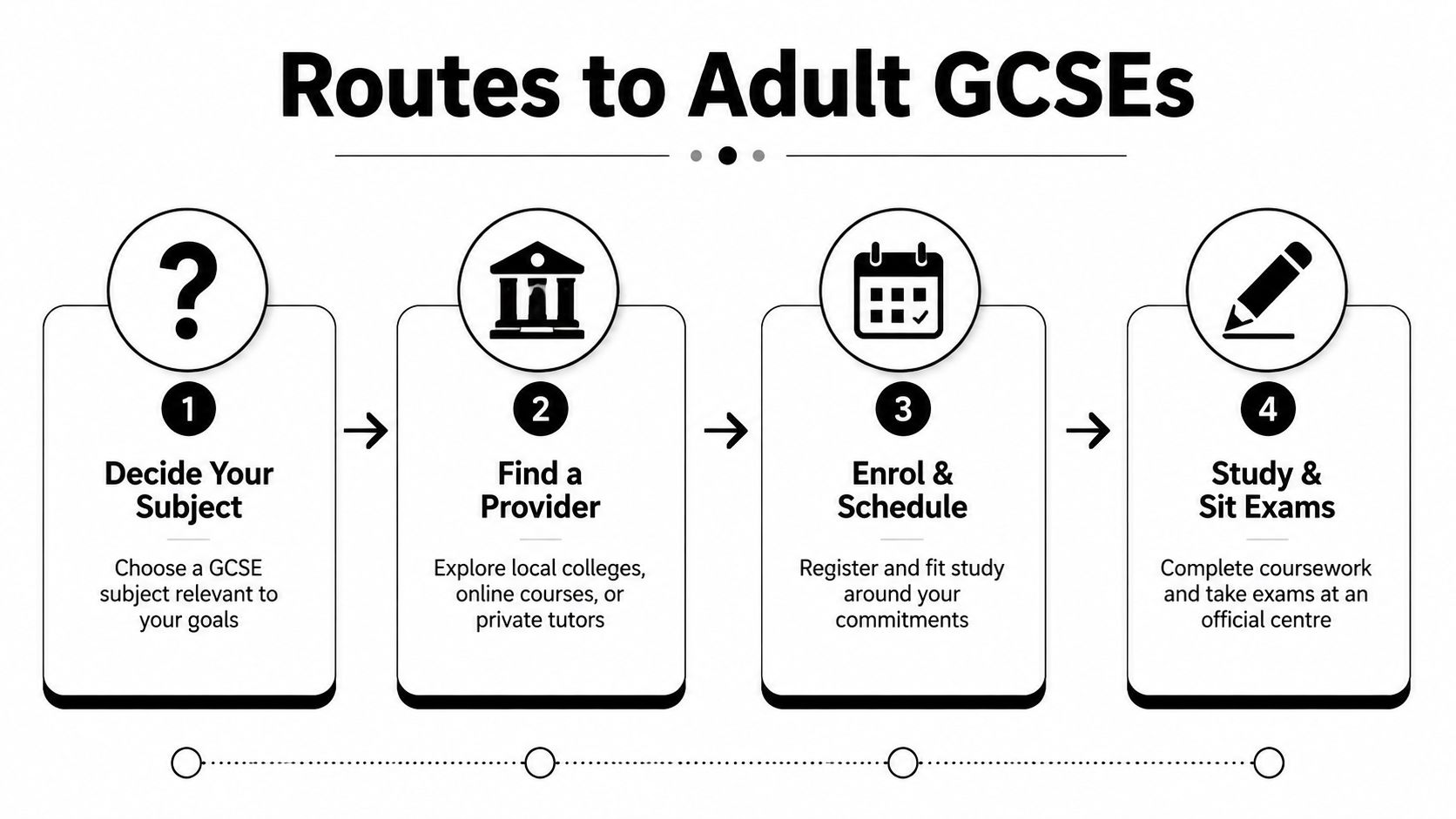
Different Routes to Take GCSEs as an Adult
There isn't just one way to study for GCSEs as an adult. That's good news, because your life probably doesn't look like a school timetable anymore. The right route is the one that fits your work hours, family routine, confidence level, and how quickly you need the qualification.
College, adult learning centre, or online
A local college can suit you if you want face-to-face support and a fixed weekly rhythm. Some adults like the feeling of turning up to a classroom and leaving the study space behind when the lesson ends. Others prefer adult learning centres because the groups are often smaller and the environment can feel less intimidating than school ever did.
Online study gives the most flexibility. You can work in the evening, at lunch, or after the children are asleep. That can make a huge difference if you're balancing shifts, caring duties, or unpredictable home life. One adult provider, Next Level Online College, offers online courses for adults who need a structured route around work and family commitments. It's one option among several, and it suits learners who want remote study with guided support.
What to keep in mind before you choose
No route is “more real” than another if it leads to the same recognised qualification. What changes is the shape of the journey.
- Choose college if you learn best with regular in-person contact and a set class time.
- Choose adult learning centres if you want a calmer pace and a setting designed for mature learners.
- Choose online study if you need your learning to fit around family, work, or travel.
- Check exam arrangements early, because GCSEs still need official exam sitting, even when the lessons are online.
There's no upper age limit for GCSEs in England, and adults can take them at any stage of life. A public example cited in the source is a learner who began GCSE Maths at 92 years old (example video). That fact says something powerful. This path is open, even if you've been out of education for decades.
If you're unsure which route suits you, start with your schedule, then work backwards. The course should fit your life, not the other way round.
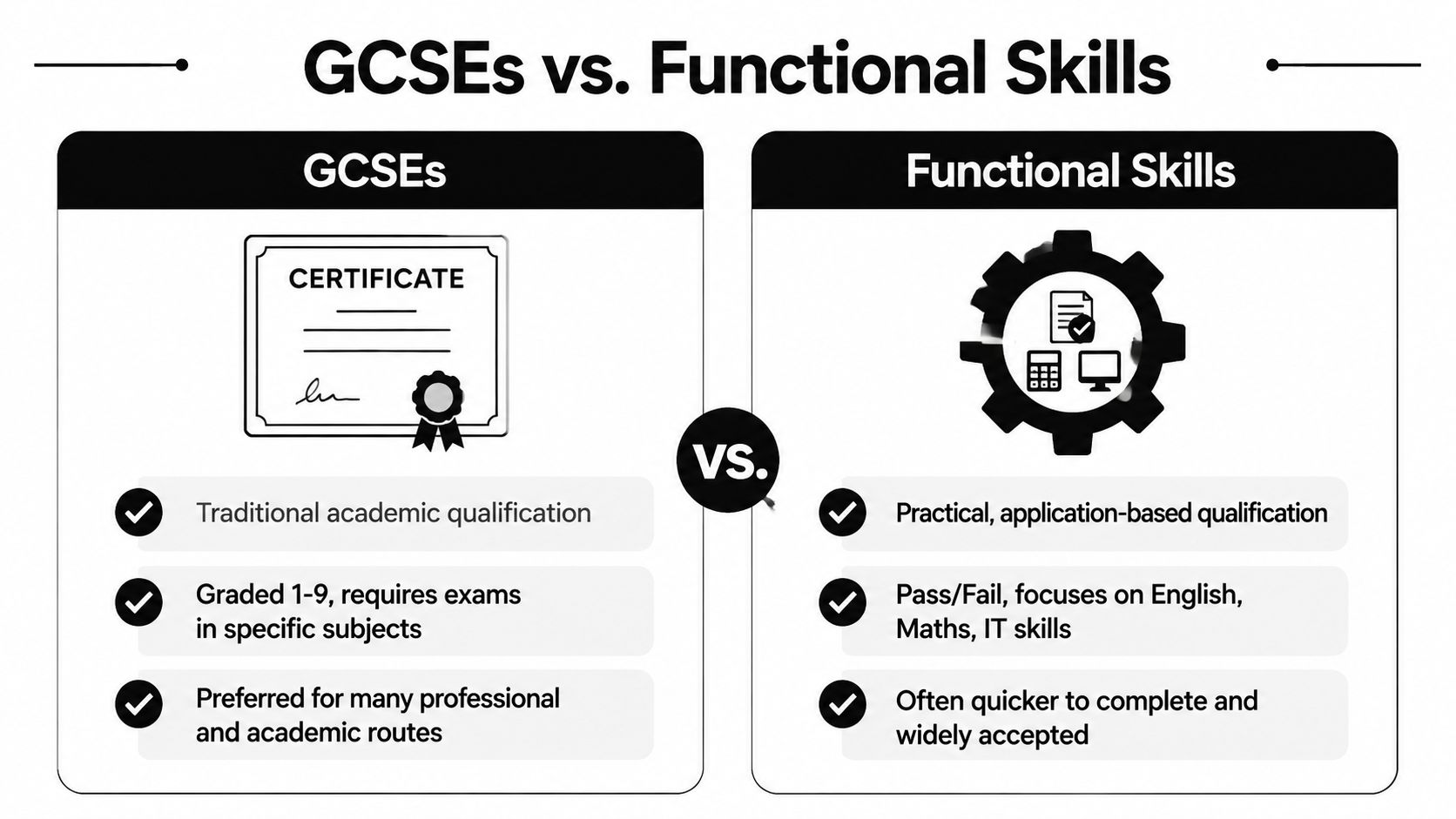
GCSEs Compared with Functional Skills
Some adults want the academic route. Others want the quickest practical step. Both choices can be sensible, but they don't serve exactly the same purpose. The key is matching the qualification to the goal in front of you.
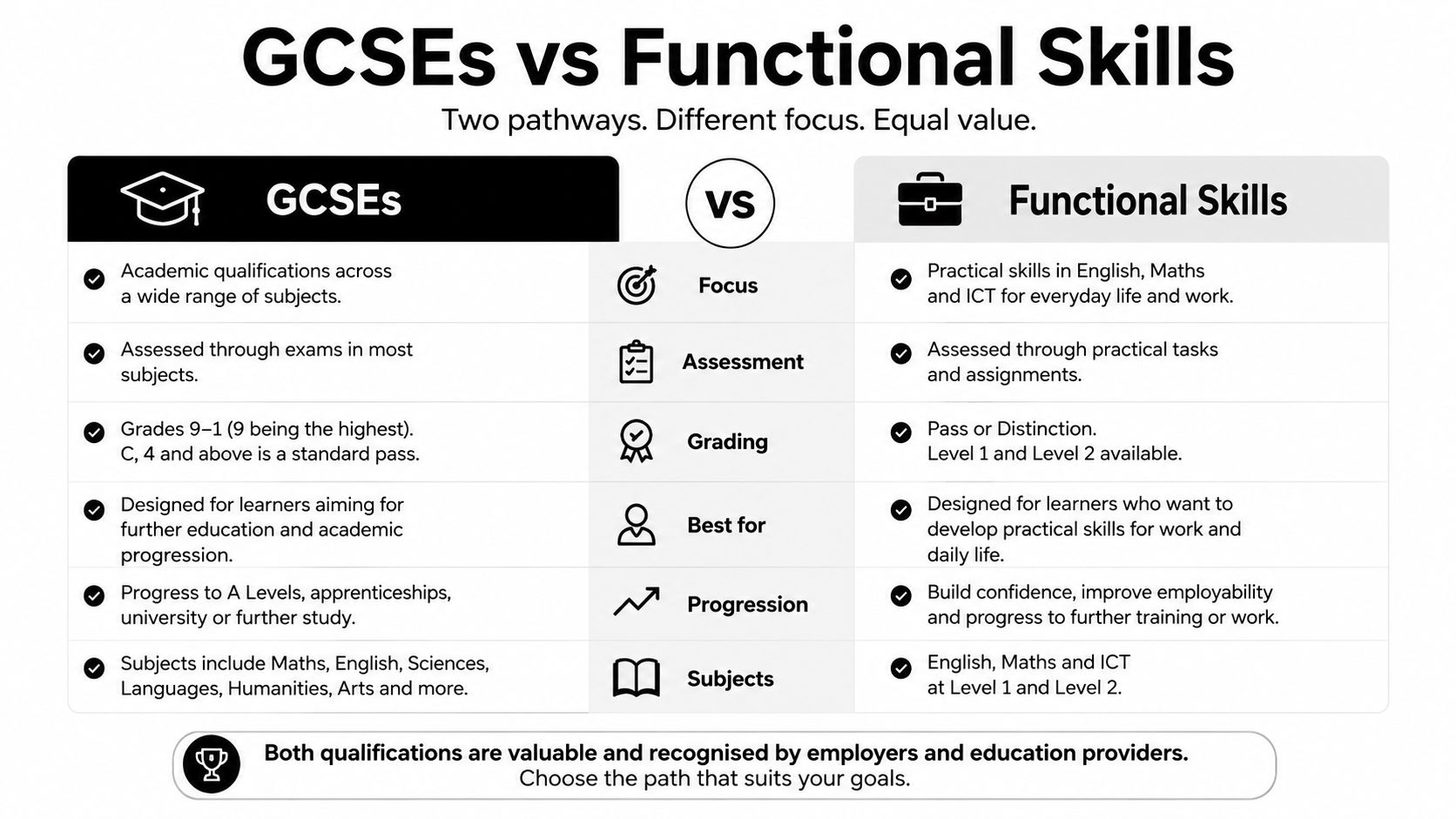
GCSEs in England are governed by Ofqual's 9 to 1 conditions, with fixed grade boundaries and specifications that must align with subject requirements, assessment objectives, and structural rules (Ofqual conditions). That makes GCSEs a strong fit for people who need an academic benchmark for university entry or a formal subject grade.
Functional Skills are different. They're more focused on practical application, especially in English and maths, and they can suit adults who want a more direct route to everyday use, work, or a faster win. If you want a deeper comparison of how the two routes relate, this Functional Skills guide gives a useful starting point.
A simple way to decide
Think about what the next step needs from you.
| Question | GCSE | Functional Skills |
|---|---|---|
| Do you need an academic subject grade for higher education? | Often yes | Sometimes not enough on its own |
| Do you want a practical skills focus? | Less so | Yes |
| Are you aiming for a university route? | Often the stronger choice | Depends on the course |
| Do you want a more applied, straightforward option? | Less direct | Often a better fit |
If your aim is university, a GCSE in English or maths is often the cleaner choice. If your aim is immediate confidence in everyday skills or a faster route into work, Functional Skills may suit you better. Neither path is a failure. They're different tools for different jobs.
Good decision-making starts with the end goal, not the label on the course.
That simple test helps remove a lot of confusion. Ask what the qualification needs to do for your life, then choose the route that gets you there without unnecessary strain.
Understanding Costs and Funding Options
Money worries stop many adults before they even apply. That's understandable. If you're already budgeting for bills, children, food, transport, and work, the idea of paying for study can feel like too much.
The good news is that many adults can study English and maths through funded routes, and government guidance points learners towards national support for improving English, maths and IT skills (GOV.UK support page). Local college pages often show that GCSE access for adults depends on funding rules, especially for people aged 19+, so eligibility matters. If you don't qualify for full funding, you'll need to look at self-funded options and compare them carefully.
What to ask before you enrol
The question isn't only “What does the course cost?” It's “What will I pay in total?”
- Course fee covers the tuition or access to lessons.
- Exam fee may be separate.
- Resit fee can add more if you need another attempt.
- Books and materials may be extra depending on the provider.
- Study support should be clear before you sign up.
That is why fee clarity matters so much for adult learners. A low headline price can become expensive if the exam centre charge and resit costs aren't explained upfront. You want the full picture before you commit.
A practical way to compare providers
| Route | What to check | Why it matters |
|---|---|---|
| College | Funding eligibility, lesson times, exam access | Helps you see whether you qualify for free or reduced study |
| Online provider | Tuition fee, exam booking support, tutor access | Shows how much self-funding will really cost |
| Private tutor route | Hourly cost, exam centre arrangements | Useful for one-to-one support, but costs can build quickly |
If you're looking at broader funding routes too, this guide to Advanced Learner Loans may help you understand how adult study can be supported in some cases.
The safest approach is simple. Read the small print, ask for the total cost, and make sure the provider explains what happens if you need another exam attempt. Price certainty reduces stress, and less stress gives you a better chance of finishing.
Smart Study Strategies for Busy Adults
Studying as an adult is not the same as studying at sixteen. Your day is already full before you even open a workbook. That means your study plan has to be realistic, not heroic.
Start small. A quiet 20-minute session after the children are in bed is better than a grand plan you can't keep. Adults often do best when they build a routine they can repeat, because repeatable routines beat last-minute panic every time.
Habits that make revision easier
- Pick one place to study. A kitchen table, a desk, or a corner of the sofa can become your study spot if you use it consistently.
- Keep one clear goal per session. For example, revise one maths topic or one English question style.
- Use short bursts. Small sessions are easier to protect around work and family life.
- Tell someone in the house your study time. That turns your revision into something people can respect instead of interrupt.
- Review mistakes, don't hide them. Every error shows you what to fix next.
If you want more structured help, these GCSE revision techniques can support your planning.
Support matters more than most people expect
Many adults struggle in silence because they think asking for help means they're not capable. It doesn't. It means you're learning like a smart person. A tutor, mentor, or course guide can stop you getting stuck on the same problem for days.
If a topic keeps beating you, change the method before you change your goal.
That might mean watching a video, doing a practice paper, or asking someone to explain one step only. Progress often comes from one small correction, not a complete overhaul.
The point is not to be perfect. The point is to stay in motion long enough for the work to pay off.
Where GCSEs Can Take You Next
A GCSE can be the point where learning starts to feel possible again. For many adults, that first pass through one qualification becomes a small but powerful proof that they can still study, finish work, and move ahead. Once that confidence starts to grow, the next decision often feels much calmer.
Some adults go on to A-levels or Access to Higher Education courses, especially if university is the goal. Others use their GCSEs to strengthen a CV, apply for a new role, or reach a path that felt closed before. The route you choose depends on your own goals and aspirations, and it can look very different from one learner to another.
Adult learning outcomes vary by route, so no single qualification fits every plan. GCSEs often suit learners aiming for university entry, while other qualifications can support quicker entry to work in some situations. The best choice is the one that matches your next step, whether that is further study, a job change, or both.
A clear path often feels simple once you break it down. First comes the GCSE, then the next qualification, then the bigger goal. For one adult, that might mean entry to a college course. For another, it could mean a move into care, education, business, or public service. For someone else, it may mean feeling ready to say yes to opportunities that once felt too far away.
The effect can reach beyond the classroom.
A qualification can change how a family thinks about the future. Children notice when a parent studies, revises, and keeps going after a setback. That example can matter as much as the certificate itself, because it shows that effort can lead somewhere.
If you want a visual reminder that learning can lead to progress, the image below reflects that sense of movement and possibility.
Progress is often quieter than people expect.
It begins with one enrolment, one revision session, one exam, then the next goal starts to feel closer.
That is the value of a GCSE for many adults. It gives you a way back into learning, and then it gives you momentum.
Common Questions from Adult Learners
“Will my old school results define me?” No. Many adults come back with more life experience, more self-discipline, and a clearer reason to keep going than they had the first time round. A difficult school memory does not erase what you can do now.
“Is online study taken seriously?” Yes, as long as the qualification is recognised and the exam is properly sat. The study route can be flexible, but the GCSE itself still carries the standard that employers and universities look for, so the main question is whether the course leads to the right qualification.
“What if I get stuck halfway through?” That happens to plenty of people. A good course should give you support, and you should feel able to ask for help before a small problem becomes something larger.
“Am I too old?” No. There is no upper age limit for GCSEs in England, and adults can take them at any stage of life, including people who return after decades away from study (example of a learner starting at 92). That alone should put the myth to rest.
Readiness to try is what matters, not your age. For many adults, that first step carries more weight than they expected, because it can shift how they see their own future, and how their family sees it too.