

You might be sitting at the kitchen table after work, looking at university courses on your phone while the house is finally quiet. Part of you feels excited. Another part feels sick with worry. You want a better future, more choices, and work that pays properly. You also want your children to see you go for something big.
Then the money question hits.
How could you afford university when bills already feel heavy, your time is stretched, and you may be starting again after years away from education?
That's where a higher education bursary can make a real difference. It isn't a trick, and it isn't another debt hanging over your head. It's support that can help make university possible.
If you're an adult learner, this matters even more. A lot of advice online is written as if everyone is 17, living at home, and moving straight from school to uni. That's not real life for many people. You may be working, raising children, caring for family, or rebuilding your confidence after a long break from study.
Your path may look different. It still counts.
Your University Dream Is Closer Than You Think
Sarah is a good example of the kind of learner I speak to all the time. She's in her thirties, works part-time, and wants a career that gives her family more stability. She's bright, determined, and ready for a fresh start. But every time she thinks about university, she sees pound signs and shuts the idea down before it has a chance to grow.
That's common.
Many adult learners don't lack ability. They lack clear information and a bit of reassurance. When you've got children to think about, rent or mortgage to pay, and food prices rising, dreaming about university can feel selfish. It isn't. Building a better future for yourself helps the people you love too.
A higher education bursary is one of the ways that future can become more manageable. It can help with costs and reduce pressure while you study. For some learners, that support can be the difference between giving up and carrying on.
Why this matters for families
When adults return to education, they often do it for more than themselves. They want to be proud of their progress. They want to show their children that it's never too late to learn. They want work that feels meaningful and pays better than the jobs they've had to settle for before.
That's powerful.
Going back to education as an adult doesn't make you late. It shows courage, responsibility, and hope.
A bursary won't solve every problem. But it can remove one of the biggest barriers, which is the fear that university is only for people with money behind them.
A different kind of starting point
If you're reading this as someone over 20, you may already know how confusing student funding sounds. Loans, grants, bursaries, hardship funds, household income checks, benefit worries. It can feel like a maze.
Here's the reassuring truth. You don't need to understand everything at once.
Start with this one idea. Some financial support for university doesn't have to be paid back, and many adult learners don't realise how important that can be until they look into it properly. Once you understand bursaries, the path ahead often feels much less frightening.
What Exactly Is a Higher Education Bursary
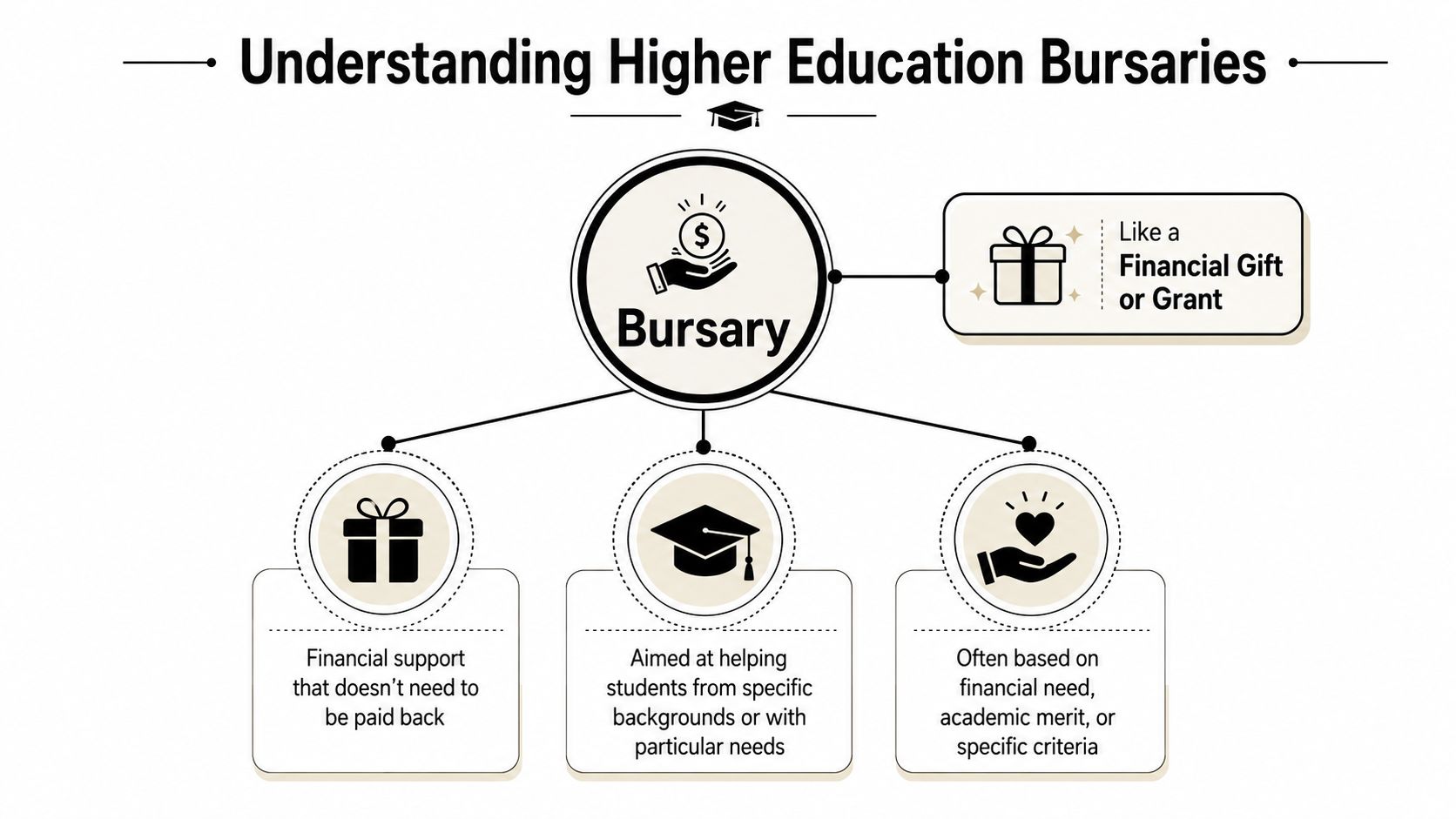
A higher education bursary is money given to help you study at university or college. The most important point is simple. You don't pay it back.
A bursary is a financial gift or grant from an institution that wants to support your education. It's there to help you stay on your course and succeed, especially if money is tight or you meet certain criteria.
Bursary versus loan
Many people find this confusing, so let's make it plain.
| Support type | What it means |
|---|---|
| Bursary | Money to help you study that doesn't need to be repaid |
| Student loan | Money you borrow for fees or living costs that has repayment rules |
| Hardship fund | Extra support in difficult circumstances, often through your institution |
A bursary is not the same as a tuition fee loan. It is also not the same as money you borrow for living costs. That difference matters when you're trying to protect your future finances.
Why universities offer bursaries
Universities know that talent is spread widely, but money is not. Bursaries exist because many students need practical help to get through higher education.
In England, full-time tuition fees are typically £9,250, and English universities were expected to spend around £320 million of their additional fee income on financial support, including bursaries for students from lower-income backgrounds, according to analysis of higher education fees and funding in England.
That tells you something important. Bursaries aren't unusual. They are part of how higher education support works.
What bursaries are usually based on
Different places use different rules, but bursaries are often linked to things like:
- Household income. Many are aimed at learners from lower-income households.
- Personal circumstances. Some support care leavers, disabled students, carers, or people from underrepresented backgrounds.
- Course type. Certain subjects, especially professional routes, may have their own support.
- Institution rules. Each university can set its own bursary schemes and conditions.
Practical rule: If money worries are one of the main reasons you think university might be out of reach, it's worth checking bursaries before you rule yourself out.
For adult learners, this can be a real mindset shift. You don't have to come from a perfect background, have lots of savings, or know all the answers. You just need to understand what support exists and whether you fit the criteria.
Types of Bursaries and How Much You Could Get
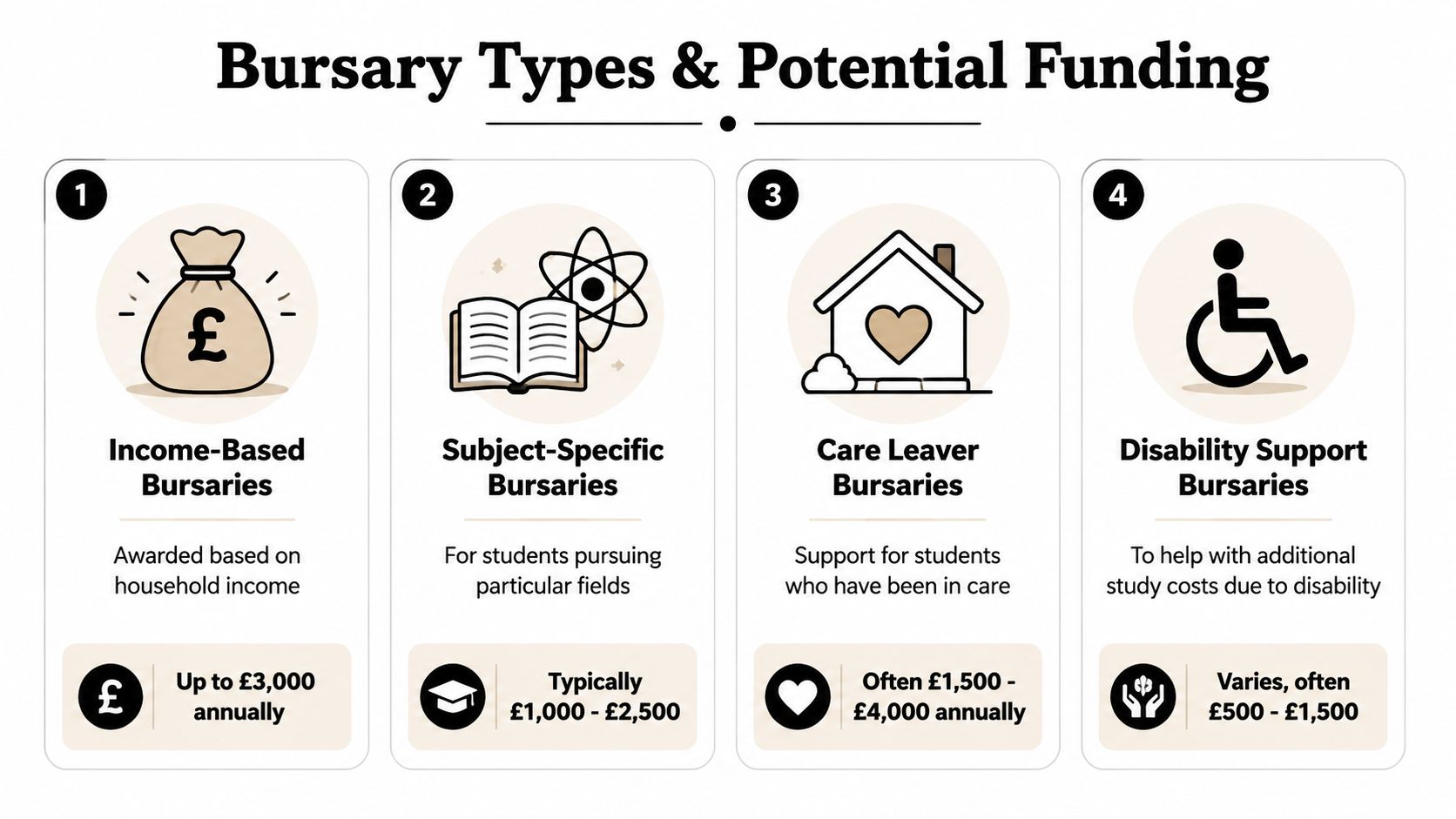
Not all bursaries look the same. Some are based on income. Some are linked to your course. Others depend on your circumstances. Once you see the different types, the whole picture becomes easier to understand.
Needs-based bursaries
These are often the most relevant for adult learners. They are usually linked to household income and are designed to help people who need support most.
This kind of support matters because evidence reviewed by TASO found that needs-based bursaries show a positive causal relationship with retention and completion for low-income households, while merit-based awards show limited or no evidence of improving retention or degree classification, as outlined in TASO's summary of financial support post-entry.
In simple terms, support based on financial need is often the most useful if money is the thing making study hard.
One current example for students entering after September 2025 is a standard University Bursary of £1,000 per academic year for eligible learners with household income of £36,592 or less, where the maximum home tuition fee is £9,535 in 2025/26, as shown on this UCAS University Bursary page.
Why the amount matters
Research suggests that bursaries are most effective at around £1,900 per year, but the average amount students often receive is closer to £750 per year, according to research on bursary effectiveness and student outcomes.
That gap is worth noticing. It means you shouldn't assume every offer will fully meet your needs. It also means knowing how to search well and apply properly can make a genuine difference.
Subject-specific support
Some courses come with their own support systems. Healthcare is the clearest example.
For the NHS Bursary Scheme 2025 to 2026, the maximum annual tuition fee contribution is £9,535 for pre-registration courses lasting 5 years or more. Graduates on accelerated pre-registration courses can receive £3,830, rising to £4,047 for students in Northern Ireland, according to the NHS Bursary Scheme rules for 2025 to 2026.
If you're planning a professional route, check whether your subject has separate funding rules as well as general bursaries.
Support linked to your circumstances
Some bursaries and grants are tied to who you are and what responsibilities you carry.
- Care leaver support. The Higher Education Bursary for care leavers is money that doesn't have to be repaid, and applications go through the local council with proof of a course place, as explained in this Prospects guide to scholarships and bursaries.
- Support for dependants. Adult learners with dependants may be able to get extra help. In England, support can be up to £3,545 if you have an adult dependant, while Wales offers up to £3,407 and Northern Ireland up to £2,695, according to Save the Student's guide to grants, bursaries and scholarships.
- Disabled Students' Allowance. For 2025/26, the maximum allowance is £27,783, with travel costs outside that cap, according to the Student Loans Company financial memorandum for 2025/26.
If you're taking an Access course before university, it's also worth learning how student finance fits into the bigger picture. This guide to Advanced Learner Loans can help you understand that earlier step.
Finding and Applying for Your Bursary Step by Step
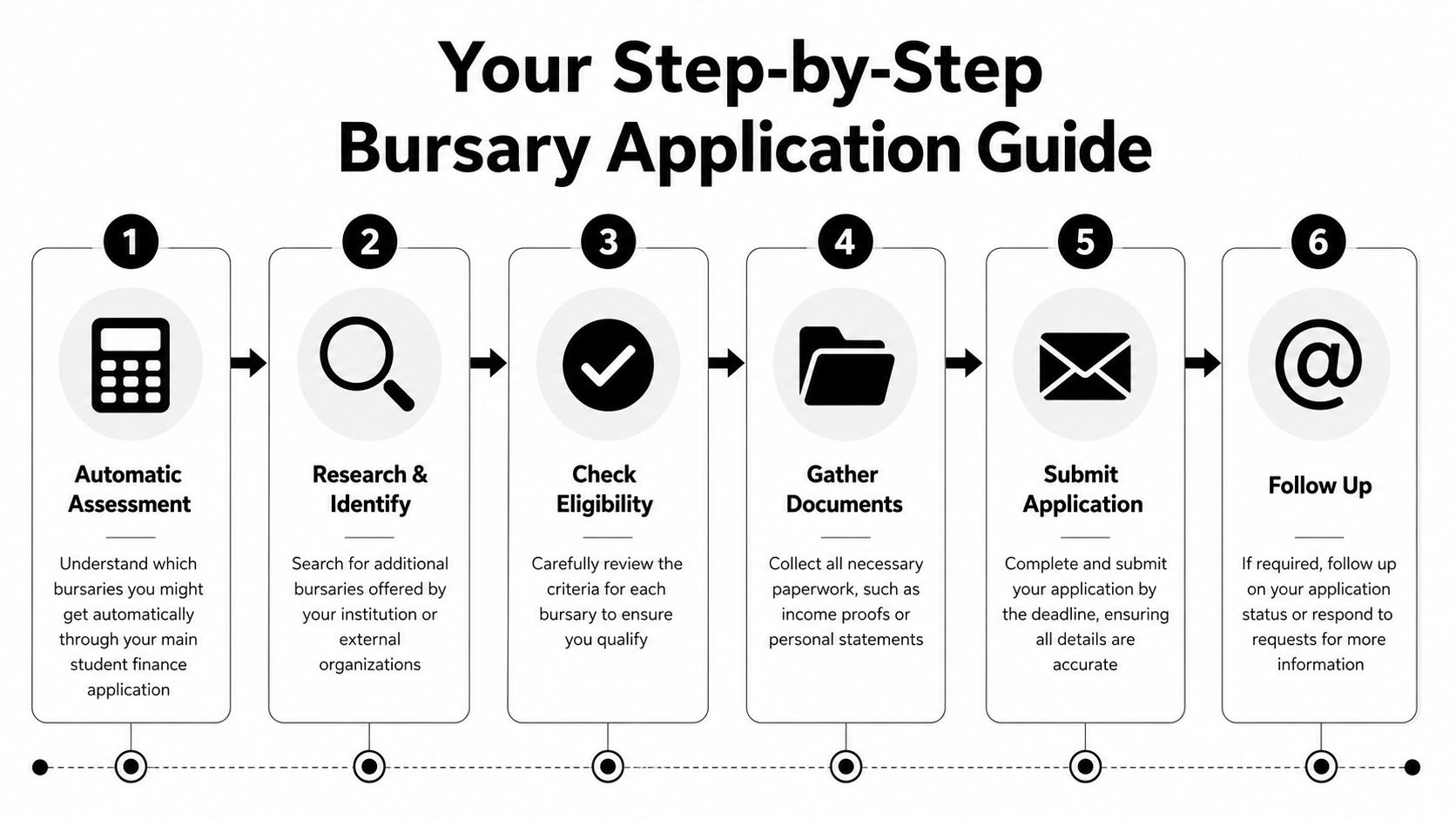
The bursary process feels much easier when you break it into small jobs. You don't need to do everything in one evening. You just need a clear order.
Start with automatic assessment
Some bursaries are linked to your Student Finance England application. That means you may be assessed without filling in a separate university bursary form.
That's good news if paperwork makes you nervous. The key is making sure your main student finance application is done properly, and that income information is provided where needed.
Then look for separate university funding
Not every bursary is automatic. Many universities also run their own hardship funds, discretionary awards, or support schemes that require a direct application.
Check the student funding or student support pages of each university you're interested in. Look for words like bursary, hardship fund, access fund, care leaver support, discretionary support, or widening participation.
A simple checklist helps.
- Read the eligibility rules carefully. Some bursaries are based on income, while others are for carers, care leavers, disabled students, or specific groups.
- Check whether you need an offer first. Some awards only open once you hold a confirmed place.
- Keep a deadline list. Missing the date can mean missing the money.
Gather your evidence early
Most applications ask for practical documents, not perfect writing.
You may need:
- Proof of income from Student Finance England or household assessment details
- An offer letter from the university or college
- Evidence of your circumstances, such as care leaver documents or disability-related paperwork
- Bank details if payment is made directly to you
Apply as early as you reasonably can. Waiting until you feel fully confident often means you miss the easiest window.
This short video gives a helpful overview before you start filling anything in.
Watch the dates
Timing matters more than many learners realise. For many university bursaries, such as those for the 2025/26 academic year, you must be financially assessed by Student Finance England by a deadline like 31 July 2026 to receive your funding for the year, as explained in the earlier Prospects guidance already referenced above.
That's why it helps to treat bursary applications like enrolment paperwork. They are part of getting ready for study, not an optional extra to think about later.
Keep the process simple
If you freeze when forms look complicated, use this order:
- Apply for student finance
- Check what may be automatic
- Search your chosen university website
- List deadlines in one place
- Send documents early
- Follow up if you hear nothing
If you want a practical overview of the application side of funding support, this guide on how to apply for online bursaries can help you get organised.
A Special Guide for Adult Learners and Access Students
Adult learners often get left out of the conversation. That isn't because support doesn't exist. It's because the system isn't explained clearly enough for people coming back to education later in life.
If you're in your twenties, thirties, forties, or beyond, you may already have noticed that lots of bursary advice sounds like it's meant for sixth form students. That can make you feel as if you've missed your chance. You haven't.

The gap that catches many adults out
A critical gap exists for adult learners because the main 16 to 19 Bursary Fund excludes those aged 19+ on higher education courses. This means adult learners must proactively contact their specific university's student support services to find non-standardised discretionary funds, as explained in the government guidance on the 16 to 19 Bursary Fund for 2025 to 2026.
That's one of the biggest points to understand.
You may not find one neat national page that lists every option for you. Instead, you often have to ask your university directly what support they offer adult learners, Access students, carers, and low-income households.
If you're taking an Access to HE route
This is especially important if your plan is to move from an Access to HE Diploma into university. You're not on the same funding path as a 16 to 18-year-old college student, so the advice aimed at younger learners may not fit your situation.
That doesn't mean there's no help. It means you need to look in the right place.
For many adults, an Access to HE Diploma online is the bridge back into education. If that's your route, start thinking about university bursaries before your course ends, not after.
What adult learners should do differently
A younger student might wait for college to tell them what's available. An adult learner usually needs to be more proactive.
Try these questions when you contact a university:
- Do you offer a bursary for students from lower-income households?
- Are there hardship funds for adult learners or students with children?
- Is support automatic through student finance, or do I apply separately?
- Do Access to HE students qualify for any transition support?
You are not asking for special treatment. You are asking for clear information so you can plan responsibly.
That's what confident learners do. Even if you don't feel confident yet, you can still take confident steps.
Your Bursary Questions Answered
The final worries are usually practical ones. They're the kind of questions people hesitate to ask because they don't want to sound silly. They aren't silly at all.
Will a bursary affect Universal Credit or other benefits
This is one of the biggest fears for adult learners.
A university-paid bursary is usually excluded from Universal Credit income calculations, unless it is specifically designated for day-to-day living costs, according to the government guidance on extra money for university or college.
That wording matters. If you receive benefits, check exactly what your bursary is for and keep any paperwork that explains it.
Do I have to repay a bursary
In normal use, no. A bursary is support that does not need to be repaid. That's one of the main reasons it can be so valuable for adults who are trying to improve their future without taking on more unnecessary financial pressure.
Will getting a bursary reduce my student loan
This depends on the rules of the support you receive and how your wider funding is assessed. If you're unsure, ask the university funding team and Student Finance England how a specific bursary interacts with your other support. It's always better to ask directly than to guess and worry.
What if I don't know whether I qualify
Apply or ask anyway if you think there's a chance. Too many adults rule themselves out before anyone has checked their circumstances.
Use simple questions:
- Is this based on household income?
- Does my age affect eligibility?
- Do you support students with children or caring duties?
- Can I still apply if I'm coming through Access to HE?
What if I feel overwhelmed by the whole process
That feeling is normal. Returning to education can stir up old doubts. You may worry that you're not academic enough, not young enough, or not organised enough.
None of that means you can't do this.
It means you need clear steps, the right support, and the courage to keep going even while you're still nervous. Many adult learners begin with shaky confidence and build it as they move forward. Every form you complete, every question you ask, and every decision you make for your future is proof that your life can change.
If you're ready to take that next step, Next Level Online College can help you move towards university with flexible online study and support built for adult learners. If you want a path that fits around work, family, and real life, now's a good time to start.