
You might be reading this after a long day at work, with the kettle on, wondering whether education is still for you. Maybe you've seen a job you want, but the application asks for maths. Maybe you've looked at a college course or university route and felt your stomach drop when you saw the entry requirements. Or maybe you're tired of feeling nervous around numbers, bills, forms, and school homework.
If that sounds familiar, you're not behind. You're not bad at learning. And you're certainly not too late.
A lot of adults carry old maths worries from school. One bad classroom memory can stick for years. It can make you think maths belongs to other people. The confident people. The naturally clever people. The ones who “just get it”.
That isn't true.
Level 2 Functional Skills Maths can be a fresh start. It isn't about proving you're perfect. It's about showing that you can use maths in real life, in work, in study, and at home. For many adults, that one qualification becomes more than a certificate. It becomes proof that they can finish something important, open doors for the future, and show their children what courage looks like.
Your Time to Unlock a Brighter Future
Sarah is the kind of person many adults will recognise. She works hard, looks after everyone else, and keeps going even when she's tired. She wants a better job, but each time she looks at vacancies, the same problem appears. Maths. The word alone makes her feel small.
She isn't lazy. She isn't lacking ambition. She's merely carrying old doubt.
At home, it shows up in quiet ways. Her child asks for help with homework and she hesitates. A bill arrives and she double-checks it three times because she doesn't trust her own judgement. She dreams about doing a course that could lead to a new career, maybe even university one day, but part of her still thinks, “People like me don't do that.”
So she stays where she is. Not because she has no potential, but because one missing qualification keeps the door shut.
More than a maths course
This is where Level 2 Functional Skills Maths can change things. It gives adults a practical route back into learning without asking them to become schoolchildren again. It meets you where you are now, with your responsibilities, your experience, and your reasons for wanting more.
That matters.
Because for most adult learners, this isn't just about sums on a page. It's about:
- Getting unstuck so a promotion, course, or new role feels possible
- Feeling capable when numbers appear in everyday life
- Showing your family that it's never too late to grow
- Building self-respect by finishing something that once felt out of reach
You don't need to feel confident before you begin. Very often, confidence shows up after you take the first step.
A key, not a punishment
Many people hear the word maths and think of pressure. Timed lessons. Red pen marks. Feeling embarrassed. But Level 2 Functional Skills Maths doesn't have to mean any of that. Think of it more like a key. A key to better options, wider choices, and a stronger sense of who you are.
When adults pass this qualification, the result often reaches far beyond study. They walk taller. They speak up more. They stop saying “I'm just no good at maths” and start saying “I did it”.
That moment can change a lot.
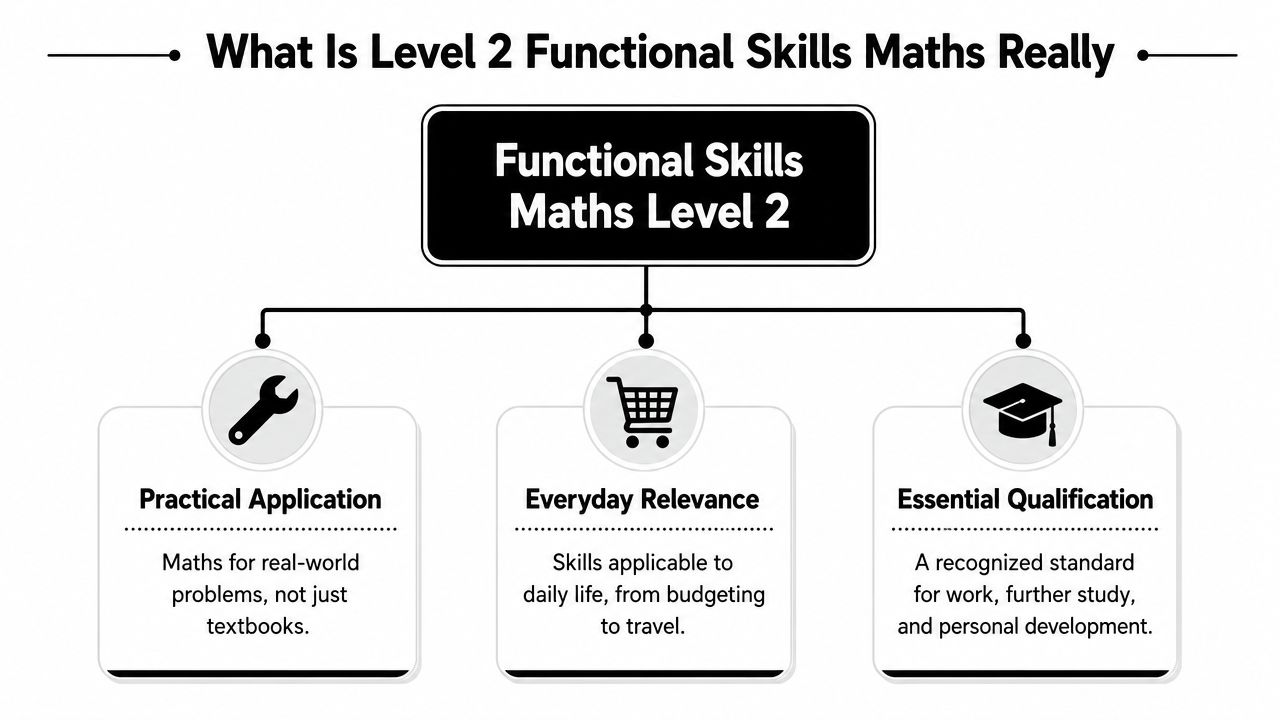
What Is Level 2 Functional Skills Maths Really
At its heart, Level 2 Functional Skills Maths is practical maths. It focuses on the kind of maths people use in life, work, and study. It isn't about filling your head with abstract ideas you'll never use again. It's about understanding numbers in a way that helps you make decisions, solve problems, and feel more in control.
Think of it like learning to drive
A simple way to understand it is this. GCSE maths can feel more academic, like studying lots of theory about how a car works. Functional Skills is closer to learning how to drive the car safely and use it to get where you need to go.
Both matter. But they aren't the same kind of journey.
Functional Skills asks, “Can you use maths in real situations?” That could mean checking a bill, understanding a chart, comparing costs, or working something out clearly under pressure.
Why adults often prefer it
Adults usually want learning that has a purpose. They don't want to wade through topics that feel far away from daily life. They want a qualification that helps them move forward.
That is one reason this route makes sense for so many learners. It is practical, focused, and easier to connect to real goals.
A quick summary helps:
| What it focuses on | What that means for you |
|---|---|
| Real-life maths | You learn maths you can actually use |
| Work and study readiness | You build skills that support applications and progression |
| Confidence with numbers | You start to trust your own thinking again |
To understand how this qualification compares with other common routes, this guide to what Functional Skills Level 2 is equivalent to can help put it into plain language.
It isn't about being a “maths person”
A lot of adults think success in maths depends on some hidden talent. It doesn't. In reality, progress usually comes from calm teaching, steady practice, and examples that make sense.
Some learners don't need “harder work”. They need clearer explanations, patience, and a chance to rebuild trust in themselves.
That's why this qualification suits so many adults who felt left behind at school. It speaks the language of real life. Once that clicks, the subject often feels far less frightening.
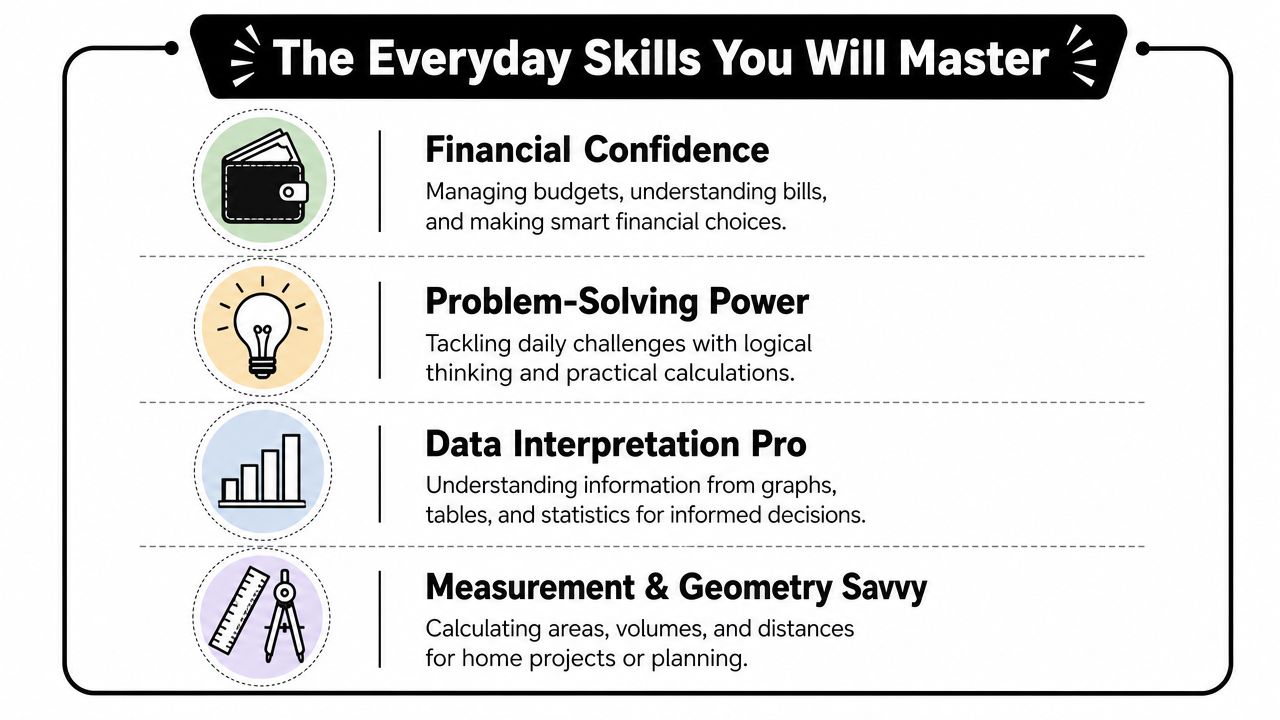
The Everyday Skills You Will Master
The best thing about Level 2 Functional Skills Maths is that it teaches skills you can use straight away. The UK government describes it as a work-, study- and life-focused qualification, and the official subject content includes handling numbers up to one million, working with negative numbers, comparing fractions, decimals, percentages and ratios, and calculating with decimals to 3 decimal places. It also includes percentage change, direct and inverse proportion, and using estimation or approximation to check answers, as set out in the official Functional Skills maths subject content.
That might sound like a long list. But in everyday life, these topics are much more familiar than they first appear.
Numbers that help in real life
Working with large numbers isn't just a classroom exercise. You use it when you read prices, compare costs, look at annual salaries, or understand figures in the news. Negative numbers appear when you check temperatures, read bank balances, or track gains and losses.
Decimals matter too. They show up in money, measurements, fuel, and recipes. Learning to work with them more confidently can make ordinary tasks feel less stressful.
Here are some examples:
- Bills and budgets help you see where your money is going and whether the figures make sense
- Pay and hours help you check wages, overtime, and deductions more carefully
- Shopping choices help you compare price tags and multi-buy offers without guessing
Fractions, percentages and ratios without the panic
Many learners freeze when they hear these words. That's understandable. But you're already surrounded by them.
Percentages turn up in sales, interest, pay rises, and exam scores. Fractions appear in cooking, sharing, and measuring. Ratios help with mixing, scaling up, and comparing quantities.
Think about the small wins these skills can bring:
| Skill | Everyday use |
|---|---|
| Percentages | Checking discounts and understanding changes in cost |
| Fractions | Splitting amounts, measuring ingredients, sharing fairly |
| Ratios | Mixing cleaning products, paint, ingredients, or materials |
Practical rule: if a topic sounds scary in maths, connect it to a real task you've already done. The maths often becomes much easier to recognise.
Reading data and checking your answers
This qualification also helps you make sense of tables, charts, and patterns. That matters at work and at home. You might need to read a timetable, compare information on a graph, or spot whether a number looks wrong.
Estimation is especially useful. It gives you a quick way to ask, “Does this answer look sensible?” That one habit can stop mistakes before they cause bigger problems.
For parents, there is another quiet benefit. The more comfortable you become with these topics, the easier it can feel to sit beside your child and say, “Let's work it out together.”
That sentence means more than maths. It shows calm, resilience, and belief.
How Your Knowledge Is Assessed
For many adults, the hardest part isn't the learning. It's the word exam. That word can bring back old fear very quickly. The good news is that the assessment for Level 2 Functional Skills Maths is much more straightforward when you understand how it works.
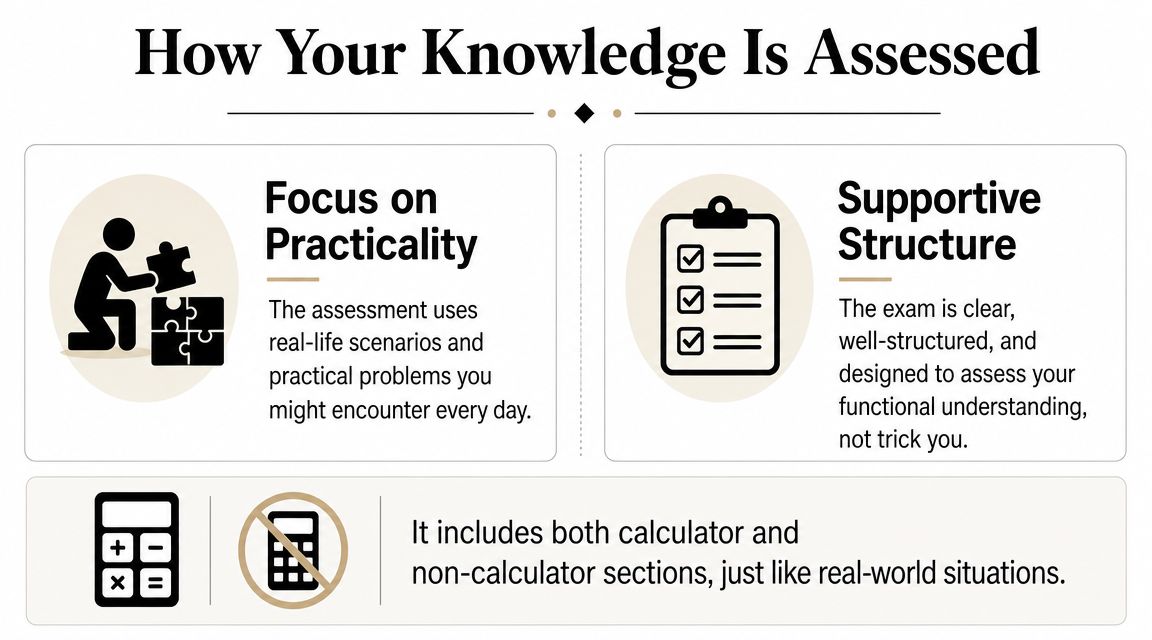
An NCFE Level 2 Functional Skills Mathematics qualification is structured as one external assessment in 2 sections, with a non-calculator section and a calculator section. It also has a regulated size of 55 Guided Learning Hours (GLH) and 66 Total Qualification Time (TQT), as shown on the NCFE qualification page for Level 2 Functional Skills Mathematics.
Why there are two sections
This split helps learners. The non-calculator section checks your core number skills. It gives you the chance to show that you can work things out accurately and understand the basics.
The calculator section is different. It lets you focus more on solving practical problems, reading information, and thinking through steps, much like you would in real life.
That means the assessment isn't trying to catch you out. It is looking at two useful abilities:
- Core fluency so you can handle key calculations with confidence
- Applied thinking so you can use maths to solve realistic problems
If you'd like extra guidance on preparing well, this practical guide on how to pass Functional Skills Maths Level 2 is a helpful place to start.
What the assessment feels like
A lot of adult learners worry that an exam means strange questions and harsh judgement. In practice, Functional Skills maths is meant to test how you use maths, not whether you can memorise huge amounts of theory.
That changes the feeling of revision too. You aren't revising to become a machine. You're building habits, methods, and confidence.
A calm way to think about it is this:
- First, learn the method so the steps make sense.
- Then practise on realistic questions so the topic feels familiar.
- Finally, build exam confidence by doing enough preparation that the format no longer feels unknown.
A fair assessment doesn't ask for perfection. It asks you to show what you can do.
Don't let the word exam decide your future
Many adults are far more capable than they think. They just haven't had a chance to prove it in the right environment. Once the assessment is broken down, it often feels less like a giant wall and more like a gate with a handle.
And gates can be opened.
Your Path to a Career and a Proud Family
A qualification can look small on paper and still change a whole life.
For some people, Level 2 Functional Skills Maths is the missing piece for a job application. For others, it is the step that makes further study possible. But the deepest change often happens inside. You stop seeing yourself as someone who missed their chance. You start seeing yourself as someone who came back and took it.
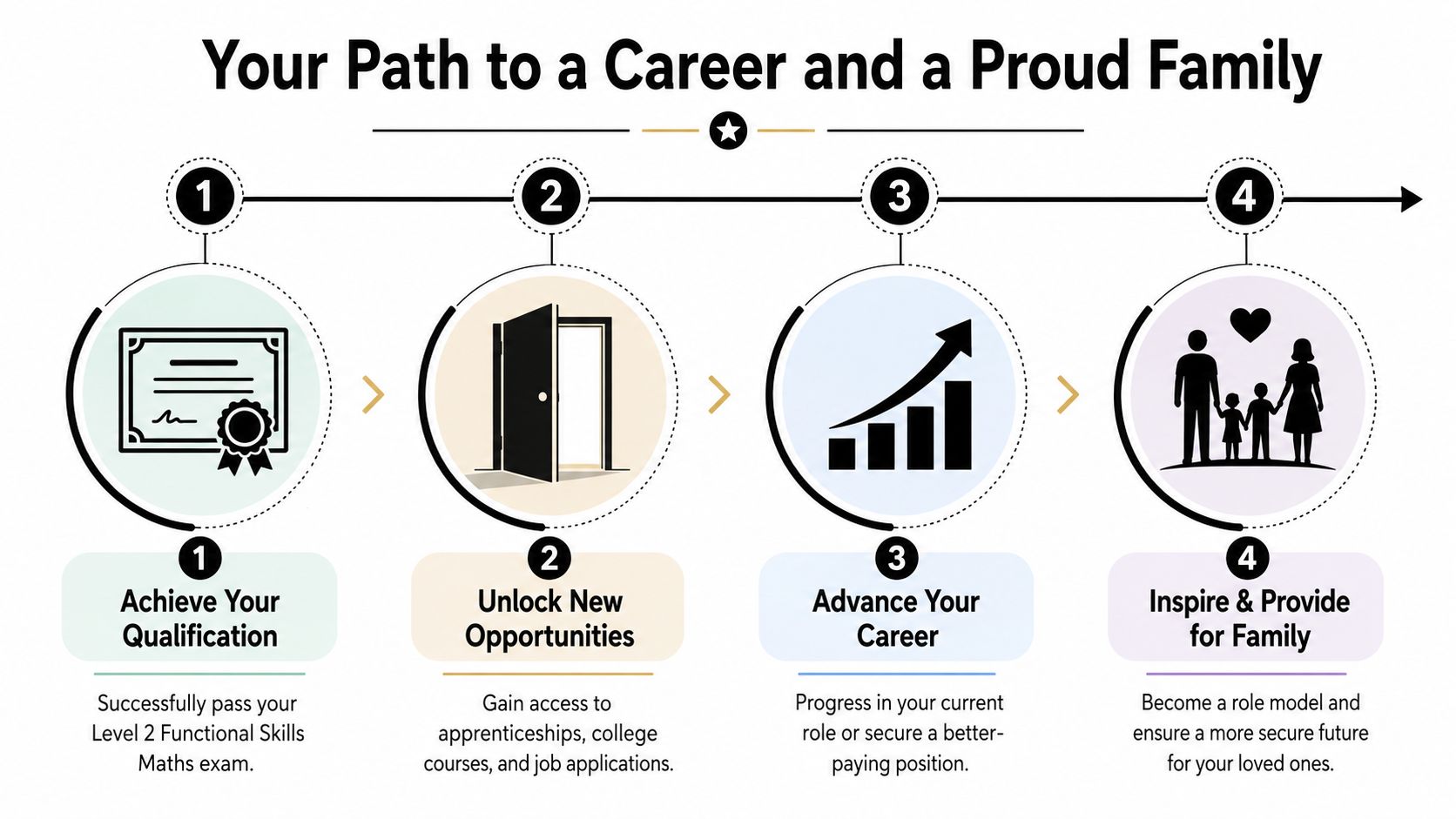
The ripple effect at work and at home
When adults gain confidence in maths, the benefit doesn't stay in one place. It often spreads into work, family life, and future plans.
You may find yourself:
- Applying for more roles because you no longer feel blocked by entry requirements
- Speaking with more confidence in meetings, training, or interviews
- Handling money more calmly because numbers don't feel like a threat
- Supporting your children more easily when schoolwork comes home
That last point matters a great deal. Children notice what adults do. When they see you learning, trying again, and succeeding, they learn something powerful. They learn that setbacks aren't the end. They learn that education isn't just for the young. They learn that bravery sometimes looks like sitting down to study after everyone else has gone to bed.
Pride has practical value
People often talk about qualifications in a dry way. Pass this. Achieve that. Meet this requirement. But there is real emotion in adult learning.
Passing Level 2 Functional Skills Maths can mean relief. It can mean pride. It can mean finally feeling that your goals are valid.
This short video captures some of that journey and what it can mean to move forward.
Success in adult learning isn't only about qualifications. It's also about identity. You begin to trust yourself in a new way.
A better future can start with one result
Maybe your next step is a better-paid role. Maybe it's a college course. Maybe it's a long-held dream of going further in education. Whatever your reason, this qualification can become a bridge between the life you have now and the one you want to build.
And when your family sees you cross that bridge, they won't just be proud of your result. They'll be proud of your courage.
How Next Level Online College Supports You
Starting a qualification is one thing. Sticking with it is another. Most adult learners don't struggle because they lack ability. They struggle because life is busy, confidence wobbles, and it's hard to study alone when you already have work, family, and responsibilities pulling at you.
That's why support matters so much.
Learning that fits around real life
Next Level Online College is built for adults who need flexibility without feeling left on their own. That means learning can fit around shifts, childcare, family routines, and the ordinary messiness of life.
A good online course should make study feel possible, not punishing. It should help you keep going when motivation dips. It should also give you a clear path so you aren't wasting energy trying to work everything out by yourself.
Support often matters in simple moments:
- When you get stuck on a topic and need someone to explain it in plain English
- When your confidence drops and you need calm encouragement
- When the exam feels close and you want clear preparation, not panic
More than content on a screen
Many adults fear online learning because they imagine silence. Just videos. Just worksheets. Just them and their worry. Good support changes that experience completely.
Next Level Online College offers adults a route that is flexible, fully online, and designed around genuine support. If you'd like to explore the course itself, you can look at the Functional Skills Maths online learning options.
That kind of structure can make a big difference. You don't just need information. You need guidance, reassurance, and a sense that someone is in your corner.
A path that can keep growing
For some learners, Level 2 Functional Skills Maths is the immediate goal. For others, it's the beginning of something bigger. Once confidence returns, many adults start thinking further ahead. GCSEs. Access courses. University. Career change. A role with more meaning and better prospects.
That is one of the most powerful things about returning to education. You may begin with one practical goal, then discover that your ambitions are larger than you allowed yourself to admit.
The right support helps protect that spark. It reminds you that learning isn't about proving your worth. You already have worth. Learning helps you build on it.
Take the First Step to Your New Beginning Today
If you've spent years telling yourself that maths isn't your thing, it may feel strange to consider trying again. That's normal. Fear often sits beside hope when someone is about to change their life.
But staying stuck has a cost too.
Every month you delay, you may still feel held back from the role you want, the course you deserve, or the confidence you wish you had in daily life. Level 2 Functional Skills Maths offers a way forward that is practical, respected, and rooted in real-world skills.
What this step can really mean
This isn't only about passing an exam. It can mean:
- Opening doors to work, training, and future study
- Strengthening your confidence with numbers in everyday life
- Becoming a role model for your children and family
- Proving to yourself that your story is still moving forward
You don't need to know everything today. You only need to be willing to begin.
Let courage be louder than self-doubt
Many adult learners wait for the perfect moment. The quiet week. The calmer month. The time when they feel fully ready. That moment rarely arrives. Real progress often begins in ordinary life, with all its noise and pressure, when someone decides that their future matters enough to act now.
So if part of you is hoping for more, listen to that part.
The person you could become through this journey is not a fantasy. It is still you. Just stronger, more qualified, and more certain of your own ability.
If you're ready to take that first step, Next Level Online College offers flexible online study and supportive guidance for adults who want a fresh start. Whether your goal is work, further study, or proving to yourself that you can do this, now is a good time to begin.