
It's late, the kitchen is quiet, and the school bag is finally by the door. You've got a spare ten minutes, maybe less, and you're wondering whether maths is something you can really come back to after all this time. If that sounds like you, you're in the right place. Level 2 maths is not about reliving school stress. It's about building the confidence, number skills, and calm thinking that help adults move forward at work, at home, and in study.
A lot of people think they need to be “good at maths” before they start. That's backwards. You start with the basics, you practise in a way that fits real life, and you build up from there. For many adults, this qualification is the point where maths stops feeling like a wall and starts feeling like a tool.
You might want to get into university. You might want a better job, a promotion, or a route into an apprenticeship. You might want to help your children with homework without dreading it. Whatever brought you here, Level 2 maths can be a steady, realistic next step.
A Fresh Start with Level 2 Maths
A parent sits at the table after bedtime, looking at a form for college or work. The maths box feels bigger than the rest. Not because the person is unable, but because the gap since school has made everything feel rusty and uncertain. That moment is common, and it does not mean the journey is out of reach.
Level 2 maths gives adults a way back in. It is the stage where everyday numeracy, practical problem-solving, and exam success come together. For many learners, it becomes more than a certificate. It becomes proof that they can return to learning, finish something important, and show their children that progress really is possible at any age.
The qualification also matters because the skills behind it are used everywhere. The national picture in England shows that 74% of pupils reached the expected standard in maths at the end of key stage 2 in 2025, up from 73% in 2024, and the expected standard is a scaled score of 100 or above while the higher standard is 110 or more GOV.UK attainment data. That school benchmark is not the same as adult study, but it shows how much value is placed on secure numeracy. For adults, Level 2 maths builds on similar ground, only with a more practical, grown-up purpose.
The best thing about this qualification is that it can fit around real life. You do not need to put everything on hold to begin. You just need a clear path, sensible practice, and a course that understands adult learners. If you've been waiting for a sign, this can be it.
What Level 2 Maths Actually Means in the UK
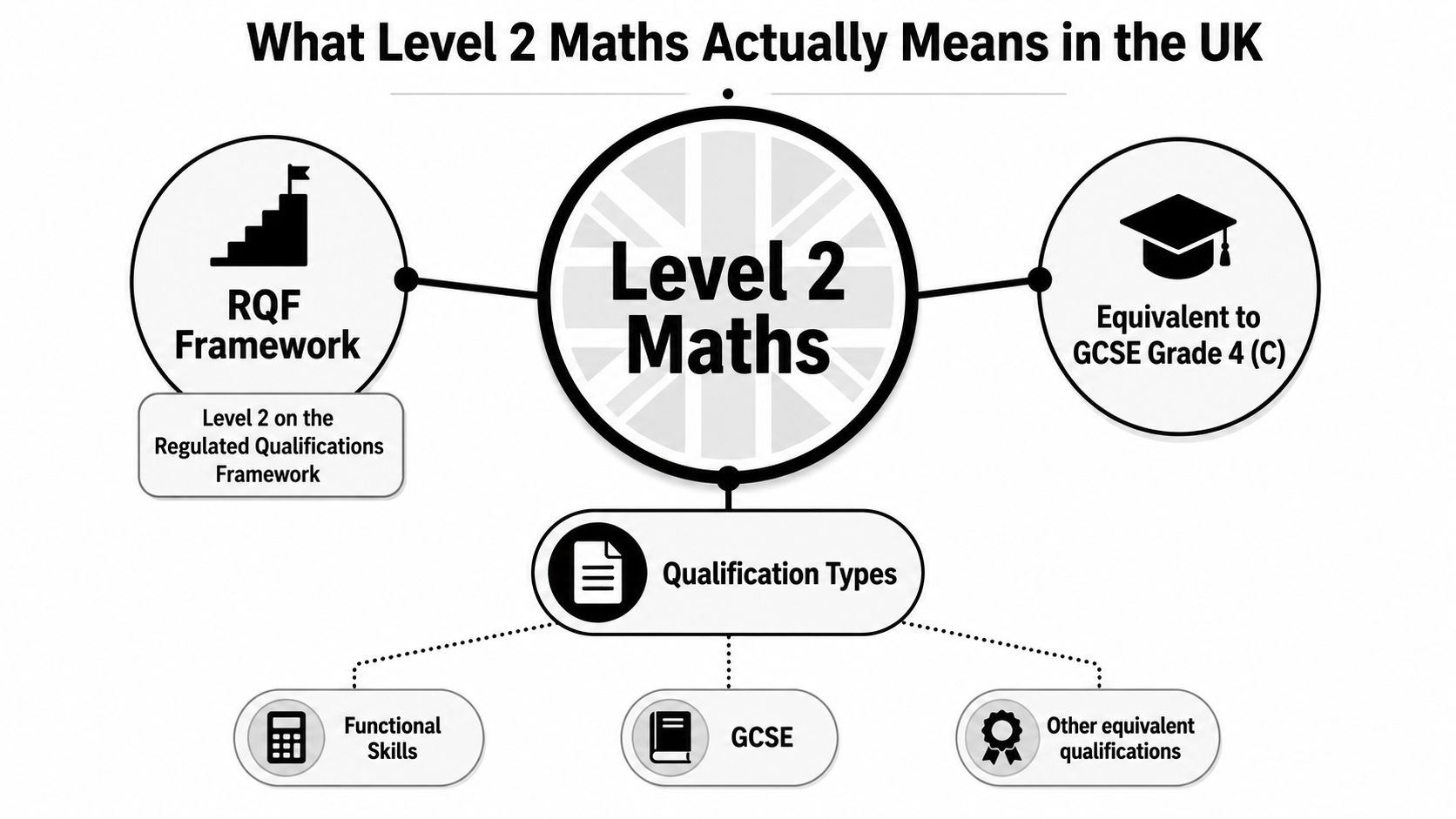
In the UK, Level 2 maths sits at a recognised point on the qualifications system. It represents reaching the top floor of a building where everyday number confidence lives. You're not climbing endlessly, you're aiming for a clear, well-known standard that employers, colleges, and universities understand.
There are two main routes adults usually take. One is Functional Skills Level 2 Maths, which is practical and applied. The other is GCSE Maths, which is more academic and usually studied in greater depth. Both are widely recognised as equivalent to GCSE grade 4, which used to be called a C. That's why the phrase “Level 2” comes up so often when people talk about entry requirements.
Two routes, one goal
The right route depends on where you want to go. Functional Skills is usually the better fit if you want a qualification that feels directly useful for work, training, or day-to-day life. GCSE Maths suits people who want a deeper academic route, especially if they plan to move on to A Levels, an Access to HE Diploma, or a traditional university offer.
Practical rule: choose the route that matches your next step, not the one that sounds hardest or most familiar.
If you want a simple explanation of how the level fits into the wider system, this guide to Level 2 qualifications gives a useful overview. The main thing to remember is that Level 2 maths is not a mystery subject. It is a recognised benchmark for secure number work, and it can open doors without asking you to become a mathematician.
Core Topics You Will Study at Level 2
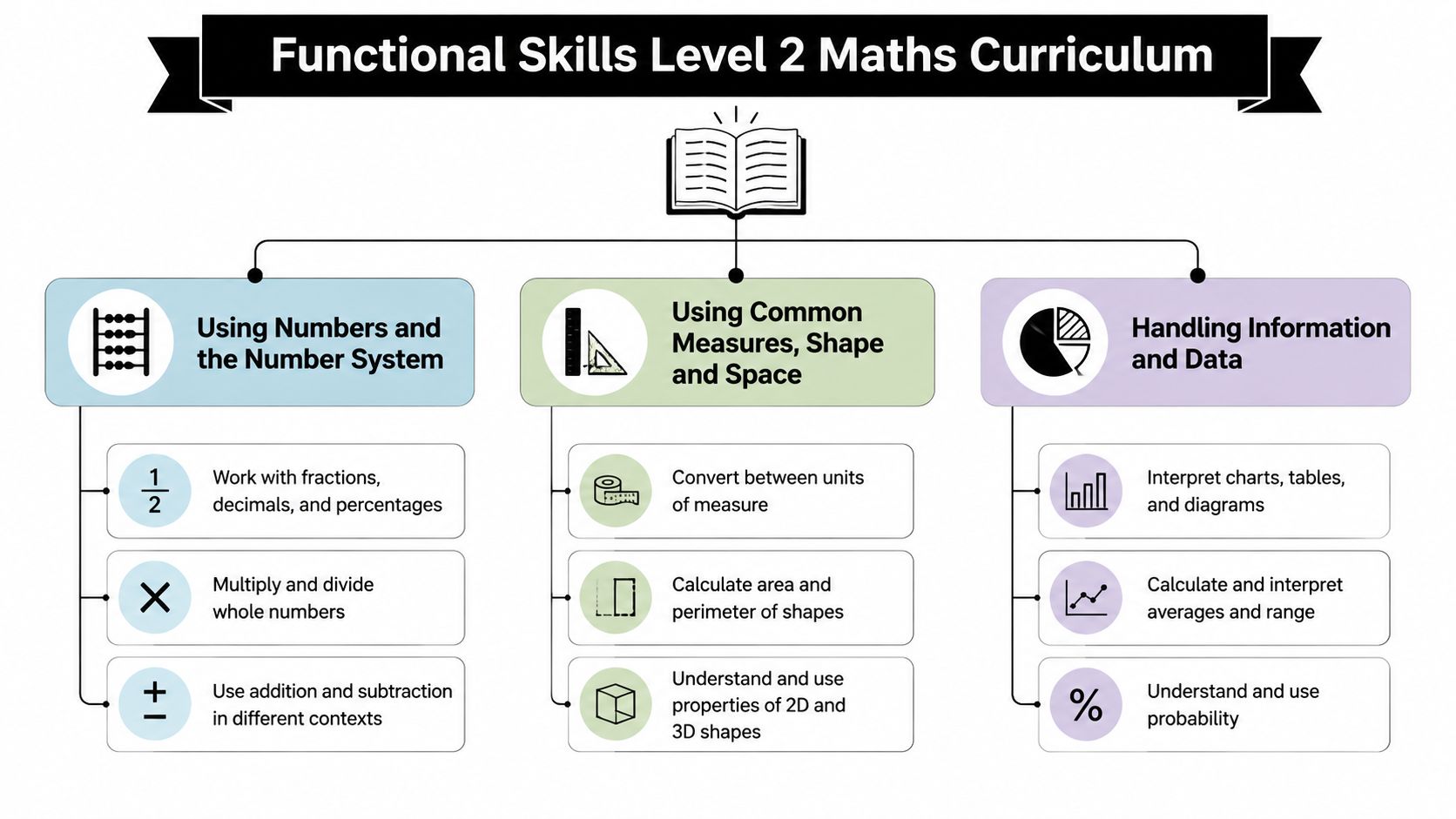
The Functional Skills Mathematics subject content at Level 2 is organised into three clear areas, using numbers and the number system, using common measures, shape and space, and handling information and data/statistics government subject content. That structure helps because it reflects the maths adults meet in real life, at work, in shops, and at home.
You can picture the three areas as three parts of the same toolkit. One helps you handle numbers accurately. One helps you measure and describe the world around you. One helps you read information and make sense of it. Together, they cover the practical maths people use every week, often without even thinking of it as a separate subject.
The number work is broader than many learners expect. At Level 2, you work with positive and negative numbers of any size, fractions, decimals, percentages and ratios, and you also need to recognise the value of a digit in whole and decimal numbers government subject content. That matters when you are checking a payslip, comparing prices, or working out a bill, because a small mistake with place value can change the whole answer.
What the topics feel like in real life
A discount in a shop uses percentages. A room measurement uses shape and space. A rota or sales chart uses data. The qualification brings those tasks into the maths work, instead of treating them as something separate.
That is often a relief for adults coming back to learning. Many people remember maths as pages of rules and nothing else. Level 2 feels different because the questions are tied to things you can meet in ordinary life, such as choosing the right amount of paint, reading a timetable, or checking whether a chart makes sense.
The data and statistics side is especially practical. Pearson's Functional Skills Level 2 guidance expects learners to construct, interpret and evaluate statistical diagrams, calculate probabilities, and compare data using mean, median, mode and range Pearson guidance via AQA. That is the kind of thinking you use when you look at a timetable, a workplace graph, or a short report and ask what it is really showing you.
One more thing helps adults feel less nervous. Level 2 is built around secure numeracy and sensible reasoning, not abstract proof. That makes it much closer to the maths many people already use than they first expect, especially if they are returning after years away from formal study.
Useful way to read the syllabus: if you can see it in a job sheet, a receipt, a measuring tape, or a chart, it probably belongs here.
If you want to see how this level is described alongside the wider qualification system, this guide to how Level 2 maths compares with GCSE gives a clear overview.
Functional Skills Level 2 Maths vs GCSE Maths
Adults often ask the same question first, which route should I choose? The short answer is this. Functional Skills Level 2 Maths is usually the more practical route, while GCSE Maths is the more academic one.
| Area | Functional Skills Level 2 | GCSE Maths |
|---|---|---|
| Main style | Applied, practical, everyday maths | Broader academic study |
| Best for | Work, apprenticeships, quick progression | A Levels, Access to HE, university routes |
| Questions | Focus on realistic problem-solving | More depth across a wider range of content |
| Feel of the course | Direct and useful | More theory and longer preparation |
| Typical learner fit | Adults who want confidence and relevance | Adults who want the full GCSE route |
Functional Skills asks you to solve routine and non-routine problems in familiar and unfamiliar situations, choose the method you need, and use a range of maths to reach the answer Functional Skills criteria. That makes it a good fit for people who need maths for a job, a course, or everyday decision-making.
GCSE Maths usually suits learners who want a wider academic base. It tends to take longer, and it often feels more familiar to people who remember school-style maths lessons. If you are aiming for a course that specifically asks for GCSE Maths, that route may be the cleaner choice.
If you want a fuller side-by-side breakdown of the two, this comparison of Functional Skills equivalent to GCSE can help you weigh it up. The key point is not which route is “better”. The key point is which route fits your next step without draining your confidence.
A simple way to choose
- Choose Functional Skills if you want practical maths for work, training, or a faster path to a recognised pass.
- Choose GCSE if you need a more academic qualification for a specific progression route.
- Choose the one you'll finish, because finishing beats starting strong and stopping halfway.
How You Are Assessed and Graded
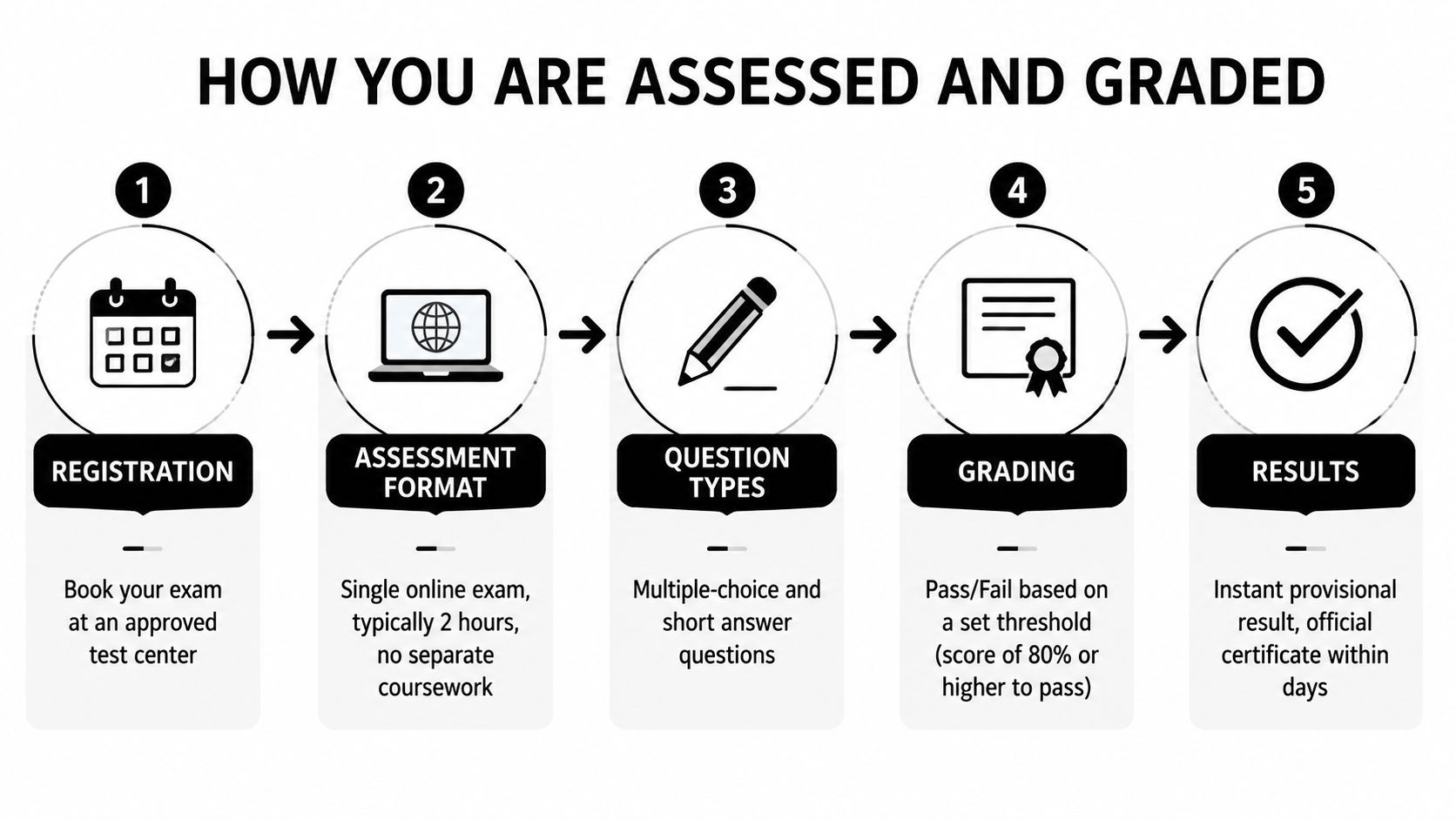
A lot of adult learners feel calmer once they know what the exam looks like. Functional Skills Level 2 Maths is usually assessed through one exam, often taken online, and some providers also include a non-exam assessment, depending on the awarding body. GCSE Maths is usually assessed through three written papers taken at the end of the course.
The grading works differently too. Functional Skills gives you a pass or not yet pass result, so the focus is on reaching the required standard. GCSE uses the 9 to 1 scale, with grade 4 and grade 5 as the main points colleges and employers often ask for. If you learned the older system, grade 4 is close to a standard pass, and grade 5 sits a little above that.
What the process feels like
Good online courses explain the exam before you book anything. You practise with sample questions, work through mock papers, and learn how marking is applied. That matters because many adults do not need more pressure. They need a clear picture of the exam so the unknown feels smaller.
You do not need a perfect memory to do well. You need practice, steady checking, and enough familiarity to spot the question type quickly.
If you do not pass first time, you can resit. That can matter a lot for adult learners, because life rarely lines up neatly around exam day. Work shifts change, children get ill, and confidence can dip at the worst moment. A sensible course makes room for that and helps you get back on track.
Treat each mock paper like a dress rehearsal. If you can see where marks are being lost before the final exam, you have already moved forward. That kind of preparation changes assessment from something to fear into something you can handle step by step.
For learners who want extra support with exam habits, the study materials in this study guide for maths offer a practical place to start.
Who Needs Level 2 Maths and Where It Leads
Leanne left school early and worked for years, then hit a wall when a better job asked for a recognised maths qualification. She did not need maths for school reasons. She needed a practical route that fitted around work, family life, and the worry that often comes with going back to learning as an adult. Level 2 maths does that for many learners.
For adults like Leanne, the qualification often acts as a bridge. It can support job applications where GCSE-equivalent maths is expected, apprenticeships in trades or healthcare, Access to HE Diplomas, and university courses that ask for proof of Level 2 numeracy. It also carries something less visible but just as important. Passing shows a learner that they can return to study, keep going, and finish something worthwhile.
The need is real. The 2023/24 Skills for Life Survey found that many adults in England still have low numeracy skills, which means a lot of people are trying to rebuild confidence with numbers at the same time Skills for Life Survey data in Pearson guidance. That should not put you off. It should remind you that you are far from alone.
There are really two clear reasons people choose Level 2 maths. Some want progression, because they need the qualification to move into a new course, a higher role, or a different path altogether. Others want workplace numeracy, because they need to handle measurements, ratios, money, timings, or data with more ease day to day. The same qualification can serve both needs, but the personal reason for starting is often very different.
Common next steps after Level 2 maths
- Move into employment where a recognised maths qualification helps you meet entry requirements.
- Apply for an apprenticeship that needs practical numeracy.
- Start an Access to HE Diploma if university is your longer-term goal.
- Strengthen your CV for promotion, retraining, or a change of role.
The benefit reaches beyond one paper and one result. Adults often begin because they want better pay, a more secure future, or a way to set a stronger example for their children. Others want to stop avoiding numbers in everyday life. Level 2 maths can support all of that while still feeling manageable one step at a time.
If you are coming back after a long break, keep the goal small and clear. You do not need to match anyone else's pace. You need the next step, then the one after that. For extra help with study habits, the maths study guide offers a useful starting point.
A Practical Study Plan That Fits Real Life
A study plan works when it respects your life, not when it fights it. If you are balancing work, children, travel, and tired evenings, the aim is consistency, not perfection. A few focused sessions each week beat one exhausted cram session every time.
One useful way to organise your week is to block out study time as if it were an appointment. Two shorter sessions can work better than one long one, because your brain stays fresher and you're less likely to avoid starting. Then, keep the learning active. Read a topic, try a few questions, check the answers, and write down what went wrong.
What to practise first
The areas adults most often lose marks on include percentages and ratios, composite-shape area and perimeter, and unit conversion. Those topics are worth extra attention because they come up in everyday tasks as well as exams. Prices, measurements, and quantity changes all lean on the same thinking.
A sensible plan is to use real life as your revision tool. Work out a recipe change. Check the cost of items in a shop. Measure a room. Compare timings on a journey. That way, the maths stops being just a page of questions and starts feeling like something you can use.
If you want a course structure that fits around family life, this maths study page is a useful place to look.
Simple habit that helps: keep a small notebook for mistakes. When the same error shows up twice, that's not failure, that's a clue.
Good online study plans often run for roughly 8 to 16 weeks, depending on your starting point and the qualification route. The important part is not racing. It is building enough familiarity that the exam feels known, not strange.
How Next Level Online College Supports Your Journey
Going back to maths as an adult can feel like carrying a heavy bag uphill. Work shifts change. Family needs come first. Confidence can dip after years away from study. A good course makes room for that and gives you a calm place to begin.
Next Level Online College is a UK-based online provider for adult learners, part of the Cambridge Online Education Ltd group. It focuses on helping people return to education, and its courses are delivered fully online so they can fit around everyday life.
Support matters as much as the lesson content. Learners are matched with subject specialists, mentors, and wellbeing advisors, so they are not left to sort everything out on their own. That kind of help matters when a topic feels confusing or when you need the same idea explained in plain English.
For Level 2 maths, the provider offers a Functional Skills Level 2 Mathematics course leading to the NCFE Level 2 Functional Skills Mathematics qualification. For adults who want a recognised Level 2 route, that gives a practical path that can support progression while still staying flexible enough for real life.
There are also pathways into university, further study, and career development. Finance options and competitive pricing can reduce practical barriers too. For many learners, that mix helps the course do more than prepare them for an exam. It supports a steadier future, with more confidence and more choices.
You do not need to feel ready in every way before you start. You just need one sensible place to begin, and a course that meets you where you are.