
Some adults open a maths book and feel their stomach drop. They remember school, old test papers, red marks, or that awful feeling of being the one who “just didn’t get it”.
Others feel something quieter but just as strong. They want more. More confidence. More choices. A better job. A chance at university. A way to show their children that it’s never too late to learn.
That’s where maths a level online can become far more than a course. It can become proof that your past doesn’t get the final say.
Your New Beginning with a Maths A Level Online
You might be working all day, sorting dinner, answering messages, helping with homework, and then wondering when your own life goals got pushed to the back. That feeling is common.
A lot of adults return to study because something has shifted. Sometimes it’s a job that no longer fits. Sometimes it’s a dream that never went away. Sometimes it’s your child asking for help with maths homework and you thinking, “I want to be able to do this too.”

Why this step matters so much
A maths A Level can open doors to university courses, professional training, and stronger career options. But it also changes something inside you.
When you study as an adult, you’re not just collecting grades. You’re rebuilding trust in yourself.
You don't need to be the person who was “good at maths” in school. You need to be the person who keeps going now.
Many adult learners are choosing flexible online study. Distance learning enrolments for level 3 qualifications, including A Levels, rose by 22% between 2019 and 2023, reaching over 250,000 adult participants, according to the UK government data cited by Oxbridge Home Learning’s summary of A Level statistics.
That matters because it tells you something simple. You are not unusual. You are part of a growing group of adults who’ve decided their education still matters.
A story many adults recognise
Think of someone who left school years ago, got into work, raised a family, and always felt they had more to give. They may have said for years, “I’m not academic.” Then one day they stop saying it.
They sign up. They start small. One lesson. One topic. One solved problem. They begin to realise maths isn’t magic. It’s a set of skills that can be practised.
Soon their children see them studying at the table. Their family sees persistence, not perfection. That example is powerful.
Here’s the truth many adults need to hear. Starting again isn’t embarrassing. It’s brave.
What changes first
Usually, the first change isn’t your grade. It’s your self-talk.
- From fear to curiosity: You stop asking “What if I fail?” and start asking “What if I can do this?”
- From shame to action: You stop judging old results and begin building new ones.
- From stuck to moving: Even slow progress feels different from standing still.
Maths a level online gives you a path that can fit around life. And for many adults, that’s the first time education has felt possible rather than out of reach.
What an Online A Level in Maths Really Looks Like
Online study can sound unclear if you’ve never done it before. People often ask, “Will I just be left alone with a pile of worksheets?” The answer depends on the type of course.
A simple way to think about it is cooking.
Some people learn from a recipe book on their own. Some join a live cooking class with a chef. Others use a meal kit with instructions, videos, and help when they get stuck. Online maths courses work in a similar way.
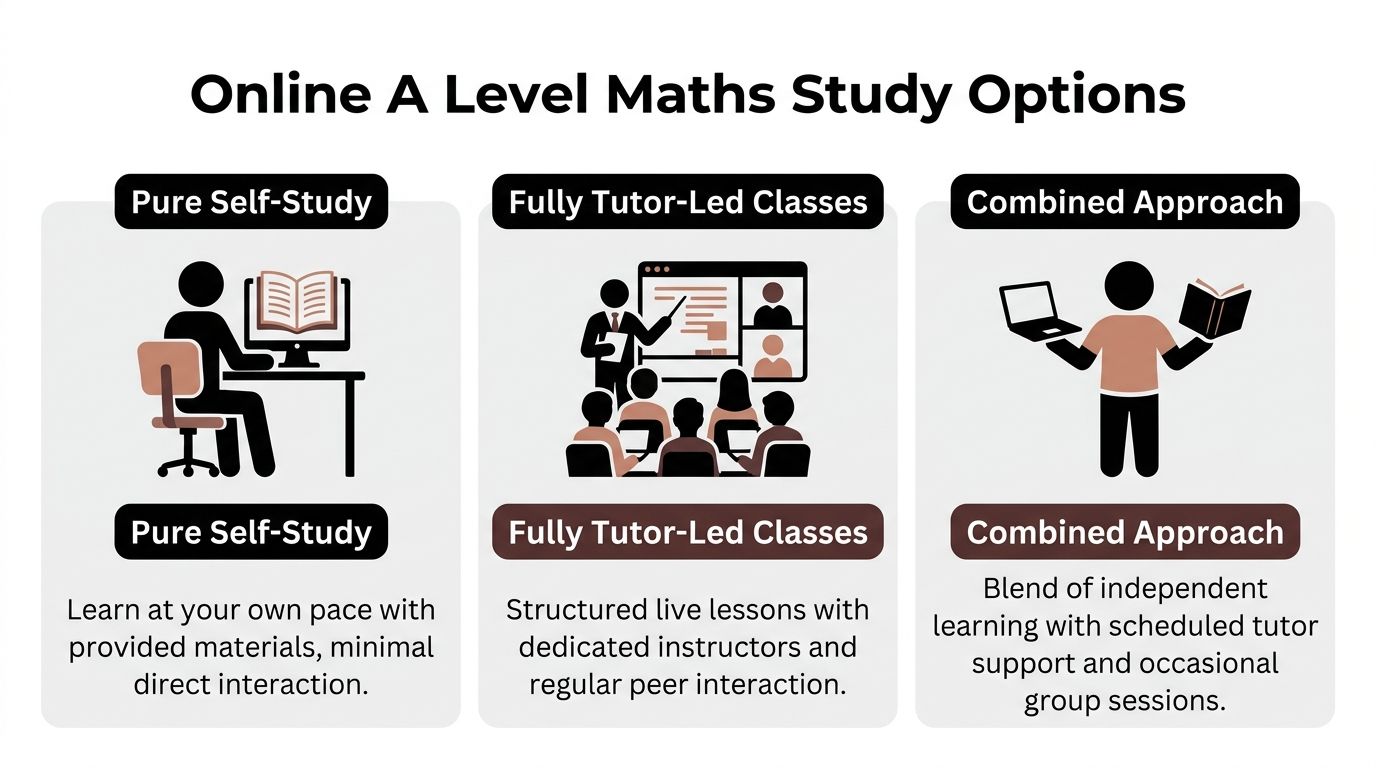
The three main ways to study
Pure self-study
This is the most independent route. You get the learning materials and work through them on your own schedule.
This suits people who are organised, confident working alone, and happy to find their own rhythm. If you like to pause, repeat, and move at your own speed without waiting for anyone else, this can feel freeing.
The hard part is obvious. When you hit a confusing topic, there may be no immediate support.
Fully tutor-led classes
This is closer to a traditional classroom, but online. You attend regular lessons and learn with a teacher guiding the group.
This can be a good fit if you want structure, routine, and someone explaining ideas in real time. It also helps if deadlines motivate you.
The challenge is flexibility. If your work shifts change or family life is unpredictable, fixed classes can become stressful.
Blended or supported learning
This gives you a mix. You study independently, but you also get tutor support, guidance, and often some live help.
For many adults, this is the most practical option because it balances freedom with support. You can keep learning around your life, but you’re not carrying everything on your own.
If you want to see how flexible A Level distance learning can work in practice, this guide to distance learning for A Levels is a useful example of the model many adult learners look for.
Which style fits your life
Here’s a simple comparison.
| Feature | Self-Study | Tutor-Led | Blended (Supported Learning) |
|---|---|---|---|
| Best for | Independent learners | People who want routine | Busy adults who need both flexibility and help |
| Pace | Set by you | Set by class timetable | Mostly set by you, with guidance |
| Support | Limited direct support | Regular teacher contact | Ongoing support when needed |
| Flexibility | Very high | Lower | High |
| Pressure level | Can feel isolating | Can feel rigid | Often feels more manageable |
| Good if confidence is low | Sometimes difficult | Helpful if you like live teaching | Often the most reassuring |
What adult learners often misunderstand
Many people think online learning means less serious learning. It doesn’t. It changes where and when you learn.
What matters most is not whether your desk is at home or in a classroom. What matters is whether the course gives you:
- Clear lessons
- A sensible order of topics
- Useful feedback
- Someone to ask when you’re stuck
- A study pace you can sustain
Practical rule: Choose the learning style you can keep doing on tired weeks, not just on your best week.
A course only works if it fits your life. Not your ideal life.
A good sign you’re choosing well
You should be able to answer this question. “When I get confused, what happens next?”
If the answer is “I’ll probably just panic and stop”, you need more support. If the answer is “I’ll know who to ask, what to review, and how to get back on track”, you’re in a much stronger position.
That’s what a strong maths a level online setup should give you. Not just content, but a way forward.
Making the Time for Your Studies
Most adults don’t doubt the value of studying. They doubt the clock.
Work runs late. Children need things. The washing doesn’t do itself. By the time the house is quiet, your brain may feel finished for the day. So the problem often isn’t motivation. It’s fitting study into a life that already feels full.
Stop waiting for the perfect study day
The perfect free evening probably isn’t coming. That’s not bad news. It means you need a study plan built for life, not fantasy life.
Short study sessions often work better than long ones you keep postponing. A focused 15 minutes can be enough to review formulas, practise one question, or watch part of a lesson and make notes.
Call it study snacking if you like. Small pieces still count.
Build study into family life
One of easiest ways to protect your time is to make studying visible at home. If your family knows that certain times are “study time”, it becomes more normal and less likely to be interrupted.
Try ideas like these:
- Family study hour: Everyone does something quiet. Your child reads or does homework while you revise maths.
- Morning start: If evenings are messy, use a short session before the house wakes up.
- Lunch break review: Keep flashcards, notes, or one practice question ready for work breaks.
- Weekend anchor session: Pick one regular slot each week for deeper work on harder topics.
This doesn’t just help your timetable. It sends a message to your children that learning matters in your home.
Children notice consistency more than speeches. Seeing you return to study teaches resilience in a way words can't.
Make your time visible
A plan in your head is easy to break. A plan in your calendar is stronger.
Use your phone calendar or a paper planner and block time in small chunks. Don’t write “study maths” in a vague way. Write the exact task.
Good examples look like this:
- Tuesday 7:30 pm: Algebra video and notes
- Thursday lunch: 2 practice questions on graphs
- Saturday 10 am: Past paper review
That matters because clear tasks feel easier to start. “Revise maths” sounds huge. “Do question 1 and 2 on quadratics” sounds possible.
Protect your energy, not just your time
Some adults keep blaming themselves for poor time management when the underlying issue is low energy. Maths needs concentration. Try to place harder tasks when your brain is freshest.
Use this simple guide:
| Time of day | Best kind of study |
|---|---|
| Early morning | New topics, hard questions |
| Lunch break | Quick review, flashcards, short video |
| Evening | Lighter practice, reading notes, checking errors |
| Weekend | Deeper study and longer exam questions |
What to do when you miss a session
You will miss some study sessions. Everyone does. Missing one session isn’t the problem. Quitting because of one missed session is the problem.
When life gets in the way:
- Restart fast: Don’t wait for Monday or next month.
- Shrink the task: Do ten minutes instead of an hour.
- Pick one page: Momentum matters more than perfection.
- Drop guilt: Guilt uses energy you need for studying.
A maths a level online course works best when you treat it like a long journey, not a daily test of character. Some weeks will be smooth. Some won’t. Progress still counts.
The Nuts and Bolts of Exams and Awards
Many adults worry about whether an online A Level is “real”. That worry makes sense, especially if you’ve been out of education for years.
The key point is simple. The qualification is based on the awarding body and exam process, not on whether you studied in a college building or at your kitchen table.
The qualification is the same
If you study an A Level in Maths through recognised awarding partners such as AQA or Edexcel, the qualification itself is the same type of A Level used for university applications and employment decisions.
That’s why the official details matter. You should always check the awarding body, the course specification, and what support you’ll get with exam entry.
If you want a clearer picture of how grades work and how they’re viewed, this explanation of A Level grades can help make the system feel less mysterious.
What you study
A Level Maths includes core mathematical ideas and applied topics. According to ExamSolutions’ overview of A Level Maths, UK A Level Maths modules typically comprise Core Pure modules plus two from Mechanics, Statistics, or Decision Maths. The same source notes that combining with Statistics is particularly effective for data-heavy careers, and that online platforms can support topic-specific mastery that may lead to significant grade improvement for self-paced adult learners.
That can sound technical, so here’s the plain-English version.
Pure maths
This is the heart of the course. It includes algebra, graphs, trigonometry, calculus, and functions.
Pure maths gives you the rules, patterns, and methods that hold everything together. If you’re aiming for subjects like engineering, economics, or computer science, this part matters a lot.
Mechanics
Mechanics applies maths to movement, forces, and motion.
If you’ve ever wondered how maths connects to cars, bridges, sport, or physics, you start to see its application here.
Statistics
Statistics helps you understand data, probability, and how to interpret information.
This matters in many modern jobs because so many roles involve data, reports, trends, and decision-making.
How exam entry usually works
Adult learners often take exams as private candidates. That means you study with a course provider, then sit the official exams at an approved exam centre.
The process usually looks like this:
- Choose your course and awarding body
- Study the full specification
- Get guidance on exam registration
- Book with an exam centre
- Sit the same official exams as other candidates
- Receive your grade through the normal awarding process
A good provider helps you understand each stage so you’re not trying to decode it alone.
What matters most: Ask early about exam centres, deadlines, and what paperwork you’ll need. Clarity reduces panic.
Why this official side matters
When adults return to education, uncertainty can feel bigger than the actual work. The exam process sounds intimidating until you break it into steps.
Once you know who awards the qualification, what topics are included, and how the exams are booked, the whole journey becomes more concrete. That’s often when confidence begins to grow.
You stop seeing the course as a vague dream. You start seeing it as a plan.
Preparing to Pass and Feel Confident
Many adults think exam success means being naturally brilliant. It doesn’t. In A Level Maths, success comes from learning how marks are awarded and then practising in that style.
That’s good news. Skills can be built.
What examiners are looking for
A Level Maths isn’t only about the final answer. Examiners want to see the method as well.
That means your working matters. If you understand the process and show it clearly, you give yourself more chances to collect marks, even if you make a small mistake later.
The three assessment objectives
The exam is split into three parts. According to OCR’s guidance on tackling problem-solving in A Level Maths, 50% of marks are for AO1 standard techniques, 25% are for AO2 reasoning, and 25% are for AO3 problem-solving. The same guidance notes that adult learners can raise their grades by targeting AO3 practice, as many marks are won or lost there.
Here’s what those mean in everyday language.
| Assessment objective | What it means in plain English |
|---|---|
| AO1 | Can you use the maths methods correctly? |
| AO2 | Can you explain what the maths means? |
| AO3 | Can you solve a problem in a less familiar situation? |
Why AO3 feels scary
AO3 questions often look harder because they’re less direct. They don’t always tell you exactly which method to use.
That can make adults freeze, especially if they already doubt themselves. But AO3 isn’t asking you to be a genius. It’s asking you to think step by step.
A question might describe a situation, give you some information, and expect you to turn it into maths. People often get stuck at this point.
How to get better at problem-solving
Use practical habits, not heroic bursts of effort.
- Say the question out loud: This slows you down and helps you notice what it’s really asking.
- Underline the givens: Mark the facts, values, and conditions before doing any calculation.
- Draw something: A quick sketch, graph, or labelled shape often makes the path clearer.
- Write your first step anyway: Even if you’re unsure, beginning creates movement.
- Check units and meaning: Ask whether your answer makes sense in the situation.
If a question feels confusing, don't ask “Can I do this?” Ask “What is the first thing I can identify?”
A calm revision method that works
Confidence grows fastest when your revision is active.
Try this weekly pattern:
- Learn one topic from notes or video
- Practise a few standard questions
- Review mistakes carefully
- Repeat with mixed questions later in the week
- Test yourself with an exam-style question
This works because it moves you from recognition to recall. Reading a method and doing a method are different things.
One powerful habit adults often miss
Teach the idea back in simple words.
You can explain it to your child, your partner, a friend, or even an empty room. If you can say, “This is why we factorise here” or “This is why the gradient changes”, your understanding becomes stronger.
That’s also good for confidence. You stop feeling like maths is a secret language other people were born knowing.
When confidence drops before an exam
That drop is normal. It doesn’t always mean you’re unprepared.
Use a short reset:
- Look at solved questions you now understand
- Redo one familiar topic
- Review your common mistakes list
- Leave one hard question and return later
Confidence doesn’t mean feeling relaxed every minute. It means knowing how to recover when nerves show up.
Paving Your Future University and Career Path
A strong reason to study maths a level online isn’t the exam day. It’s the life that can follow.
For many adults, this qualification is the bridge between the life they’ve had to manage and the life they want to build.

Why universities value A Level Maths
A Level Maths is widely respected because it shows more than subject knowledge. It shows reasoning, persistence, and the ability to handle complex ideas.
That matters for degrees such as:
- Engineering
- Computer science
- Economics
- Physics
- Architecture
- Data-focused business courses
- Some health and social science pathways with strong data content
For adults who once thought university had passed them by, this can be a turning point.
A useful starting point for exploring progression routes is this guide on how to get into universities.
What the progression data suggests
A Level Maths is strongly linked with higher education progression. UCAS data reveals that 92% of A Level Maths students progress to higher education, compared to 68% of A Level students overall. For adult learners, completing this qualification online can lead to achieving 4% higher average UCAS tariff points, according to the source cited in this YouTube reference.
Those figures matter because they show maths doesn’t just sit on your record. It can strengthen your path forward.
The careers it can support
This qualification can support entry into careers where analytical thinking matters. That includes roles linked to technology, finance, planning, data, and design.
Examples include:
| Area | Possible direction |
|---|---|
| Technology | Software, systems, digital problem-solving |
| Finance | Accounting support, financial services, analysis |
| Engineering | Design, infrastructure, technical planning |
| Business data | Reporting, forecasting, operations analysis |
| Public service | Research, planning, policy support |
You may not move into a new career overnight. But a recognised maths qualification can help you meet entry requirements and feel more credible when new opportunities appear.
Here’s a helpful video if you’re thinking about where study can lead next.
The family impact is real
Career progression matters. University access matters. But there’s another outcome adults often discuss more privately.
Studying changes the story your family sees.
Your children see that setbacks don’t finish a person. Your household sees someone making a long-term decision instead of just getting through the week. You begin to act like the person who belongs in the next chapter of life.
A qualification can change your options. The journey towards it can change your identity.
That identity shift matters because it affects how you apply for courses, speak in interviews, and respond to challenge. You’re no longer just hoping life improves. You’re building the proof that you can improve it.
Your Questions About Studying Maths Online Answered
Adult learners usually don’t need more pressure. They need honest answers. Here are some of the worries people carry before they begin.
Am I too old to do A Level Maths
No. You are not too old to learn maths.
Adults often do well because they bring patience, purpose, and a clear reason for studying. You may be busier than a teenager, but you’re also more likely to understand why the qualification matters.
Being older can help. You’re not studying because someone told you to. You’re studying because you’ve chosen a better future.
What if I was bad at maths at school
Being unhappy at maths in school doesn’t mean you can’t succeed now.
School may have moved too fast. You may have had poor teaching, low confidence, anxiety, or too much going on outside class. Adult learning is different because you can go at a pace that suits you and revisit ideas until they click.
The right question isn’t “Was I good at maths then?” It’s “Am I willing to learn it now?”
I’ve forgotten almost everything. Is that a problem
It’s common, and it’s fixable.
Many adults return to study and find they remember less than they expected. That doesn’t mean you’re not capable. It means you need a sensible starting point and a course that builds in the right order.
Start with basics. Don’t feel embarrassed about that. Strong maths is built layer by layer.
Do I need to be confident with technology
Not especially.
Most online study uses familiar tools such as a laptop, internet access, email, video lessons, downloadable materials, and online messaging or portals. If you can open websites, watch videos, and type messages, you can learn the rest.
The technology side usually becomes easier quite quickly because you use the same few tools again and again.
Will I be studying alone all the time
Not necessarily.
That depends on the type of course you choose. Some adults like independent study. Others need tutor help and regular check-ins. Many do best with supported learning that gives flexibility without isolation.
If low confidence is one of your biggest worries, don’t choose the loneliest option just because it sounds cheaper or simpler. Support matters.
How do I stay motivated when life gets busy
Don’t rely on motivation alone. Build systems.
Try these:
- Keep your reason visible: Write down why you’re doing this and put it where you study.
- Track small wins: Tick off topics, questions, or study sessions.
- Use a fixed weekly routine: Habits reduce decision-making.
- Accept imperfect weeks: A hard week doesn’t cancel your goal.
Motivation comes and goes. Routine carries you when motivation is quiet.
What if I fail an exam
Failing an exam would feel disappointing, but it would not mean you are a failure.
For adults, the bigger victory often starts earlier. You returned. You studied. You faced something that used to frighten you. Those things matter.
And if a result isn’t what you hoped for, it becomes information. You look at what went wrong, improve your approach, and go again if needed.
Do I need special equipment
You usually need only the basics.
A reliable internet connection, a computer or laptop, somewhere quiet to study when possible, paper for working out, and the standard maths tools your course recommends are usually enough. A calculator may also be part of your exam preparation, depending on the specification.
You do not need a perfect home office. Many adults study at kitchen tables, in bedrooms, during lunch breaks, and in short evening sessions.
I’m scared of starting and not finishing
That fear is common because the goal means a lot to you.
The best answer is to make the start smaller. Don’t promise yourself perfection for two years. Promise yourself one lesson, one week, one routine.
You don’t finish by feeling ready for the whole journey. You finish by returning to the next step again and again.
Is maths a level online really worth it
If it helps you reach university, change career direction, improve your confidence, and show your children what perseverance looks like, then yes, it can be worth it.
Not because it’s easy. Because it can change what you believe is possible for your future.
If you’re ready to take that next step, Next Level Online College offers flexible online learning for adults who want recognised qualifications, supportive guidance, and a study path that fits around life. It’s a strong place to begin if you want to rebuild confidence, work towards university, and create a future your family can feel proud of.