
Some evenings end with the same quiet thought. You've made the tea, sorted the house, answered messages, helped someone else, and then wondered what happened to your own plans.
Maybe you've thought about university before. Maybe you told yourself you were too busy, too old, not confident enough, or not “academic”. Those feelings are common. They don't mean your chance has gone.
Online access to higher education has changed what's possible for adults in the UK. It means learning can fit around work, children, caring, and real life. It means the door to higher education doesn't only open for people who can sit in a classroom every weekday. It can open for you too.
Your Time for a Brighter Future Is Now
A lot of adult learners carry the same private worry. “I want more for my family, but I left it too late.”
You might be in a job that pays the bills but doesn't give you much future. You might want a career that feels more secure, more meaningful, or better paid. You might want to prove to yourself, and to your children, that you can finish what you started.
That matters.
When a parent or carer goes back into education, it often changes more than one life. Children notice. Partners notice. You notice. The message becomes clear: growth doesn't stop when school ends.
Online learning isn't a strange new experiment anymore. In England, 75% of all students were enrolled on courses with some form of online learning in the 2020/21 academic year, showing how normal this route has become in higher education, according to higher education participation reporting.
A small brave step can change the whole story
Think about someone who left school years ago with mixed memories and low confidence. They scroll through college websites late at night, then close the tab because it all feels too big. Entry rules seem confusing. Technology feels intimidating. The word “university” sounds like it belongs to someone else.
Then one day, they ask a simple question. What would I need to start?
That question changes everything. Not because all fear disappears, but because fear stops making the decisions.
You don't need to have the whole journey planned. You only need to be willing to take the first step.
Online access to higher education gives adult learners room to begin where they are. That could mean building up English and maths, taking GCSEs, studying A Levels, or choosing a direct route designed for adults. None of that is a sign you're behind. It's a sign you're building properly.
Why this matters to your family
Your goal may be personal, but the effect reaches far beyond you.
- Your children see effort: They learn that hard things can be done.
- Your confidence grows: Each completed task replaces old doubt with proof.
- Your options widen: Qualifications can open doors to further study and new careers.
- Your home changes tone: Hope becomes something people can feel, not just talk about.
If you're nervous, that's normal. If you're hopeful, hold onto that. Hope is often where change begins.
What Online Learning Really Means for You and Your Family
Online learning sounds technical, but for most adult learners it means something much simpler. It means choice.
It means you can study after work, early in the morning, or when the house finally goes quiet. It means you don't have to put your whole life on hold to move forward. For many families, that's the difference between education feeling impossible and education feeling real.

Online access to higher education isn't only about watching lessons on a screen. It's about having a path that works with the life you already have. For decades, providers such as The Open University have supported adults who couldn't study on campus because of work, family life, or where they lived. By the early 2020s, it had already educated more than 2 million students, showing the long-standing demand for flexible study routes, as noted in this background on flexible higher education access.
It's about more than a qualification
A certificate matters. A university place matters. Career progress matters.
But there's something else that matters too. Online learning can change how you see yourself.
If you've spent years putting everyone else first, study can be a powerful way to say, “I matter as well.” That isn't selfish. It's healthy. It shows your family that learning, ambition, and self-respect belong in everyday life.
A helpful truth: education at home doesn't shrink your world. It can expand it.
Your children may see you reading notes at the kitchen table. They may hear you talk about deadlines, ideas, and goals. Those everyday moments can become part of your family story. You become the person who kept going.
What online learning can make possible
Different learners want different things. You might want to:
- Reach university: Gain the qualifications you need for entry.
- Change career direction: Move towards a role that feels more secure or rewarding.
- Increase confidence: Prove to yourself that you can learn well now, even if school felt hard before.
- Create a stronger future: Build skills that can support your family over time.
Online learning is respected because it asks for real commitment. It takes planning, effort, and courage. You're not choosing an easier path. You're choosing a path that fits.
Finding Your Starting Point on the Path to University
Many adults get stuck at the same point. They want to move forward, but they don't know where to begin.
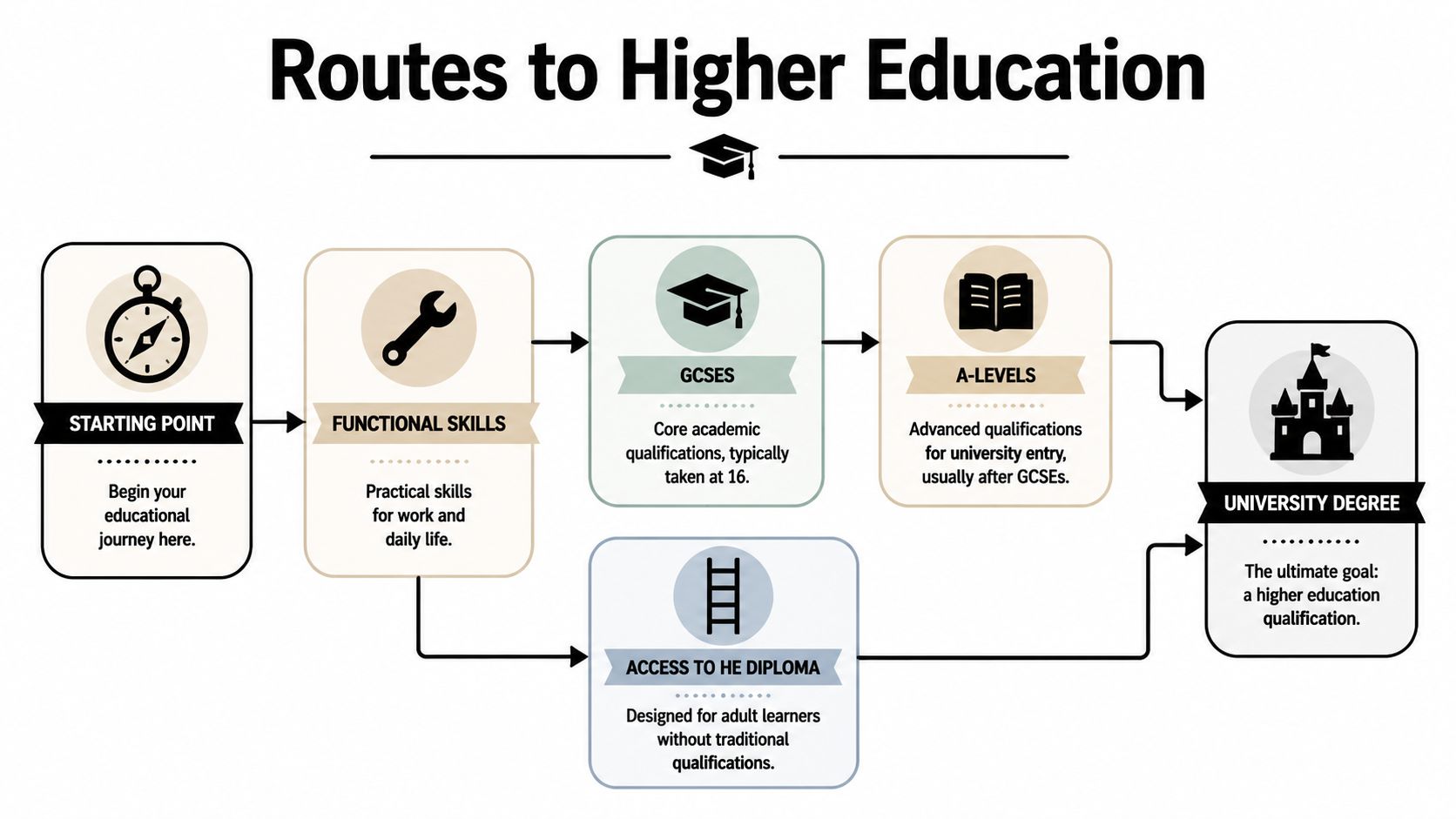
That confusion makes sense. Qualifications can look like a jumble of names and rules. A simpler way to see them is this. Think of them as stepping stones across a river. You don't need every stone. You need the ones that match where you are now and where you want to go next.
The main stepping stones
Some learners need to rebuild confidence first. Others are ready for direct university preparation. Here are the main routes.
| Qualification | Who It's For | Main Goal |
|---|---|---|
| Functional Skills | Adults who want to build practical English and maths confidence | Create a stronger base for work, daily life, and further study |
| GCSEs | Learners who need core qualifications often asked for by courses and employers | Meet entry requirements and strengthen academic knowledge |
| A Levels | Learners aiming for traditional university entry routes | Prepare for degree-level study in specific subjects |
| Access to HE Diploma | Adults without the usual traditional qualifications | Provide a direct route towards university study |
Functional Skills and GCSEs
If school left you feeling shaky in English or maths, Functional Skills can be a strong first move. They focus on practical use. Reading clearly. Writing properly. Using maths in real situations. For some adults, that's exactly what helps confidence come back.
GCSEs are often the next key step. Many higher education courses and career routes ask for them, especially in English and maths. If you don't already have the grades you need, taking GCSEs as an adult can open up options that once felt closed.
A lot of learners worry that starting with foundation-level study means they're behind. It doesn't. It means you're choosing a route that gives you the best chance of success.
Build the foundation first if you need it. Confidence grows faster when the basics feel solid.
A Levels and Access to HE Diplomas
A Levels are the route many people recognise from school or sixth form. They suit learners who want subject depth and are aiming for degree courses that ask for specific subjects.
For many adults, though, the Access to HE Diploma is the clearest bridge to university. It's designed for people returning to education and can be a practical choice if you don't have the standard qualifications already. If you want to explore that route, this guide to an Access to HE Diploma online shows what the qualification is for and how it supports adult progression.
How to choose your own starting point
Ask yourself these questions:
What qualification do I already have?
Find out what you've got before assuming you need to start from scratch.What course or career do I want later?
Nursing, teaching, social work, business, and many other paths can each have different entry requirements.What feels realistic right now?
The right route isn't the one that sounds impressive. It's the one you can begin and continue.Where is my confidence level today?
If your confidence is low, a smaller first step can be the smartest step.
A simple way to think about it
If you need to strengthen the basics, start with Functional Skills.
If you need recognised core qualifications, GCSEs may be the answer.
If you want a traditional academic route, look at A Levels.
If your goal is university and you want a route built for adults, an Access to HE Diploma may be the best fit.
No matter which stone you step on first, the important thing is this. You are still on the path.
How to Apply and Get Started Without the Stress
Applications often feel scarier than the actual course. Forms, entry rules, login details, and unfamiliar terms can make people freeze before they even begin.
A calmer way to handle it is to treat the process like a short checklist, not a giant life test.
Start with clarity, not pressure
First, choose the course that matches your goal. If you want university later, check what qualifications that future route usually asks for. If you're rebuilding confidence, choose the level that helps you succeed now.
Then speak to someone before enrolling if you can. A good adviser or admissions team member should explain the course in plain English, talk through entry requirements, and help you work out whether the level is right for you.
If you're thinking ahead to degree entry, this guide on how to get into universities can help you understand the bigger picture.
The application usually works like this
Most providers follow a similar process:
- Choose your course: Pick the qualification that matches your current level and future plan.
- Ask questions: Contact the provider if anything is unclear. Ask about support, assessments, deadlines, and study hours.
- Complete the enrolment form: Fill in your details carefully. Take your time.
- Send any documents needed: Some courses may ask for ID or previous qualification information.
- Wait for confirmation: Once accepted, you'll usually receive instructions for the next steps.
That's the core of it. Not a mystery. Just a sequence.
What the first few weeks often feel like
Many adult learners worry they'll be thrown straight into difficult work. Good online providers usually make the start gentler than that.
You may receive login details, an induction guide, and access to your online learning area. You might have a welcome call or get a message from a tutor. Often, the first goal is to log in, look around, and get comfortable.
That matters because early confidence can shape the rest of your journey.
Practical rule: if a provider's explanation leaves you more confused than before, ask again. You deserve clear answers.
Your life experience counts
Adult learners sometimes think their old school record tells the whole story. It doesn't.
Motivation, reliability, and real-life experience matter. If you've worked, raised children, cared for family members, managed a household, or handled responsibilities under pressure, you've already built skills that help in study. Organisation, persistence, communication, and problem-solving all count.
You do not need to walk in already polished. You only need to be ready to begin.
Making Your Dream Affordable with Smart Funding Options
Money worries stop many good people before they even enquire. That's understandable. If you're already managing bills, food costs, travel, and family needs, education can feel like one expense too many.
But cost doesn't always have to mean “not possible”. It often means “I need to look at the options properly”.
Ways adults often fund study
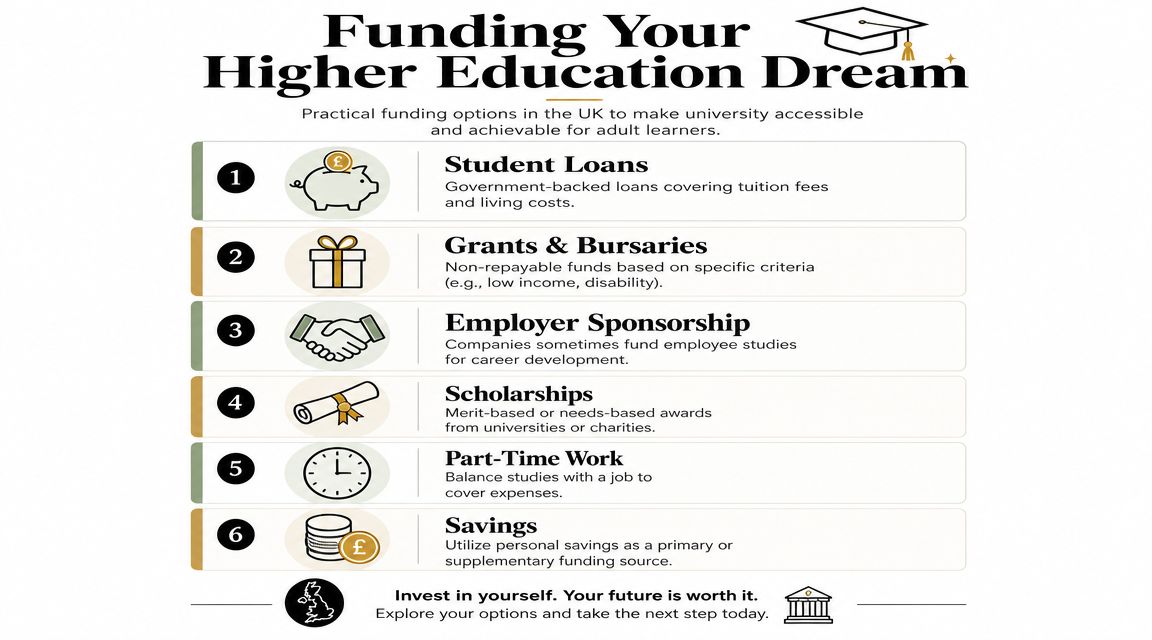
Different routes suit different households. Common options include:
- Student loans: Government-backed support may be available for some higher education routes.
- Grants and bursaries: Some learners may qualify for support that doesn't need to be repaid.
- Employer support: If your course links to your role or future development, your employer may help.
- Scholarships: Some institutions or charities offer help based on need or other criteria.
- Monthly payment plans: Spreading the cost can make study more manageable.
- Savings or mixed funding: Some adults combine personal savings with another option.
A provider may also offer staged payment choices. For example, finance plans for online study can help learners spread costs instead of paying everything at once.
If you're considering an Access route
Many adult learners looking at university choose an Access to HE Diploma because it's designed as a direct route into higher education.
If funding is your biggest fear, ask very direct questions before you enrol. Ask what support exists, what payment choices are available, and whether there are funding routes linked to your course type. Don't assume the answer will be no.
A simple budget mindset helps
When adults return to education, they sometimes compare the cost only to what they spend now. A better question is this. What is this course helping me move towards?
That could mean a university place, stronger qualifications, a career change, or better long-term earning potential. You are not only paying for lessons. You are investing in access, confidence, and future options.
Some costs are about getting through the month. Education is often about changing the next few years.
Ask these questions before you commit
Keep it practical. Before enrolling, ask:
- What is the full cost of the course?
- Can I pay monthly?
- Are there any extra costs for exams or materials?
- Is there funding support for my situation?
- What happens if my circumstances change during the course?
Clear answers make better decisions. And better decisions reduce stress.
Creating a Study Plan That Fits Around Your Real Life
The biggest fear for many adults isn't the subject. It's time.
You might be thinking, “I'd love to study, but where would I fit it in?” That question matters because your life is already full. Work shifts, school runs, care duties, meals, cleaning, and tired evenings are real. A good study plan has to respect that.
In the UK, 9.2 million people were providing unpaid care in 2021, and adults with caring responsibilities are less likely to take part in formal learning, according to UK evidence on carers and participation. If you're balancing study with caring or family duties, you're not failing at time management. You're carrying a lot.
Use small pockets of time
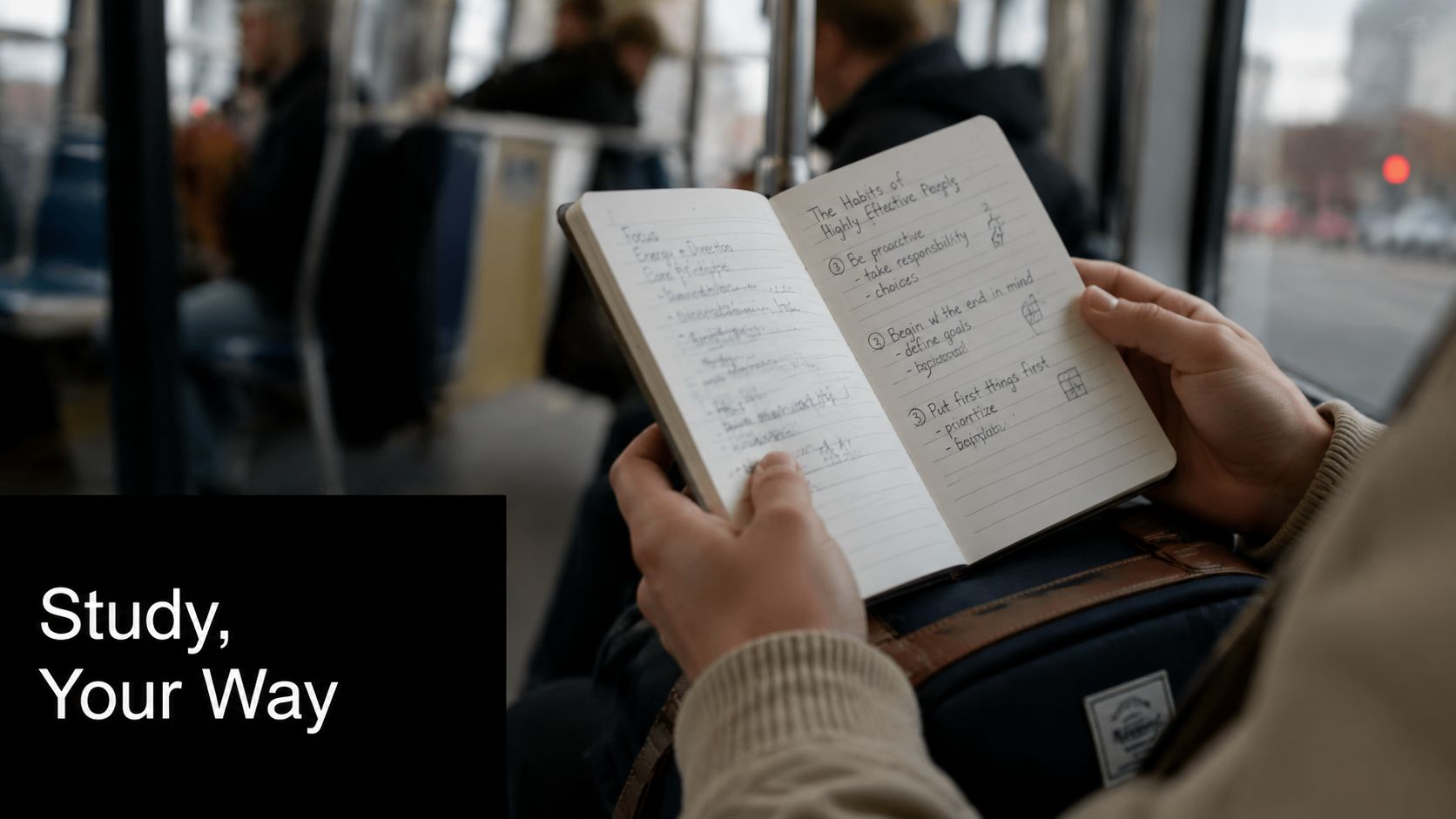
A working parent might study in three short bursts. One on the bus, one at lunch, one after the children are asleep. A carer might use quieter morning time for reading, then do written work later in the week when support is available.
That kind of pattern counts. Study doesn't only “work” if it happens in long perfect blocks.
Try looking for time in places like:
- Your commute: Reading notes, watching short lesson clips, or planning tasks.
- Lunch breaks: Reviewing key terms or drafting a paragraph.
- Evenings: One focused hour can go a long way.
- Weekend pockets: A bit of catch-up can reduce stress before Monday.
Create a space that tells your brain it's time to focus
You don't need a home office. Many adults study at the end of the kitchen table, in a quiet corner of the sofa, or at a small desk in a bedroom.
What matters is consistency. Keep your notebook, charger, pens, and login details together. The simpler it is to start, the easier it is to keep going.
A study space doesn't have to look impressive. It only has to work for your life.
Bring your family into the plan
Tell the people around you what you're doing and why. Children often respond well when they understand that Mum or Dad has homework too. Partners, relatives, and friends may be able to help more than you expect once they know your study times matter.
Useful phrases can be simple:
- “I'm studying from 7 to 8 tonight.”
- “Can you help with bath time on Thursdays?”
- “I'm doing this for our future, so I need quiet for one hour.”
Later on, if you need a bit of motivation, this short video can help you reset your mindset.
Keep the plan gentle and honest
A realistic plan beats an ambitious one you can't maintain.
Some adults do well with a weekly rhythm like this:
- One session for reading
- One session for writing
- One short catch-up slot
- One quick weekly review
If a hard week knocks you off track, don't turn one missed session into a story about failure. Return at the next slot. That is how adult learners succeed. Not by being perfect, but by coming back.
Your Questions Answered for Your Journey Ahead
Even when you feel ready, a few worries can still whisper in the background. Let's answer some of the most common ones plainly.
Am I too old to go back to learning
No. Adult education exists because learning doesn't belong to one age group. Your age can bring strengths younger learners are still building, such as patience, purpose, and life experience.
What if I'm not good with computers
That fear is very common, and it doesn't mean online learning isn't for you. Good online colleges understand that confidence with technology is part of access, not a bonus. They often provide structured onboarding, live helpdesk support, and step-by-step guidance so learners can settle in with support from day one, as described in this summary of digital confidence support in online study.
What if I struggle with an assignment
Struggling doesn't mean you don't belong. It means you're learning.
When something feels difficult, the right response is to ask for help early. Tutors, support teams, and study guidance exist for exactly that reason. Strong learners are not the ones who never get stuck. They're the ones who keep going and use support well.
What if my home internet isn't perfect
That can affect study, and it's a real issue for some learners. If your connection is uneven, ask providers how mobile-friendly their systems are, whether materials can be downloaded, and what happens if your access drops during study. Flexible course design matters.
What if I've failed before
Then you are like many adults who come back stronger the second time. Old experiences can hurt confidence, but they do not predict your future. You're not the same person you were then. Your reasons are clearer now.
The question isn't whether your path has been messy. The question is whether you're ready to take the next step.
You don't need to become fearless before you begin. You only need to decide that your future matters enough to act on it. One conversation, one course page, one application, one login. That's how a new chapter starts.
If you're ready to explore your options, Next Level Online College offers flexible online courses for adult learners in the UK, including Functional Skills, GCSEs, A Levels, and Access to HE Diplomas. If you want a clearer path towards university, a better job, and the chance to make your family proud, taking that first small step today could make all the difference.