
Some evenings feel heavier than others. You finish work, sort the house, help the children, and then that quiet thought comes back. You want more. More confidence, more chances, more security, and a future that feels bigger than the one you were told to settle for.
If that's where you are, online english courses for adults can be much more than study. They can be the moment you stop putting your dreams at the bottom of the list. They can help you speak up at work, apply for a new role, support your children with their homework, and take real steps towards college or university.
Many adults carry shame about education when they shouldn't. In the UK, around 32% of working-age adults don't have English skills at a Level 2, which is the level many jobs and universities look for, according to the verified data provided. That doesn't mean those adults aren't capable. It means they haven't yet had the right chance to gain the qualification.
You are not behind. You are starting from where life has brought you, and that is enough.
Plenty of adults return to learning after years away. Some do it for a promotion. Some do it because they want their children to see them succeed. Some do it because they've spent too long doubting themselves and are ready for that to change.
Your Time to Shine Is Now
There may be a part of you that still thinks, "Maybe I've left it too late." I want to challenge that gently but clearly. You haven't left it too late. You've reached the point where your reasons are stronger than your fear, and that's often when lasting change begins.

Why this matters beyond the certificate
An English qualification can help you meet entry requirements, but its impact reaches far beyond a form or application. It can change how you see yourself.
When adults go back into education, they often tell me the biggest shift isn't just in their grades. It's in their voice. They stop saying "I'm no good at learning" and start saying "I'm working on it". That change touches every part of life.
A qualification in English can help you:
- Support your children with confidence when they ask for help with reading, writing, or school forms
- Apply for jobs with fewer worries about whether you meet the English requirement
- Take the next step towards university or further training if you've got bigger ambitions
- Show your family what's possible when someone keeps going, even after setbacks
You are not the only one
If you've ever felt embarrassed about needing help with English, please hear this. You are not alone in feeling this way. In the UK, around 32% of working-age adults don't have English skills at a Level 2, which is what many jobs and universities look for. This isn't a reflection of intelligence. It's about having the right opportunity to gain the qualification, and that opportunity is right in front of you now.
That matters because shame tells people to stay still. Hope helps them move.
Practical rule: Don't wait to feel fully confident before you begin. Confidence usually grows after the first few steps, not before them.
You may be doing this for your children. You may be doing it for better pay, a new role, or the chance to finally study something you've always cared about. All of those reasons count. This can be the chapter where your family sees you choose yourself, and keep going.
Understanding Your English Course Options
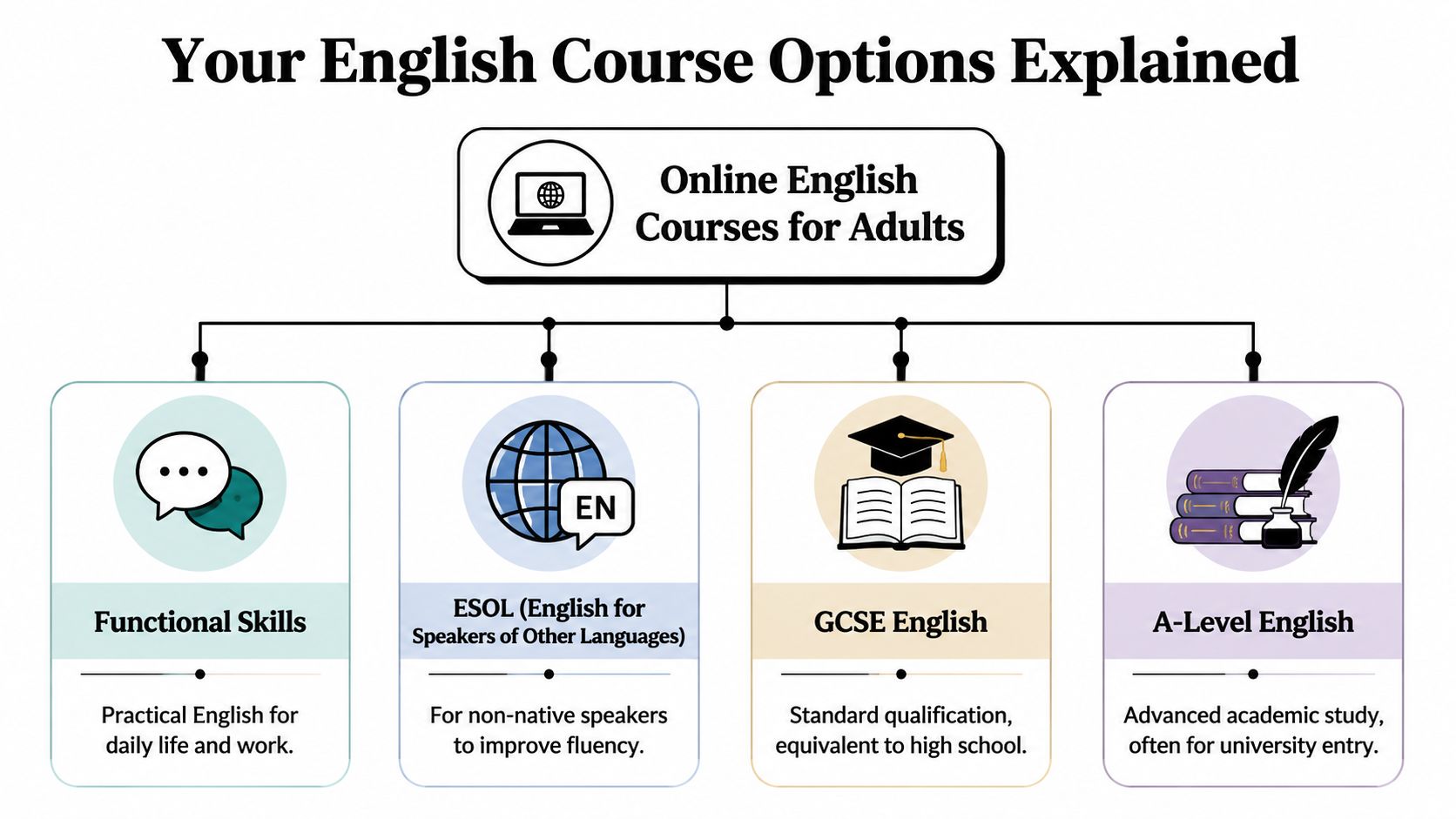
The world of adult education can sound more confusing than it needs to be. Functional Skills, ESOL, GCSE, A-Level. These names can feel like a code. They aren't. Think of them as different keys. Each key opens a different door.
The good news is that these qualifications sit inside a respected and valuable part of education. The UK English language learning sector contributes approximately £1.4 billion to the economy and supports around 35,700 jobs, according to English language learning statistics collected here. That tells you something important. These qualifications matter. Employers and universities know them.
Functional Skills English
This is often the best starting point for adults who need a recognised qualification for work, training, or further study. It focuses on practical English you use in real life.
That means things like reading clearly, writing accurately, and communicating with confidence. If you want a simple explanation of where this fits, this guide to what Functional Skills English means is useful.
Functional Skills can suit you if you want to move forward without getting lost in too much academic detail at the start.
ESOL
ESOL stands for English for Speakers of Other Languages. This route is designed for people whose first language isn't English.
If you can already speak some English but want to improve your reading, writing, listening, and speaking, ESOL may be the right fit. It helps build fluency for daily life, work, and study.
GCSE English
A GCSE English qualification is widely recognised and often asked for by employers, colleges, and universities. For many adults, this is the qualification they've always meant to go back and get.
It can be a strong option if your goal is a more traditional qualification that opens doors to further education and career progression.
Some learners need the fastest route to a recognised qualification. Others want the route that matches future university plans. The best choice depends on the door you're trying to open.
A-Level English
This is a more advanced qualification. It usually suits adults who already have the qualifications needed to study at that level and want to prepare for university or a subject that involves deeper reading and writing.
It isn't the first step for most returners. But for some learners, it's the right next one.
Finding the Course That Fits Your Life Story
Choosing between online english courses for adults becomes easier when you stop thinking only about course names and start thinking about your life.

The parent who wants a fresh start
Sarah is a mum of two. She wants to help more with homework, but she also wants better work options. She doesn't need a complicated route. She needs a qualification that proves she can read, write, and communicate at the level employers expect.
For someone like Sarah, Functional Skills English often makes sense. It's practical, clear, and closely linked to daily life and work.
The career changer who needs a recognised qualification
David has years of work experience, but every time he looks at new jobs, he sees the same problem. The role asks for English at a certain level. He knows he can do the job, but the missing qualification keeps holding him back.
A recognised English course gives someone like David proof on paper of the skills he already uses in real life. That can turn a frustrating "almost" into a real opportunity.
The learner aiming for college or university
Amina has bigger study plans. She wants to move towards higher education, but she knows she needs the right stepping stone first.
That could mean GCSE English, or it could mean starting with Functional Skills if that is the strongest first step for her confidence and current level. What matters most is not choosing the most impressive-sounding option. It's choosing the one that gives her the best chance of finishing well and moving forward.
A simple way to decide
If you're unsure, ask yourself these questions:
- Do I need practical English for work and everyday life? Functional Skills may suit you.
- Is English not my first language? ESOL may be the better fit.
- Do I need a widely recognised school-level qualification? GCSE English may be the route.
- Am I already at a strong level and aiming for advanced study? A-Level English may be the next stage.
Your course should fit your life story, not someone else's. The right choice is the one that helps you keep going.
What Each English Qualification Unlocks for You
An English qualification should do more than fill a line on a CV. It should help you build a steadier future, feel surer of yourself, and show your children what persistence looks like in real life.
For adults, the right course often works like a stepping stone. You do not need to cross the whole river in one jump. You need the next solid step that matches where you are now and where you want to go.
Online study can make that step easier to manage because it fits around work shifts, school runs, and family responsibilities. Many adult learners find they are more likely to stay on track when study fits into real life instead of competing with it.
Which English Qualification Suits Your Goal?
| Qualification | Best For… | Can Lead To… |
|---|---|---|
| Functional Skills English | Adults who need a practical, recognised qualification for work or further study | Entry requirements for some roles, workplace training, apprenticeships, and a clear starting point for further learning |
| ESOL | Adults whose first language isn't English and who want to improve fluency | Stronger everyday communication, more confidence in public settings, and progress into other courses |
| GCSE English | Adults who need a standard, widely recognised qualification | Access to many jobs, college courses, and some university entry routes |
| A-Level English | Adults aiming for advanced academic study | Higher-level study in literature, language, and related subjects |
What Functional Skills can lead to
Functional Skills English is often a strong first choice for adults coming back to education after years away. It focuses on practical reading, writing, speaking, and listening, the kind of English you use to understand instructions, write clear messages, and deal with forms, emails, and everyday workplace tasks.
That can make a real difference in specific situations. A learner might need Functional Skills to start a care course, meet the entry requirement for an apprenticeship, or apply for a customer service or support role where clear written communication matters. Equally, it gives many adults proof that they can study again and finish successfully.
What GCSE English can lead to
GCSE English carries broad recognition because employers and colleges know exactly what it represents. If a vacancy or course asks for English at a standard level, this is often the qualification they have in mind.
For adults who want that familiar benchmark, it can help to explore options to study GCSE English online. GCSE can strengthen your choices later, whether that means applying for a promotion, returning to college, or meeting an entry requirement that once felt out of reach.
The best qualification is the one that helps you make real progress in your own life, and gives you a result you can be proud to show your family.
What ESOL and A-Level can lead to
ESOL helps adults build the English they need to take part more fully in daily life. That might mean speaking with a teacher at your child's school, handling conversations at work with less anxiety, or feeling more at ease in appointments and community settings. Those changes may sound small on paper, but in daily life they can be life-changing.
A-Level English serves a different purpose. It suits learners who already have a strong foundation and want to study language or literature at a higher level. For the right person, it can be part of a bigger academic plan and a source of real personal fulfilment.
All four routes have value. The right one is the one that helps you build a future that feels bigger, steadier, and more hopeful than the one you have today.
How to Choose the Best Online Course for You
You finally sit down after work. The children are settled, the house is quieter, and your laptop is open. For a moment, it feels possible. Then the important questions arrive. Will this course fit around my life? Will anyone help if I get stuck? Can I really finish what I start this time?
Those questions matter.
A good online course should do more than offer lessons. It should give you a realistic path to the finish line. Many adult learners step away from study because work, family, health, or confidence problems get in the way. That is why support and flexibility are so important. A course may sound impressive on a website, but the true test is whether it still works when life becomes busy.
Ask what support you will receive
Support is the difference between struggling in silence and making steady progress. Adult learners often need clear explanations, patient feedback, and someone who treats questions with respect.
Before you enrol, check for practical help such as:
- A real tutor who explains mistakes in plain English
- Regular feedback so you know what to improve next
- Easy ways to ask questions without waiting too long for a reply
- Personal support if stress, family responsibilities, or self-doubt start affecting your study
It also helps to compare providers that offer accredited online courses in the UK with clear learner support. Accreditation matters, but day-to-day help matters too. You need both.
Choose a course that fits the life you have now
The best course for you is not always the one with the longest description or the biggest promise. It is the one you can keep returning to, even in a busy week.
A course works like a well-fitted coat. If it pulls too tightly around your schedule, you stop wearing it. If it fits your real life, you can move in it.
Look closely at three things:
- Study pace. Can you learn in the early morning, after work, or at weekends?
- Access. Can you use the course easily on the device you already have?
- Assessment. Do you understand how your work is marked and what you must do at the end?
This short video may help you think more clearly about what to look for before you enrol.
Pay attention to how the provider speaks to adult learners
The tone of a course provider tells you a lot. Some write as if every learner is already confident, organised, and free every evening. Adult life is rarely that tidy.
You deserve a provider that understands what it means to return to education later in life. That means warmth, structure, and patience from the start.
A good provider will not make you feel embarrassed for asking basic questions. They will make progress feel possible, one step at a time.
Choose the course that helps you picture yourself finishing. That result is bigger than a certificate. It can help you become a stronger example for your children, improve your options at work, and prove to yourself that your future is still open.
Your Toolkit for Success as an Adult Learner
Adult learners often worry about the same things. "I don't have time." "I've forgotten how to study." "What if I'm not clever enough?" These fears are common, but they don't have to control what happens next.
Verified data shows that modern online courses allow short 15 to 20 minute study sessions and offer instant feedback on writing. That suits busy adults. It matters especially for parents, because 62% of female learners in the UK mention childcare as a significant factor, and flexible online study helps reduce that barrier.
Learn in small pockets of time
You don't need a perfect three-hour block every day. Most adults don't have that.
Try this instead:
- Use short sessions when the house is quiet, before work, during lunch, or after the children go to bed
- Keep one notebook or folder so you don't waste time searching for papers
- Aim for steady progress rather than long, exhausting study days
Small sessions count. They build momentum.
Build a routine your family can see
When your family knows your goal, they're more likely to support it. Even young children understand, "Mum is studying" or "Dad has classwork to do."
A simple routine helps:
- Pick your study times for the week.
- Tell your family when those times are.
- Protect those slots as much as you can.
- Celebrate each finished piece of work.
Be kinder to yourself while you learn
Adults often expect themselves to get everything right straight away. Children don't learn like that, and adults don't either.
If you make mistakes in spelling, punctuation, or writing structure, that doesn't mean you can't do the course. It means you're learning. Feedback is not proof you've failed. It's proof you're in the process.
Progress in adult learning often looks quiet at first. One better paragraph, one clearer sentence, one finished task. Then confidence starts catching up.
Keep your reason close
Write down why you're doing this. Maybe it's for a better future. Maybe it's to become a role model. Maybe it's because you want to prove something to yourself after years of doubt.
Keep that reason where you can see it. On hard days, motivation needs reminding.
The First Step to Your New Future
A lot can change when you stop saying "one day" and start saying "now". That's what this journey is really about. Not being perfect. Not catching up with everyone else. Just taking one brave, steady step towards the life you want.
Online english courses for adults give people a second chance, and often a much better one than the first. They can help you become the parent who feels confident at parents' evening, the worker who applies for the better role, or the student who finally believes university could be possible.
You do not need to have all the answers today. You only need enough courage to begin. The right course can help you grow in skill, yes, but also in self-belief. That change can ripple through your whole home. Your children see it. Your family feels it. You feel it.
Start with the course that matches your life as it is now. Build from there. One lesson, one assignment, one success at a time.
The future you're hoping for doesn't begin when everything is perfect. It begins when you take the first real step.
If you're ready to take that step, Next Level Online College offers flexible online courses for adult learners across the UK, with recognised qualifications, clear progression routes, and support designed for real life. If you want a path that fits around work, family, and your future goals, it's a good place to begin.