
You might be reading this late at night after work, or while the house is finally quiet. Part of you wants a better future. Another part is worried you've left education too long, that science sounds too hard, or that you'll let yourself down.
Those feelings are common. They don't mean you're not ready. They usually mean this matters to you.
An online gcse science course can be a practical way back into learning if you want to move into a new job, meet entry requirements for further study, or prove to yourself and your family that you can still do something big. This isn't about becoming perfect overnight. It's about taking one clear step, then another, until your confidence starts to grow.
Your Journey to a GCSE Science Qualification Starts Here
Starting again as an adult can feel strange. You may be comparing yourself to younger students, remembering old school experiences, or worrying that you won't keep up. But adult learners often bring something powerful to study. They have purpose.
You're not studying just because someone told you to. You're studying because you want more choice, more stability, and more pride in your future. That reason matters on the hard days.
Online learning has become a normal route for GCSE study. The demand for online GCSE courses rose sharply, with a 235% increase in online learning registrations for GCSEs between 2019 and 2021, and in 2020 to 2021 over 1.2 million GCSE entries were supported by remote learning, with science making up 28% of these according to Pearson's information on free online GCSE Science lessons.
That matters for one simple reason. It shows that studying science online isn't unusual anymore. Many people have already taken this path.
What this means for you
An online course can give you structure without forcing you back into a school-style routine. You can study at home, fit learning around daily life, and build knowledge steadily.
If you're still wondering whether this route is realistic, it helps to look at options built for adults, such as GCSEs for adults online. Seeing that these courses exist for people in your position can make the goal feel real.
You do not need to feel confident before you begin. Very often, confidence comes because you begin.
A calmer way to think about returning to study
Try to replace one big frightening question, “Can I do all of this?”, with three smaller ones:
- Can I study for a short time each week? Most adults can, even if life is busy.
- Can I ask for help when I'm stuck? That's part of learning, not a sign of weakness.
- Can I keep going even if I have a wobble? Progress matters more than perfection.
If the answer is yes, even a nervous yes, then you've already got the most important thing you need.
Why a Science GCSE is Your Key to a Brighter Future

A Science GCSE can open doors. For some adults, it's a step towards nursing, healthcare support, childcare, university access, or other training routes where science is useful or required. For others, it's about finishing something they once thought was out of reach.
The value isn't only academic. It's personal.
When your children see you revising at the kitchen table, asking questions, and sticking with a challenge, they learn something powerful. They learn that adults can grow too. They learn that setbacks don't have to be the end of the story.
The reasons people keep going
People rarely return to education for just one reason. Usually, it's a mix of practical needs and emotional ones.
- Work and money: A recognised qualification can help you apply for roles that ask for GCSEs or prepare you for the next stage of study.
- Self-respect: Passing a subject you once feared can change how you see yourself.
- Family pride: Your success often becomes bigger than you. It lifts the mood of the whole home.
- Future plans: University, college, or career training can feel far away until you tick off one key qualification.
A science qualification also teaches useful habits. You learn how to read carefully, think logically, solve problems, and explain ideas clearly. Those skills help in many jobs, not just science-based ones.
Practical rule: Don't think of GCSE Science as “just another subject”. Think of it as proof that you can commit to a goal and finish it.
Many adults worry that studying science means memorising endless facts with no real-life use. That isn't the best way to see it. Science helps you understand health, energy, food, medicines, the environment, and the technology around you. It gives you a better grip on the world.
A short explanation can help make this feel more concrete.
Success changes more than your CV
A qualification can improve applications, but it can also change the story you tell yourself. Instead of saying, “I'm not academic,” you may start saying, “I'm someone who kept going.” That shift is huge.
Here's what often changes after an adult learner commits to study:
| Area | Before starting | After steady progress |
|---|---|---|
| Confidence | Doubt and hesitation | Growing belief |
| Family life | Worry about setting an example | Pride in being a role model |
| Career direction | Feeling stuck | More options to explore |
| Self-image | “I missed my chance” | “I'm building my future” |
That's why this step matters. It isn't only about passing an exam. It's about becoming the person you already hope you can be.
What You Will Actually Learn in GCSE Science
Science can sound bigger than it really is. Once you break it down, it becomes much more manageable. At GCSE level, you're learning clear ideas about living things, materials, energy, forces, and the world around you.
Combined Science and Single Sciences
For many adults, this presents the first point of confusion.
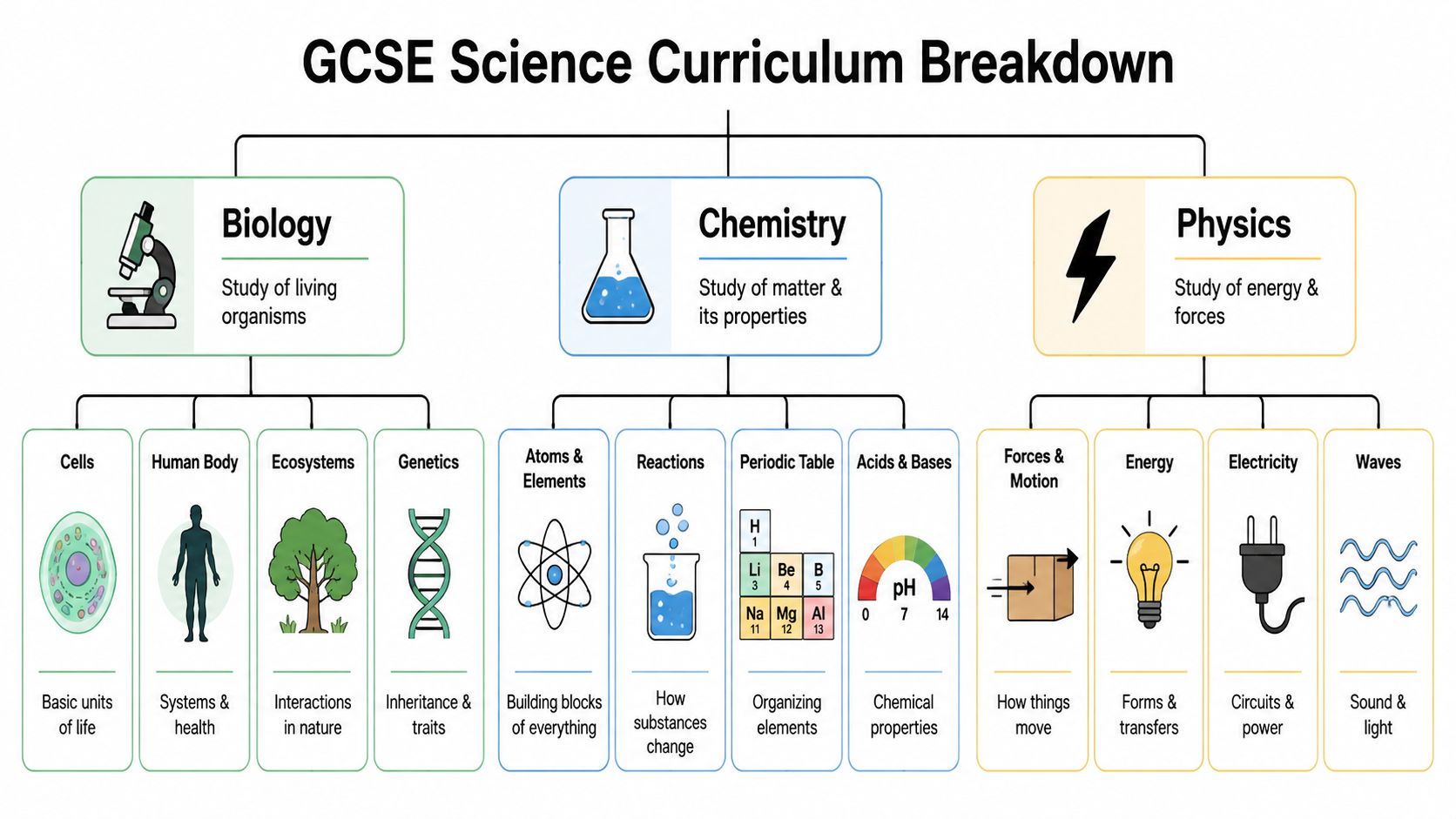
Combined Science means you study Biology, Chemistry, and Physics together as one broader course. You still cover all three areas, but not in as much depth as separate subjects.
Single Sciences means you take Biology, Chemistry, and Physics as separate GCSEs. This route is often better for learners who want more depth or who may later move into science-heavy study.
A simple way to think about it is this:
- Combined Science is like getting a strong guided tour of the whole science world.
- Single Sciences are like taking three separate trips and exploring each place in more detail.
Biology in simple words
Biology is the study of living things. It helps you understand how plants, animals, and humans stay alive, grow, and change.
You might learn about:
- Cells: The tiny building blocks that make up living things.
- The human body: How organs and body systems work together.
- Ecosystems: How animals, plants, and habitats depend on each other.
- Genetics: How features can be passed from parents to children.
If you've ever wondered why we get ill, how exercise affects the body, or why children may look like their parents, you're already thinking about biology.
Biology is often the easiest place for nervous learners to start because so much of it links to everyday life.
Chemistry and Physics without the jargon
Chemistry is about substances. It looks at what things are made of and what happens when they change. Cooking gives a simple example. Heat changes ingredients. Mixing substances creates something new. That's chemistry in action.
Physics is about rules. It explains how things move, how electricity works, how energy transfers, and how light and sound behave. If you switch on a lamp, use a plug, ride a bike, or brake in a car, physics is involved.
Here is a plain guide:
| Subject | Easy way to think about it | Everyday examples |
|---|---|---|
| Biology | The story of life | Health, plants, food, the body |
| Chemistry | The recipe book of the universe | Cooking, cleaning products, materials |
| Physics | The rulebook for how things work | Motion, electricity, heat, sound |
What learners often fear, and what's actually true
Some adults worry they need to be brilliant at maths to cope with science. In reality, you need to be willing to practise and ask questions. Some parts feel easier than others, and that's normal.
Others worry they won't remember everything. You won't remember it all at once. Learning science is a process of seeing an idea, revisiting it, practising it, and slowly making it familiar.
That's why a good online gcse science course breaks topics into small pieces. You don't have to climb the whole mountain in one day.
How Online Learning Fits Around Your Busy Life

Think about a normal week. Work takes energy. Family needs you. Meals need cooking. Messages need answering. By the time you sit down, your brain may feel full. That's exactly why flexible study matters.
A typical online GCSE Science course often uses a blended model with 2×60-minute live online lessons per week plus 2 to 4 hours of flexible self-study, and many courses use virtual labs for required practicals such as titrations or dissections that can be completed digitally from home, as described by Oxford Online School's online GCSE Combined Science course overview.
That setup works well for adults because it gives both structure and breathing room. You know when your live sessions happen, but you still have freedom over much of your week.
A realistic week for an adult learner
Let's make this feel real.
On Monday evening, you join a live lesson after dinner. You don't need to know everything before you log in. You just show up, listen, take notes, and ask one question if something doesn't make sense.
On Wednesday, you spend half an hour reviewing what you covered. On Friday, you watch part of a recorded explanation again because one topic didn't stick the first time. On Sunday afternoon, while the washing is on, you do a short quiz.
That is study. It doesn't have to look dramatic.
Why online doesn't mean alone
Adults sometimes fear that online learning will feel isolating. A strong course should feel guided, not abandoned.
Look for support like this:
- Live teaching: Real-time lessons help you keep momentum.
- Recorded materials: You can replay tricky parts at your own pace.
- Tutor help: You need someone to ask when a topic feels muddy.
- Progress tracking: Seeing what you've completed can be a big confidence boost.
Small, regular study sessions usually work better than waiting for one perfect free day that never arrives.
Virtual practical work also helps reduce stress. If the thought of labs sounds intimidating, digital tools can make the process clearer. You can focus on the method and the idea behind the experiment without the pressure of a busy classroom.
How to make the routine work at home
A few simple habits can make a big difference:
- Choose a regular study slot that fits real life, not fantasy life.
- Tell your family your plan so they know when you need quiet.
- Keep your materials in one place so starting feels easy.
- Study even when motivation is low if only for a short session.
Many adults discover something surprising after a few weeks. The routine that seemed impossible starts to feel normal. Then confidence follows.
Choosing the Right Online Course and Provider
Not every course offers the same level of support. This matters more than many adults realise. The right provider doesn't just give you lessons. They help you stay on track when life gets messy.
If you're comparing options, think like a careful shopper. You're not only buying access to content. You're choosing a learning partner.
For a wider look at recognised study routes, you can explore accredited online courses in the UK.
What to check before you enrol
Start with the basics. A good course should answer simple questions clearly. If the information is vague, that's a warning sign.
Use this checklist:
- Recognised exam board: Check whether the course matches a recognised board such as AQA, Edexcel, or OCR.
- Tutor access: Find out how you ask questions and how quickly support is usually given.
- Exam help: Make sure they explain how you'll book exams as a private candidate.
- Practical preparation: Ask how required practicals are covered.
- Study materials: See whether lessons, notes, quizzes, and revision tools are included.
Good signs and warning signs
A good provider usually explains things in plain English. You should be able to understand what you're getting, what support exists, and what the next steps are.
Warning signs often include hidden costs, unclear exam guidance, and no real mention of tutor support. If a course sounds easy but doesn't explain how learners are helped, be careful.
Here's a simple comparison:
| What to look for | Strong provider | Weak provider |
|---|---|---|
| Course information | Clear and detailed | Vague or confusing |
| Support | Tutor guidance available | Little sign of real help |
| Exam process | Explained simply | Left for you to work out |
| Learning style | Structured and flexible | Unclear or badly organised |
Choose the course that makes you feel supported, not the one that makes the boldest promises.
Questions worth asking
Before you enrol, ask direct questions. You don't need to pretend you know everything.
Try these:
- Who do I contact if I get stuck?
- How are lessons delivered?
- Is the course suitable for adult learners?
- How do you help with exam booking?
- What happens if I need extra time or a short break?
A provider's answers can tell you a lot. If they reply with patience and clarity, that's encouraging. If they dodge the question, keep looking.
The right course should leave you feeling calmer, not more confused.
Navigating Exams and Assessments With Confidence
Exams are often the part adults fear most. That's understandable. The word itself can bring back old stress. But exams become less frightening when you know exactly what the process looks like.
Start with this thought. Your course is there to prepare you in stages, not throw you into the deep end.
What assessment usually involves
GCSE Science is not only about reading notes. You'll also prepare for practical elements, usually through guided activities, demonstrations, and practical-focused tasks built into the course.
You should also expect revision support. This may include topic questions, mock exam practice, and feedback that shows where you're doing well and where you need a bit more work.
The exam is not a surprise attack. It should feel like the final step of work you've been practising for months.
Booking exams as a private candidate
Many adult learners take their exams as private candidates. That means you study through your course, then sit the formal exam through an approved centre.
As of March 2025, Ofqual regulations support remote invigilation equivalence, which makes exam access easier for online learners. It's also important to know that private candidates can face higher exam fees, at around £150+ per paper, so it helps to choose a provider that supports you with finding and booking a JCQ-approved exam centre, as noted by Open Study College's GCSE information page.
That single detail catches many learners out. The teaching may be online, but your exam arrangements still need proper planning.
A simple step-by-step view
Here's the process in calm, plain language:
- Study the course content and build your understanding topic by topic.
- Practise exam questions so you get used to the wording and timing.
- Prepare for practical requirements using the methods your course provides.
- Book your exam place through an approved centre if needed.
- Revise steadily in the final weeks instead of cramming at the last minute.
If revision worries you, practical help can make a huge difference. A guide to GCSE revision techniques can help you build a plan that feels manageable.
How to stay calm near exam time
A few simple habits help:
- Use short revision sessions instead of forcing marathon study.
- Focus on one topic at a time when your mind feels crowded.
- Do practice questions because science improves when you apply what you know.
- Ask for help early if a topic keeps tripping you up.
You do not need to feel fearless to sit an exam. You only need preparation, guidance, and a steady plan.
Your Next Steps to Begin Your Transformation
You don't need to have your whole future mapped out today. You only need to decide whether you're ready to take yourself seriously.
An online gcse science course can help you build a recognised qualification, stronger self-belief, and a better example for your children. It can also become the first solid step towards university, career training, or a job that gives you more security and satisfaction.
A simple way to begin
Keep it straightforward:
Think about your reason
Write down why this matters to you. Better work. University plans. Family pride. Personal proof.Choose your route
Decide whether Combined Science or separate sciences suits your goals better.Check the support
Pick a course that offers proper teaching, tutor help, and exam guidance.Set a realistic study routine
Don't aim for perfect. Aim for regular.Start before you feel fully ready
Readiness often grows after action, not before it.
Your family doesn't need to see you do this perfectly. They need to see you do it bravely.
There may still be doubt in your mind. That's alright. Most meaningful changes begin with some fear. What matters is that you don't let that fear make the decision for you.
A year from now, you could still be wondering if you should have started. Or you could be revising for exams, speaking more confidently, and showing your children what determination looks like in real life.
That future is built from one choice. The choice to begin.
If you're ready to take that first step, Next Level Online College offers flexible online learning designed for adult learners who want recognised qualifications, real support, and a path towards a better future. If you want to make your family proud, improve your career options, and prove to yourself that you can do this, it's a strong place to start.