
You might be reading this after a long day. The children need you. Work has taken your energy. Money worries sit in the back of your mind. And somewhere underneath all that, there's still a quiet thought that won't go away.
You want more.
Maybe you want your GCSEs. Maybe you need A Levels for university. Maybe you want to prove to yourself, and to your family, that your story isn't finished. What often stops adults isn't lack of ability. It's the fear of fitting study into real life, and the fear of starting again.
That's why personalised learning plans matter. They turn a big dream into a path you can walk.
Your Journey Starts with a Personal Map
A lot of adults think education only works if you can study like a teenager with free evenings and no bills. Real life says otherwise. You may be working shifts, raising children, caring for family, or trying to stretch every pound. In that situation, “go back to education” can sound less like hope and more like pressure.
But a good plan shouldn't ask you to become someone else.
It should start with your life as it is now.
UK adult learning conversations increasingly centre on flexibility, because many learners are trying to study alongside work, family, and financial pressure. That practical question matters just as much as the course itself, as noted in this discussion of adult learners balancing study with real-life constraints.
Why a map matters when confidence is low
When confidence has taken a knock, vague advice doesn't help. “Just stay motivated” isn't enough. You need something clearer.
A personalised learning plan is a personal map. It helps you answer simple but powerful questions:
- Where am I now with my skills, confidence, and time?
- Where do I want to get to such as university, a new job, or passing English and maths?
- What route fits my life instead of someone else's?
- What support do I need when life gets messy?
That matters because big goals often feel frightening when they stay big. A plan breaks them into steps you can face.
You do not have to sort out your whole future in one weekend. You only need the next clear step.
This is about more than a course
A personalised learning plan isn't only about revision timetables and targets. It's about what education can change.
It can help you become the parent who says, “I went back and did it.”
It can help you apply for roles you once thought were out of reach.
It can help you build a home where your children grow up seeing persistence, courage, and learning in action.
You're not behind. You're building.
What a Personalised Learning Plan Really Is
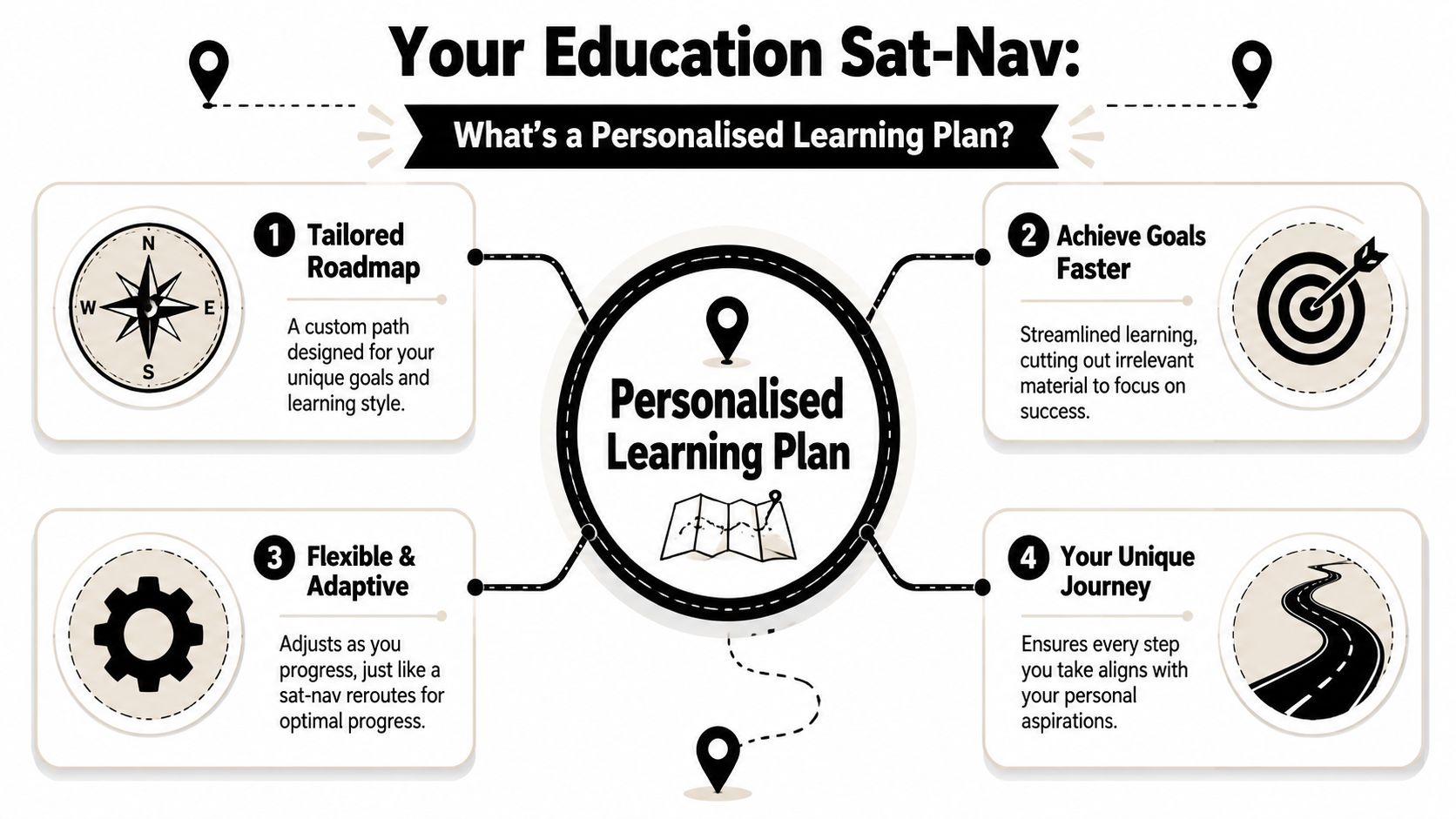
The easiest way to understand a personalised learning plan is to think of a sat-nav for your education.
A sat-nav needs two things. It needs your starting point, and it needs your destination. Then it works out the route. If there's a delay, it adjusts. If you miss a turn, it doesn't shame you. It helps you get back on track.
That's what personalised learning plans do.
It's not a scary test
Some adults hear the word “plan” and picture forms, judgement, or being told what they can't do. A proper plan should feel very different.
It should help you see:
| Part of the plan | What it means in plain English |
|---|---|
| Starting point | What you already know and what needs work |
| Destination | Your goal, such as GCSEs, A Levels, university, or a career move |
| Route | The lessons, resources, and weekly study pattern that fit your life |
| Check-ins | Regular reviews so the plan stays useful |
The UK has a long history with this idea. Ofsted's review of personalised learning found it works best when it links assessment, clear targets, and regular review, rather than sitting as a vague label. That's why a plan is more than paper. It's a working system built around progress and feedback, as described in this Ofsted-linked review of personalised learning practice.
A living guide, not a fixed script
Life changes. Children get ill. Work rotas move. Your confidence can rise in one subject and wobble in another. A useful plan changes with you.
That means your personalised learning plan might include:
- A clear main goal such as getting into nursing, teaching, business, or social work
- Short-term targets so the big goal feels manageable
- Study methods that suit real life like evening sessions, weekend catch-up, or mobile study on breaks
- Support points so you know who to ask when you get stuck
Practical rule: If a plan only looks good on paper but doesn't fit your week, it isn't personalised yet.
The point isn't to create the perfect plan on day one. The point is to build a route you can keep following.
How This Plan Transforms Your Family's Future
Passing a qualification matters. But most adult learners aren't doing this just for a certificate.
You're doing it because you want life to feel different.
Maybe you want your children to see you studying at the kitchen table and realise that learning doesn't end at school. Maybe you want to stop shrinking yourself in job interviews. Maybe you want work that feels meaningful, stable, and better paid.
Your children are watching more than you think
Children notice effort. They notice when you keep going, even when you're tired. They notice when you say, “This is hard, but I'm still doing it.”
That example stays with them.
When you follow a learning plan, you show them that goals aren't magic. Goals are built in ordinary moments. A page of notes after bedtime. A lesson on your lunch break. A weekend revision session instead of giving up.
You become proof that change is possible.
Confidence grows from kept promises
A lot of adults return to study carrying old labels. Not academic. Too late. Not clever enough. Bad at maths. Bad at writing.
A personalised plan helps challenge those labels because it gives you small promises you can keep. Finish one task. Attend one tutorial. Revise one topic. Then do it again.
That repeated progress can change how you see yourself.
Each completed step says something powerful. “I can trust myself to move forward.”
Better opportunities often start with one qualification
Education can open doors to further study, professional training, and work with more responsibility. For many adults, the first step is choosing a route that feels realistic. That could mean English and maths first, then GCSEs, then higher-level study. If you're comparing options, these adult education courses online show the kinds of pathways many returners use to build towards university or a career change.
Not everyone starts with a clear final destination. That's fine.
What matters is that you start moving towards a future with more choice. More confidence. More security. More pride when your family sees you become the person you knew you could be.
The Simple Building Blocks of Your Success Plan
A strong personalised learning plan doesn't need fancy language. It's usually built from a few clear parts. Think of it as a friendly conversation about your future.
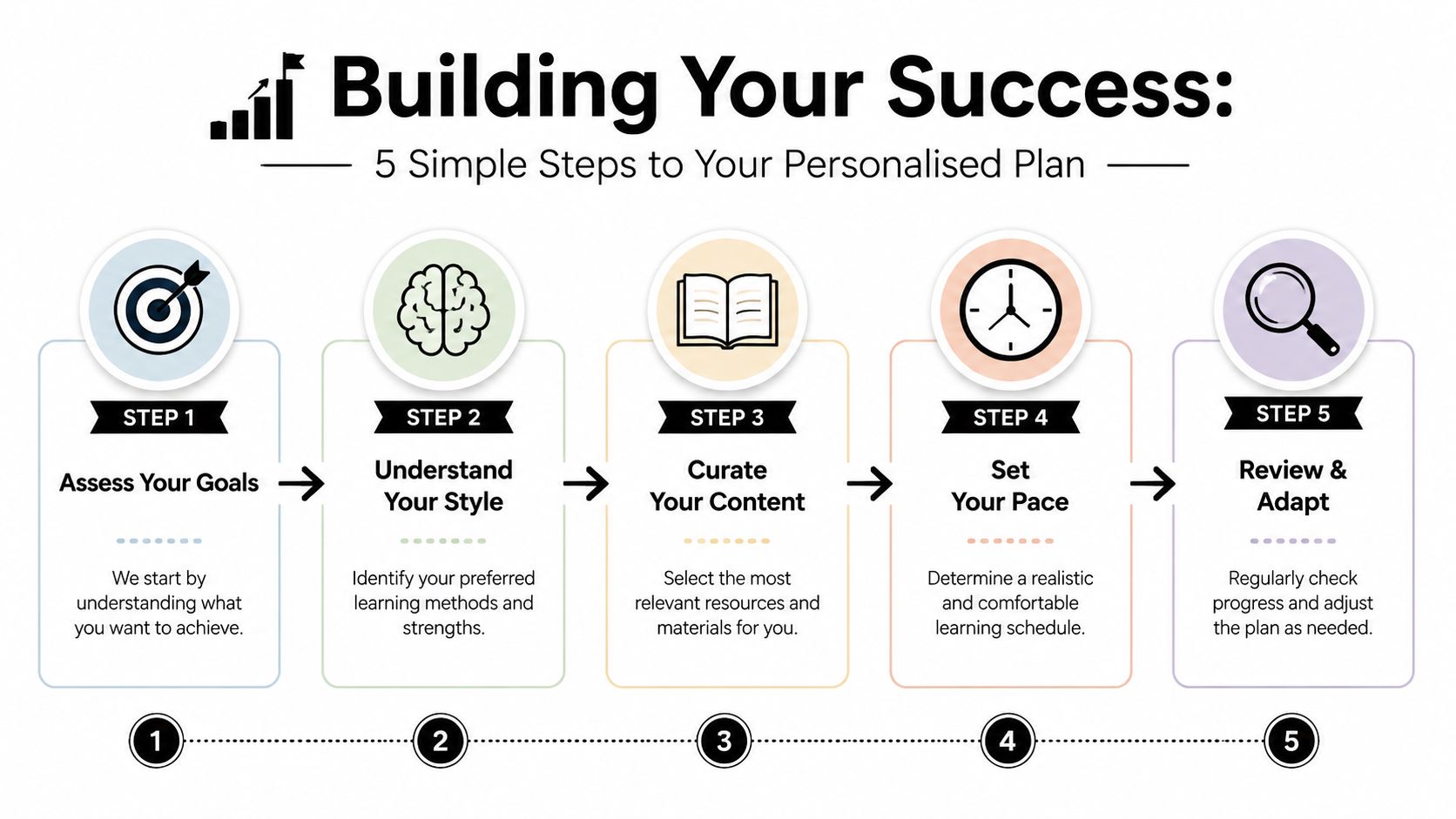
Where are you now
This is your starting point. You look at your current skills, your past study experience, your confidence level, and your weekly routine.
You might be strong in speaking but rusty in writing. You might understand maths ideas but panic under timed conditions. You might have plenty of determination but very little spare time.
None of that is failure. It's information.
Where do you want to go
Your destination needs to be clear enough to guide your choices. “I want a better life” is honest, but it's hard to plan from. “I want GCSE Maths so I can move towards an Access course” is easier to act on.
Your goal might be:
- A foundation goal such as Functional Skills in English or maths
- A stepping-stone goal such as GCSEs or A Levels
- A bigger progression goal such as university entry or a career change
What's the best route
Now, the plan becomes practical. You decide how learning will happen in a way that fits around your week.
Some people can study early in the morning. Others work better once the children are asleep. Some need short bursts. Others prefer longer weekend sessions.
A route might include:
| Question | Example answer |
|---|---|
| When will you study? | Tuesday and Thursday evenings, plus one hour on Sunday |
| What will you study first? | The weakest topic or the subject with the nearest assessment |
| How will you learn? | Online lessons, tutor feedback, practice papers, revision notes |
| What happens if you fall behind? | Adjust the week and focus on the most important next task |
Who's on your team
Even the most determined adult can lose momentum when studying alone. Support matters.
That support could come from a tutor, mentor, family member, study group, or even a child who proudly asks, “How did your lesson go today?” The important thing is that you're not left guessing your way through.
Are we there yet
Good plans don't sit in a drawer. They get reviewed.
In England's apprenticeship guidance, providers are expected to create an initial assessment and a personalised training plan that is reviewed and updated at least every 12 weeks, which shows how important regular check-ins are for keeping learning aligned to real progress. You can see that expectation in this summary of personalised training plans and review points in apprenticeships.
That doesn't mean your review has to feel formal. It can be as simple as asking:
- What's going well
- What feels difficult
- What needs to change this month
A living plan protects your progress because it changes before small problems become big ones.
What Your Learning Plan Could Look Like
It helps to see what this looks like in real life. So let's use a simple example.
Sarah is a mum in her thirties. She works part-time, manages most of the school run, and wants to become a nurse. She knows she can't jump straight to university yet. First, she needs to build the qualifications and confidence to get there.

Sarah's long-term goal
Her big goal is clear. She wants a route into higher education and then into nursing.
That goal gives meaning to the smaller tasks. When she studies fractions or writes an English response, she isn't “just doing homework”. She's building her future.
Sarah's short-term plan
Her personalised learning plan might look something like this:
Main aim
Build the qualifications needed for future higher education study.First focus
Strengthen English and maths skills, then move towards the next qualification stage.Weekly pattern
Two evening study slots after the children are asleep, one short weekend catch-up session, and light revision on her phone when she has spare moments.Support
Regular tutor contact, feedback on written work, and clear advice before assessments.Review point
A scheduled check-in to see what's working and what needs adjusting.
Notice what this plan doesn't do. It doesn't pretend Sarah has endless time. It doesn't assume she can study every night. It doesn't punish her for being an adult with responsibilities.
It works with her real life.
What happens when life gets busy
One week, Sarah's child is off school. Another week, work asks for extra hours. These situations can lead some learners to think they've failed.
They haven't.
A personalised plan should bend without breaking. If one week goes badly, the answer isn't shame. The answer is to scale back, protect the most important task, and restart.
This short video gives a useful sense of how flexible support and planning can make study feel more manageable:
Why stories like Sarah's matter
You may not want nursing. Your goal might be teaching, business, childcare, counselling, policing, construction management, or getting through the door to further study.
The shape of the plan changes. The principle stays the same.
A dream becomes more reachable when it has a route, a rhythm, and support.
Making Your Plan Fit Around Your Busy Life
The biggest question many adults ask isn't “Can I learn?” It's “Where will I find the time?”
The answer usually isn't finding huge empty spaces. Most adults don't have those. The answer is building a study routine out of small, repeatable pieces.
Think in pockets, not perfect days
A perfect study day might never come. Real progress often happens in short bursts.
Try this approach:
- Use short sessions because twenty focused minutes can still move you forward
- Keep one main task per session so you don't waste time deciding what to do
- Leave work ready for the next time by ending with a note like “Next, finish question 4”
That way, study feels lighter to start.
Make your phone help you
Your phone can distract you, but it can also support you. Use it for quick revision, reading notes, checking feedback, or watching a short lesson while travelling or waiting.
Many learners do better when they stop thinking of study as something that only counts at a desk.
Let your family into the plan
Families often support study better when they understand the routine. A simple shared calendar can help. If your children know that Tuesday evening is your study time, they begin to see it as normal and important.
You're not taking time away from them for no reason. You're building something that can benefit all of you.
For adults who need flexible study patterns, these distance learning courses in the UK show how learning can sit around work and home life rather than competing with it.
Be kind, but be organised. If one week goes wrong, restart the next day instead of waiting for the perfect Monday.
Keep the plan realistic
A realistic plan beats an ambitious one you can't maintain. Start smaller than your ego wants. Build from there.
That might mean three short sessions a week, not seven. It might mean one subject first, not everything at once. It might mean asking for help earlier than you're used to.
That isn't weakness. It's smart planning.
How We Build Your Plan at Next Level Online College
Support matters because personalisation on its own isn't enough. Without clear structure and frequent feedback, some learners can feel lost rather than helped, as explained in this discussion of why personalised learning needs strong support and feedback.
That's especially important for adults returning to education after a break. Flexibility is useful, but only if someone helps you turn that flexibility into a plan you can follow.
What that looks like in practice
At Next Level Online College, the process is built around adult learners who need study to fit around real responsibilities. That means starting with your goals, looking at your current level, and shaping a path through recognised qualifications such as Functional Skills, GCSEs, A Levels, or Access to Higher Education.
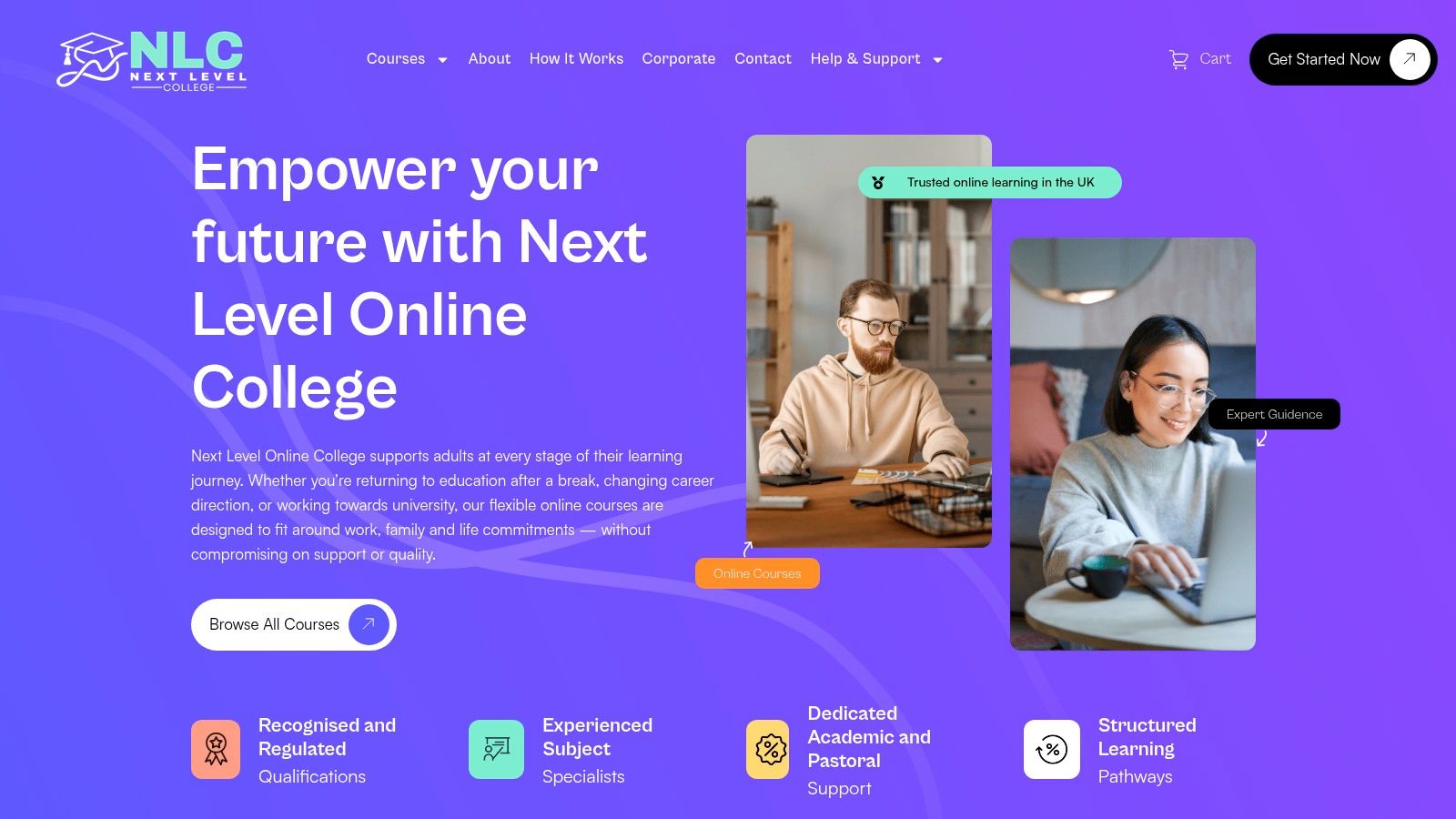
The key parts are practical:
- Clear starting point so you know what level you're working at
- Structured course pathway so you're not guessing what comes next
- Tutor and pastoral support so problems don't build in silence
- Progression focus so your course links to a bigger goal like university or a new career
Why adults often need more than content
Online learning can sound simple until you're the one doing it after a hard day. Videos and worksheets alone don't always solve the actual problems. Adult learners often need reassurance, accountability, and help rebuilding confidence as much as they need subject knowledge.
That's why a proper personalised learning plan should include both academic support and human support.
Flexible learning works best when someone helps you turn good intentions into steady action.
If you've been putting off study because you're worried you'll be left alone to work it all out, that concern makes sense. The right setup doesn't leave you guessing. It gives you a route, support, and regular moments to reset when life shifts.
If you're ready to stop wondering and start building, Next Level Online College can help you take the first step. A simple conversation can turn a distant dream into a clear plan that fits your life, supports your family's future, and helps you become the role model your children already need.