
You may be sitting at your kitchen table reading this after work, wondering if it's too late to go back into education. Maybe you've spent years raising children, holding down a job, helping customers, training new staff, managing a home, or supporting people in your community. You've learned a lot. But because it didn't happen in a classroom, it can feel like it doesn't count.
That feeling is common. It can chip away at your confidence. You might look at a college course or a university path and think, “Other people have certificates. I've just got life experience.”
But life experience isn't “just” anything. It can be the start of your next chapter.
Prior learning recognition is one of the most powerful ideas in adult education because it says something many adults need to hear. Your past still matters. The things you've learned through work, family life, volunteering, and training may help you move forward faster, with more confidence, and with a clearer path towards the future you want.
Your Life Experience Is Your Superpower
Sarah isn't a real student, but her story will feel familiar to many people.
She left education years ago. Since then, she's worked in care, helped train new starters, organised rotas, spoken with worried families, handled paperwork, and kept calm when things got tough. At home, she's managed bills, school runs, appointments, meals, and everything else family life throws at you. She's capable, dependable, and strong.
Still, when she looks at a course page, she feels small.
Why adults often doubt themselves
Many adult learners have a strange habit. They respect everyone else's skills, but they dismiss their own. They say things like:
- “I was only doing my job.”
- “I never went to university, so I'm probably not good enough.”
- “I've got no proper proof.”
- “I'm too old to start again.”
Those thoughts can stop brilliant people from taking the next step.
What's often missing isn't ability. It's recognition. Adults can spend years building skills without ever hearing those skills described in academic language. Problem-solving becomes “just coping”. Leadership becomes “just helping out”. Planning becomes “just being organised”.
What your experience really shows
When you look more closely, your daily life may already show the kind of learning colleges and universities value.
| Life experience | What it may show |
|---|---|
| Managing a team at work | Leadership, communication, decision-making |
| Caring for children or relatives | Planning, responsibility, resilience |
| Volunteering in the community | Teamwork, service, initiative |
| Running budgets and schedules | Numeracy, organisation, prioritising |
| Learning systems on the job | Adaptability, technical understanding |
That doesn't mean every experience turns into credit automatically. It does mean your story may hold more value than you think.
Your experience may not look like a textbook, but it can still prove real learning.
Why this matters for your family too
Going back into education isn't only about you. It's also about what your children, partner, and family see when they look at you.
They see someone who didn't give up.
They see someone who chose growth over fear.
They see someone building a better future.
That matters. Children notice more than we think. When they see you study, stretch yourself, and keep going, they learn that education isn't only for the lucky or the young. They learn that it's for people who are brave enough to try.
If you've ever wanted to build a stronger future, move into a more fulfilling career, earn more, or prove to yourself that you can do this, prior learning recognition can become more than a process. It can become proof that your life has already prepared you for more.
What Is Prior Learning Recognition
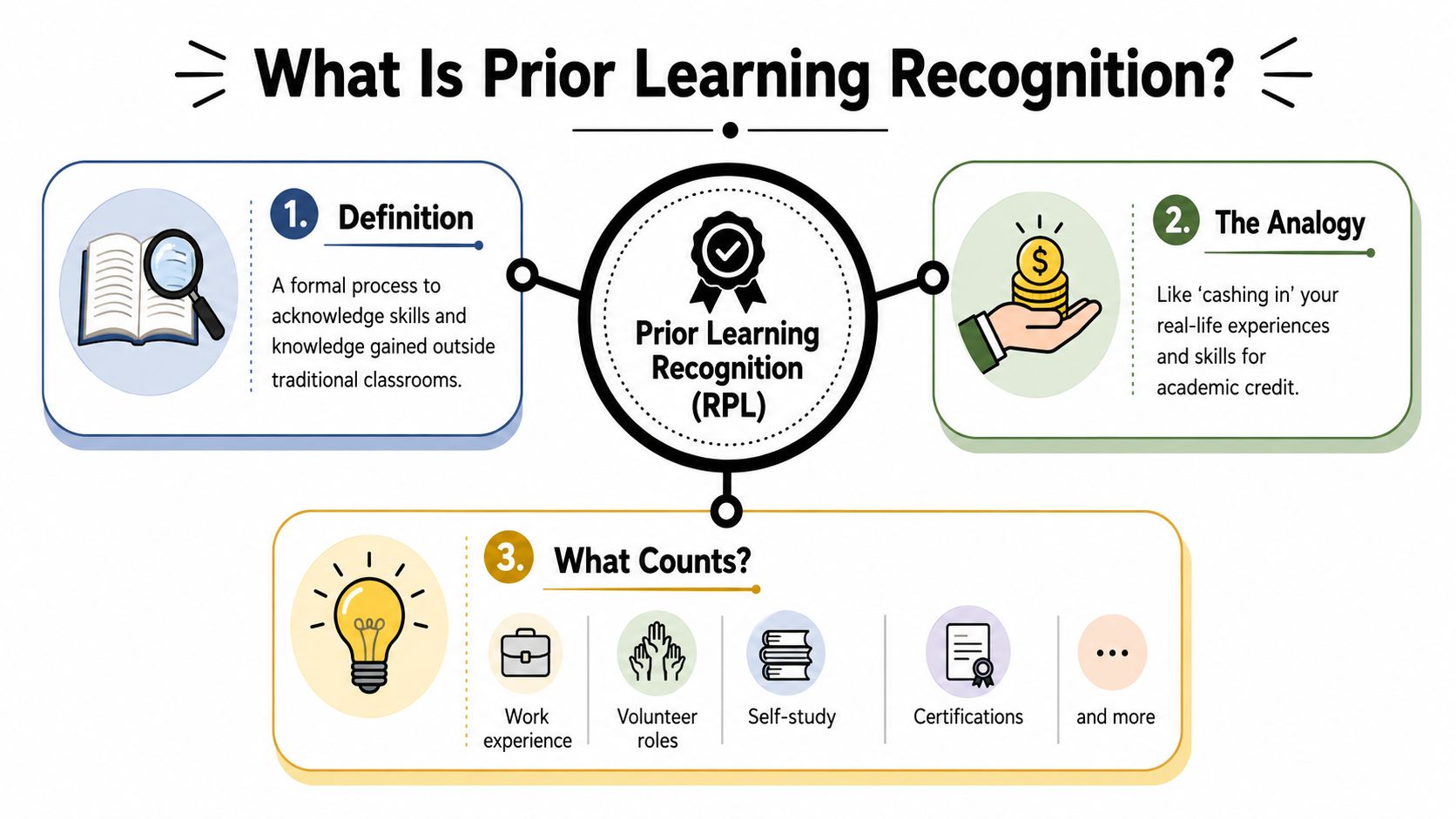
Prior learning recognition is a formal way of looking at what you already know and asking, “Can this count towards a course?”
A simple way to think about it is this. It's a bit like cashing in life points. If you've already learned something through work, training, family life, volunteering, or previous study, you may not need to start from zero.
That doesn't mean you skip learning. It means a college or training provider may recognise learning you've already gained.
The two main types
In the UK, Recognition of Prior Learning uses two distinct categories. There is Prior Certificated Learning, which means learning that was formally assessed and certified from previous study. There is also Prior Experiential Learning, which means non-certified skills gained through work, family, volunteering, or travel. The key point is that only the learning, not the experience itself, is assessed for credit, as explained in the Greater Manchester RPL policy and regulations.
Here's what that looks like in plain language.
Prior Certificated Learning
This is the easier one for many individuals to understand.
You studied before. You passed something. You have a certificate, transcript, or official record. That earlier learning may count if it matches part of your new course.
Examples might include:
- An old college qualification such as a BTEC or NVQ
- Professional training that was assessed and awarded
- Units from a previous course you didn't fully finish
Prior Experiential Learning
This is the part that often changes everything for adult learners.
You may have no certificate for it, but you've still learned through doing. Maybe you've supervised staff, solved complaints, handled safeguarding concerns, planned events, or supported vulnerable people. Maybe you've built skills through parenting, caring responsibilities, or community work.
What matters is not just saying, “I did this for years.” You need to show what you learned from doing it.
The part that confuses people
Many adults hear about prior learning recognition and think experience alone is enough. It isn't. The assessor isn't giving credit for being busy or for turning up to work.
They're looking for evidence of knowledge, skill, and understanding.
Practical rule: Don't ask, “What have I done?” Ask, “What have I learned, and how can I show it?”
For example:
- A job title on its own doesn't prove much.
- A reflective explanation of how you led a team through a difficult change is stronger.
- A certificate helps, but it may still need to match the course outcomes.
That's why prior learning recognition can feel technical at first. Once you understand the difference between experience and learning, it starts to make sense. And once it makes sense, it becomes much less frightening.
How RPL Can Fast-Track Your Success
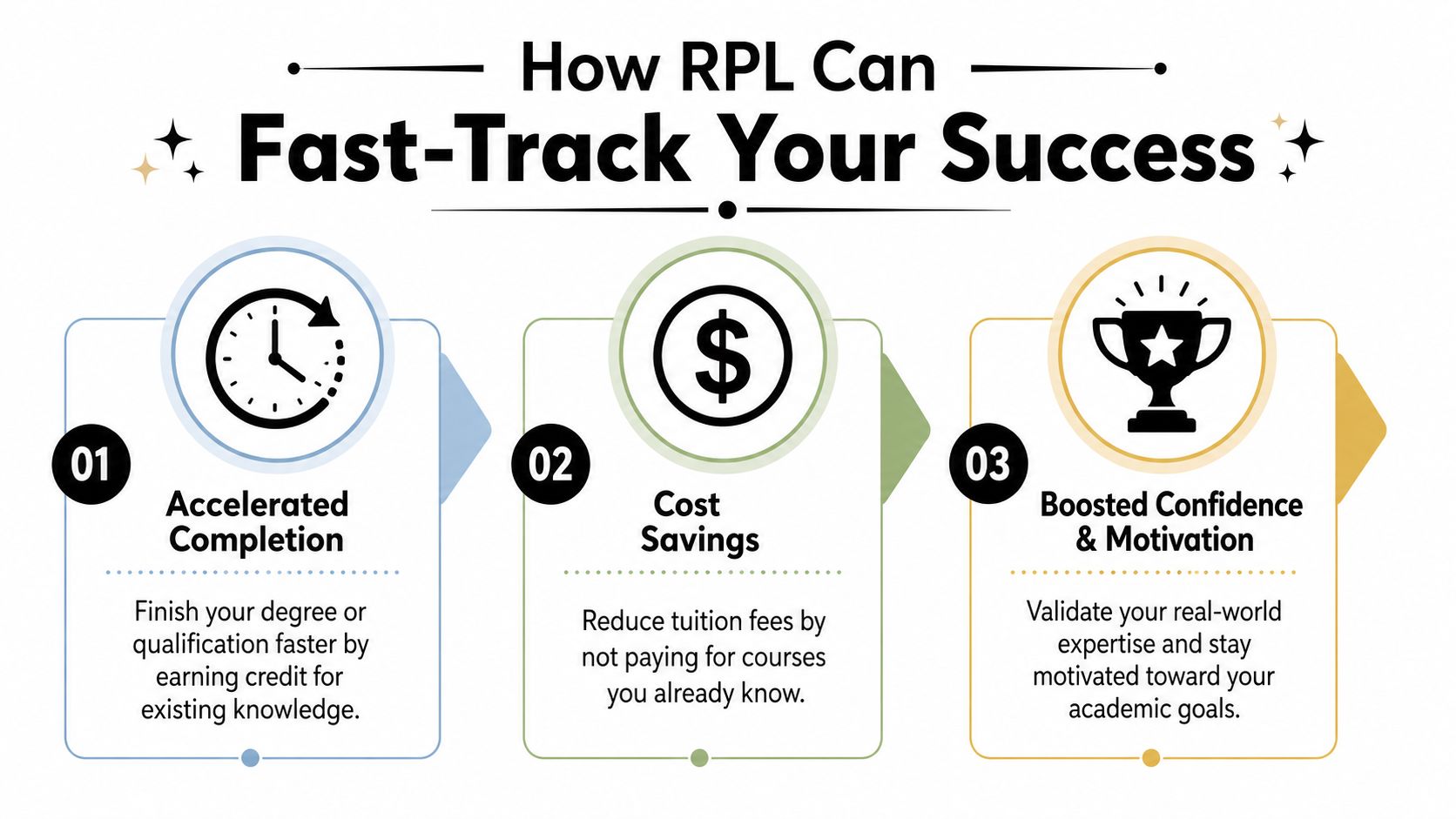
When prior learning recognition works well, it can change how you see your future.
Instead of feeling like you must start from the very bottom, you begin from where you really are. That's powerful for practical reasons, but it's also powerful emotionally. Many adults don't need someone to flatter them. They need someone to recognise what they've already built.
A shorter route can feel possible
One of the biggest barriers for adults is time.
You may be working. You may be parenting. You may already be stretched. The idea of doing every part of a course from scratch can feel heavy before you even begin. Prior learning recognition can help by recognising learning you've already done, which may reduce the amount of new study required.
That can turn a dream into a plan.
Cost matters too
Money is another real concern. If part of your learning can be recognised, that may affect the overall cost of your programme in some settings.
A clear example appears in apprenticeships. The UK government says that where Recognition of Prior Learning is applied, providers must carry out a thorough initial assessment and calculate prior learning as a percentage of the total off-the-job training hours. They then reduce content, duration, and price using that process, including the instruction to “half this, to get the starting point for the price reduction”, as set out in the government guidance on apprenticeships initial assessment to recognise prior learning.
That's a technical rule, but the human meaning is simple. If you already know some of what a programme covers, you may not need to pay in the same way for learning you've already gained.
Confidence grows when your experience is validated
This benefit matters just as much as time or money.
Lots of adults walk into education carrying shame. They think they “messed up” school, or that they're behind everyone else. Prior learning recognition can challenge that story. It gives formal value to learning that happened outside a classroom.
A parent who has organised family life through difficult times may discover they've built serious planning skills. A worker who has trained others may realise they've developed leadership and communication. That shift in self-belief can change how you study, how you speak, and what you aim for next.
Later on, that confidence can help if you're exploring routes such as getting into university without A Levels.
Here's a short video that helps bring the idea to life.
The UK system can feel patchy
There's one honest point to make. England doesn't have one simple, universal national system for prior learning recognition.
The OECD confirmed that there is no England-wide national strategy for Recognition of Prior Learning and said it remains “of limited use and is mainly conducted in programmes” rather than through a full national policy, as noted in the OECD report on the recognition of prior learning.
That may sound disappointing, but it doesn't mean the opportunity isn't real. It means the rules depend on the type of course, provider, and pathway. So the smartest move is to ask clear questions early and get proper guidance.
Building Your Portfolio of Evidence Step by Step
This is the part many adults fear most. The word “portfolio” can sound formal and hard. In reality, it means gathering proof and explaining it clearly.
You don't need fancy language. You don't need to sound academic. You do need to be honest, organised, and willing to think about what you've learned.
Start with the learning, not the paperwork
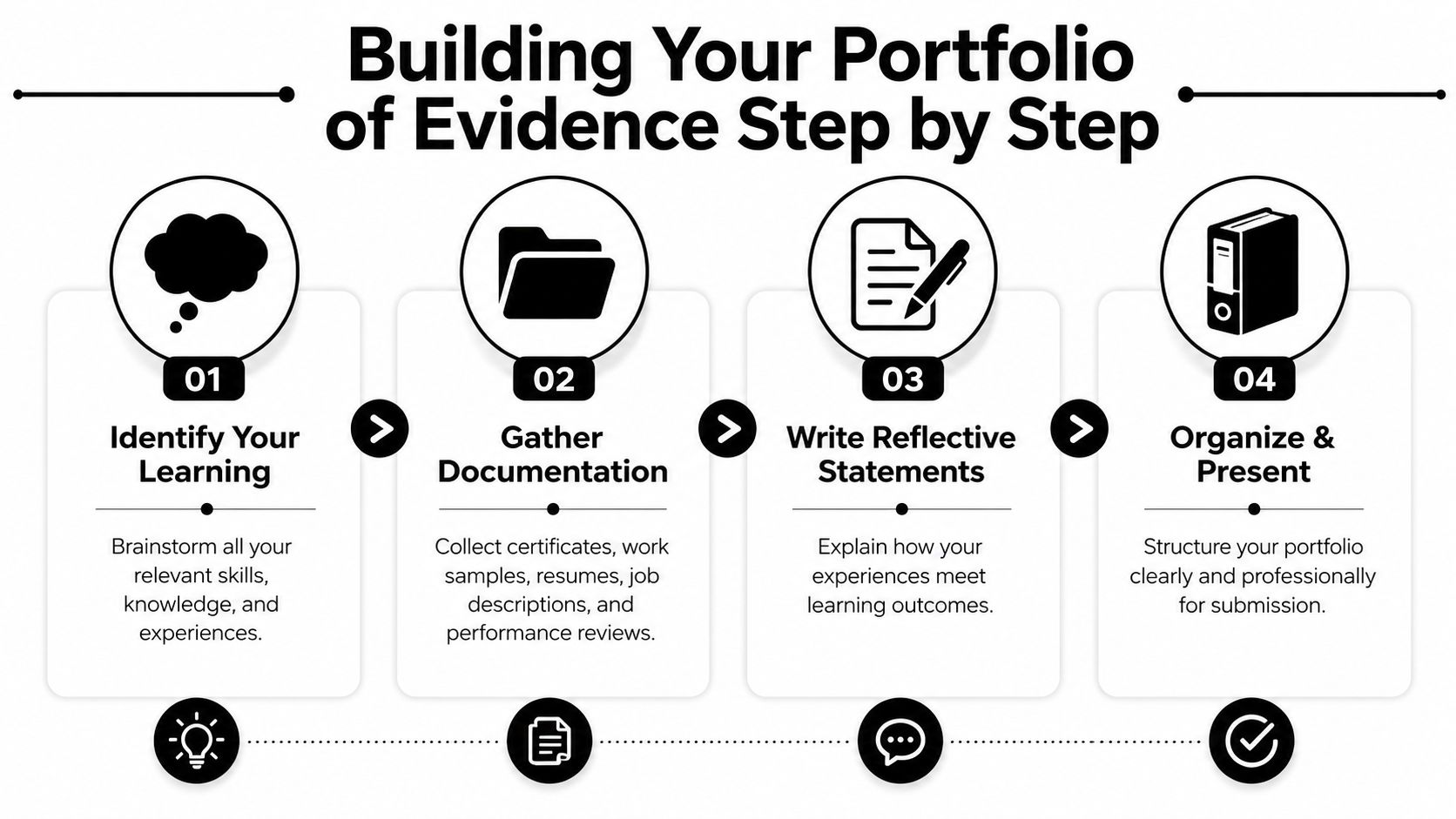
A common mistake is to collect papers first and think later. Start the other way round.
Ask yourself:
- What do I know how to do well?
- Where did I learn it?
- Which parts of that learning match the course I want to join?
If you've worked in health care, business support, customer service, childcare, construction, education, or management, you've probably learned more than you realise. The same goes for unpaid roles.
Build a simple evidence file
Once you've listed your skills and knowledge, begin collecting anything that helps prove them.
Useful items often include:
- Your CV with clear job roles and responsibilities
- Job descriptions from current or past roles
- Certificates from training, even short courses
- Appraisals or reviews that describe your performance
- Work samples such as reports, plans, checklists, or presentations
- Emails or letters that show responsibility or achievements
- Volunteer records if they show relevant duties
Don't panic if you don't have everything. Many adults think, “I've lost old paperwork, so that's the end of it.” It usually isn't. You can often strengthen a claim in other ways.
Learn how to write a reflective account
A reflective account is a clear piece of writing about what happened, what you did, and what you learned.
Keep it grounded. Use real examples. Focus on your decisions and your understanding.
A basic structure might look like this:
| Part | What to include |
|---|---|
| Situation | What was happening? |
| Action | What did you do? |
| Learning | What knowledge or skill did you use or gain? |
| Result | What happened because of your actions? |
| Match | Which course outcome does this support? |
Here's a plain example.
I supported a new member of staff during their first weeks in the workplace. I explained procedures, showed them how to record information correctly, and checked their understanding. Through this, I used communication, coaching, and quality checking skills. This experience shows I can apply workplace standards and support others to meet them.
That doesn't need to sound clever. It needs to show learning.
Ask for witness evidence
Sometimes another person can help confirm what you've done and how well you've done it.
This might come from:
- A manager who has seen your work directly
- A colleague with enough senior knowledge to comment properly
- A volunteer coordinator if your unpaid work is relevant
- A professional contact who can describe your responsibilities
Ask them to be specific. “She is hardworking” won't help much. “She trained new staff on records, safety procedures, and communication with clients” is much better.
A strong witness statement describes what you actually did and how it linked to real standards or responsibilities.
Map each piece to learning outcomes
At this stage, prior learning recognition becomes more than a folder of papers.
You need to connect each piece of evidence to the course requirements. That might mean matching your certificate, reflective account, or witness statement to a particular module or learning outcome.
In UK practice, learners must actively produce and map their own evidence to learning outcomes. Accepted methods can include reflective accounts, expert witness testimony, professional discussions, or portfolios that cross-reference skills to assessment criteria. Learners also need to work with an assessor to create a clear assessment plan, according to the NOCN Recognition of Prior Learning policy and procedurePolicyandProcedure(V5.0202102)(1).pdf).
Keep it neat and manageable
Your portfolio doesn't need to be huge. It needs to be clear.
Try this simple order:
- A short summary of your background
- A skills list linked to the course
- Your main documents
- Reflective accounts
- Witness testimonies
- A mapping sheet showing what each item proves
If you're organised, the process gets easier fast. If you're not naturally organised, don't let that put you off. This is a skill you can build while preparing your claim.
The best portfolios aren't written by perfect people. They're built by real people who finally give their experience the credit it deserves.
Understanding Credits Fees and Your Study Path
When adults first hear about prior learning recognition, many hope it means they can skip most of a course. However, it is often more balanced, and that's a good thing.
A respected qualification should recognise your past learning while also making sure you gain fresh, current knowledge. That's why providers set limits.
How much prior learning can count
In UK universities, there are rules around how much of a course can be covered through RPL. Northumbria University's policy states that the minimum claim for exemption must equal one whole module and that learners can have a maximum of two-thirds of their total programme credits come from RPL. That means learners must still complete at least one-third of the course themselves, as explained in the Northumbria policy on recognition of prior learning and the HE framework.
That might sound like a limit, but it also protects you.
It means your final qualification reflects both your experience and new study. You won't just rely on what you learned years ago. You'll add up-to-date skills and knowledge that employers and universities expect.
Why the limits can help you
There's a good reason most providers won't let prior learning cover everything.
Think about how much changes in the workplace. Rules change. Technology changes. Best practice changes. A course should help you connect your experience to what matters now.
That's especially important if your aim is progression. You may want a better job, a new profession, or a route into higher study. Completing a meaningful part of the course helps show that you can succeed at your current level, not only describe your past.
Key point: RPL gives you a head start. It doesn't remove the value of new learning.
What this can mean for fees
If prior learning reduces the amount of learning you need to complete, it can also affect what you pay in some cases. The exact effect depends on the provider and the type of programme.
If funding is on your mind, it's worth exploring support such as Advanced Learner Loans. The most important step is to ask early how credits, exemptions, and fees work together on your chosen pathway.
Keep your expectations realistic and hopeful
The strongest mindset is this. Don't expect a free pass, but don't underestimate your starting point.
You may not get credit for everything you've done. You may get recognition for more than you expected. Either way, you're not beginning from nowhere, and that can make the whole journey feel lighter, fairer, and more achievable.
Start Your Journey with Next Level Online College
When you've been out of education for a while, the first step can feel harder than the rest. Not because you can't do it, but because doubt gets loud at the start.
That's why it helps to make the next move simple. Not a big promise. Just one calm action.
Start with a conversation
If you think your work history, past study, volunteering, or life experience could support your progress, ask for a proper conversation about it.
Before that chat, gather a few simple notes:
- Your course goal such as university entry, a career change, or a qualification for promotion
- Your past study including any certificates, even older ones
- Your work and life experience that may show responsibility, knowledge, or skill
- Your questions about credits, entry, time, and support
You don't need to arrive with everything sorted. You just need enough to start.
Tell your story clearly
Many adults shrink their own story when they speak. Try not to do that.
Say what you've done. Say what you were responsible for. Say what training you completed. Say if you've supported others, managed processes, handled difficult situations, or built skills over time. These details matter.
If your long-term goal is university, a helpful next step is reading this guide to an Access to HE Diploma online. It can help you see how adult-friendly pathways work in practice.
Give yourself permission to begin
You don't need perfect confidence before you act. Confidence is often gained after starting, not before.
You also don't need to prove your worth to deserve support. If you've spent years showing up for work, family, and other people, you've already shown commitment. Education can now become one place where that commitment comes back to help you.
A serious goal can begin with one honest conversation. That's often how lives change. Starts without fanfare, then everything changes.
Your Questions About Prior Learning Answered
Some worries stay in your mind even after you understand the basics. That's normal. Adult learners often carry practical questions mixed with fear, and both deserve a straight answer.
What if I have no certificates, only work experience
Yes, work experience can matter.
Adult learners often ask whether uncertified workplace experience counts for RPL, yet much of the UK information people find focuses mostly on academic credit and gives less attention to the evidence needed for experience-based claims, such as reflective accounts, CVs, and reflective statements, as discussed in this article on the importance of RPL in higher education.
That means you shouldn't assume “no certificates” equals “no chance”. It usually means you'll need to explain and evidence your learning more carefully.
Does older learning still count
Sometimes yes, sometimes not.
Providers usually want prior learning to be current enough to match today's standards. Some policies set time limits, while others may accept older learning if you can show you've kept your knowledge up to date through work or further practice.
The best response is not to rule yourself out. Ask. An older qualification may still be useful, especially if your later experience shows you've continued using the same skills.
Is this a proper and respected route
Yes. It's a recognised academic and training process, not a shortcut made up on the side.
The important point is that providers don't hand out credit for nothing. They check evidence, compare it to learning outcomes, and decide whether it matches the course requirements. That makes the process fair and credible.
If your learning meets the standard, it deserves to be recognised.
What if I'm not good at writing about myself
You don't need to sound polished. You need to be truthful and specific.
A lot of adults find this part hard because they're modest, not because they lack ability. Start with facts. What did you do? What decisions did you make? What did you learn? What changed because of your actions?
If you can speak about your experience, you can learn to write about it too. Bit by bit, that skill grows.
If you're ready to turn your experience into progress, Next Level Online College can help you explore a flexible route back into education. Whether your goal is confidence, a recognised qualification, university, or a better career for you and your family, taking the first step could be the moment your future starts to change.