
You've been doing the work for years, even if no one ever called it a qualification. Maybe you've run a home, held down a job, helped at school, trained new staff, or kept everything steady when life was messy. If you're now looking at recognition of prior learning UK options, the first thing to know is this, the skills you use every day can count.
That matters because adult learners often feel they're starting from zero when they're not. You may not have the paper trail you wanted, but you do have knowledge, judgement and proof from real life. This guide keeps the language plain, the process calm, and the goal clear, helping you see how RPL can shorten the road to a recognised course, a better job, university entry, and the kind of success your family can be proud of.
What This Guide Is Really About
A lot of adults come to this topic with the same quiet thought. “I've done plenty, but I haven't got the right bits of paper.” That feeling is common, especially when you're juggling work, children, bills and tiredness, and still wondering whether education is really for you.
Recognition of prior learning is about more than being “given credit”. It is about making your existing learning visible so that a college, university or training provider can decide what parts of a course you may not need to repeat. That can help you move faster, save effort, and keep hold of the confidence you've already built in real life.
For the adult returner, that can be a turning point. You're not only chasing a certificate. You're showing your children what persistence looks like, building a path to higher pay, and opening doors to work that feels more fulfilling. A qualification can become a family story, not just a personal one.
Practical thought: if you've already solved problems at home or at work, you've probably learned more than you give yourself credit for.
The big idea here is simple. RPL treats experience as something that can be checked, matched and recognised, rather than dismissed because it didn't happen in a classroom. That makes it especially useful for adults who've learned through life, work, parenting, volunteering or training.
For learners who want a structured route into study, the support around the qualification matters too. Some online providers, including Next Level Online College's accreditation information, help learners understand how recognised study sits alongside prior learning and onward progression.
If you're reading this with a mix of hope and nerves, that's normal. You don't need to know every rule yet. You just need to see that your experience has value, and that there is a proper process for turning it into something useful.
What Recognition of Prior Learning Actually Means in the UK
In UK education, RPL works in a similar way to an employer recognising the skills you already bring to a role. If you can already show that you know how to do part of the job, you should not have to repeat every beginner step from scratch. The difference is that education providers check your learning through a formal process before they award any credit.
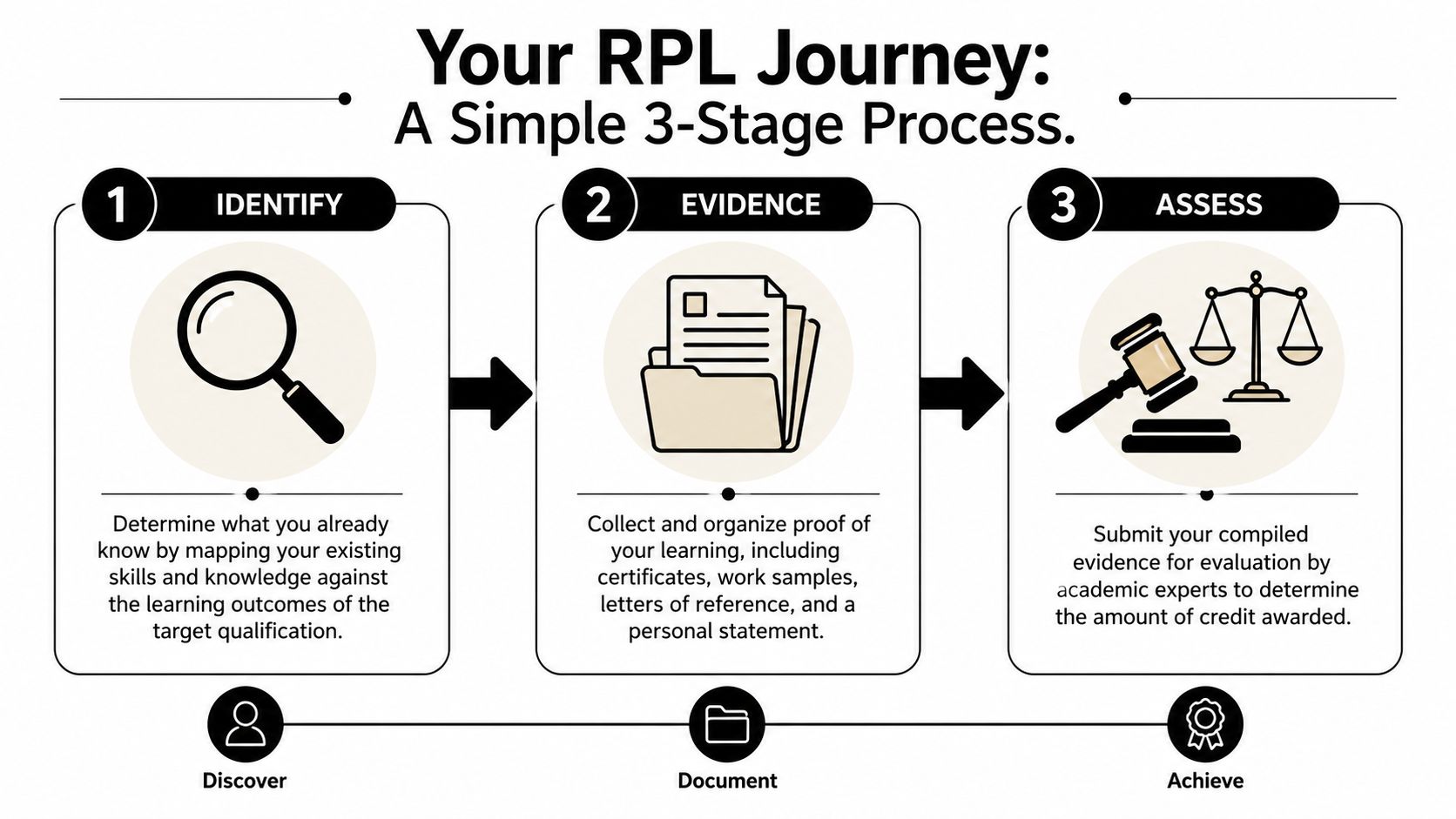
That process is built on the UK quality frameworks that shaped RPL practice, including the approach described by QAA Scotland. RPL recognises learning from formal, non-formal and informal settings, including skills gained through life and work experience, and it uses a three-stage model of identifying learning, providing evidence and assessment. That structure matters because it keeps RPL grounded in standards, rather than leaving it as a loose promise that experience alone is enough.
The three kinds of learning
Formal learning is the easiest to spot. It is learning that already came with a certificate, diploma, degree or other qualification result, perhaps from school, college, university or an approved training provider. If you have a GCSE certificate or a workplace certificate linked to a regulated course, that sits in the formal category.
Non-formal learning is organised learning outside the usual school route. It can include workplace CPD, a short course, a training workshop or a professional certificate you earned while working. A first aid course, a safeguarding update or an IT training session can fit here if the learning can be shown clearly and matched to the course you want.
Informal learning is the learning life gives you day by day. Parenting, caring, volunteering, running a household, helping in a community group or mentoring someone at work all build useful skills. You may have learned planning, communication, budgeting, patience, problem-solving or leadership without ever sitting an exam.
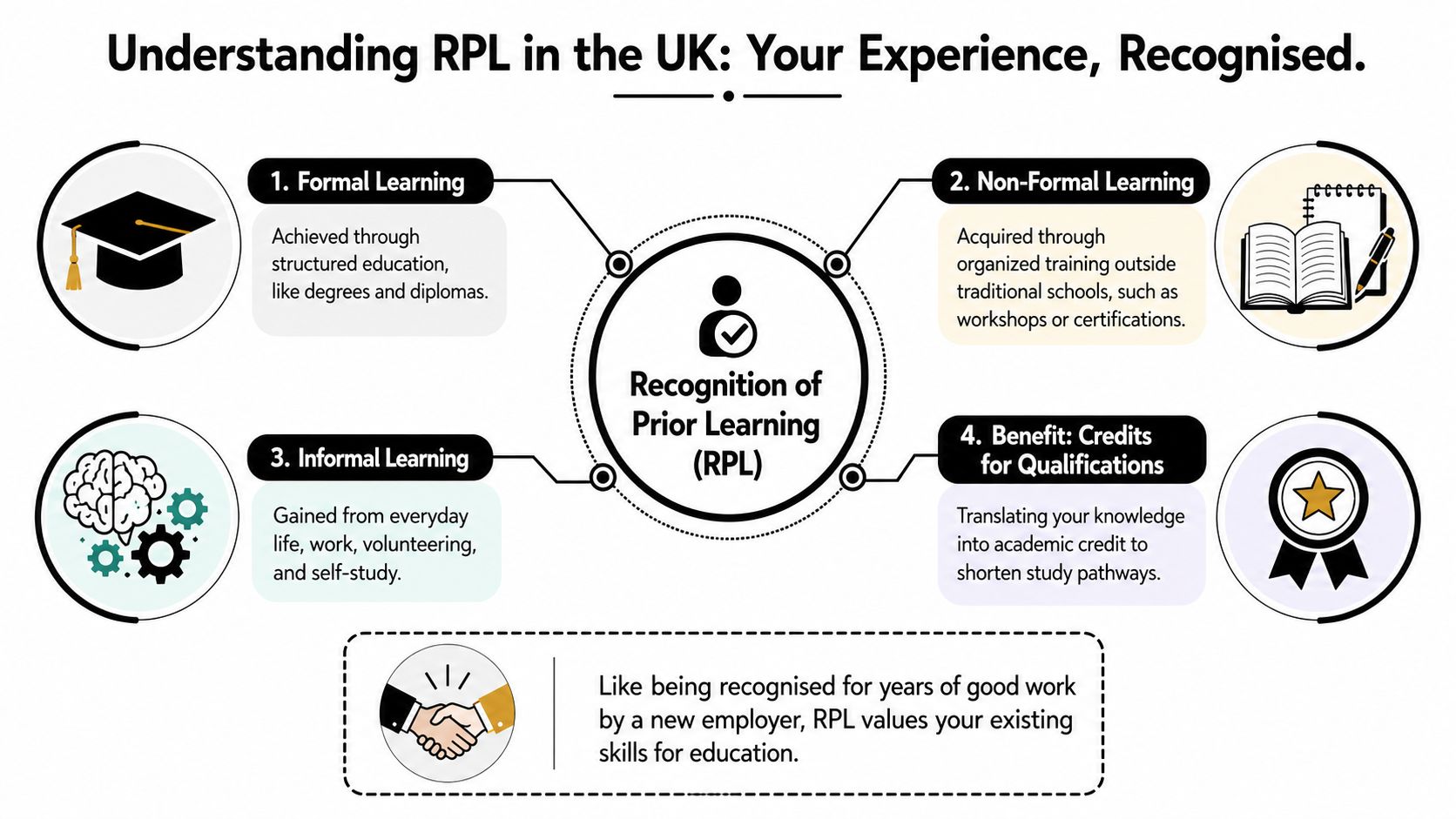
Like being recognised for years of good work by a new employer, RPL values your existing skills for education.
The key question is not “Was this learned in a classroom?” It is “Can I explain what I learned, when I learned it, and how it matches the course I want now?” That is why RPL can feel reassuring for adult learners returning to education, including those looking at routes such as Next Level Online College's accreditation details for online courses. You are not starting from nothing. You are showing how the experience you already carry can count in a formal setting.
How the RPL Process Works Step by Step
The process is usually calmer than people expect. It starts with a clear look at what you already know, moves into gathering proof, and ends with someone matching that proof to the qualification standard. You're not expected to guess your way through it alone.
The first part is about identifying learning. This means looking at the course you want and asking which parts might already be covered by what you've done before. If the course asks for planning, written communication or subject knowledge, think back to where you've used those things already, at work, in study, or in family life.
The next part is evidence. That's the bit that often makes people worry, but it's mostly about being organised. Assessors may want certificates, transcripts, module details, letters from an employer, sample work, or a short statement from you explaining what you learned and where. The London university guidance says transcripts or certificates plus module or syllabus detail are typically needed, and some places ask for translated evidence if documents aren't in English, because assessors need to map prior learning to learning outcomes before credit can be awarded. London's guidance on applying for RPL shows how practical that mapping is.
Then comes assessment. A tutor or panel compares your evidence against the qualification requirements and decides what can be recognised. Sheffield Hallam University explains that RPL can cover both prior certificated learning and prior experiential learning, and that the claim must be supported by evidence matched to specific learning outcomes and credits, and recent enough to be relevant to the award. Sheffield Hallam's RPL guidance makes that distinction very clear.
Simple rule: if the learning can't be matched to the course outcomes, it usually can't be credited.
You do not need to have the whole case ready on day one. You only need to start collecting the pieces that show your learning is real. The limits and credit rules come later, and they're there to keep the system fair.
A short video can also help make the process feel less abstract.
Which UK Qualifications Accept RPL and How Much Credit You Can Get
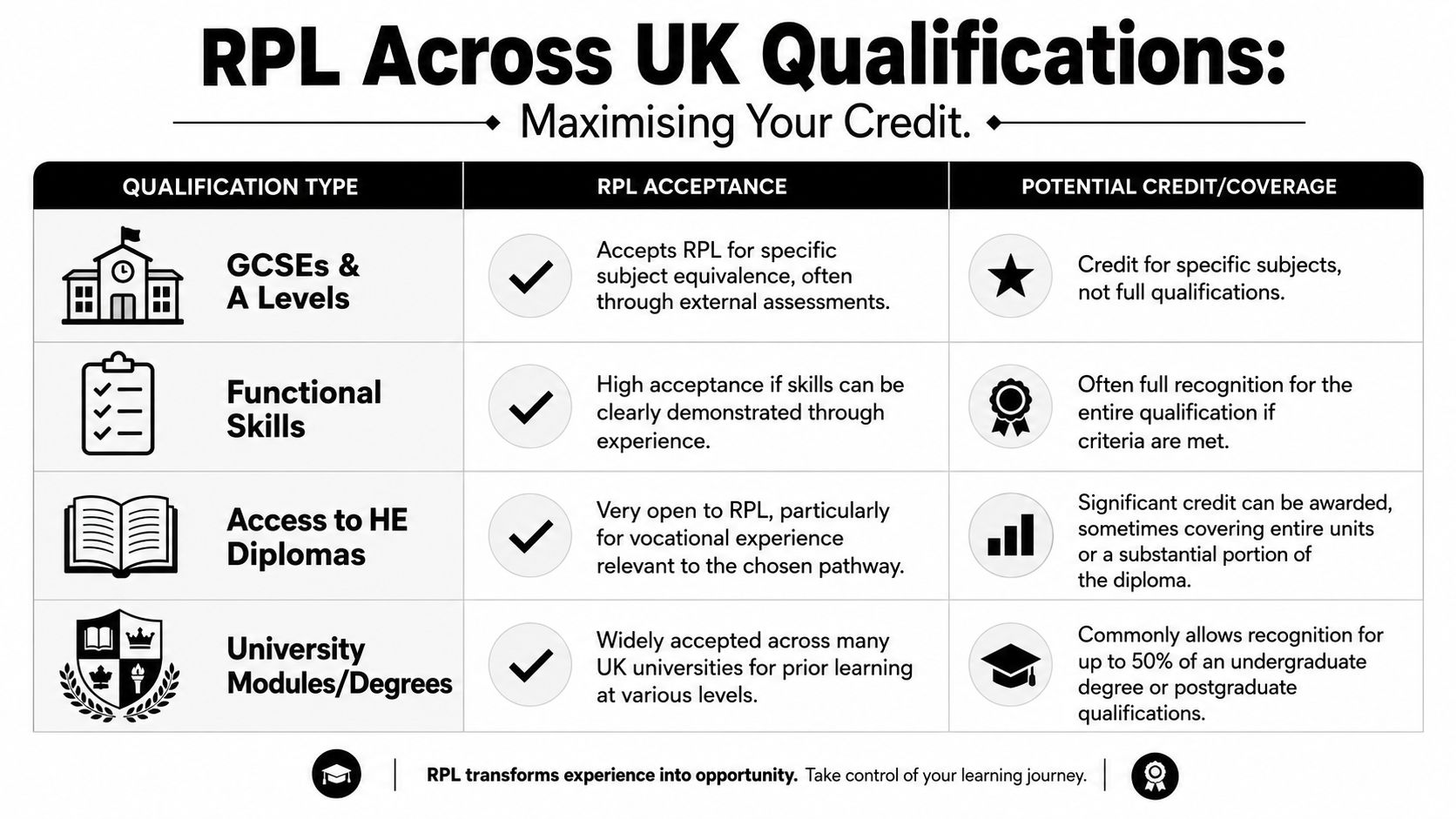
RPL can sit inside many different routes, but it does not work the same way everywhere. Some qualifications welcome it strongly, some allow only limited credit, and some do not allow it at all. That is not a flaw. It is how the system protects standards while still recognising learning people have already done.
At university level, Bristol shows how formal this can be. For a four-year degree, up to 240 of 480 credit points can be recognised. For an undergraduate diploma, up to 120 of 240 credit points can be recognised. For an undergraduate certificate, no RPL credit is permitted. Bristol also separates exempted units, where marks do not count to the final award, from transferred units, where marks are included in the award calculation. Bristol's RPL regulations make it clear that credit recognition is tightly controlled.
AIM Group sets out another clear limit, saying a maximum of 70% of a qualification can normally be achieved through exemption or equivalency, and at least 30% must be gained through new learning at the same level of the qualification. AIM Group's RPL policy gives learners a plain threshold to work from.
| Qualification Type | Total Credits | Maximum via RPL | Source |
|---|---|---|---|
| Undergraduate degree at Bristol | 480 | 240 | Bristol's RPL regulations |
| Undergraduate diploma at Bristol | 240 | 120 | Bristol's RPL regulations |
| Undergraduate certificate at Bristol | N/A | 0 | Bristol's RPL regulations |
| Qualification covered by AIM Group policy | Not stated | 70% normally, 30% new learning required | AIM Group's RPL policy |
Some qualifications, especially short or foundation awards, may not allow RPL at all. That protects the integrity of the award and makes sure learners still complete the core learning the course is meant to give them.
For many adult learners, even a small amount of credit can make the route feel lighter. Fewer units can mean less time studying around shifts, school runs and family life. It can also make the fee picture feel more manageable, which matters when the household budget is already stretched. If someone is planning to progress towards higher study, Next Level Online College's guide to an Access to HE diploma is a useful place to start because it shows how that route can fit into the wider picture.
Building a Strong Evidence Portfolio You Can Be Proud Of
Evidence sounds formal, but it's really just the story of what you've already done, backed up with proof. A strong portfolio doesn't have to be fancy. It just needs to be clear, tidy and honest.
The most useful items are often the ones people already have somewhere in a drawer or email inbox. That can include transcripts, certificates, module handbooks, employer references, reflective accounts, photos of work you've done, logs from projects, or records of volunteering and training. If the learning came from a job or a community role, keep anything that shows what you were responsible for and when.
Start with a simple folder system
A neat structure saves time later. One folder for certificates, one for work history, one for references, one for reflective notes, and one for course information usually works well. If a document is in another language, keep the translation with it so the assessor can read both together.
That's exactly the kind of practical detail that matters in the London applicant guidance, which says universities usually want a transcript or certificate plus module or syllabus detail, and may ask for translated evidence if the original isn't in English. London's RPL application guidance is a good reminder that assessors need enough detail to map your learning to the award.
Portfolio rule: if you can't find it quickly, it isn't ready yet.
Sheffield Hallam's guidance also helps here, because it shows that prior certificated learning and prior experiential learning are both valid starting points. So if your proof is a qualification certificate, that's useful. If your proof is a work log, witness statement or reflective account, that can also matter.
For reflective writing, keep it plain. You do not need fancy words. Try a sentence like, “I learned to organise tasks, communicate clearly and meet deadlines while managing this role, and I can show that through the evidence attached.” That kind of language helps the assessor see the learning, not just the activity.
A good portfolio often surprises people. Once your experience is written down in front of you, it becomes easier to see that you've already been building knowledge for years. That can lift confidence as much as it helps with credit.
Real Stories of Adults Using RPL Through Next Level Online College
A mum from one of our learner journeys had spent years stretching a household budget, helping at school and keeping track of everything for her family. She worried she was “too behind” for education, then realised those everyday skills were evidence of planning, communication and organisation. By using RPL alongside a Functional Skills English course, she skipped a unit and moved faster towards an Access to HE diploma.
Another adult learner was working full-time and resitting GCSE Maths while also aiming for an A Level Psychology route. He had a previous training certificate that matched part of the course learning, so RPL helped him gain credit and protect his evenings for family life. The relief came when the credit award letter arrived, because the path to his next goal suddenly felt reachable.
These are the moments that matter. The paperwork is important, but the emotional shift matters too, from “I hope I can do this” to “I can see how I'm getting there”.
For adult returners, that shift can change everything at home. Children notice when a parent keeps going. Partners notice when study becomes something steady rather than stressful. And learners often find that once they start to recognise their own progress, they start to walk a little taller.
What RPL Means for Your Time, Fees and Next Steps
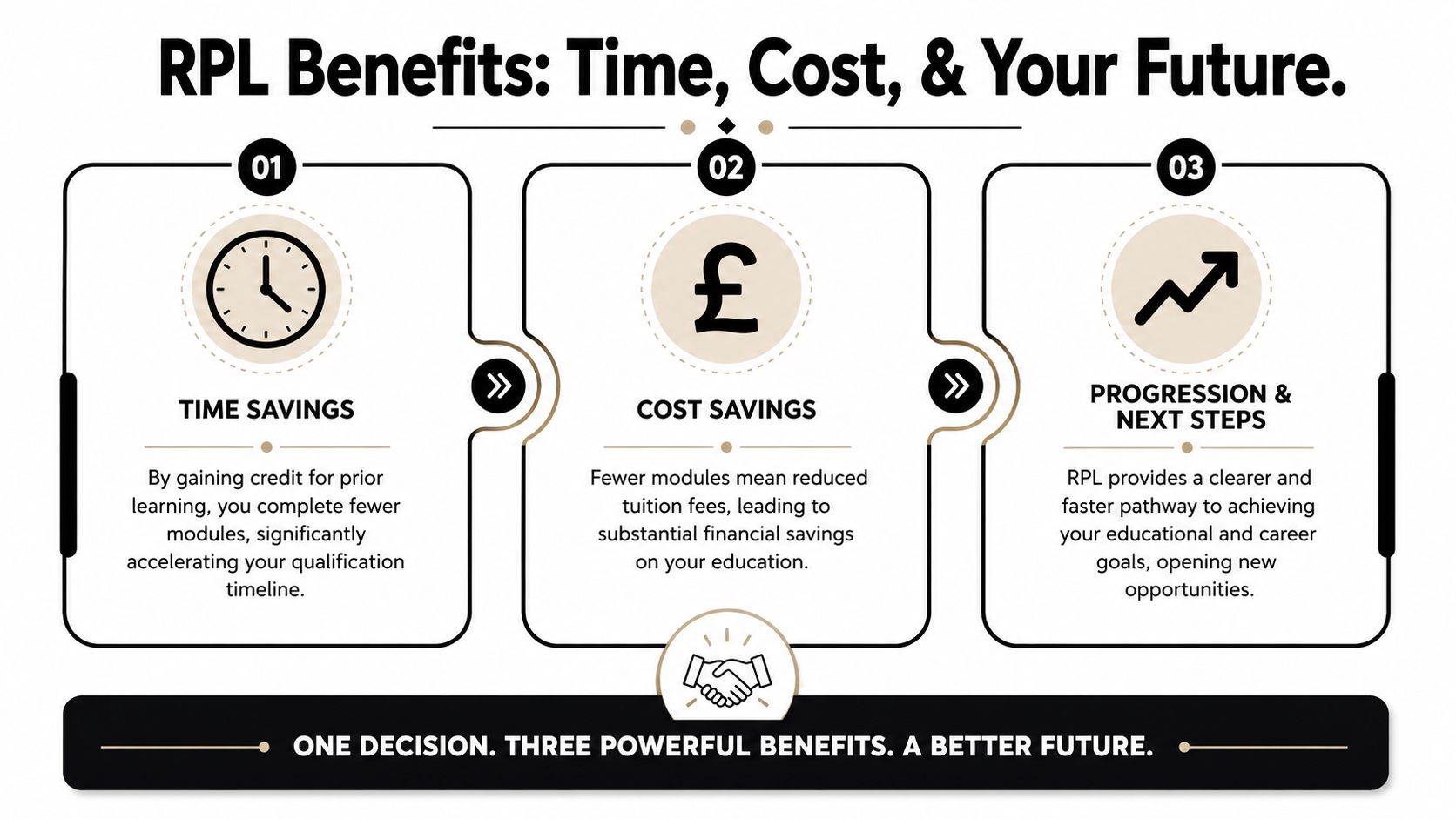
RPL changes more than the timetable. It changes the way a course fits into real life. If some learning is recognised, you may need to complete fewer modules, which can free up time for work, childcare and rest.
The apprenticeship route shows this clearly. Government guidance says providers must identify prior learning, adjust the training plan and price, and record the change in the evidence pack, with a proportional price reduction based on the prior learning hours. That means prior learning is not just an academic issue, it affects funding and programme design too. The government's apprenticeship prior learning guidance makes that operational side impossible to ignore.
Time limits also matter. The University of Hull says prior learning claims must be evidenced and, in some cases, currency-limited to no more than nine years old. Real Training uses a five-year completion limit for prior qualifications and asks for an ENIC-NARIC statement for non-UK qualifications. Hull's prior learning policy shows one example of a currency rule that can affect a claim.
Advanced Learner Loans information may also be relevant if you're weighing up how to fund study while keeping the family budget steady.
So the promise of RPL is not just a line on a certificate. It is credit back into your week, your wallet and your future. That is why adult learners often feel a fresh burst of confidence once they see how much of their experience can count.
Frequently Asked Questions and Your Next Move
How long does an RPL claim usually take? It depends on the provider and the evidence, but the key is to get your documents organised early so the assessor can work faster.
Can RPL help me get to university quicker? Yes, if your prior learning matches the course outcomes, it can shorten the route by reducing the amount of new study you need.
What if my evidence is older than the institution's limit? Some providers have currency rules, like Hull's nine-year limit, so older evidence may not count even if the learning was real.
Does RPL affect finance or instalment plans? It can, because recognised credit may change the amount of study you need and the way a course is priced, so it's worth asking before you enrol.
Choose the Next Level Online College route that fits your goal, whether that's Functional Skills, GCSEs, A Levels or Access to HE. Book a conversation with an advisor, bring your experience to the table, and take one small step this week, because that first step can turn quiet ambition into a qualification your whole family will celebrate.
If you want a course path that fits around work and family, Next Level Online College offers flexible online study with support for adult learners who are ready to move forward. Bring your prior learning, your goals and your questions, and let's turn your experience into a plan you can act on now.