

You're standing by the kettle with a course leaflet in one hand and a pile of household bills in the other. Perhaps you've been thinking about study for months, but family responsibilities, work and the fear of taking on debt keep getting in the way. You may also wonder whether university is still realistic after time away from education.
That uncertainty is understandable. Student finance for mature students brings together age rules, household income, course intensity, residency, tuition support and living-cost help. The rules can feel as though they were written for an 18-year-old with no rent, children or work rota.
You're not behind, and you don't need to solve everything today. This guide turns the main terms into clear decisions, so you can see what you might claim, when to apply and how repayment works.
Starting the Journey as an Adult Returner
A 42-year-old might read a university leaflet after the children are in bed, then place it beside the mortgage statement. The course could lead to a more fulfilling career, better pay and the pride of showing the family that a new beginning is possible. Yet the practical questions arrive quickly. Can the household manage while studying? Will existing debts make another loan unsafe? What happens if work hours change?
Adult returners often carry responsibilities that younger applicants may not have. You might be paying rent or a mortgage, caring for children or relatives, and working while you study. You may also remember leaving education before and worry that you'll struggle again. Those worries say more about the size of the decision than your ability to succeed.
The funding system can feel tangled because different support routes sit in different places. Student Finance England, Advanced Learner Loans, university bursaries and employer schemes may each have separate forms, evidence requirements and application dates. A course provider can also describe fees differently from the way Student Finance England assesses them.
A useful starting point: choose the course first, then ask the provider for its official intensity, study mode and funding details.
Mature learners are a substantial part of UK higher education, not an unusual exception. A House of Commons Library briefing reported almost 254,000 mature undergraduate entrants in 2019/20, equal to 39% of all undergraduate entrants, while just over 202,000 mature postgraduate entrants in 2018/19 represented 50% of postgraduate entrants.
If you're exploring university entry after a break, practical guidance on how to get into universities can help you work out which qualification or route comes next. By the end of this guide, you'll have a practical map of the main support available, the thresholds that affect it and the steps that make an application easier.
What Makes a Student Mature in the Eyes of the System
In everyday conversation, a mature student is an adult who starts or returns to higher education later than the usual school-leaver route. Funding rules use a more practical idea. They ask about your age, independence, residency and course intensity, because those details affect how your household income is assessed.
For Student Finance England, a learner who is 25 or over at the start of the course is generally treated as an independent student for means-tested support. That usually means the assessment focuses on your own household circumstances rather than treating your parents as financially responsible for you. Younger applicants may also be treated as independent in certain situations, including marriage, civil partnership, having children or being estranged from parents.
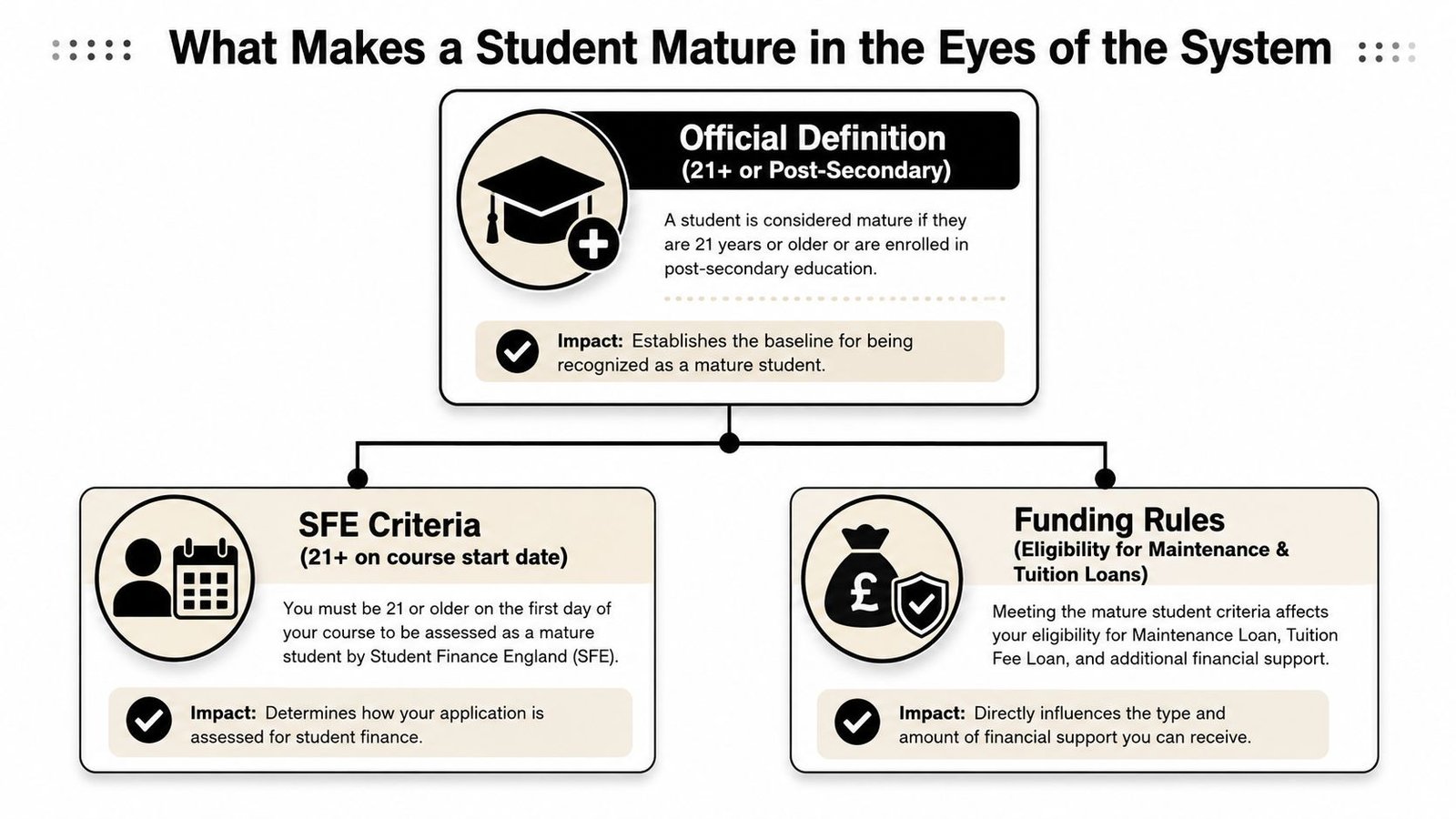
The four gates to check
Age is only one gate. You'll normally need to meet residency requirements as well. For many applicants, that means having been ordinarily resident in the UK for the required period and holding the relevant settled or immigration status. England, Wales, Scotland and Northern Ireland run different student finance systems, so the body you apply to depends on where you normally live, not just where your university is located.
Course intensity is another quiet decision-maker. For undergraduate finance in England, most courses need at least 25% intensity to qualify for part-time student finance, according to the official eligibility rules. Intensity describes how much of a full-time course you complete in an academic year. A course at 25% may offer less support than one at 50% or above, because you're studying a smaller share of the full programme.
Dependency status can change the income assessment. A partner's income may be relevant where the rules treat you as an independent adult with a household, while parental income may be relevant for a younger dependent applicant. That's why two people on the same course can receive different maintenance offers.
These gates work like a series of doors. If you meet the age and residency requirements but choose a course below the relevant intensity threshold, the available package may still be limited. Confirm each point with your funding body before enrolling.
The Main Funding Types You Can Claim
Picture an adult returner balancing work, rent and a course offer. The funding package becomes easier to understand once you separate money paid towards study from money intended to cover daily life. A Tuition Fee Loan normally goes directly towards eligible course fees. A Maintenance Loan helps with costs such as travel, food and accommodation, and uses a different assessment.
There is no age limit on tuition fee loans. The historical UK maximum for a full-time undergraduate course was £9,250 per year in 2020/21, as noted in the parliamentary briefing cited earlier. Confirm the fee and available support with your university and Student Finance England.
Maintenance support changes according to where you live, household income, study intensity and age. For 2026/27, the maximum for a student living away from parents outside London is £10,830, compared with £14,135 for London. A student aged 60 or over has a lower maximum of £4,582, according to the continuing full-time student finance guidance.
| Funding Type | Maximum Amount | Who It Suits |
|---|---|---|
| Tuition Fee Loan | Up to £9,250 per year in the 2020/21 framework | Eligible full-time undergraduate students |
| Maintenance Loan | Up to £10,830 outside London in 2026/27 | Students needing help with living costs |
| London Maintenance Loan | Up to £14,135 in 2026/27 | Eligible students living in London |
| Living-cost support at age 60 or over | Up to £4,582 in 2026/27 | Older eligible learners under the specific rules |
| Part-time maintenance support | 50% of the full-time rate at 50% to 66% intensity, or £4,438.50 in 2025/26 | Eligible part-time students |
| Advanced Learner Loan | Amount depends on the eligible course | Learners on qualifying Level 3 to 5 study, including Access to HE routes |
| Targeted grants | Depends on eligibility | Students with children, adult dependants or disabilities |
Targeted grants fill specific gaps rather than acting as one general payment. Depending on your circumstances, you may qualify for an Adult Dependants' Grant, Childcare Grant, Parents' Learning Allowance or Disabled Students' Allowance. Each has separate evidence requirements and eligibility rules.
Access to HE funding has an important second stage. An Advanced Learner Loan can support eligible Level 3 to 5 courses, including Access to HE Diplomas. If you complete a qualifying higher education course, an eligible Access loan can be written off in full, with no financial limit on the amount cancelled, according to the official Access to HE loan guidance. You can review Advanced Learner Loans for eligible courses and ask your provider about bursaries, hardship funds and employer support.
Support can also depend on how disability affects your study. A checked 2026 student support guide can help you prepare questions for your provider. The practical aim is to match each need with the right source of support, rather than expecting one loan to cover every cost.
How Part-Time, Full-Time and Access Routes Compare
For an adult returning to study, the course format affects both the support available and the demands on your week. A full-time degree may provide the clearest route to tuition and maintenance support, but fitting lectures around employment or caring responsibilities can be difficult. Part-time study can protect your income and create more breathing room. Its maintenance support is usually tied to study intensity, so “part-time” does not describe one fixed funding outcome.
An Access to HE Diploma serves a different purpose. It can help you meet university entry requirements, while an Advanced Learner Loan may cover fees for an eligible course. Complete a qualifying higher education course afterwards, and the Access loan can be cancelled, as explained in the official guidance linked earlier. The write-off is therefore connected to what you study next, not solely to finishing the Access course.
Short modular study may suit adults who cannot commit to a complete degree at once. The government plans that from September 2026, learners in England will be able to access finance for shorter, “bite-sized” modules. The proposed system would provide funding equivalent to four years of post-18 study, up to £39,160, with maintenance support paid in smaller amounts linked to module size. Because this is a planned reform, confirm the latest rules and course eligibility before making arrangements around it.
| Study Route | Tuition Support | Maintenance Support | Key Caveat |
|---|---|---|---|
| Full-time degree | Eligible Tuition Fee Loan | Income-assessed support may be available | Age, household income and living arrangements matter |
| Part-time degree | Tuition support can scale with study intensity | Means-tested support can be scaled to intensity | Most courses need at least 25% intensity |
| Access to HE Diploma | Advanced Learner Loan for eligible courses | Depends on the route and available support | Loan write-off depends on completing eligible higher education |
| Short modular course | Planned modular finance from September 2026 | Smaller payments linked to module size | Rules are changing, so confirm course eligibility |
Intensity is the part many applicants miss. At 50% to 66% intensity, parliamentary briefing data says the maximum part-time maintenance support was 50% of the full-time rate, or £4,438.50 in 2025/26. That level can affect whether you continue working, cover travel and arrange childcare.
Ask the provider: “What is the course intensity for each academic year, and which funding route applies?” A precise answer is more useful than calling a course “flexible.”
Walking Through the Application Step by Step
Start with the official Student Finance England account rather than waiting for every detail to feel perfect. You'll normally need to create or access your account, confirm your identity, provide course information and decide whether you want the available living-cost support assessed.
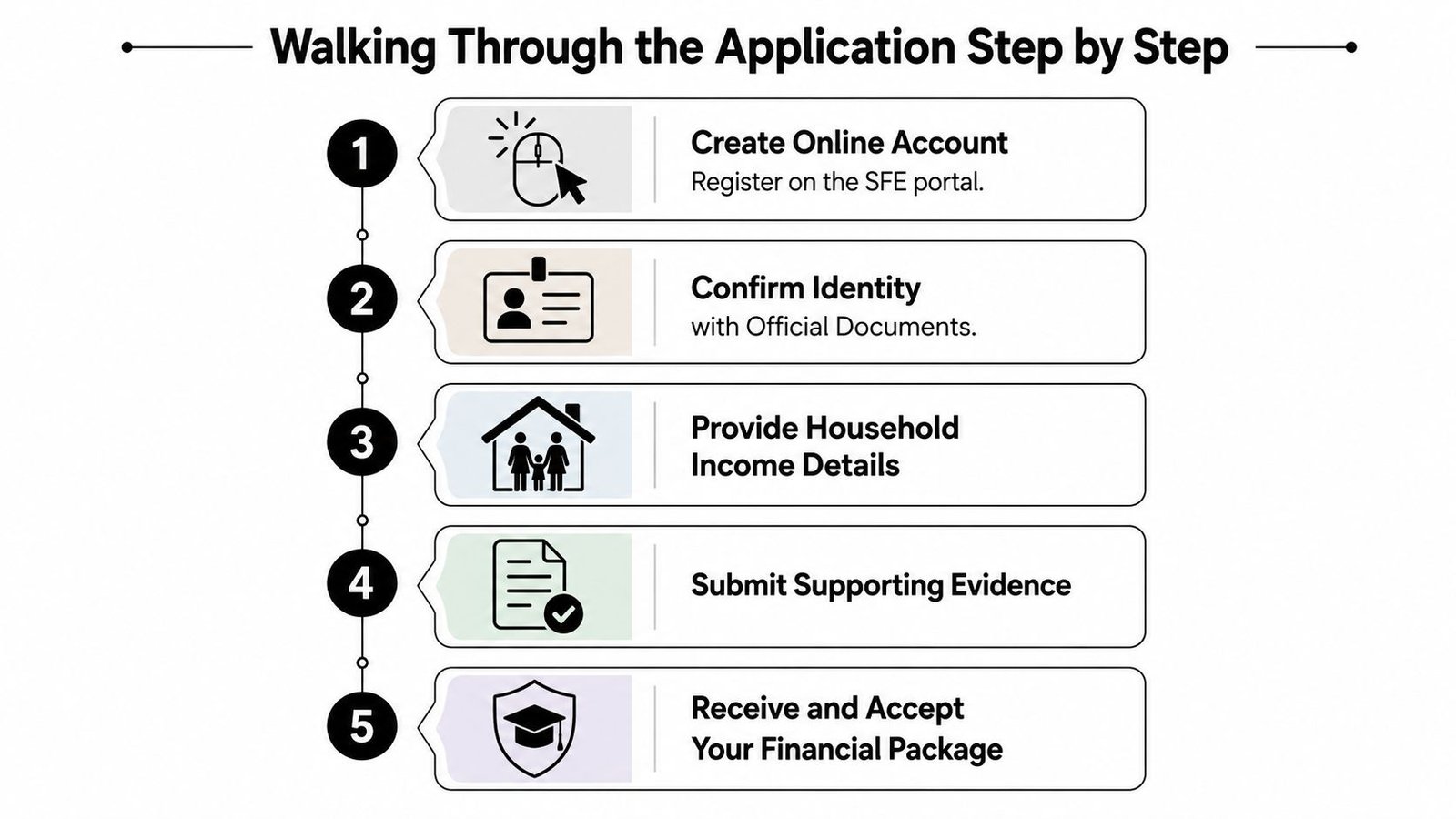
A calm application order
Create your account. Use the official SFE portal and keep your login details safe. Your application can't move forward if you can't access the account later.
Confirm your identity. The service may ask for official documents or other identity checks. Upload clear evidence and respond quickly if SFE requests more.
Add the course details. Enter the provider, course and study mode exactly as your institution gives them to you. A mismatch can delay confirmation.
Complete the household income section. Independent status doesn't mean income is ignored. If you have a partner, their circumstances may form part of the assessment, so answer that question carefully rather than leaving it blank.
Request the support you need. Select the appropriate Maintenance Loan amount and add any relevant applications for targeted support. If you're taking Access to HE study, use the Advanced Learner Loan route rather than assuming it sits inside the degree application.
Here's a short video that can help you visualise the process before you begin:
Avoid preventable delays
Missing identity evidence, using the wrong course title or failing to answer household-income questions can hold up a payment. Keep copies of submitted documents and ask your college or university to check that it has confirmed your registration.
Apply as early as your provider allows for a September, January or mid-year start. The exact deadline for backdated funding depends on the funding body and course, so ask SFE and the institution before the course begins rather than assuming you can claim later.
Repayment Without the Worry
Student loan repayment usually doesn't work like a bank loan with a fixed monthly bill. For many borrowers, deductions are made through the PAYE system, based on income. If earnings fall below the relevant repayment threshold, deductions stop, and if your income changes, the amount taken can change as well.
The commonly quoted Plan 2 figures in the supplied visual are a £27,295 threshold, a 9% repayment rate above that threshold and a 40-year forgiveness point. These figures must be checked against the plan and tax year that applies to you, because repayment terms can differ by loan type and can change through official policy.
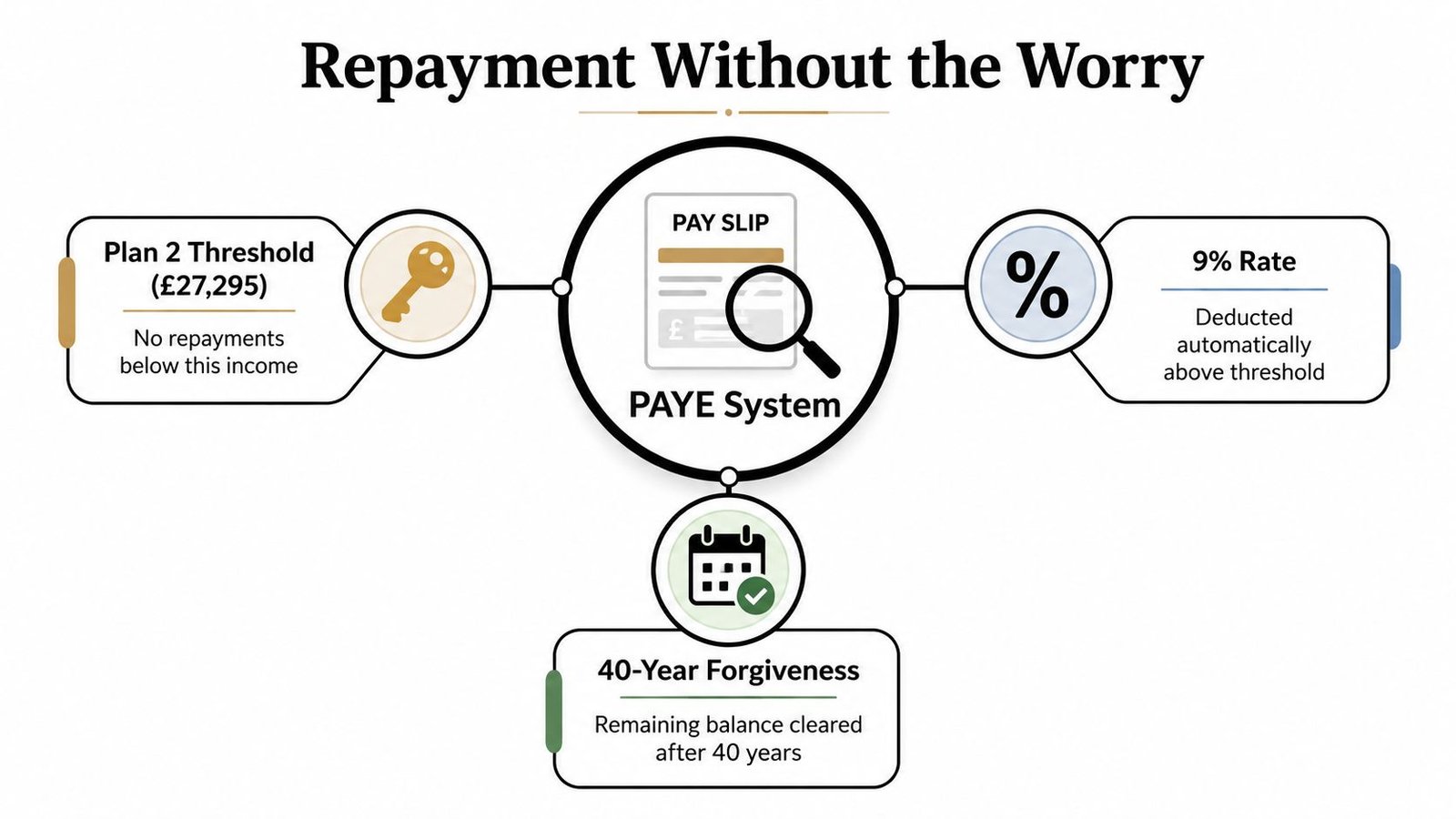
What happens when life changes
If you leave work, reduce your hours or earn less, your deductions can reduce or pause when your income falls below the applicable threshold. The loan doesn't normally demand payment because you've experienced a family change or returned to study. Your income remains the key trigger for deductions.
You should also distinguish between ordinary degree borrowing and the Access to HE write-off. If you take an eligible Access to HE Advanced Learner Loan and later complete a qualifying higher education course funded by Student Finance England, the full outstanding Access balance can be cancelled, with no financial limit on the write-off, according to Student Loans Company guidance.
For a wider discussion of repayment choices and ways to save on student loan interest, look at the plan type and your income rather than treating every student loan as identical. Don't make extra payments because fear tells you to. First check the terms, likely income path and whether an overpayment may need to be reclaimed.
Tips, Bursaries and Real Stories That Boost Your Support
A statutory loan may form the base of your plan, but it doesn't have to be the whole plan. Ask your university about bursaries, hardship funds, departmental awards and support linked to your subject or personal circumstances. Some learners may also investigate the NHS Learning Support Fund, Turn2us grants or Snowdon Trust awards, where the relevant eligibility rules apply.
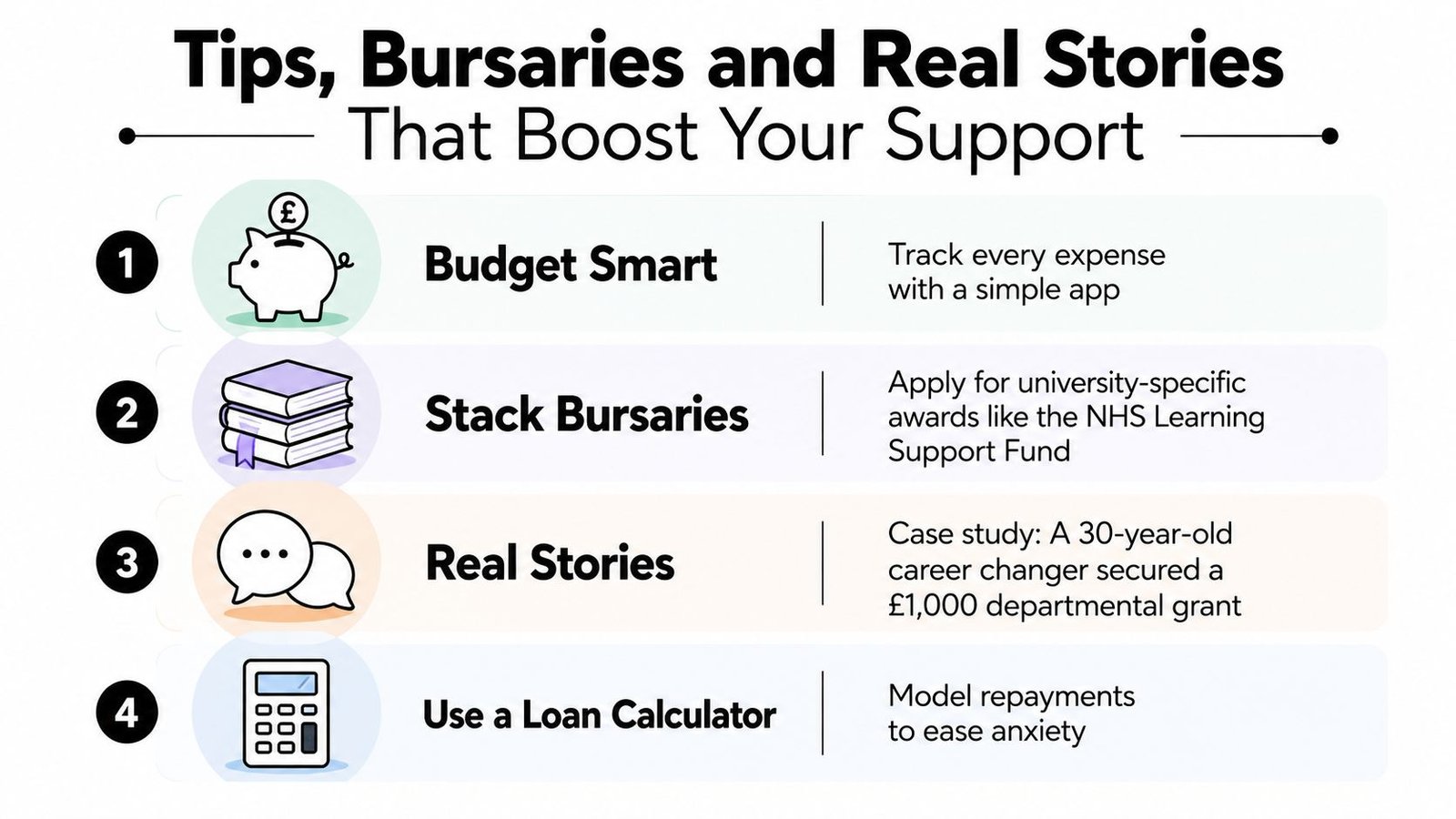
Two journeys, two different plans
Consider a 42-year-old single parent taking an Access course before progressing to a degree. Their plan might combine an Advanced Learner Loan for the Access route, a later maintenance application for the degree, childcare-related support where eligible and a university hardship application if an unexpected bill makes the budget impossible. The Access loan write-off rule could also matter when they complete the qualifying higher education course.
A 55-year-old career changer studying part-time may have a different balance. Keeping paid work could reduce the need for living-cost borrowing, while a part-time maintenance assessment, a university bursary and a small hardship award could make travel, books and reduced working hours manageable. The course intensity must be checked before enrolment because it affects the support calculation.
These are planning examples, not guarantees. Your result depends on the course, income, household and evidence you provide.
Ask for a reassessment if your household circumstances change. A fall in income, a change in childcare needs or a new caring responsibility may affect an income-assessed application. Don't assume the first assessment remains correct for the whole year.
A simple budget can reveal the gap. List rent or mortgage, food, travel, childcare, utilities and course costs before deciding how much paid work you can safely continue. If you prefer a digital method, you can use Velzee for student budgeting to compare approaches and keep regular spending visible.
You can also explore online bursaries and ask your provider when applications open. Apply early, because some funds are limited and may require a short statement explaining your circumstances.
Your First Steps to Claim What You Deserve
Your first week doesn't need to involve a mountain of paperwork. It needs a short checklist and one honest conversation with the course provider.
Confirm the course facts. Ask whether the course is full-time, part-time or modular, and request the intensity for each academic year. Check the information on UCAS or directly with the provider.
Gather your evidence. Prepare identity documents, residency information and the household income details needed for an assessment. If you have a partner, don't ignore the partner-income question.
Create your SFE account. Start the application as early as possible. Applying around nine months before the start date gives you time to correct missing information, although you should follow the official deadline for your course.
Check additional support. If disability affects your study, ask about Disabled Students' Allowance and its evidence deadlines. If you have children or adult dependants, check the relevant targeted grants rather than assuming the standard Maintenance Loan covers those costs.
Record the renewal date. Student finance usually needs attention each academic year. Put a reminder in your calendar so you don't assume one application covers the entire course.
Funding rules can feel bureaucratic, but age alone doesn't shut the door. Many mature learners can access some form of support if they have an eligible place and meet the relevant course, residency and income conditions. Your chosen institution's Student Money and Advice team can check the details against your actual circumstances.
Next Level Online College offers flexible online GCSEs, A Levels, Functional Skills and Access to Higher Education Diplomas with academic and pastoral support for adults studying around work and family life. Visit Next Level Online College to explore a suitable route and take the first practical step towards your next qualification.