
Some people read about wedding planning late at night after a long shift, with dishes still in the sink and a voice in their head saying, “I should have done something with my life by now.” If that sounds like you, you are not behind. You are not too late. You are at the point where a new path is starting to feel possible.
A wedding planners course can be much more than a course. It can be the first solid step away from work that drains you and towards work that asks for your creativity, your calmness, your care, and your good judgement. It can help you turn natural strengths, like being organised, thoughtful, and good with people, into a real profession.
Many adults return to learning with shaky confidence. They worry they have forgotten how to study. They worry younger people will be ahead of them. They worry they will start and not finish. Those feelings are normal. They are also not proof that you cannot do this.
Wedding planning suits adults well because life experience matters. If you have managed a home, solved problems under pressure, balanced a budget, supported family members, or organised important events, you already have useful building blocks. A good course helps you shape those strengths into professional skills.
This path can also mean something personal. It can show your children that learning does not stop at school. It can show your family that change is possible. It can show you, perhaps for the first time in a long time, that your future can still grow.
Your Dream of a Creative Career Can Start Today
Kelly worked in a job that paid the bills but left her flat at the end of each day. She was the person friends always turned to when a party needed sorting out. She knew how to keep calm, make lists, and notice the little details other people missed. Still, she told herself that those were “just things I’m good at”, not the start of a career.
That is where many adults get stuck. They can see the dream, but they cannot yet see the bridge.
A wedding planners course can become that bridge. It gives shape to an ambition that may have been sitting in your mind for years. Instead of saying, “I wish I could do something creative,” you begin saying, “I am training for this.”
Why this career feels different
Wedding planning is not only about flowers, table settings, or pretty venues. It is about helping people through one of the biggest days of their lives. You become the calm person in the room. You turn stress into structure. You help a couple feel safe, heard, and excited.
That kind of work can feel meaningful.
For many adult learners, meaning matters just as much as money. They want a career that feels alive. They want to wake up knowing their work makes a difference. They want their children to see them building something brave.
Tip: If your confidence is low, do not ask, “Am I ready to become a wedding planner?” Ask, “Am I ready to take one step towards it?” That question is often much easier to answer.
Starting while life is still busy
You do not need a perfect life before you begin. Most adults study while juggling work, family, and everyday responsibilities. That is why many people first look at flexible adult education courses online when they are exploring a career change.
The act of enrolling can shift something powerful inside you. It tells your mind that this dream is no longer a fantasy. It is a plan.
And plans build confidence.
You may still feel nervous. That is fine. Courage rarely feels neat and tidy. It often looks like reading course pages on your phone, asking questions, and deciding that your future deserves effort.
The first win matters
Your first win may not be getting a client or launching a business. It may be saying, “I started.”
That matters more than you think. Adults who return to study often carry old stories about themselves. Maybe school was hard. Maybe life got in the way. Maybe other people made you feel small. A new course can help you write a different story, one built on action, not doubt.
If wedding planning keeps calling to you, listen to that. It may be the start of work you enjoy, a stronger income, and a version of yourself your family will be proud to see.
What You Will Learn in a Wedding Planners Course
A good wedding planners course turns a big, emotional job into clear steps you can follow. That matters for adult learners, especially if you are returning to study in the UK and want a path that feels structured, practical, and realistic.
Instead of throwing everything at you at once, the course usually builds your knowledge in layers. You learn the basics first, then the systems that keep events running smoothly, and then the business skills that help you earn well and work with confidence.
The foundation skills
At the beginning, the goal is simple. You need to understand what the job involves.
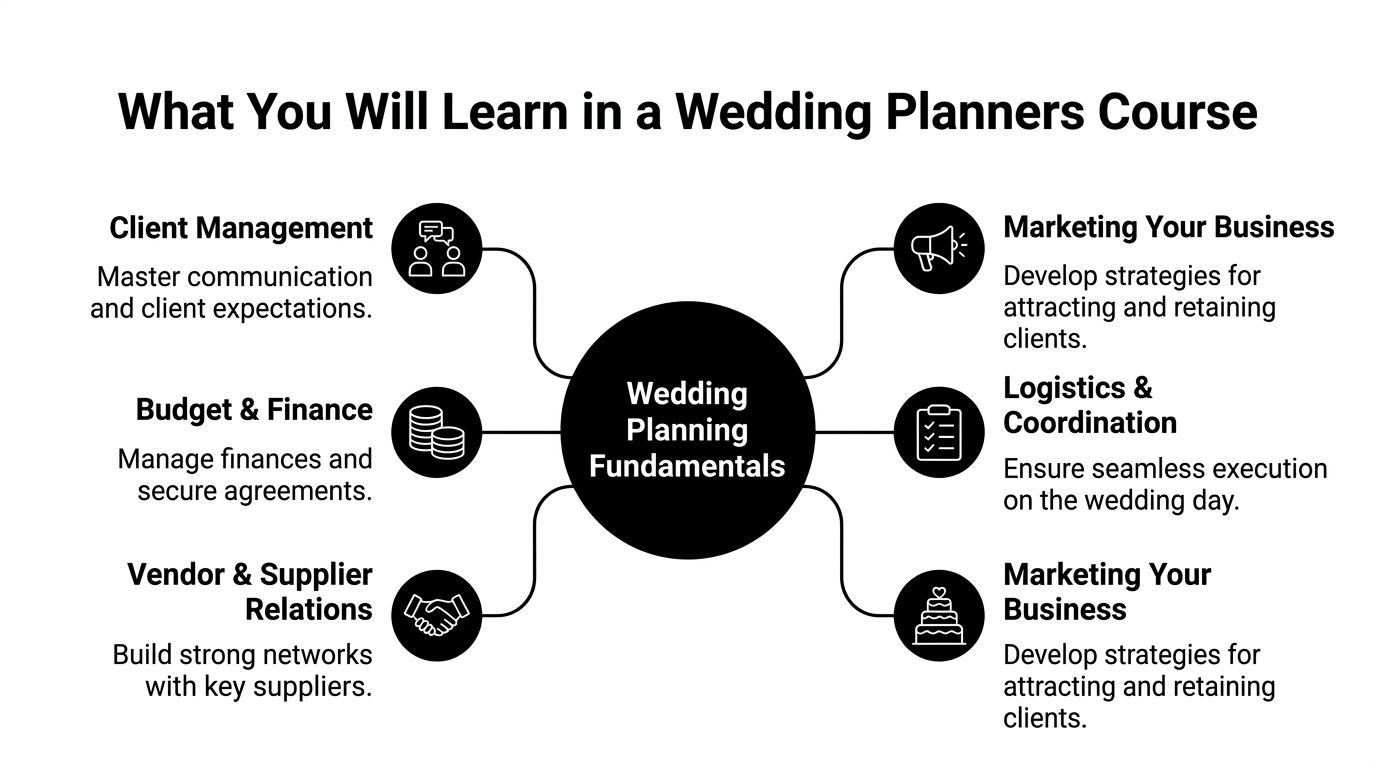
Many courses start with the building blocks of wedding planning, such as ceremony flow, reception planning, etiquette, and communication with clients. These early lessons give the role a clear shape. They help the job feel manageable instead of overwhelming.
You may learn about:
- Wedding etiquette: how weddings often run, and how traditions can vary between families, faiths, and cultures
- Client communication: how to listen properly, ask calm, clear questions, and guide couples without taking control
- Planning basics: how to turn ideas, wishes, and deadlines into a workable plan
This stage is often a confidence boost. You stop feeling like someone who just loves weddings, and start feeling like someone who understands how to support people through one of the biggest days of their lives.
The practical tools
Once the basics are in place, the course usually shifts into day-to-day planning skills. At this stage, knowledge starts to feel useful.
A strong programme often covers:
Budget management
You learn how to track costs, keep spending in view, and help clients make choices they can afford.Contracts and paperwork
You learn why clear records matter, what agreements are for, and how written details protect both you and the couple.Supplier coordination
You learn how to work with venues, caterers, florists, photographers, and transport providers so everyone is working from the same plan.Timelines and logistics
You learn how to map out the day, spot problems early, and keep many moving parts under control.Event design and styling
You learn how colours, layouts, décor, and atmosphere come together to create a celebration that feels personal.
These are the skills that turn a dream into a service people will pay for. They also help adult learners trust themselves, because each lesson solves a real problem you are likely to meet in the job.
The business side
Wedding planning is creative work, but it also involves rules, responsibility, and money. That part can feel intimidating at first. With the right teaching, it becomes much easier to understand.
Some courses cover pricing, record keeping, professional standards, business set-up, event law, and how to respond calmly when plans change. In the UK, this matters even more for adults who want a career change they can take seriously, because you may be weighing self-employment, freelance work, or work with venues and event companies. A course that explains these areas clearly can help you feel less like you are guessing and more like you are preparing for real work.
For many learners, this is the moment the course starts to feel transformational. You are not only learning how to style a beautiful event. You are learning how to protect your time, earn properly for your work, and build something stable for yourself and your family.
Why the order matters
Learning wedding planning works a lot like learning to cook for a large family celebration. First you learn what each part is for. Then you follow a method. After that, you can manage the whole event with much more calm.
That structure is especially helpful if you have been out of education for years. You do not need to arrive with expert knowledge. You just need a course that teaches in a sensible order, so one skill supports the next.
Here is a simple breakdown:
| Course area | What it helps you do |
|---|---|
| Foundations | Understand weddings, traditions, and client expectations |
| Operations | Build schedules, coordinate suppliers, and keep plans on track |
| Finance | Handle budgets, pricing, and written agreements carefully |
| Design | Create weddings that look thoughtful and personal |
| Business | Prepare for employed roles or self-employed work |
By the end, you are building more than knowledge. You are building proof for yourself that you can learn again, grow again, and create a career that feels both creative and secure.
That is a powerful thing to carry home.
Comparing Different Types of Wedding Planner Courses
You might be sitting at the kitchen table after work, looking at course pages while everyone else is busy, and wondering why every option seems to promise the same thing. That confusion is common, especially if you are returning to study as an adult and want to make a careful choice this time.
Course titles can sound alike while offering very different outcomes. Certificate, diploma, accredited, tutor-led, self-paced. The words are familiar, but the level of support, depth, and recognition can vary a lot.
A helpful way to sort them is to compare them to learning to drive. A short introductory course helps you understand the rules of the road and whether you enjoy being behind the wheel. A longer diploma-style course gives you more practice, more guidance, and a better sense of how to handle real situations calmly. A recognised pathway can matter if you want your learning to carry weight in the UK for progression, credibility, or future study.
Short courses and deeper programmes
Short courses suit adults who want to test their interest before making a bigger commitment. They can help you decide whether wedding planning feels exciting in real terms, not just in theory.
A deeper programme suits learners who already know they want change. If your goal is paid work, a business of your own, or a qualification that helps you progress, you will usually need more than a brief introduction. You need enough training to practise decision-making, communication, budgeting, and client care in a way that feels usable.
Here is a simple comparison:
| Course type | Best for | What to watch for |
|---|---|---|
| Short certificate | Exploring the career | May only give a basic overview |
| Diploma-style course | Adults preparing for a serious career change | Check whether assignments and tutor feedback are included |
| Accredited or recognised pathway | Learners who want progression or added credibility | Check what the recognition means in the UK and whether it supports your next step |
The best choice is the one that fits your aim. A course should meet you where you are now, then help you grow into the planner you want to become.
Online or in person
Some adults learn best in a classroom. A regular place and time can create structure, and face-to-face contact can make study feel more real.
Many adult learners in the UK find online study easier to keep going with. Work patterns change. Children get ill. Caring duties can appear without warning. Online learning can fit around real life in a way that classroom attendance often cannot.
That flexibility matters because finishing the course is what builds confidence. Every completed module is evidence that you can still learn, still improve, and still create a different future for yourself.
Online courses do vary. Some send materials and expect you to manage alone. Others provide a clear schedule, marked work, tutor support, and a recognised framework. Before enrolling, it helps to understand the difference between marketing language and real course recognition by reading about accreditation for online courses.
The UK issue that many learners miss
A lot of wedding planning advice online is written for an American audience. That can leave UK learners comparing courses without knowing whether the content matches the market they want to work in.
Many online courses are based in the US and do not explain UK expectations around contracts, venue practice, or progression routes. With over 250,000 marriages in the UK each year (ABC Wedding Planners course information), choosing a UK-recognised course can make a real difference for adult learners who want study that supports work opportunities or later education.
This distinction matters for UK-based planners.
If you hope to build trust with UK clients, work with local venues and suppliers, or show your family that this new direction has substance, the course should reflect the country where you plan to build your future. For many adults, that clarity brings relief. You are not starting over blindly. You are choosing a path that fits your life, your market, and your ambitions.
Questions to ask before you choose
A polished sales page does not always answer the questions that matter most. Give yourself permission to read slowly and ask practical questions.
- Is the course clearly relevant to the UK? You should be able to see how it fits local expectations.
- What kind of support is included? Tutor feedback, deadlines, and guidance can help adult learners stay on track.
- Will I produce work I can use later? Assignments, planning documents, and portfolio pieces can help you feel prepared.
- Does the recognition have a clear purpose? It should support your goals, whether that is employment, self-employment, or further study.
A good course does more than teach information. It helps you feel steadier, more capable, and more believable to yourself.
Choose for the life you want to build
Price matters. Speed matters too. But if this course is part of a larger turning point, it is wise to ask a bigger question. Will this option help you become the person you want your family to see?
The right wedding planners course can do more than teach a creative skill. It can help you rebuild trust in your own ability, earn your own income, and become an example of what is possible after a setback, a long pause, or years spent putting everyone else first.
That kind of progress is worth choosing carefully.
How to Choose the Right Course for You
At 9 pm, the house is finally quiet. You are looking at course pages on your phone, wondering whether this is too late, too ambitious, or too expensive. That feeling is common for adult learners in the UK, especially if you are returning to study after years of work, caring responsibilities, or putting your own goals last.
A good choice begins with honesty, not pressure.
The right wedding planners course should fit your actual week, your confidence level, and the future you want to build. In the UK, that also means checking whether a course has clear value for employers, self-employment, or further training, because course quality and recognition are not all the same.
Match the course to your real life
A course only helps if you can keep going with it. A beautiful syllabus will not carry you through school runs, shift work, family needs, or tired evenings. Your timetable is the foundation.
Start by asking yourself a few plain questions:
- How many hours can I study in a normal week?
- Will I need flexible access, or do fixed class times suit me better?
- Do I stay focused with deadlines and tutor check-ins?
- Will I need to pause and restart at times because of work or family life?
This is not about lowering your sights. It is about building on solid ground. A course that fits your week works like a pair of shoes you can walk in. You make progress because the fit is right.
Check what the course helps you produce
Good teaching matters, but so does evidence of what you can do.
If a course helps you create planning documents, client forms, mood boards, budgets, timelines, or sample proposals, you finish with more than notes. You finish with tools you can use when speaking to clients, applying for roles, or starting small on your own.
That can be reassuring for adults who worry they have nothing recent to show. Each completed piece is proof. Proof builds confidence faster than motivation alone.
Pay close attention to recognition and support
This part can feel confusing, especially because so much course advice online is written for the US. UK learners often need to look more carefully at how a provider explains quality, recognition, and learner support.
Before you enrol, it helps to read about how accreditation for online courses can affect credibility and progression. You do not need to become an expert overnight. You need to know what the course is recognised for, who it is designed to help, and whether that matches your goal.
Support matters just as much.
A course may be self-paced, but that should not mean unsupported. If you can ask questions, receive feedback, and see a clear route through the material, you are far more likely to finish. Adult learners often carry old doubts back into education. Warm, visible support can quiet those doubts and help you trust yourself again.
Compare courses like a practical buyer
It helps to compare two or three options side by side. Use the same checklist for each one so you do not get swept along by glossy wording.
Look for:
- A study format that suits your routine
- Clear outcomes at the end of the course
- Assignments or portfolio pieces you can keep
- Tutor access or learner support
- Transparent costs and payment terms
- UK relevance for your career plans
This approach is calm and sensible. You are not trying to pick the fanciest option. You are choosing the one that gives you the best chance of finishing well and using what you learn.
Choose the course that helps you become more sure of yourself
Many adults believe they need to feel confident before they begin. In reality, confidence usually arrives after a few small wins. Finishing a module. Understanding wedding budgets. Creating a planning timeline. Asking a tutor a question and realising you can do this after all.
That is why the best course for you may be the one that feels steady, clear, and manageable.
Steady can change your life.
A well-chosen wedding planners course does more than teach a creative skill. It can help you return to learning with dignity, build financial independence step by step, and show your family what courage looks like in real life.
Your New Career and Business Pathways
A wedding planners course can open more than one door, and that matters if you are rebuilding your future as an adult learner in the UK. You might want the security of paid employment first. You might want the freedom of self-employment later. You do not have to decide your whole life at once. The course gives you the first set of tools, much like learning to cook gives you the skills to work in a restaurant or host your own table.
Working for an employer
Some learners feel stronger starting inside an established business. A venue, hotel, events company, or wedding planning studio can give you structure, routines, and daily examples of how professionals handle clients, suppliers, budgets, and timelines.
That kind of role can be especially encouraging if you have been out of education for years.
You are not expected to know everything on day one. You build confidence by doing real tasks in a real setting. One week you may help update a planning schedule. Another week you may support a client meeting or help coordinate suppliers on the day itself. Small responsibilities grow into professional trust.
For many adults, this route feels steady and dignified. It offers income, experience, and a chance to see how a business runs before you decide what you want next.
Starting your own business
Other learners know they want something they can call their own. A wedding planning business can begin modestly and still grow into meaningful, well-paid work. You may start by helping with smaller weddings, civil ceremonies, or day-of coordination. Over time, you can shape a service style that reflects your calm, taste, and values.
Self-employment often sounds big and distant. In practice, it starts with simple building blocks. A course helps you create those blocks. You learn how to organise enquiries, present your services clearly, prepare planning documents, and speak to clients with confidence. It works like laying bricks for a house. One brick on its own looks small. A row of them becomes something solid.
For adult learners in the UK, this path can feel personal. It is not only about business. It is about proving to yourself that your experience still counts, your judgement still matters, and your working life is not finished.
New trends create new opportunities
Wedding planning changes as couples change. UK clients are asking for celebrations that feel more personal, practical, and reflective of their values. Today, 62% of UK couples want eco-friendly weddings and 40% are choosing smaller, more intimate events (Wedding Planner Institute trend overview).
That creates room for newer specialisms, including:
Sustainable weddings
Helping couples choose lower-waste options, local suppliers, and thoughtful details that reflect what they care about.Micro-weddings
Planning smaller celebrations that still feel warm, elegant, and memorable.Design-led planning
Creating a strong visual style through colour, layout, flowers, stationery, and atmosphere.Coordination support
Stepping in to manage the day smoothly for couples who have planned most of it themselves.
This short video gives a feel for the kind of work and mindset involved in wedding planning.
Building a broader future
Wedding planning can also lead into related careers. The skills travel well. Organisation, customer care, scheduling, supplier communication, budgeting, and event coordination are useful in many parts of the visitor economy.
If you can picture yourself working more widely with guests, venues, or experiences, exploring related travel and tourism courses can help you see how your options may grow over time.
You do not need a perfect long-term plan before you begin. Many adults discover their strongest direction after training, once their confidence catches up with their ability.
A future that feels like yours
This career can grow with your life. You may begin with intimate weddings and later become known for calm coordination, stylish design, or environmentally thoughtful celebrations. You may choose employed work, freelance work, or a business of your own.
That flexibility can be powerful if you have spent years doing work that felt purely practical and left little room for your judgement or personality.
A wedding planners course can be the start of much more than a new skill. For many adult learners in the UK, it becomes a regulated, credible route back into learning, into earnings, and into self-belief. It can help you show your family that change is still possible, and show yourself that your next chapter can be creative, respected, and fully yours.
Your Clear Next Steps to Becoming a Wedding Planner
You might be sitting at your kitchen table after work, looking at course pages on your phone, wondering whether this is really the moment you begin. For many adult learners in the UK, this stage feels quiet on the outside and huge on the inside. The good news is that your next steps can be simple, practical, and calm.
A wedding planners course feels much more manageable when you treat it like building a house room by room. You do not need to finish the whole future today. You only need to choose the first solid action.
Step one is asking the right questions
Before you enrol, give yourself permission to ask for clarity. Clear answers help you choose with confidence, especially if you are returning to study after years away from education.
Ask about the study schedule, tutor support, deadlines, total cost, and the qualification you receive at the end. In the UK, that last point matters because adult learners often want a course that feels credible and structured, not vague or improvised.
Useful questions include:
- How flexible is the study schedule?
- What support is available if work, family life, or confidence affect my progress?
- What qualification will I receive at the end of the course?
- Will I create practical planning documents or a portfolio during study?
- Is the course designed for adults returning to education?
Good questions do not make you demanding. They show that you are taking your future seriously.
Step two is making your start feel real
Enrolling can feel emotional. It often marks the point where an old idea becomes a real plan.
Make that moment visible in your daily life. Put study sessions in your calendar. Set up a folder for notes and assignments. Tell one supportive person what you are doing.
Small signals like these help your brain accept that this is no longer just a wish. It is now part of your routine, like any other commitment that matters.
Step three is keeping proof of what you learn
As you study, save your work carefully. Keep copies of planning exercises, mood boards, timelines, budget sheets, supplier notes, and client communication tasks.
These are not just assignments. They are early proof of your skill, judgement, and professionalism. If you later speak to clients, venues, or employers, having real examples can help you feel prepared rather than nervous.
Some course providers note that strong earnings are possible in this field, and that a recognised qualification can help build trust with clients and employers in the UK market from the start (Florida Gulf Coast University career training wedding planner course).
This is important because people are not only choosing your creativity. They are choosing your reliability.
Step four is gaining experience in manageable ways
Experience often starts small. That is normal.
You may help at a local event, support a friend with one part of a celebration, observe how a supplier works, or accept a beginner opportunity through your course if one is offered. Each of these steps teaches you something useful about timing, communication, and staying calm when plans change.
A simple way to approach this is to keep a record of what you did, what went well, and what you would improve next time. That habit works like a training mirror. It helps you see your progress clearly.
You could begin by:
- Helping with a local event when a suitable opportunity appears.
- Supporting friends or family carefully and writing down what you learned.
- Asking your course provider about practical opportunities linked to study.
- Introducing yourself politely to suppliers and learning how professionals communicate.
Key takeaway: Qualifications help open doors. Practical examples of your work help you walk through them with confidence.
Keep the pressure low and the standard steady
You do not need to reinvent your whole life in a few weeks. Steady progress is enough.
Complete one unit. Submit one assignment. Improve one planning document. Learn one new system. Those small wins build confidence the same way savings build in a bank account. A little at a time, then all at once you can see the difference.
Many adults worry they are starting too late. In truth, maturity can be one of your strengths. Life experience often brings patience, empathy, organisation, and calm judgement. Those qualities matter in wedding planning, and they can grow even stronger when you train with purpose.
You Can Do This A Brighter Future Awaits
If you have read this far, something in you is already leaning towards change. Trust that.
A wedding planners course can give structure to your talent and direction to your ambition. It can help you grow from someone who wonders “could I?” into someone who can say “I am doing this.” That shift is powerful.
You do not need to have all the answers today. You do not need a polished background, perfect confidence, or years of spare time. You need a starting point, a willingness to learn, and the belief that your future is still worth building.
For many adults, returning to education becomes about more than work. It becomes proof. Proof that they can finish something important. Proof that they can build a better income. Proof that their children can see them trying, learning, and rising.
That example stays with a family.
The path may feel new, but new does not mean wrong. It often means alive. If you want work that blends organisation, creativity, human connection, and real purpose, this could be the right move for you.
Be proud of your interest. Be proud of your courage. And be open to the idea that this next chapter could be the one that changes everything.
If you are ready to take that first step, Next Level Online College offers flexible, fully supported online learning for adults across the UK. Whether you are rebuilding confidence, preparing for career change, or working towards university progression, their recognised and regulated courses are designed to fit around real life and help you move forward with belief in yourself.