
A GCSE equivalent is any Level 2 qualification that is officially recognised as having the same value as a GCSE grade 4 or above, which is the standard pass. In England, GCSEs use a 9 to 1 grading scale, and grade 4 or above is the key mark many colleges, universities, and employers look for.
If you're reading this because you want a better job, a university place, or the feeling that you're moving forward again, you're not alone. Many adults carry around the idea that they “messed up at school” or “left it too late”. That feeling can sit subtly in the background for years, especially when job forms ask for English and maths, or when you want to show your children that learning matters.
The good news is that the education system isn’t only built for teenagers. There are recognised routes for adults, and some of them are more flexible and more practical than the path you may remember from school. That’s where the question what is a gcse equivalent starts to matter. It isn’t just jargon. It’s often the missing key that opens the next door.
Your Guide to GCSE Equivalents and a Brighter Future
It often starts with a quiet moment. You see a job you would be good at, or a college course that could change things at home, and then one requirement stops you cold. GCSE English and maths.
For many adults, that line on the page brings back old feelings fast. You may know you are capable. You may already organise a household, juggle bills, solve problems under pressure, and support other people every day. Yet an application form can make it seem as though your whole future still depends on what happened in school years ago.
Sarah felt exactly that. She works hard, cares for her family, and wants more stability and choice. Every time she looked at a new opportunity, the same question appeared. Did she have the right qualifications?

That is why GCSE equivalents matter so much.
A GCSE equivalent gives adult learners another recognised route to the same level many employers, colleges, and training providers ask for. The route is different, but the destination can be the same. It works a bit like taking a better road to reach the same place. You are still heading towards the job, course, or next stage of study you want, but by a path that fits adult life more realistically.
That difference matters when you are balancing work, childcare, money, and confidence. Adult learners often need study options that feel practical, flexible, and relevant to real life. A GCSE equivalent can offer exactly that.
Why this matters to adults
A recognised equivalent can help you:
- Apply for courses: Many further and higher education routes ask for English and maths at the same level as a GCSE pass.
- Get better work: Employers often want proof that you can communicate clearly and handle everyday maths.
- Rebuild confidence: Passing a recognised qualification proves that your education story is still being written.
- Show your family what persistence looks like: Children notice when a parent keeps going, especially after setbacks.
One of the biggest worries for returning learners is the fear that an equivalent is somehow a lesser option. In practice, the better question is whether the qualification is recognised for the next step you want to take. Adult education is not about replaying school. It is about choosing a route that matches your life now and helps you build a more secure future.
That future can look very different from a certificate on a wall.
It can mean qualifying for healthcare training, childcare, business support, teaching assistant roles, or university entry. It can mean better hours, stronger pay, and more choice. It can mean less stress at the end of the month. For some people, it also means something personal. The chance to prove to themselves that they were never the problem. They just needed a route that suited the person they had become.
If you have been out of education for years, the system can seem full of unfamiliar terms and mixed messages. That confusion is normal. The good news is that there are recognised options built for adults who are ready for a comeback.
A GCSE equivalent is often the first key that helps that comeback begin.
What Makes a Qualification a GCSE Equivalent
A GCSE equivalent is a qualification that reaches the same academic level as a GCSE pass and is accepted for similar next steps.
For adult learners, that point matters because names can be misleading. A course may sound familiar or impressive, but the actual question is simpler. Does it sit at the right level, and will the college, university, or employer accept it?
The clearest way to understand this is to use the qualification ladder. Each rung shows the standard a learner has reached. GCSE passes sit at Level 2. If another qualification is also recognised at Level 2, it may count as a GCSE equivalent, depending on what you want to do next.
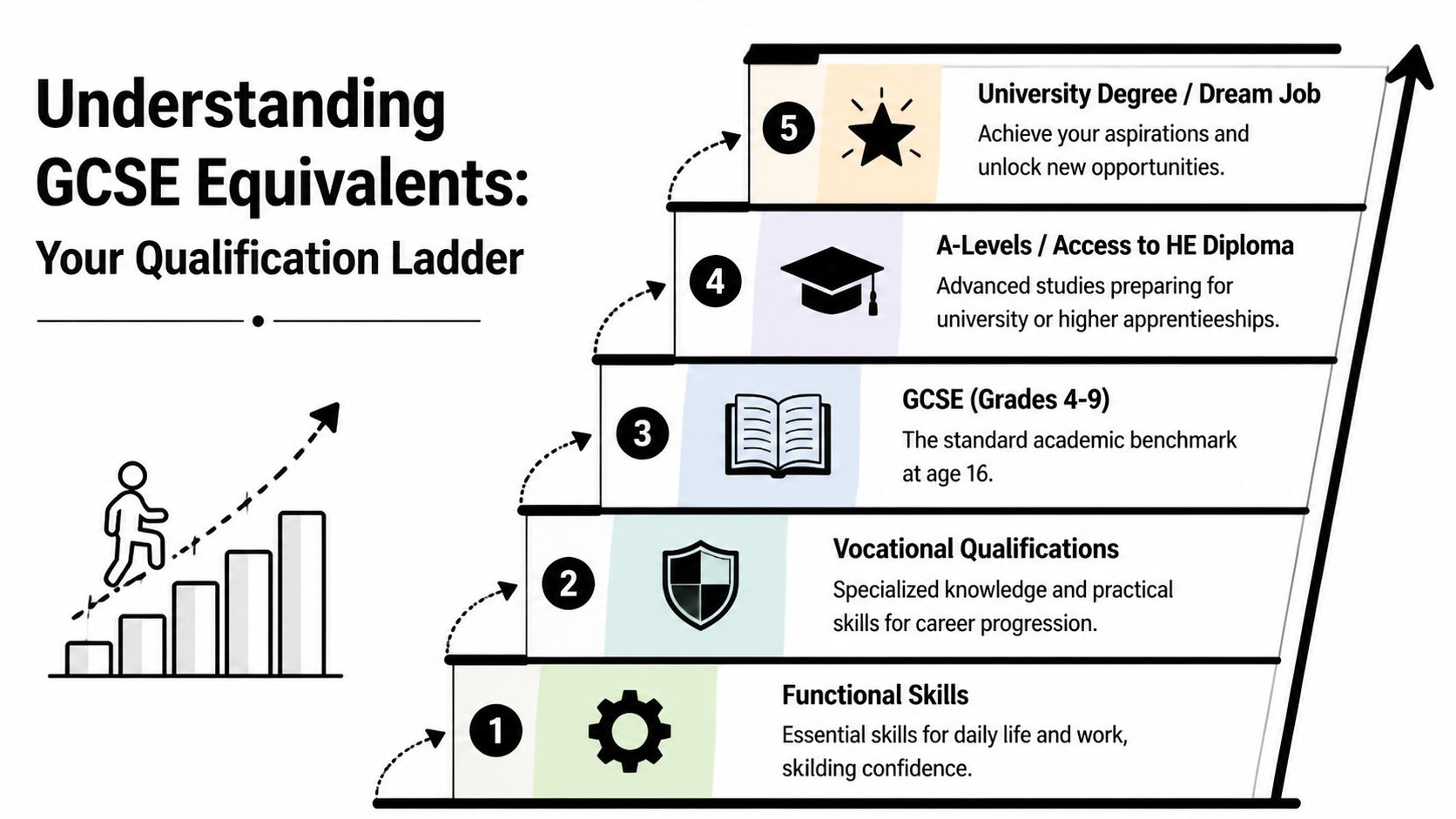
The level matters more than the label
This is often the moment when adults feel relieved. You do not need to go back and copy the exact school route you missed the first time. You need a recognised qualification that proves you can work at the required standard now.
A Level 2 qualification works like taking a different road to the same destination. The road may be more practical, more flexible, or better suited to adult life, but it still gets you to the place many courses and employers ask for.
| Qualification stage | What it means |
|---|---|
| Level 2 | The level where GCSE passes sit |
| Equivalent qualification | A different qualification at the same standard |
| Next step | Entry to many Level 3 courses, training programmes, and job roles |
Three checks to make before you enrol
Confusion usually comes from mixing up three separate ideas.
The subject
You may need English, maths, science, or a vocational subject.The level
For GCSE equivalence, the qualification usually needs to be Level 2.The acceptance
A qualification can be the right level and still not be accepted everywhere, so always check the entry rules for your course or job.
That last point saves people time, money, and disappointment.
For example, some adult learners choose Functional Skills because it is widely accepted for English and maths requirements and is built around practical use. If you want a clearer picture of that route, this guide to Functional Skills equivalent to GCSE explains where it fits.
Why people talk about grade 4
GCSEs in England now use the 9 to 1 grading system. A grade 4 is the standard pass, so many equivalent qualifications are described as being equal to GCSE grade 4.
That can sound technical at first, but the idea is straightforward. If a form asks for GCSE English or maths at grade 4 or above, you are checking whether your alternative qualification is recognised as meeting that same standard.
Once you separate level, subject, and acceptance, the system becomes much easier to handle. And that matters, because choosing the right qualification is not only about getting a certificate. It is about choosing a route that fits adult life and helps you build a stronger future with confidence.
Common GCSE Equivalents Perfect for Adults
Adults usually want three things from study. It needs to be recognised, manageable, and useful. Two of the most common GCSE equivalents that fit those needs are Functional Skills Level 2 and BTEC Level 2.

Functional Skills Level 2
Functional Skills is often the best-known route for adults who need English or maths. In the UK, Functional Skills Level 2 is officially recognised as equivalent to a GCSE grade 4, and it is often a good fit for adults because it focuses on practical use and can often be completed in 3 to 6 months, as explained in this guide to Functional Skills as a GCSE equivalent.
That practical focus matters. Instead of feeling like you’re returning to a school desk from years ago, the work is closer to real life. Reading information clearly. Writing for purpose. Using maths in everyday situations.
If you want a closer look at this route, this page on Functional Skills equivalent to GCSE shows how the qualification is commonly used by adult learners.
BTEC Level 2
BTECs are different. They’re vocational, which means they are linked more closely to practical areas such as business, health, or other work-related subjects. Some BTEC Level 2 qualifications count as GCSE equivalents, with sizes that can match one or more GCSEs, as shown in Goldsmiths’ accepted GCSE equivalencies guidance.
For adults, that can feel more motivating because the learning is connected to a job direction. If you already know the sector you want to move into, a BTEC can give you both a recognised level and a clearer sense of purpose.
A simple comparison
Choose Functional Skills if
- You need English or maths quickly: It’s a direct route for common entry requirements.
- You want practical learning: The focus is on useful everyday skills.
- You need flexibility: It often suits adults balancing work and family.
Choose a BTEC if
- You want a work-related subject: It links learning to a career area.
- You prefer applied study: Many adults like producing work that feels relevant.
- You need broader vocational evidence: It can support progression into further training.
The best qualification isn’t the one that sounds most impressive. It’s the one that gets you accepted for your next step and fits your real life.
Some adults still think “equivalent” means “less than”. It doesn’t. It means a recognised alternative route. For many people, especially those coming back after a long break, that alternative route is the one that finally works.
How Equivalents Unlock University and Dream Jobs
When adults ask what is a gcse equivalent, they’re usually asking a deeper question. “Can I still get where I want to go?”
The answer is often yes.
A recognised equivalent can be the first move toward university, professional training, or a more stable career. For example, Functional Skills Level 2 in maths and English are accepted by 98% of UK higher education providers as a GCSE grade 4 equivalent, and 75% of adult learners who complete Functional Skills advance to Access to HE diplomas, according to this summary of Functional Skills progression to higher education.
That matters because many adult learners don’t go straight from one qualification to a degree. They build step by step. First English and maths. Then an Access to HE course. Then university. That path is real, and it works.
The route can be simple
A common path looks like this:
Gain the equivalent you need
This often means English, maths, or both.Progress to Level 3 study
For many adults, that means an Access course.Apply for university or career training
Nursing, midwifery, social work, teaching support, law, business, and many other routes begin this way.
If you’re exploring that next stage, this page on an Access to HE Diploma online shows how adults often bridge from core qualifications into university preparation.
Why this changes family life
The qualification itself is small compared with what it can lead to. It can mean your children seeing you revise at the kitchen table and learning that setbacks don’t define a person. It can mean moving from work that drains you into work that uses your strengths.
It can also change how you see yourself. Many adults return to study believing they are “not academic”. Then they pass. Then they keep going.
A short video can help bring that next step to life.
Some doors don’t open all at once. They open one qualification at a time.
How to Check and Prove Your Qualifications
This part often worries people more than the studying. Paperwork can feel harder than learning. The good news is that checking a qualification is usually a simple process when you take it one step at a time.
Start with the awarding body
Look at your certificate and find the awarding body. That’s the organisation that issued the qualification. If you already have an old certificate but you’re not sure what level it is, the awarding body is usually the first place to check.
If you no longer have the paperwork, contact the organisation that issued it and ask for guidance. They can often confirm what the qualification was called and whether replacement documents are available.
Check the official status
Use official course information and recognised records to confirm whether the qualification is regulated and what level it sits at. If you’re comparing providers, it helps to read a clear guide on accredited online courses in the UK so you know what proper recognition looks like.
A few useful questions to ask are:
- What level is this qualification?
- Is it accepted for the course or job I want?
- Who is the awarding body?
- Can I get written confirmation?
If your qualification is from another country
If you studied outside the UK, ask about UK ENIC recognition. That service helps compare overseas qualifications with UK levels. This can be very helpful if you already have learning behind you but need it understood properly here.
Keep copies of certificates, emails, and acceptance messages in one folder. Future you will be glad you did.
You don’t need to solve everything in one afternoon. One email, one phone call, or one check can give you the clarity you need to move ahead.
Take Your First Step Today with Our Support
It’s 9:30 at night. The kitchen is finally quiet, the children are asleep, and you’re staring at a course page wondering whether this is really the moment you begin again. Part of you wants a better job, more security, and proof that your past results do not get the final word. Another part is nervous.
That feeling is normal.
Coming back to education as an adult is different from school because your reason is different now. You are not studying just to collect a grade. You are building options. More income. Better training. A career change. A stronger example for your family. A GCSE equivalent can be part of that fresh start because it gives you a flexible route to recognised qualifications that fit around real life.
A good course should work like a steady set of stepping stones. You do not need to jump the whole river in one go. You only need one solid next step.
What your first step can look like
- Start with your goal: Do you need English, maths, or both for work, university, or a new course?
- Check the exact entry requirement: A college, university, or employer can usually tell you which qualification they accept.
- Pick a study format you can keep going with: A realistic plan beats an ideal plan that collapses after one busy week.
- Use the support that is there: Tutors, course advisers, and structured study plans exist to make this manageable.
Many adult learners worry about being out of practice. That can feel frightening at first, but it often changes quickly. Adults usually bring something school pupils are still learning. Purpose. When you know why you are studying, it becomes easier to stay with it on the tired evenings and busy weekends.
Your age does not count against you
Adult learners often do well because they approach study with patience, discipline, and a clear reason for finishing. You may be doing this for a promotion, a nursing course, an apprenticeship, or to open doors that closed too early the first time round.
Those reasons matter.
One completed lesson can change how you see yourself. One passed assessment can replace years of self-doubt with evidence that you are capable. Progress often starts subtly, then grows.
If you’re ready to take that first step, Next Level Online College offers flexible support for adult learners who want recognised qualifications without putting the rest of life on hold. Whether you need English, maths, GCSEs, A Levels, or a route towards university, the right support can turn a nervous start into steady, real progress.