
You might be coming to this after a long day, wondering whether A Level Economics is really for someone like you. Maybe you're working, caring for children, or both, and the idea of studying again feels a bit distant. That feeling makes sense. Returning to education can stir up nerves, especially if it's been years since you last opened a textbook.
The good news is that what is a level economics is much less mysterious than it first sounds. In UK terms, it's a two-year academic qualification that sits at Level 3, and it's built to help you understand how money, markets, businesses and government decisions affect everyday life. It is not just for teenagers heading straight from school. It's a real route for adults who want to move forward, gain confidence, and open doors that have felt closed for too long.
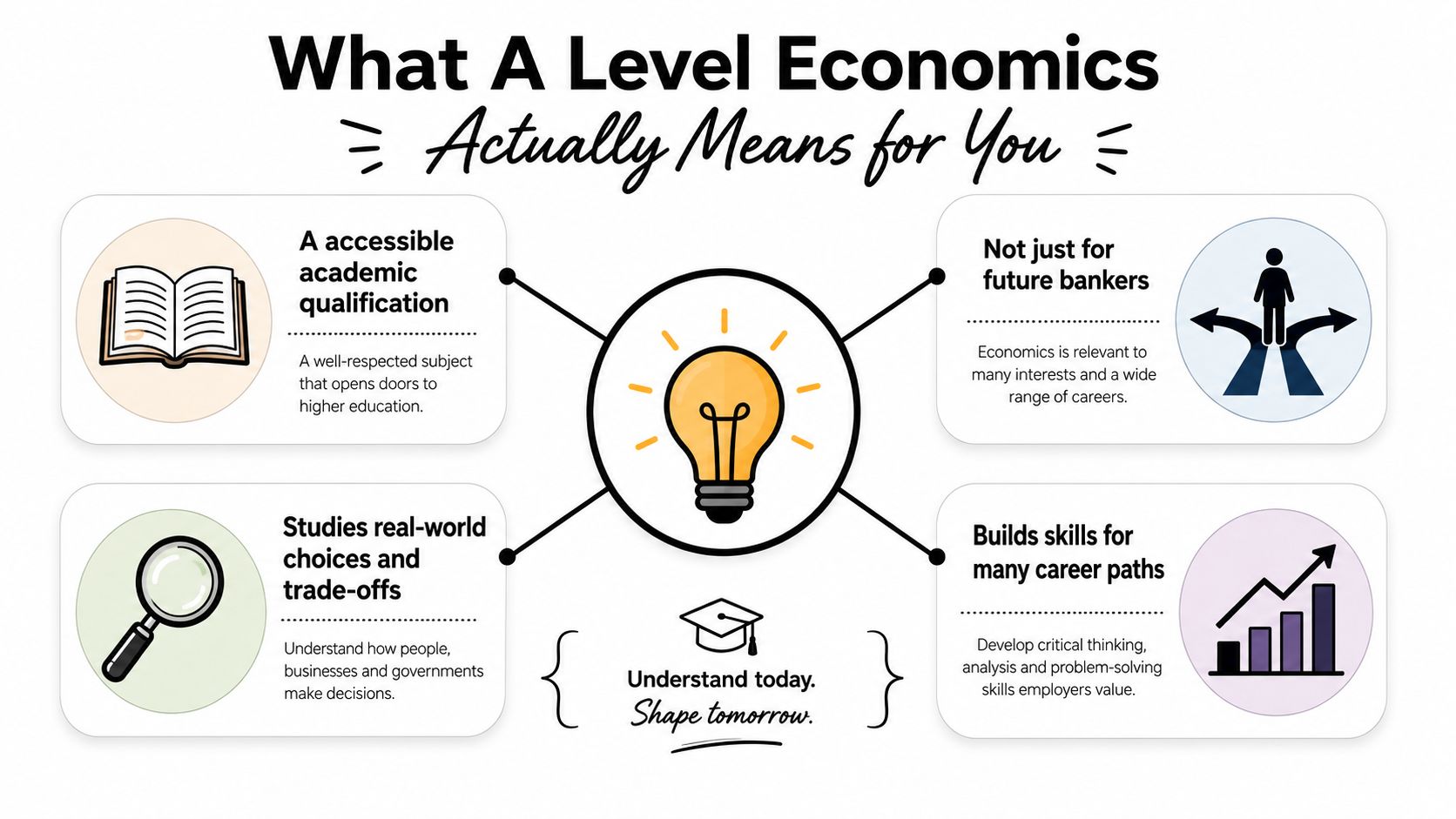
What A Level Economics Actually Means for You
You do not need to be a future banker to make sense of this subject. If you've ever looked at the cost of the weekly shop, wondered why petrol prices change, or asked why one job pays more than another, you've already started thinking like an economist.
A qualification that fits real life
A Level Economics is a recognised academic qualification studied over two years, and it gives you a structured way to understand how the economy works in practice. It sits alongside other A Levels as a route into higher education, and it's also useful for adults who want to show employers that they can think clearly, handle information, and explain ideas well. The course is not about memorising a pile of dry facts. It's about learning how to read the world with more confidence.
That matters if you want a better job, a university place, or a fresh start. Universities value A Levels because they show academic ability, and employers respect qualifications that prove you can analyse problems and communicate properly. For an adult learner, that can feel personal too. It's not only about a certificate. It's about proving to yourself that you can still learn, still grow, and still aim higher.
Practical rule: if you can explain a price rise, compare two choices, or spot trade-offs in daily life, you've already got the kind of thinking economics uses.
Not just theory, but a way of seeing choices
One reason adults often warm to economics is that it makes sense of things they already notice. Why do some people get a pay rise while others don't? Why do prices move? Why does government policy sometimes help and sometimes cause frustration? Economics gives you language for those questions.
If you'd like to see how the course is put together in a flexible online format, the A Level Economics course page shows how it can fit around adult life. That's useful because many returners don't just need content. They need a route that feels manageable.
The value of the qualification is this. It turns everyday confusion into understanding, and understanding into confidence. For many adults, that's the first step back into education, and it's a strong one.
The Four Core Themes You Will Study
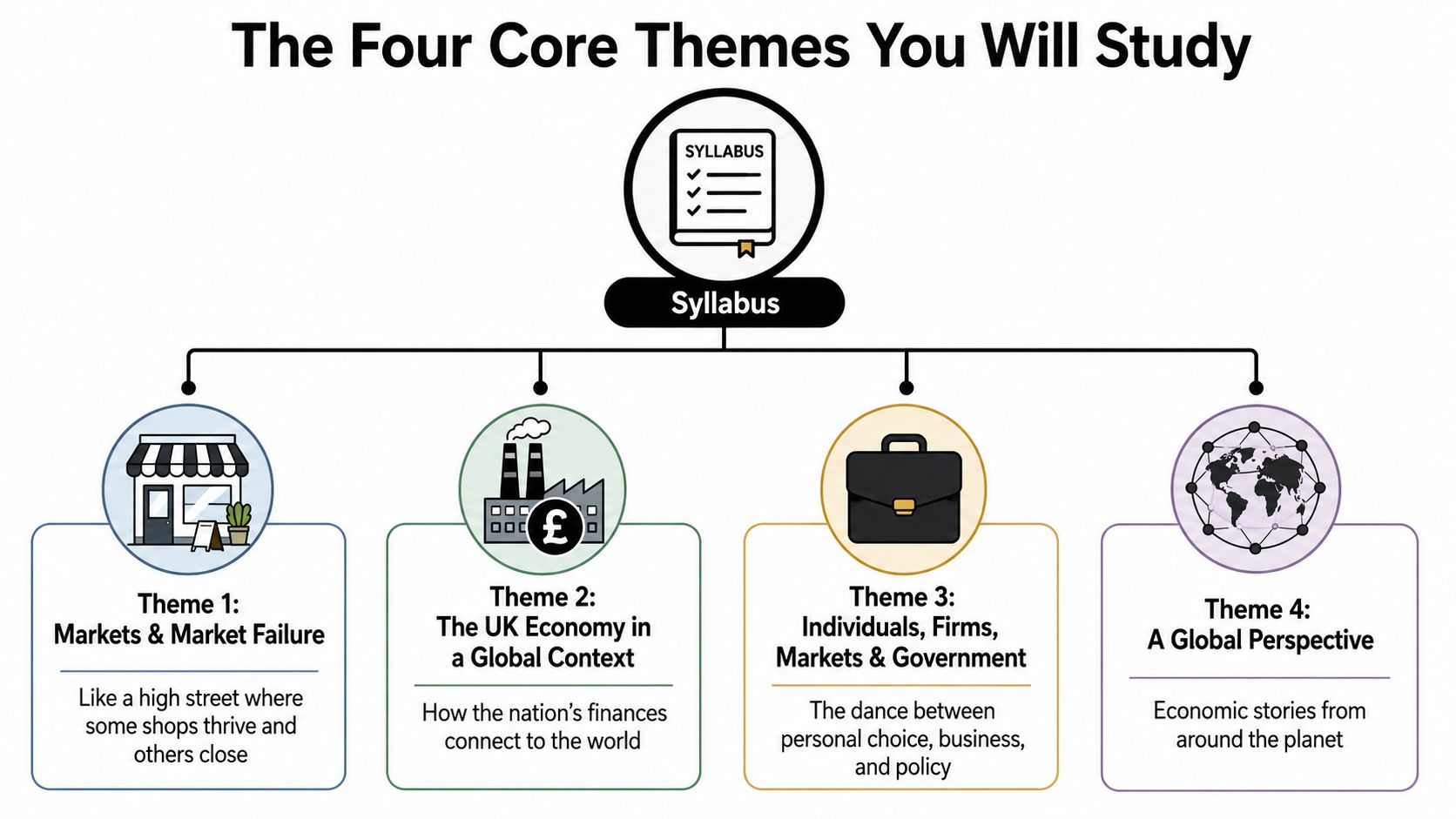
A Level Economics is organised in a way that helps the ideas build on each other. You start close to everyday markets, then widen out to the UK economy, business decisions, and finally the global picture. That's helpful, because economics can feel huge at first. A clear structure stops it from becoming a blur.
Theme by theme in plain English
Theme 1, Markets and Market Failure, is like a busy high street. Some shops are thriving, some struggle, and some close. You look at how supply and demand work, but you also look at why markets sometimes fail to give people the right outcomes. That could mean things like shortages, pollution, or services that are hard to provide fairly.
Theme 2, the UK Economy, steps back and asks bigger questions. What's happening with jobs, prices, growth and government policy? You begin to see how decisions made by the state affect households, firms and the wider economy. It's the “big picture” theme.
Theme 3, Business Behaviour and the Labour Market, zooms in again. Here, you study how firms think about costs, prices, wages and competition. You also look at labour markets, which helps explain why some jobs attract better pay or different working conditions.
Theme 4, a Global Perspective, opens the window wider still. You look at trade, growth, development, globalisation, and financial markets. It helps you understand why one country's policy change can ripple across others.
Useful way to think about it: the same petrol price story can be studied in two ways. One angle looks at the market itself. Another looks at inflation, policy, and the wider economy.
| Theme | Focus | Real-World Example |
|---|---|---|
| Markets and Market Failure | How buyers, sellers and prices interact | A local shop raising prices when costs rise |
| UK Economy | Jobs, inflation, growth and policy | Government action when prices rise |
| Business Behaviour and Labour Market | Firms, wages and competition | Why one employer pays more than another |
| Global Perspective | Trade, growth and international issues | How world events affect UK imports |
The key point is that the course is applied, not just abstract. You're not sitting in a room with theory for theory's sake. You're learning to read the economy as it exists now, in the UK and beyond.
How You Are Assessed and Graded
A Level Economics usually ends with three exam papers, and that can sound intimidating until you break it down into pieces. The assessment is designed to test what you can understand, explain and apply, not just what you can memorise. That's good news for adult learners, because clear thinking matters just as much as instant recall.
What the exam journey looks like
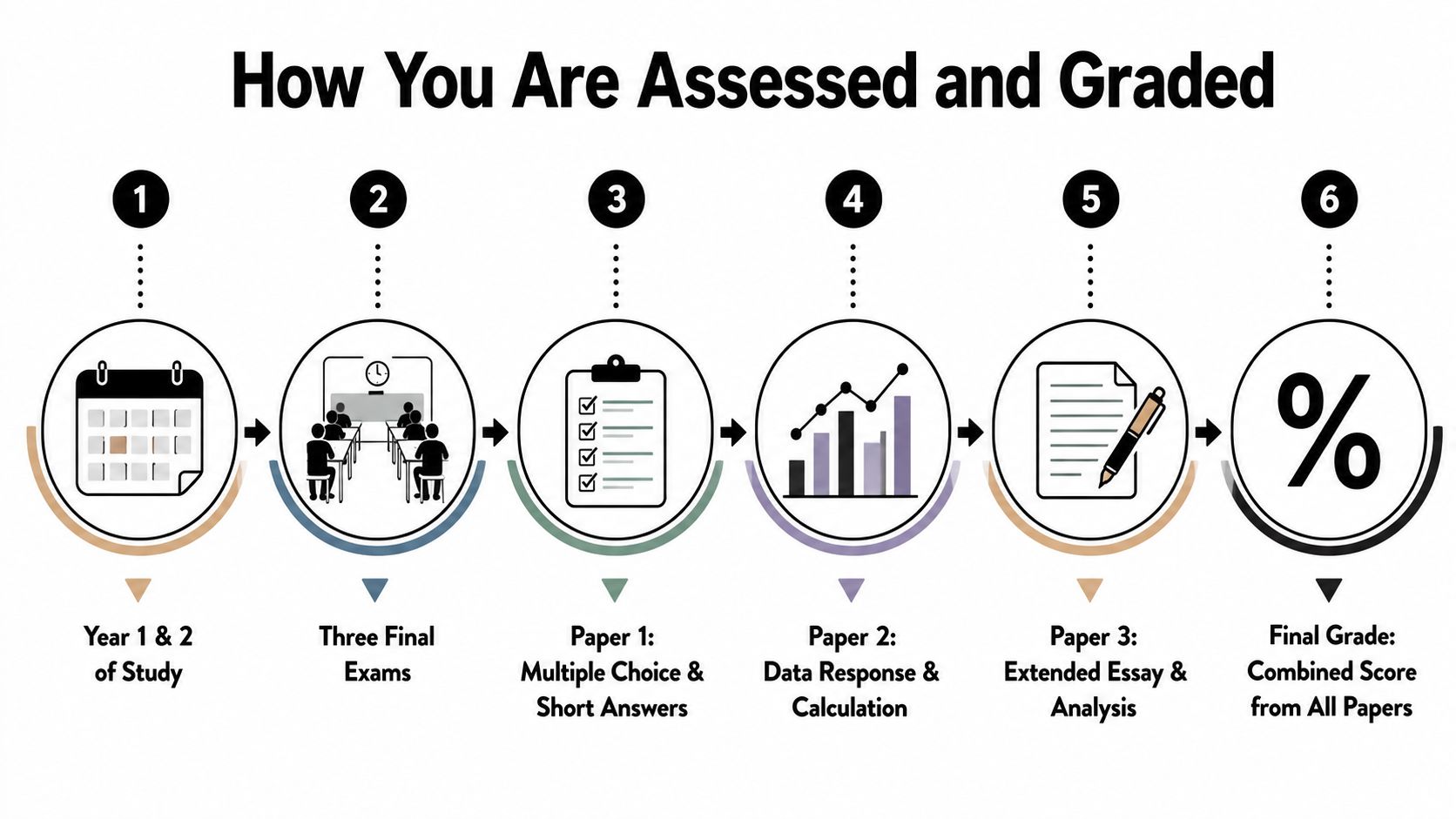
The papers usually combine multiple-choice, data-response, and essay questions. That means you'll meet short questions, questions built around charts or extracts, and longer answers where you explain an argument in more detail. The subject is also split between microeconomics and macroeconomics, so you cover both individual decision-making and the bigger economy.
Think of a data-response question like reading a newspaper article and then answering, “What's going on here, and why does it matter?” You're not being asked to be a human calculator. You're being asked to show that you can make sense of evidence.
Grades run from A down to E*, and universities often ask for at least a grade C in relevant subjects. If grades have felt like a sore point in the past, that does not mean you're stuck. It means you need a clear plan, steady practice, and support that doesn't make you feel small.
For a simple overview of grade levels, the A Level grades guide can help you understand where the qualification sits and what progression can look like.
A calm way to approach the papers
- Learn the command words: words like “explain”, “analyse” and “evaluate” tell you what the examiner wants.
- Practise with data early: charts and tables become less scary once you've seen them a few times.
- Write in steps: a strong answer often starts with the idea, then the reason, then the example.
- Don't chase perfection first: a clear answer is more useful than a brilliant plan you never finish.
You do not need to know everything before you start. You need to understand the shape of the exam, then build skill by skill.
Once you see the structure, the subject feels less like a wall and more like a staircase.
Economics in Everyday Life
Economics is already around you, even on ordinary days. You see it when the weekly shop costs more than expected, when a mortgage payment changes, or when a family member asks why their wages have not kept up with their bills. Those moments are not random. They are the subject in action.
The world outside the textbook
A rise in the cost of everyday goods can make a household feel stretched. That is why the Office for National Statistics glossary explains CPI as the main indicator of inflation in the UK, tracking price changes over time for a fixed basket of consumer goods and services. It also notes that the CPI index is anchored to a base period, so movements can be read as percentage changes rather than raw prices.
That matters because economics is not abstract when you're budgeting at home. If prices rise, your money buys less than before unless your income rises too. That is the life link between a price index and the pressure people feel in the shops.
Mortgage costs, job pay, and petrol prices all tell similar stories. A change in one part of the economy can spread to other parts. A family may notice it as tighter spending. A business may notice it as higher costs. An economist reads it as evidence.
Learning to read the signs properly
A Level Economics helps you stop reacting blindly to headlines. Instead of just thinking, “Everything's getting worse,” you start asking better questions. Which cost is rising? Who is affected? Is this a supply problem, a demand problem, or a policy issue?
That shift is powerful for adult learners because it turns frustration into understanding. You begin to see why one news story matters more than another. You also become more confident talking about things that once felt reserved for “people who know about economics”.
The subject is data-heavy, but that is part of its strength. You'll practise reading charts, short extracts, and numerical evidence, which makes the course feel relevant to real life, not separate from it.
Skills You Will Build and Where They Can Lead
A Level Economics gives you more than subject knowledge. It trains the habits that employers and universities look for, and those habits can change how you see yourself. Many adults return to study hoping for a qualification. What they often gain is a stronger voice.
The skills that quietly build confidence
You learn critical thinking, which means not taking every claim at face value. You learn data interpretation, which helps you understand charts, tables and numerical evidence. You also build structured writing, because economics rewards clear answers with a beginning, middle and end.
These skills matter well beyond the exam hall. If you can break down a problem, compare evidence, and explain your thinking clearly, you are already doing work that transfers into many jobs. That includes office work, customer service, administration, finance, policy, and communication roles.
Small win worth noticing: the first time you explain an economic idea in your own words, you've already started thinking like a student again.
Why this can help your future
The qualification can support university entry because it sits within the A Level route that universities recognise. It can also support applications for degrees in business, finance, policy, law and the social sciences, because those subjects value analysis and evidence-based thinking. For adults who want a career change, that matters.
It can also help at work. Better analysis often leads to better decisions, and better decisions can lead to new responsibilities, promotions or a move into a more fulfilling role. That's not a promise of instant change, but it is a realistic pathway. People who can explain information clearly and make sense of change are useful in almost every workplace.
The family side matters too. Many adult learners want their children to see them study, struggle a little, then keep going. That kind of example is powerful. It shows that learning is not just for the young, and that confidence can grow later in life.
When you finish this course, you won't just have a subject on paper. You'll have a sharper way of thinking, and that can help in work, study and family life.
Worries Adult Learners Often Have and How to Beat Them
The biggest worry for many adults is not the syllabus. It's the feeling of being out of practice. That feeling is real, and it deserves respect. But it does not mean you can't succeed.
The usual fears, answered honestly
If maths makes you nervous, you are not alone. Economics does include calculations and numerical evidence, but the work is usually manageable with practice and good teaching. You are not expected to be an expert on day one. You're expected to learn.
If you worry about being the oldest person in the room, online study changes that feeling completely. You're not being watched in a classroom while you rebuild your confidence. You can learn in your own space, at your own pace, and focus on progress rather than comparison.
If work and family life make study feel impossible, the answer is not “try harder”. The answer is structure. Small, regular study sessions work better than waiting for a free weekend that may never come. Adults often do best when study is built into real life, not placed beside it like an extra burden.
What universities think about mature students
Many adults assume universities only want school leavers. That's not how higher education works. Universities welcome mature students because life experience can strengthen motivation, resilience and focus. If anything, having responsibilities at home can make your commitment clearer, not weaker.
A helpful mindset is to treat every study session as a small vote for your future. Ten minutes spent checking a chart or rewriting a paragraph is not wasted time. It is proof that you're moving.
- If maths feels rusty, begin with basics and repeat them often.
- If confidence feels low, aim for one clear win each week.
- If the workload feels heavy, cut it into smaller pieces.
- If self-doubt appears, remember that adults learn differently, not less well.
The route forward is not about being fearless. It's about keeping going while afraid, then noticing that the fear gets quieter.
Studying A Level Economics Online as an Adult
Online study suits adults because life doesn't pause while you work towards a qualification. A flexible course lets you fit learning around shifts, children, caring duties and the unpredictable bits of normal life. That can make the difference between “someday” and “now”.
How flexible study can support you
A structured online provider can give you the shape of a course without forcing you into someone else's timetable. Next Level Online College, part of Cambridge Online Education Ltd, offers supported online study with subject specialists, mentors and wellbeing support, which can help when confidence dips or routines slip. It's one route among several, but it shows what adult-focused support can look like in practice.
The guide to doing A Levels online is useful if you want to understand how flexible study works alongside adult responsibilities. For many learners, that kind of clarity removes the biggest barrier, which is uncertainty.
Study habits that make the work feel lighter
A few simple habits can make a huge difference:
- Set a weekly timetable: pick regular slots so study becomes normal, not rare.
- Start past questions early: the sooner you see exam style, the less shocking it feels later.
- Use short reviews often: quick check-ins help information stick better than one long cram.
- Ask for support quickly: confusion grows when it is left alone.
A good online course should make study feel organised, not lonely.
Entry requirements can vary, so the safest next step is always to check the course details and ask before you enrol. If you're unsure whether your current level is enough, that uncertainty is common. It's also fixable with the right guidance.
The best time to begin is when you're ready to take one small, sensible step. That might be reading the course page, sending an enquiry, or writing down the times you could realistically study each week.
Your Next Step Toward a Brighter Future
A Level Economics is a practical, respected route for adults who want to understand the world, grow in confidence, and move towards university or better work. It teaches you how markets, the UK economy, business decisions and global issues fit together, and it does that in a way that can be learned step by step.
If you've been waiting for a sign that it's not too late, this is it. Your age does not cancel your ability. Your past does not block your future. Every hour you spend learning is an investment in a stronger, more secure version of yourself.
There's also something powerful about the example you set. When children see a parent studying, they see effort, pride and possibility. That can change how a whole family thinks about learning.
Take the next small step today and explore Next Level Online College. A conversation, a course page, or an enquiry could be the start of something that changes your future.