
Some evenings feel heavier than others. You finish work, sort the tea, answer messages, help with the kids, and then that thought comes back again. You want more. More confidence. More choices. More security for the people you love.
Maybe you've seen a job you could do well, but it asks for maths and English. Maybe university has crossed your mind, subtly, in those moments when life finally goes still. Maybe you just want to stop feeling nervous when a form, an email, or a set of numbers lands in front of you.
If that sounds like you, please hear this first. You have not missed your chance. You are not too old. You are not “bad at learning”. You are a grown adult carrying real responsibilities, and the fact that you're even thinking about returning to education says something powerful about you.
Functional skills level 2 maths and english can be a fresh start. Not a return to school as you remember it. A practical path built for adults who want skills they can use in daily life, work, and further study. It’s a chance to prove something to yourself, not just to anyone else.
And yes, it can become something bigger than a qualification. It can be the moment your children see you studying at the kitchen table and learn that courage matters. It can be the step that helps your family move forward. It can be the day you stop saying “I wish I had” and start saying “I did”.
Your Time to Shine A Fresh Start with Maths and English
There are many adults across the UK sitting in the same position right now. Laptop open. Tea going cold. Searching late at night because they want a better future but feel unsure where to begin.
Some feel stuck in work. Others want to apply for nursing, teaching, an apprenticeship, or a university course and have found that maths and English are the missing pieces. Some want to help their child with homework without that old wave of panic.

This isn't about going backwards
A lot of adults worry that studying again will feel like being pushed back into a classroom where they once felt lost. Functional Skills are different. They focus on useful skills for real life.
That means reading clearly, writing with confidence, and using maths in everyday situations. You’re not doing it to impress a school teacher. You’re doing it so you can move forward.
You don't need to become a different person to succeed. You need the right support, a clear plan, and the belief that this goal belongs to you too.
Why this step matters so much
When an adult chooses to learn again, it often changes more than one life.
- For you: You gain confidence, options, and a recognised qualification.
- For your family: You show that effort matters and that it’s never too late to grow.
- For your future: You create a path towards better work, further study, and more stability.
If you've been doubting yourself, that's normal. Most adult learners feel nervous at the start. Courage doesn't mean feeling fearless. It means taking the first step anyway.
What Are Functional Skills Level 2 Qualifications
Think of Functional Skills as a toolkit for life. Not a box full of theory you may never use, but a set of tools you can reach for at work, at home, and in further study.
Functional Skills Level 2 in maths and English are recognised qualifications that show you can use these skills in practical ways. They’re widely accepted as equivalent to a GCSE grade 4, which used to be called a grade C. For many adults, that makes them an excellent route back into learning.
A toolkit you can actually use
In English, the toolkit helps you:
- Read with understanding: useful for work instructions, letters, news articles, and online information.
- Write clearly: useful for emails, applications, reports, and messages that need the right tone.
- Speak and listen with confidence: useful in meetings, interviews, and everyday conversations.
In maths, the toolkit helps you:
- Work with numbers: for wages, bills, shopping, and budgets.
- Use measures: for time, distance, weight, and size.
- Handle data: for charts, tables, and making sense of information.
Who these qualifications are for
Functional skills level 2 maths and english suit many kinds of learners.
Some people need them for a job application or promotion. Some need them to get onto an Access to Higher Education course, apprenticeship, or university route. Others want them for personal pride. That matters too.
You may recognise yourself in one of these:
| Situation | Why Functional Skills can help |
|---|---|
| You left school without the grades you needed | You can gain a respected Level 2 qualification as an adult |
| You want a new career | Many roles ask for maths and English at this level |
| You want to support your children better | You build confidence with reading, writing, and numbers |
| You’ve been out of education for years | The practical style often feels more relevant and manageable |
Why adults often prefer this path
Adults usually want learning to be clear, focused, and useful. They don't want to spend time on topics that feel far away from daily life.
That’s one reason Functional Skills can feel more approachable. The learning connects directly to tasks people already recognise, such as writing a professional message, reading for meaning, or checking figures.
A simple way to think about it: GCSEs often build broad academic knowledge. Functional Skills focus on showing that you can use key skills well in real situations.
Respect, flexibility, and real purpose
These qualifications are not a lesser option. They’re a practical option.
For adults with work, family duties, and busy schedules, that can make a huge difference. You’re building skills with purpose. Every page you study has a clear reason behind it.
And that matters when confidence is fragile. It’s easier to keep going when you can see why the learning matters to your life right now.
A Closer Look at Functional Skills English Level 2
You sit at the kitchen table after work. One child needs help reading a school letter. Another asks what a form means. You know you are capable, but the words seem to blur and your confidence drops for a moment.
That feeling is more common than many adults admit. Coming back to English study can stir up old doubts. It can also become one of the bravest choices you make for yourself and for your family.
English at Level 2 helps you read with understanding, write with purpose, and speak with confidence in everyday situations that matter. It gives you skills you can use at home, at work, and in those important moments when you want your voice to carry weight.

The three main parts of English
Functional Skills English Level 2 includes writing, reading, and speaking and listening. The LearnDirect overview of Functional Skills English and maths Level 2 states that writing makes up 40 to 50%, reading comprehension makes up 30 to 40%, and speaking and listening makes up 20 to 30% across three modular exams. The same overview notes that learners generally need to show over 85% accuracy in spelling, punctuation, and grammar, and that structured practice on tasks such as formal letters or articles can reduce common errors by up to 40% in mock assessments.
That might sound like a lot at first. It helps to picture it as learning three parts of the same skill. Reading helps you notice meaning, writing helps you express it, and speaking and listening help you share it with other people.
Reading with a sharper eye
Reading at this level is about more than getting through the words on the page. It is about spotting what the writer means, why they wrote it, and whether you should trust it.
You might read a leaflet, article, or workplace document and ask:
- What is the main message?
- Who is it written for?
- Which parts are fact, and which are opinion?
- Is the writer trying to inform, persuade, or warn?
These questions matter in ordinary life. They help you read a school email carefully, compare job information, and judge whether something shared online is reliable.
This can be a quiet turning point for adult learners. You stop feeling pushed around by confusing information. You start feeling steady and informed.
Writing that sounds clear and confident
Writing worries many adults because it can feel public. Once the words are on the page, they seem to prove something about you. That pressure is real, especially if school once made writing feel like a test of your worth.
Functional Skills takes a kinder and more practical approach. You build writing step by step, like laying bricks in a wall. First comes the purpose. Then the structure. Then the small details such as spelling, punctuation, and tone.
You learn how to handle different kinds of writing, such as:
- a polite complaint email
- a clear message to a manager
- a formal letter
- a short article or report
Good writing is clear writing. Long words are not the goal. Helping the reader understand you the first time is the goal.
If you want extra support in this area, this Functional Skills English online course is designed around the kind of practical help adult learners often need.
Speaking and listening without dread
Many people feel nervous about this part before they try it. They worry about freezing, forgetting what to say, or sounding foolish in front of others.
In practice, speaking and listening is about joining in thoughtfully. It includes listening closely, responding to what others say, and making your own point clearly. If you have ever explained a problem at work, discussed plans with family, or spoken to a teacher about your child, you have already used the foundations of this skill.
That is why this qualification can mean more than a certificate.
It can help you speak up in meetings. It can help you ask better questions. It can help you become the parent who feels confident at school appointments and the adult who no longer stays silent out of fear. For many learners, that change reaches far beyond education. It shows their children what courage looks like in real life.
Making Sense of Functional Skills Maths Level 2
The school letter arrives. Your child asks for help with a trip payment, the discount code on the food shop is confusing, and you catch yourself thinking, “I should be able to do this.”
If that feeling hits a nerve, you are not alone. Many adults carry old maths worries for years. Functional Skills Maths Level 2 gives you a calmer, more practical way back in. It teaches the kind of maths people use to run a home, cope at work, and make confident decisions for themselves and their family.
The kind of maths you already use
A lot of adult learners say, “I’m bad at maths,” when what they often mean is, “I had a bad experience learning maths.”
That is a very different thing.
You are probably already using maths when you check a payslip, compare offers in the supermarket, work out whether overtime is worth it, split a bill, read a timetable, or measure a room before buying furniture. Functional Skills builds on those real moments. It breaks them into clear steps, so the process feels less like guessing and more like following a map.
That matters because confidence in maths rarely appears all at once. It grows one small win at a time.
What you will study
Functional Skills Maths Level 2 usually centres on practical number work, measures, shape, space, and handling data. In plain English, that means learning how to work with money, time, percentages, graphs, tables, area, and everyday problem-solving.
The assessment also puts a strong focus on applying maths to realistic situations, rather than only answering abstract sums. For many adults, that makes the subject feel more fair. You are learning how to use maths, not just how to remember rules under pressure.
If you want flexible support with that practical approach, this Functional Skills Maths online course is designed for adults fitting study around work and family life.
Data handling without the fog
Statistics can sound intimidating at first. Mean. Median. Mode. Range. The words can seem technical until you see what they do.
The Pass Functional Skills guide to mean, median, mode and range explains that Level 2 learners are expected to calculate the mean, median, mode, and range from a set of data as part of handling information and data.
Here is the plain-English version:
| Term | What it means |
|---|---|
| Mean | The average |
| Median | The middle number when values are in order |
| Mode | The number that appears most often |
| Range | The difference between the highest and lowest value |
These ideas are often easier than they first appear. They work like different ways of summarising a story hidden inside a set of numbers. Once someone shows you a few worked examples, the pattern often starts to click.
After a bit of explanation, a short video can make the topic click for many learners.
Why this maths matters outside the exam
This qualification can help with far more than passing a test. It can help you understand household costs, spot mistakes on bills, compare financial options, and feel steadier when numbers appear in everyday life.
For many parents, there is something even bigger at stake. Gaining confidence in maths shows your children that fear does not get the final say. You can return to learning, keep going, and succeed. That is a powerful example to set.
And if you have doubted yourself for years, passing Functional Skills Maths Level 2 is more than an academic result. It is proof that you can still grow, still achieve, and still build a stronger future for the people who depend on you.
Functional Skills vs GCSEs Which Path Is for You
This is one of the biggest questions adult learners ask. Should you choose Functional Skills or GCSEs?
The honest answer is that neither path is “the best” for everyone. They are different routes, and the right one depends on your goal, your schedule, and the kind of learning that suits you.
A simple difference in focus
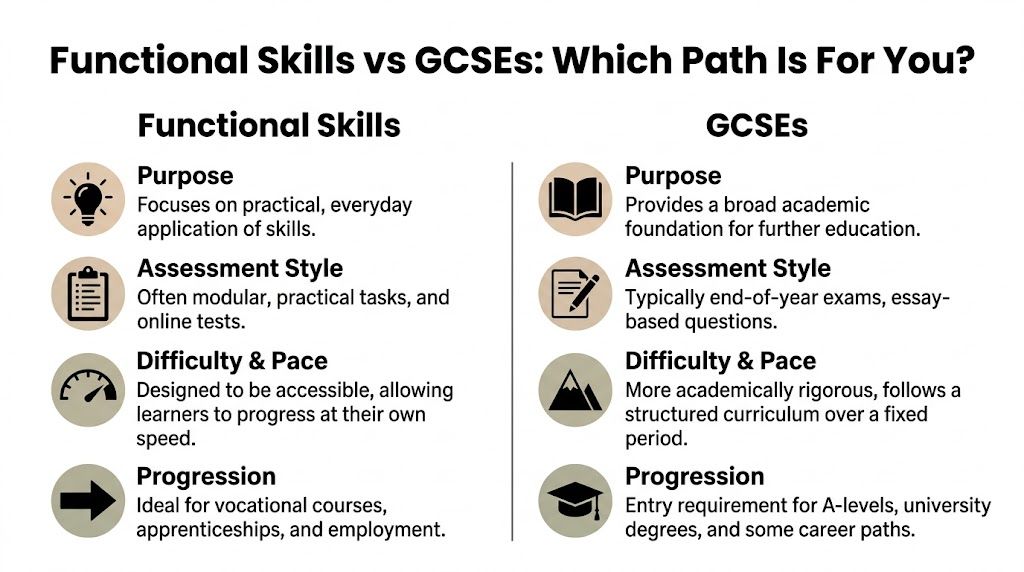
GCSEs usually give a broader academic foundation. Functional Skills focus more tightly on using English and maths in practical situations.
That means Functional Skills often feel more direct for adults who need a recognised qualification for work, training, or further study and want learning that connects clearly to real life.
Functional Skills Level 2 vs GCSE at a Glance
| Feature | Functional Skills Level 2 | GCSE (Grade 9-1) |
|---|---|---|
| Main focus | Practical use of English and maths in everyday and workplace settings | Broader academic study of the subject |
| Style of learning | Often feels more direct and job-related | Often feels wider and more theory-based |
| Assessment feel | Strong emphasis on applying skills to real scenarios | Stronger focus on the full school-style subject |
| Best fit for | Adults returning to education, career changers, learners needing a practical route | Learners wanting a more traditional academic pathway |
| Common goal | Progression to work, training, apprenticeships, and further study | Progression to further education and many career routes |
Questions that help you decide
A short self-check can help.
- Do you need a practical qualification soon for work or a course? Functional Skills may be the better fit.
- Do you prefer real-world tasks over school-style study? Functional Skills often suit that preference.
- Do you want a broader academic subject experience? GCSEs may feel more suitable.
- Are you balancing study with work and family life? Functional Skills often appeal to busy adults for that reason.
Decision rule: Choose the course that matches your destination and your current life, not the one you think sounds more impressive.
If you need reassurance about equivalence
Many adults worry that employers or universities won’t value Functional Skills in the same way. That fear can stop people before they begin.
If that concern is on your mind, this guide on what Functional Skills Level 2 is equivalent to can help you understand where the qualification sits and why it is widely recognised.
The most important thing is this. A qualification only changes your life if you can realistically complete it. The “right” course is the one that helps you move forward with confidence.
How These Qualifications Change Lives
It is 9.30 at night. The children are finally asleep, the house is quieter, and you are staring at a course page wondering whether you are too late, too busy, or too far behind to begin again.
You are not.
For many adults, functional skills level 2 maths and english become the turning point that looked impossible from a distance and manageable once the first step was taken. A pass can help you apply for work, meet course entry requirements, and feel steadier in everyday life. More than that, it can change the story you tell yourself about who you are and what you are capable of.
Progress shows up in ordinary life
These qualifications matter because they connect learning to real situations. English helps you read instructions, write clearly, and communicate with more confidence. Maths helps you work through numbers you encounter in life, from budgeting and measurements to percentages and problem-solving.
That practical link is reassuring for adults who did not enjoy school the first time round. You are not being asked to become a different person. You are building skills you can use at work, at home, and in the small moments that shape daily life.
A certificate may fit in a folder.
Its effect reaches much further.
Confidence grows in ways you can feel
Many learners start their course carrying years of doubt. Some have been told they were "bad at maths" or "not academic." Some left education early and still feel embarrassed about it. Those feelings are common, but they are not a verdict on your future.
Learning again works a bit like strengthening a muscle that has been out of use for a long time. At first, it can feel shaky. Then one topic clicks. Then another. After a while, you notice that the voice in your head has changed. You stop saying, "I can't do this," and start saying, "I'm learning how to do this."
That shift matters.
It often shows up in simple, powerful ways:
- You read a letter or email without that knot of panic
- You help your child with homework more calmly
- You speak more confidently in interviews or at work
- You handle everyday numbers with less stress
- You feel proud of finishing something that once scared you
Your family sees more than your result
Children pay close attention to what adults do, especially when life is hard. They notice effort. They notice courage. They notice when someone keeps going after a tiring day instead of giving up on themselves.
So when you work towards these qualifications, you are doing more than studying maths and English. You are showing your family what persistence looks like. You are showing them that learning does not end at school, that mistakes are part of progress, and that it is possible to begin again.
That is a powerful lesson to pass on.
For some adults, this becomes one of the proudest parts of the journey. Not just the pass itself, but the example it sets. Your child may remember seeing you revise at the kitchen table. Your partner may see your confidence return. Your family may feel the difference before the certificate even arrives.
Better opportunities often begin quietly
Life rarely changes all at once. More often, it changes through steady choices repeated over time. One lesson. One practice paper. One evening where you keep going even though you feel rusty.
That is how a new future often begins.
Functional skills level 2 maths and english can lead to better job options, further training, and a stronger sense of direction. They can also bring something just as important. Self-respect. Relief. The knowledge that you did something difficult for yourself and for the people who depend on you.
If you feel nervous, that does not mean you are not ready. It usually means this matters to you.
And that is often where real change starts.
Your Plan for Success with Next Level Online College
It is 9.15 at night. The children are finally settled, the house has gone quiet, and you are staring at your laptop wondering whether your brain is too rusty for this.
That moment is familiar to many adult learners.
Starting again can feel bigger than the course itself. You may worry about time, memory, confidence, or whether you will be able to keep going after a long day. Those worries are real. They do not mean you are incapable. They mean you are doing something brave.
A good plan makes that bravery easier to carry. Like following a sat nav on an unfamiliar journey, it stops you from wasting energy guessing where to turn next.
Start with a routine you can actually keep
You do not need a perfect timetable. You need one that works on ordinary weeks, not fantasy weeks.
For many adults, shorter sessions work better than trying to cram everything into one long burst. Twenty or thirty focused minutes can do far more than two distracted hours. Small, repeated effort builds knowledge the same way bricks build a house. One layer at a time.
A simple starting pattern might be:
- Pick two or three regular study slots each week
- Keep each session short and clear
- Focus on one topic at a time
- Use mistakes as signposts for what to practise next
That last point matters. A wrong answer is not proof that you are bad at maths or English. It is more like a torch showing you where the gap is.
Build study around real life
Your plan should fit around work, school runs, caring responsibilities, and tired evenings. If it fights against your life, it becomes harder to stick with.
Try something as straightforward as this:
| Day | Focus |
|---|---|
| Monday | Quick recap of the last lesson |
| Wednesday | One new topic and a few practice questions |
| Friday | Review mistakes and note any weak spots |
| Weekend | A longer session if time allows |
This kind of structure reduces pressure. You are not deciding from scratch every day. You already know the next step, and that makes it easier to begin.
What helpful support looks like
Adult learners usually do best with support that is clear, calm, and built for busy people. Lessons should explain things in plain English. Practice materials should match the exam level. Tutors should help you spot what needs work without making you feel judged.
Next Level Online College is designed with that adult reality in mind. Its courses are built for people balancing study with jobs, family life, and other responsibilities. That matters because confidence often grows faster when someone is guiding the process and the course gives you a sensible order to follow.
If a course leaves you unsure where to start, what to revise, or how to improve, the problem may be the course design, not your ability.
Why structure helps people pass
Many adults struggled at school not because they could not learn, but because the teaching did not meet them where they were. Returning to study is different when each lesson builds on the last and you can practise before moving on.
According to the Pass Functional Skills Maths Level 2 course page, 93% of students pass their Functional Skills Maths Level 2 exam after completing the provider’s dedicated course, based on 5,399 exam sittings. That figure relates to Pass Functional Skills, not Next Level Online College, but it shows how much difference a structured course and guided support can make for adult learners.
That should bring some relief. Success is not about being naturally academic. It is often about having the right help, in the right order, at the right pace.
A steady mindset for difficult days
Some evenings will go well. On others, you may feel slow, distracted, or frustrated.
That is part of learning.
Try to respond in ways that protect your confidence:
- Treat one bad session as one bad session. It does not define the week.
- Shrink the task. One worksheet or one writing activity is enough.
- Ask for help early. Confusion is easier to fix while it is still small.
- Notice what has improved. Questions that used to scare you may now feel manageable.
Progress is often quiet at first. Then one day you realise you understand something that once seemed impossible.
What success really looks like
Success begins long before exam day.
It shows up when you sit down to study after work instead of talking yourself out of it. It shows up when you read a question carefully instead of panicking. It shows up when your child sees you trying, your partner sees you growing, and you start seeing yourself differently too.
Then the pass comes.
And when it does, it is more than a certificate. It is proof that you kept going. It is proof that your future does not have to be decided by old school memories. It is proof to your family, and to yourself, that change is possible.
Frequently Asked Questions and Your Next Step
How quickly can I pass
That depends on your starting point, your schedule, and how much time you can study each week. Some adults move quickly. Others take a steadier path. What matters is choosing a pace you can keep up without burning out.
Are the exams taken from home
Some providers offer remote options, while others use test centres. The details can vary, so it’s best to check the exact arrangements before enrolling.
What if I don't pass first time
A first attempt doesn’t define you. Many adult learners need time to settle their nerves, understand the exam style, or strengthen a weaker area. A setback is not proof that you can’t do it. It’s usually a sign that you need a sharper plan and a bit more support.
Is there any funding available
Funding and payment options can vary depending on the course, provider, and your circumstances. It’s worth asking directly so you know what support may be available to you.
What if I feel embarrassed about starting
You are not the only one who feels that way. Many adults carry old school memories into new learning. But shame has no place here. Wanting a better future for yourself and your family is not embarrassing. It’s admirable.
If you’ve read this far, part of you is ready. You don’t need to have every answer today. You only need to take one honest next step.
If you're thinking about functional skills level 2 maths and english, Next Level Online College offers a friendly place to start. Speak to a student advisor, ask your questions, and talk through your goals without pressure. One conversation could be the beginning of a future you’re proud to show your family.