
You might be reading this after the kids have gone to bed, or on your phone during a work break, wondering whether it’s too late to go back and fix the qualifications you missed first time round. Maybe a job application asked for English and maths. Maybe a college course said you need Level 2. Maybe you’ve spent years being capable, hardworking, and dependable, yet one line on a form keeps stopping you.
That feeling hurts. It can make smart adults feel small.
The good news is that you’re not stuck. If you’re trying to work out whether there’s a functional skills equivalent to gcse, the short answer is yes. But the better question is this. Which path fits your life, your confidence, and your future goals?
Your Time to Shine Is Now
A lot of adult learners carry an old story about themselves. It might sound like, “I was never good at school,” or “I’m just not academic,” or “I’ve left it too late now.” I hear these worries all the time. They feel real, especially if school was hard, life got in the way, or nobody showed you that learning could happen differently.
But those old stories don’t have to decide your future.

Think about a parent who wants to train for a better job but keeps seeing “GCSE grade 4 or equivalent” on every course page. They may already manage a home, work hard, solve problems every day, and support other people constantly. What they need isn’t proof that they’re clever. They need a qualification system that recognises what they can do and helps them move forward.
That’s why this matters so much. Qualifications aren’t just bits of paper. They can help you apply for courses, get promoted, earn more, and show your children that it’s brave to keep growing.
You are not starting from nothing
When adults return to study, they often think they’re behind. In truth, they’re bringing life experience with them. If you budget, write messages, read instructions, help with homework, speak to customers, or organise family life, you already use many of the skills these qualifications are built on.
Going back to education as an adult isn’t a step backwards. It’s a decision to back yourself.
That matters in a family too. Children notice when a parent keeps going. They notice the revision notes, the online lessons, the small acts of discipline. Even if you feel nervous, you’re showing them something powerful. You’re showing them that learning doesn’t end at school.
A better path can fit real life
Many adults need a route that works around jobs, childcare, shifts, stress, and everyday responsibilities. Traditional school-style study doesn’t suit everyone, and it doesn’t need to. There are now flexible routes designed for adults, including options you can explore through adult education courses online.
If you’ve been putting this off because you’re scared of failing again, take a breath. You don’t need to know everything today. You just need to understand your options well enough to choose the one that gives you the best chance of success.
Understanding Your Two Main Options
Most adults looking into English and maths will come across two names again and again. GCSEs and Functional Skills. The names can sound technical, but the basic idea is simple.
One route is the qualification many people know from school. The other was built to help people show practical skills for work and everyday life.
What a GCSE is
A GCSE is the traditional school qualification. It covers a broad range of subject knowledge and usually goes deeper into theory. In English, that can include more detailed reading and analysis. In maths, it can include more abstract topics and a wider spread of content.
You can think of a GCSE like a large library. It gives you a broad academic base and shows that you’ve studied the subject in depth.
That broad base can be useful if you want a more academic route later on.
What Functional Skills are
Functional Skills are adult-focused qualifications in English, maths, and ICT. They focus on practical, real-world use rather than the broader theory covered in GCSEs. National Numeracy’s overview of Functional Skills explains that these qualifications are designed around everyday life and workplace competency, and that they are accepted by most UK employers, colleges, and universities, although individual requirements can vary.
A simple way to picture it is this:
- GCSE: a full map of the subject
- Functional Skills: a practical toolkit you can use straight away
If a GCSE is like learning the full theory behind a car, Functional Skills are more like learning how to drive confidently, read the dashboard, plan the route, and handle everyday journeys.
Why adults often get confused
The confusion usually comes from one word. Equivalent.
People hear that Functional Skills are equivalent to GCSEs, then worry that this must mean “sort of accepted” or “accepted only in some places” or “not a proper qualification”. That’s where confidence can drop.
Here's a clearer explanation:
| Qualification | Main focus | Best fit for |
|---|---|---|
| GCSE | Broad academic knowledge | Learners who need a traditional academic route |
| Functional Skills | Practical use in work and daily life | Adults who want a direct, flexible route to a recognised qualification |
Some learners don’t need the broadest route. They need the route they can actually complete and use.
That doesn’t make one route “good” and the other “bad”. It means they were designed for different situations. The best choice depends on what you want to do next, how you learn best, and what kind of study will help you keep going when life gets busy.
Are Functional Skills Officially Equivalent to a GCSE
Yes. Functional Skills Level 2 is officially recognised as equivalent to GCSE grade 4 across the UK. LearnDirect’s explanation of Functional Skills Level 2 equivalence makes clear that this equivalence sits on the Regulated Qualifications Framework, often shortened to RQF, and that it is used as a benchmark by employers, colleges, and universities.
That’s the key point many adults need to hear. This isn’t just a casual claim or a sales phrase. It’s part of the regulated qualifications system.
What “Level 2” actually means
The RQF is a framework used to place qualifications at the right level. You don’t need to memorise the whole system. You only need to know this part:
- Functional Skills Level 2 sits at Level 2
- GCSE grade 4 also sits at Level 2
That means they are recognised at the same qualification level.
For many adult learners, this is a huge relief. It means Functional Skills aren’t a “lesser version” made up for people who struggled at school. They are a real, recognised qualification that can open real doors.
Why this matters in normal life
If a job advert asks for GCSE grade 4 or equivalent in English or maths, adult learners often panic because they assume only the traditional school route will count. In many cases, a Level 2 Functional Skills qualification is exactly the kind of equivalent being referred to.
That can mean a new role, entry to further study, or being able to tick the box that has been holding you back.
You can read more about this on what Functional Skills Level 2 is equivalent to, especially if you want the wording explained in a more direct way.
Equivalent does not mean identical
People often get tangled up here. Two qualifications can be equivalent in level without being the same in style.
A simple example helps. A front door key and a side door key may both let you into the same house, but they are shaped differently and used in different locks. In the same way, GCSEs and Functional Skills can both show Level 2 standard, but they do it through different content and assessment styles.
Important point: Equivalent means the same recognised level. It does not mean the same course, the same exam style, or the same best use.
That’s why some adults thrive with Functional Skills. The qualification is recognised, but the learning experience often feels more approachable and more connected to real life.
What about Level 1
Some learners start below Level 2, and that’s okay. The same LearnDirect source also explains that Functional Skills Level 1 is a stepping stone before Level 2. If you need to rebuild confidence first, that pathway can matter a lot.
There is no shame in starting where you are.
A strong future is often built one steady level at a time.
A Clear Comparison for Your Life and Goals
A better question than “Which one is equivalent?” is “Which route fits my life well enough that I can finish it and use it?”
For an adult learner, that question matters. A qualification is not just a certificate. It is time after work, study around childcare, a second chance after a bad school experience, and a step toward a steadier future.
Here is the clearest way to compare the two.
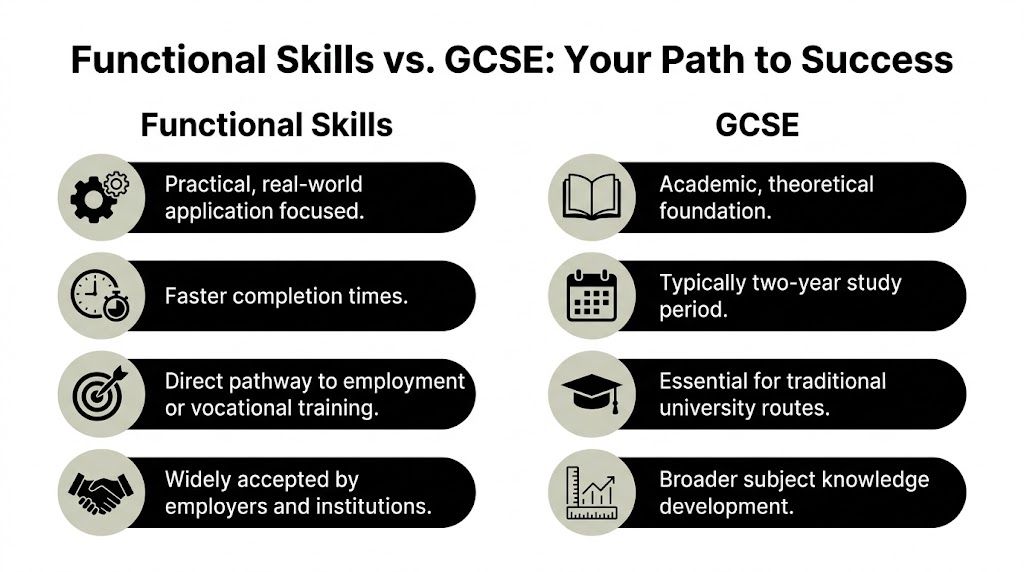
| Area | Functional Skills | GCSE |
|---|---|---|
| Focus | Practical, real-world tasks | Broader academic study |
| Study time | Usually shorter and more targeted | Usually longer with more content to cover |
| Assessment | Shorter exams based on applied tasks | Longer exams covering a wider syllabus |
| Grading | Pass or fail | Grades 9 to 1 |
| Timing | Often more flexible | Usually tied to set exam periods |
| Best for | Adults who need a direct route to progress | Learners who need a fuller academic foundation |
Study style and content
Functional Skills and GCSEs can both help you prove your English or maths level, but they feel different to study.
Functional Skills work like learning to drive on the roads you use every week. The focus is on reading, writing, and maths in everyday situations such as work tasks, problem-solving, and clear communication. GCSE study is broader. It asks you to cover more ground and spend more time building subject knowledge across a wider syllabus.
That difference can shape your confidence from the first week.
If school once made you feel that learning was not for you, a practical course can feel more approachable because you can see the point of each task. If your long-term plan includes a route that expects stronger academic depth, GCSE study may suit that better.
Assessment and exam experience
The exam style matters more than many adults expect. It can affect stress levels, revision habits, and whether study feels manageable in a busy week.
Ofqual explains that Functional Skills qualifications are available in English and maths at different levels, with assessments designed to show practical application of skills in real contexts: Ofqual's Functional Skills qualification information. GCSEs are assessed and graded differently, with a wider body of content and the familiar 9 to 1 grading scale.
In plain English, this often means:
- Functional Skills can feel clearer if you want a direct pass target and practical tasks.
- GCSEs can feel more suitable if you want a graded result and are comfortable covering broader content.
- Your best option is the one that matches both your goal and your current capacity.
Time commitment in a busy adult life
Hours on a course page do not tell the whole story. Your real timetable does.
If you are working shifts, raising children, helping family, or rebuilding confidence after years away from study, a shorter and more focused route may be easier to keep going with. That is not taking the easy option. It is choosing a route that fits your life well enough to succeed.
If you want to compare practical study options in both subjects, these Functional Skills Level 2 maths and English courses show what that route can look like in everyday adult life.
How it feels as a learner
This part is easy to overlook, but it matters.
Many adults are not choosing between two qualifications on a spreadsheet. They are choosing between two emotional experiences. One may feel like a fresh start. The other may feel like returning to a school system that never quite fit.
Some learners feel relief with Functional Skills because the work seems relevant straight away. Some feel proud choosing GCSE because it represents a goal they want to finish on their own terms. Both responses are valid.
Choose the route that supports your future and your confidence.
That is the heart of this decision. The best path is not the one that sounds most impressive in theory. It is the one that helps you make steady progress toward the job, course, or stability you want for yourself and your family.
When to Choose Functional Skills for a Fast and Practical Boost
For many adults, Functional Skills are not the second-best option. They are the right option.
They can suit learners who need a recognised qualification, want practical content, and need study to fit around real life rather than the other way round. As noted earlier, these qualifications focus on everyday and workplace use, which is one reason they are often a strong fit for adults returning to learning.
The adult who needs a quick route into a course
Think about someone applying for a college course in a practical field. They don’t need years of theory before they can move forward. They need to meet the entry requirement in English or maths and prove they can handle real tasks.
Functional Skills often make sense here because the learning is applied and direct.
The worker aiming for a promotion
Maybe someone is already good at their job but wants to step up into a better role. Their manager knows they’re reliable, but the job description still asks for Level 2 English or maths.
In that case, Functional Skills can be a smart move because they show usable skills in communication, number work, and problem-solving without dragging the learner back into a school experience that didn’t suit them.
The parent rebuilding confidence after a bad school experience
This person may freeze at the word “GCSE” because it brings back memories of pressure, embarrassment, or being told they were not good enough. A practical qualification with a clearer, more adult-focused feel can change everything.
That change isn’t just academic. It’s emotional too.
Practical rule: If your main goal is to prove real-life English or maths ability quickly and move on to the next stage, Functional Skills are often worth serious consideration.
Signs this route may fit you well
You may be a good match for Functional Skills if these sound familiar:
- You need flexibility: Work and family responsibilities mean fixed school-style routines are hard.
- You learn best by doing: Real examples make more sense to you than abstract theory.
- You want momentum: Finishing one recognised qualification could help you believe in yourself again.
- You’re aiming at practical progression: Employment, vocational training, and many further education routes value applied competence.
Why this route can feel more achievable
Adult learners often do better when study feels relevant. If a maths task looks like budgeting, measuring, comparing values, or reading data, it can feel less distant and more manageable. If an English task feels like clear reading, useful writing, and confident communication, it can feel more natural too.
That doesn’t mean Functional Skills are easy. It means they are designed differently.
For the right person, that difference can be exactly what turns “I can’t do this” into “I’m doing it”.
When a GCSE Is the Key to Your Dream Career
You might be sitting at your kitchen table after work, looking up course requirements and feeling your stomach drop. You were ready to move ahead. Then you spot two letters that change the whole decision. GCSE.
That moment can feel frustrating, especially if Functional Skills seemed like a better fit for your life. But this is also useful information. It tells you what the next step needs to be.
Some goals ask for the exact qualification
For certain careers and training routes, the wording matters. If an application says GCSE English and maths at grade 4 or above, the safest choice is to treat that as a direct requirement, not a suggestion.
Teacher training is a good example. The government’s Initial Teacher Training criteria for 2025 to 2026 make clear what providers must accept. For that route, checking the official requirement is far better than hoping one qualification will be treated the same as another.
This is less about which qualification is “better” in general and more about which one fits the door you want to walk through.
Why a GCSE can matter for long-term options
A GCSE often works like a wider foundation course. It can suit routes that expect more subject breadth, more theory, or more traditional academic evidence.
That may matter if you are aiming for:
- university courses with strict entry rules
- professional training routes with set academic requirements
- competitive pathways where admissions teams prefer the clearest possible match
- future options you have not fully decided on yet
If your goal is still taking shape, a GCSE can keep more choices open.
How to decide without second-guessing yourself
Adult learners often worry that choosing GCSE means choosing the harder road. Sometimes it does mean a more academic style of study. But hard and wrong are not the same thing.
A driving test is a useful comparison. If the job you want requires a manual licence, being confident in an automatic car does not change the rule. You would need the licence that matches the requirement. Qualifications can work the same way.
Before you enrol, ask:
- What does the course or employer ask for in writing?
- Does it say “GCSE”, or does it say “GCSE or equivalent”?
- Am I choosing for my life now, or for the career I want in two or three years?
- Would getting the GCSE give me more peace of mind about future applications?
The best choice is the one that matches your real goal, your real timeline, and the real entry rules.
If GCSE is your route, that is still good news
Finding out you need a GCSE can feel disappointing at first. Then it often becomes a relief. The guesswork is gone.
You are not stuck. You are clearer.
And clarity is powerful for an adult learner. It means you can stop debating labels and start building a plan that serves the life you want for yourself and your family.
Your Next Step to a Brighter Future with Next Level
By now, the main message should feel clearer. The question isn’t just whether there is a functional skills equivalent to gcse. There is. The question is which route gives you the best chance of building the future you want.
If you need a practical, flexible, recognised Level 2 qualification for work, further study, or confidence-building, Functional Skills may be the right fit. If your chosen route has strict academic entry requirements, a GCSE may be the stronger choice.
Either way, your next step matters more than your past.

Choose based on your real life
Adult learners often get stuck because they try to choose the “best” qualification in the abstract. But your life isn’t abstract. It has alarm clocks, school runs, work shifts, bills, caring duties, and tired evenings.
So ask yourself:
- What do I need this qualification for?
- How quickly do I need it?
- What kind of study style helps me keep going?
- Will I be more likely to finish one route than the other?
These are wise questions, not weak ones.
Confidence grows through action
A lot of adults wait until they “feel ready”. But readiness often shows up after the first lesson, not before it. Confidence tends to grow in motion.
That means your first step doesn’t need to be dramatic. It can be quiet and steady. It can be reading the entry requirements carefully. It can be asking for advice. It can be choosing the course that matches your goal instead of the one that matches your old fears.
Here’s what many adult learners discover once they begin:
- Structure helps: A clear plan makes study feel less chaotic.
- Support matters: Encouragement can stop one bad week becoming a full dropout.
- Progress changes identity: Passing small milestones helps you stop seeing yourself as “someone who failed at school”.
Why support makes such a difference
Adults returning to education don’t just need lessons. They often need reassurance, routine, flexibility, and someone who understands that life can get messy.
The strongest study support for adult learners usually includes:
| What helps | Why it matters |
|---|---|
| Clear teaching | You don’t waste energy guessing what the lesson means |
| Flexible study | You can keep going around work and family life |
| Encouraging tutors | Setbacks don’t feel like proof you should quit |
| Pastoral support | Stress, confidence, and motivation are taken seriously |
| Recognised qualifications | Your hard work leads somewhere real |
That’s why choosing a provider matters almost as much as choosing the qualification itself.
Think about the future version of you
Try to picture the version of you who has done this.
They apply for the course instead of closing the tab.
They put the qualification on the CV with pride.
They help their children with homework and mean it when they say, “Keep going.”
They stop feeling that old sting every time a form asks about maths and English.
That future isn’t fantasy. It starts with one practical decision.
You do not need a perfect past to build a strong future.
If you’ve spent years putting other people first, this step can still be for your family too. Better qualifications can support better opportunities. Better opportunities can support more income, more confidence, and more choice. And your example can stay with your children for years.
So be kind to yourself as you decide. Don’t judge your worth by what happened at school. Judge your next move by where you want to go.
If you’re ready to choose the right path with proper support, Next Level Online College offers flexible online study for adult learners, including Functional Skills and GCSE options. That means you can get guidance based on your goals, not a one-size-fits-all answer, and start building a future you can feel proud of.