
Somewhere recently, you may have seen it.
A job advert asked for GCSE English and maths at Grade 4 or above. A college page mentioned a Grade 5. Your child came home talking about a Grade 8 or Grade 9, and suddenly the school system felt unfamiliar.
That can knock your confidence.
Many adult learners already carry the weight of thinking they “missed their chance” or that education has moved on without them. If that sounds like you, take a breath. You are not behind. You are learning something new, and that is a strong place to start.
When people ask what do GCSE grades mean, they’re usually asking a bigger question too. They want to know what the numbers say about their future. Can they still get into university? Can they change career? Can they prove to themselves, and to their family, that they’re capable of more?
The answer is yes.
Your Journey Starts with Understanding
You might be filling in an application form after work, tired from a long day, and then hit a question that stops you cold. It asks for your GCSE grades, but the job advert says applicants need a Grade 4 in English and maths. You remember A to G, maybe even O-Levels, and now it feels like everyone else got a handbook you never received.
That feeling is more common than you think.
For adult learners, GCSE grades can seem like a secret code. The numbers look strict. The wording can sound formal. It’s easy to think, “If I don’t understand this already, maybe education isn’t for me.” But that isn’t true. You don’t need to know everything before you begin. You only need the courage to ask the question.
Why this matters so much
GCSE grades are not just labels on a results slip. They often decide whether you can move forward into further study, training, or a better job. They can affect whether you feel able to apply at all.
That’s why understanding them matters. Once the code becomes clear, the path ahead looks clearer too.
For many people, this is also emotional. It’s about more than qualifications. It’s about being able to help your children with homework without feeling lost. It’s about showing them that learning doesn’t stop when life gets busy. It’s about being proud of yourself.
If you need a simple starting point, this guide to what a GCSE is in the UK can help make the whole system feel less intimidating.
You do not need a perfect school past to build a strong future.
A better way to look at grades
Try to think of GCSE grades as keys, not judgments.
- One key opens study options like college courses and university routes.
- Another key opens work opportunities where employers ask for English and maths.
- The biggest key opens confidence because every step forward proves you can do hard things.
If school was difficult the first time round, that does not mean you cannot succeed now. Adult learners often bring focus, determination, and life experience that younger students are still developing.
You’re not starting from nothing. You’re starting from experience.
Decoding the New 9 to 1 GCSE Grading System
A lot of adult learners pause here.
You see a grade like 4 or 5 and wonder whether it is good, whether it counts, and whether you have already missed your chance. That reaction is completely understandable, especially if school felt confusing the first time around. The good news is that the system is much simpler once someone explains what the numbers are saying.
In England, GCSEs changed from A to G* grades to a 9 to 1 scale during reforms introduced between 2015 and 2018. 9 is the highest grade and 1 is the lowest. English and maths changed first in 2017, and the updated system was then used across reformed GCSEs, as explained in this overview of the GCSE grading system reform.
The change can feel bigger than it really is.
At heart, the numbered system gives a more precise picture of performance. A ruler with more markings gives a more exact measurement. GCSE numbers work in a similar way. They allow schools, colleges, and employers to see differences in achievement more clearly, especially at the higher end.
Why the numbers replaced letters
Under the old system, several levels of performance were grouped together more broadly. The newer system creates more separation at the top, especially with 9, 8 and 7, so strong results can be recognised more accurately.
One point often causes confusion. Grade 9 sits above the old A*. It marks exceptionally high performance. You do not need a Grade 9 to build a better future, and many adult learners feel relieved when they hear that. For most real-life goals, the grades that matter most are lower down the scale and much more achievable.
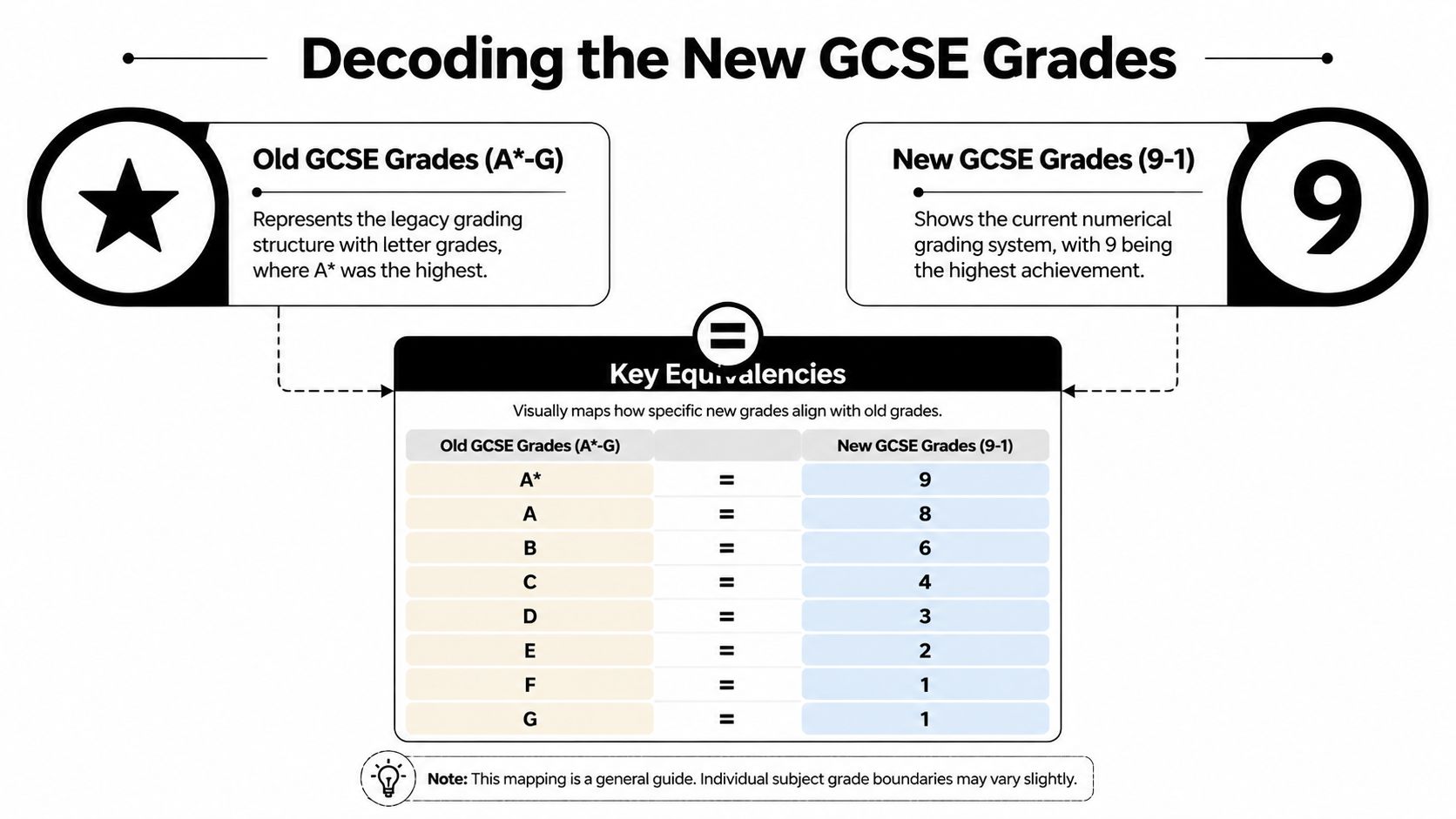
GCSE grade conversion old vs new system
| New Grade (9 to 1) | Old Grade (A* to G) | What It Means |
|---|---|---|
| 9 | Above A* | Exceptional performance |
| 8 | A* to A | Very high achievement |
| 7 | A | Strong result |
| 6 | B | Good result |
| 5 | B to C | Strong pass |
| 4 | C | Standard pass |
| 3 | D to E | Below pass standard |
| 2 | E to F | Lower result |
| 1 | F to G | Lowest graded result |
This table is a guide rather than an exact translation. The two systems do not line up perfectly. Still, it gives you a practical way to read modern GCSE results without feeling lost.
The two grades you need to know most
If you only remember two numbers, make them these.
Grade 4 is the standard pass. It is broadly similar to the old Grade C.
Grade 5 is the strong pass. Many colleges, sixth forms, and progression routes prefer this grade in core subjects.
That small jump can make a real difference. A Grade 4 often meets the minimum requirement. A Grade 5 can give you a stronger position when places are competitive or progression rules are stricter. If your long-term aim includes higher education, this guide on how to get into universities as an adult learner can help you see how GCSEs fit into the bigger picture.
Where people often get confused
Many adults assume success only means getting top grades. That belief can knock confidence before revision even starts.
A more useful question is: what grade gets you to your next step?
For many learners, the answer looks like this:
- English and maths are asked for most often by employers and colleges.
- A Grade 4 is enough for many courses, jobs, and training routes.
- A Grade 5 gives you a stronger platform where entry requirements are tighter.
- Grades 7 to 9 are excellent, but they are not the only grades that matter.
That matters emotionally as much as practically. If you are coming back to education after years away, you do not need perfection to feel proud of yourself. You need progress you can build on. A pass in the right subject can mean a new course, a better job application, or the moment your children see you studying and realise that hard things can be done at any age.
What GCSE Grades Mean for University

You finish work, clear the dinner plates, open your laptop, and look up university courses. For a moment, the goal feels real. Then you see the entry requirements asking for GCSE English and maths, and the old doubt creeps in.
That moment matters. GCSE grades are often the first gate on the path to higher education for adult learners. Once you understand what universities use them for, the process usually feels far less mysterious.
GCSEs do not usually give you the tariff points that make up a university offer. Other qualifications, such as A levels or Access to Higher Education courses, are more likely to do that. GCSEs usually work like the foundation under a house. They support everything that comes next, especially in English and maths.
The grades universities look at most closely
Universities and colleges commonly ask for at least a Grade 4 in GCSE English and maths, and some courses prefer or require a Grade 5. The reason is practical. These subjects give admissions teams confidence that you can cope with reading, writing, note-taking, coursework, and basic numerical work.
A simple way to read it is this:
- Grade 4 often meets the minimum entry requirement.
- Grade 5 can give you a stronger chance where entry rules are tighter.
- Course requirements vary, so checking the exact wording early can save stress later.
Many adults find this reassuring once it is clear. You do not need to guess what universities want. You can work towards a visible target.
How universities use GCSEs
Universities usually look at GCSE grades in two ways.
First, they use them as a threshold. If a course says you need GCSE English and maths at Grade 4 or above, that is a box you need to tick before your application can move forward.
Second, they use them as evidence of readiness. A good GCSE grade suggests that you can handle the everyday demands of study, such as understanding written materials, communicating clearly, and working with numbers where needed.
This is especially important if you have been out of education for years. A GCSE pass does more than satisfy a rule. It shows, to you as much as to anyone else, that you can still learn, still progress, and still aim higher.
A realistic target if university is your goal
If university is somewhere in your future, set your priorities in this order:
Get English and maths secured first
These are the subjects most often named in entry requirements.Aim for Grade 5 if you can
That can keep more courses open, especially on competitive routes.Check each course carefully
Universities, colleges, and adult access routes do not all ask for exactly the same GCSE profile.Build your plan one stage at a time
GCSEs lead to the next qualification. Then that qualification supports your university application.
That last point matters emotionally as well as practically. For many adult learners, university is about more than a degree. It is about proving something to themselves, setting an example at home, and creating better choices for the years ahead. If you want a clearer picture of the full route, this guide on how to get into universities as an adult learner explains the next steps in plain English.
A GCSE grade can look like a small number on paper. In real life, it can be the moment you stop seeing higher education as something for other people, and start seeing it as something you can reach.
Unlocking Better Careers and Higher Pay

A GCSE grade can look small on paper. In working life, it can carry real weight.
Employers often use English and maths qualifications as a quick way to judge whether someone can handle written communication, basic calculations, records, instructions, and training. If you’ve ever skipped applying for a role because the form asked for GCSEs, you already know this matters.
Why employers ask for GCSEs
A pass in GCSE English and maths can help when you want to move into roles with more responsibility. It can also matter if you want to start professional training, apply for a promotion, or change direction completely.
Careers such as nursing, teaching, policing, office-based roles, customer service, business administration, and many apprenticeships often expect solid basic qualifications. The exact route can vary, but the pattern is clear. Stronger core qualifications usually give you more room to move.
That doesn’t mean GCSEs guarantee a dream job. They don’t. But they remove a barrier that stops many adults before they even get considered.
What changes after you get the grade
The value of a GCSE pass is often practical before it is emotional.
- Applications feel possible again because you can meet basic entry requirements.
- Training routes open up when colleges or employers ask for English and maths.
- Confidence grows because you stop seeing yourself as someone who “can’t do school”.
- Your family notices when you study consistently and follow through.
Many adults say the first big shift is not in their CV. It is in their mindset. They stop apologising for their education and start improving it.
A short video can make that next-step thinking feel more real:
You do not need to have it all mapped out
Some people return to study because they know exactly what career they want. Others only know that they want more stability, more choice, and a better example to set for their children.
Both reasons are enough.
A qualification is not only about the job you apply for next. It is also about the version of yourself you become while earning it.
If you’ve been telling yourself that study is selfish, try flipping that thought. Building better prospects for yourself can mean more security at home, more options for your family, and a stronger sense of pride in everyday life.
Your Action Plan for Success It Is Never Too Late
Starting again is often the hardest part. Not because the work is impossible, but because fear gets loud before progress begins.
Adult learners usually worry about the same things. Will I remember how to study? Will I have time? What if I fail? Those questions are normal. They do not mean you are not ready. They mean this matters to you.
Step one is choosing your real goal
Be specific with yourself.
Do you need GCSEs for university later on? For a job application? For a training course? Or because you want to prove to yourself that you can finish what you started?
Your answer shapes your plan.
- If your goal is university, English and maths often come first.
- If your goal is work, check the exact entry requirements on job adverts or training routes.
- If your goal is confidence, start with the subject that feels most urgent and most useful.
Build a plan that fits adult life
You do not need to copy the timetable of a teenager in school. Adult study works best when it fits around real responsibilities.
A practical plan often looks like this:
Choose one or two subjects
Too much at once can feel heavy. A focused start is often stronger than an overloaded one.Create regular study slots
Short, steady sessions usually work better than waiting for the “perfect” free day.Use support early
Ask questions when you get stuck. Don’t let one confusing topic become a reason to stop.Track small wins
Finishing one topic, one assignment, or one revision session matters.
If your main need is to improve your core grades, these options for GCSE maths and English for adults show the kind of flexible route many returners look for.
What to do when confidence drops
Confidence rarely appears first. Action usually comes first, and confidence grows after.
Try this when doubt creeps in:
- Talk to yourself like you would talk to your child. You wouldn’t call them stupid for learning slowly.
- Look at progress, not perfection. Improvement counts.
- Remember your reason. A better future is built one decision at a time.
Many adults think they need to “feel ready” before they begin. In truth, beginning is often what creates the feeling of readiness.
How Next Level Online College Helps You Win
The right learning environment can make a huge difference when you’re returning to education. Adult learners do best when study feels structured, calm, and realistic.
That means more than getting access to course materials. It means having a clear path, regular guidance, and support from people who understand that you may be balancing study with work, children, caring duties, or all three.
Support matters when life is busy
Next Level Online College is built around the circumstances of adult life. As a UK-based online provider, it offers flexible, fully supported courses for adult learners, including recognised and regulated qualifications such as Functional Skills, GCSEs, A Levels, and Access to Higher Education diplomas.
That matters because flexibility on its own isn’t enough. Many adults need both freedom and support. They need study that fits around life, but they also need experienced people who can guide them when confidence dips.

What helps adult learners keep going
Some features matter more than others when you’ve been out of education for a while.
- Flexible online study means you can work at times that suit your home life.
- Dedicated academic support helps when a topic feels harder than expected.
- Pastoral and wellbeing support can steady you when nerves, stress, or self-doubt show up.
- Clear progression routes help you see where your course can lead next.
Next Level Online College is part of the Cambridge Online Education Ltd group and draws on long experience supporting adult returners. That kind of background matters because adults are not just learning content. They are rebuilding trust in their own ability.
Success feels personal
For an adult learner, success is rarely just about the grade itself.
It is the feeling of logging in after a tiring day and still showing up. It is the moment your child sees you revising and learns that effort matters. It is handing in work, sitting the exam, and realising you did not quit this time.
The right course does more than teach a subject. It helps you see yourself differently.
That shift can stay with you long after the exam is over.
Your Questions Answered A Guide for Adult Learners
When you’re thinking about returning to study, small questions can become big worries. Let’s clear up a few of the most common ones.
Do my old GCSEs or O-Levels still count
Yes, old qualifications still matter. Employers and colleges do not usually pretend your past learning disappeared just because the grading system changed.
The main issue is understanding the modern equivalent. If a course or employer asks for a Grade 4 or 5, they are usually trying to identify a level of English or maths ability. If you have older qualifications, ask the provider or employer how they view them.
Is a Grade 4 a pass or do I need a Grade 5
A Grade 4 is a pass. It is called the standard pass.
A Grade 5 is also a pass, but it is seen as a strong pass. That is why some colleges, sixth forms, and progression routes prefer it, especially in English and maths. If you are unsure, aim as high as you can, but check the actual requirement for your next step rather than guessing.
Can adults retake GCSEs after a long break
Yes, adults can return to GCSE study after years away from education. Many do.
What matters most is choosing a learning approach that suits your life now. Adult learners usually need flexibility, clear support, and a plan that can survive busy weeks. You do not need to study like you did at school. In fact, you will probably study better now because your reason is stronger.
What if I was never good at school
Being unhappy at school and being unable to learn are not the same thing.
Schools are built around one stage of life. Adult learning is different. As an adult, you may be more focused, more motivated, and more willing to ask for help. Plenty of people who struggled as teenagers do far better when they return later with a real goal in mind.
A useful way to think about it is this:
- School was your first attempt, not your final verdict.
- Your past grades are information, not a life sentence.
- You can build upward from here with the right support and enough consistency.
If you’ve read this far, you’re already doing something powerful. You’re not avoiding the question anymore. You’re facing it, understanding it, and turning it into a plan.
If you’re ready to take that next step, Next Level Online College can help you turn uncertainty into progress. Whether you need GCSE English, GCSE maths, Functional Skills, A Levels, or a route towards university, you’ll find flexible online study built for adult life, with real support from people who believe you can do this. Your future doesn’t depend on where you started. It depends on what you choose next.