
Maximise Your Potential: Your Guide to Smarter GCSE Revision
It is 9:15 at night. The kitchen is finally quiet, the packed lunches are half done, and you are looking at a textbook while wondering whether your brain still works the way it used to. If that sounds familiar, you are in the right place.
Many adult learners carry the same worry. You may have been out of education for years. You may be fitting study around shifts, school runs, caring responsibilities, and plain exhaustion. That can make revision feel less like a fresh start and more like a test of whether you still belong in education.
You do belong.
Adult learners often have an advantage that younger students are still developing. You have a reason. You can see the link between today’s study session and a better job, more stability at home, and the example you set for your children. Revision is no longer just about passing an exam. It is about building a future your family can feel.
Good GCSE revision techniques work like tools in a well-used kitchen drawer. You do not need every tool at once, and you do not need a perfect house to use them well. You need the right one at the right moment. A short recall exercise on your lunch break. Ten minutes of flashcards on the bus. Twenty-five focused minutes once the house settles. Used consistently, those small sessions grow into real progress.
If you are still getting your bearings, this guide explaining what a GCSE qualification involves can give useful context before you build your revision plan.
A steady, little-and-often approach usually suits adult life far better than last-minute cramming. It leaves room for interruptions, helps you remember more, and makes study feel manageable enough to repeat next week.
Low confidence does not have to stop you from beginning. Confidence is often built through action. Each time you sit down and complete a session, you give yourself evidence that you can do this. Those small wins add up, and over time they can change your options, your income, and the story your family tells about what is possible.
1. Spaced Repetition
Tuesday night, the kitchen is finally quiet. You open your Biology notes and realise last Thursday’s topic feels hazy already. That can be discouraging, especially when every study session has to fit around work, children, and the rest of adult life. Spaced repetition gives those hard-won sessions a structure, so what you study has a far better chance of staying with you.
The idea is simple. Review the same material more than once, with small gaps between each review. Your brain treats each return as a reminder that the information still matters. Over time, facts become more secure in memory, which makes revision feel less like starting from scratch each week.
It works well for adult learners because life rarely allows long, perfect study blocks. You may revise on Sunday afternoon, then squeeze in ten minutes on Wednesday lunch break, then return again on Friday evening. Spaced repetition turns that stop-start pattern into a strength.
How to use it in daily life
Start small. Choose one topic and make short flashcards for definitions, formulas, quotations, dates, or steps in a process. Paper cards work well. Digital cards work well too. The best system is the one you will use after a long day.
Apps such as Anki can organise cards by subject and show older material again at sensible intervals. If you are still getting clear on the qualification itself, this guide to what a GCSE qualification involves can help you see where your revision fits.
A realistic weekly rhythm might look like this:
- First review: Learn a small set of cards today.
- Second review: Revisit them at your next study session.
- Third review: Check them again after a slightly longer gap.
- Later reviews: Keep bringing older cards back so they stay active in memory.
A kettle works on the same principle. It does not stay hot because you boiled it once on Monday. It stays useful because you heat it again when needed. Memory works in a similar way. Brief, well-timed returns keep knowledge ready for use.
Practical rule: Keep each card to one clear question and one clear answer. If you crowd too much onto one card, review becomes harder than it needs to be.
This approach also protects your confidence. A short review that goes well can lift your mood before work. A card you answer correctly after several days shows that your effort is building something real. For many adult learners, that matters as much as the method itself, because each small success proves you are capable of gaining qualifications that can improve your options and change what your family sees as possible.
2. Active Recall
Reading notes can feel productive. Often, it isn’t. Your eyes move across the page, the words look familiar, and your brain says, “Yes, I know this.” Then you shut the book and the answer disappears.
Active recall fixes that.
It means pulling the answer out of your mind before you look it up. That small struggle is where learning happens. You aren’t just recognising the topic. You’re practising remembering it, which is exactly what exams ask you to do.

A mature GCSE History learner might write a weekly self-quiz on key events, people, and causes, then answer it without notes. That’s simple, low-cost, and powerful. It turns revision into training rather than just reading.
Make your notes ask questions
Take each topic and turn it into questions.
For example, instead of writing:
- photosynthesis definition
- factors affecting reaction rate
- structure of the heart
write:
- What is photosynthesis?
- Which factors change the rate of a reaction?
- How does blood move through the heart?
That small change makes your brain work harder. Harder doesn’t mean worse. It means stronger learning.
A major UK revision platform notes that students often find statistics topics easy to understand in theory, but harder to apply in practice. That’s why it recommends a staged approach using worked examples, exam-style questions at different difficulty levels, and past papers. Active recall fits perfectly with that idea. It moves you from passive familiarity to usable knowledge.
Let yourself get stuck for a moment. That pause is not failure. It’s your memory getting stronger.
Try these easy versions:
- Cover and answer: Hide the notes and say the answer aloud.
- Blank page recall: Write everything you remember about one topic, then check what you missed.
- Question cards: Put a question on one side and the answer on the other.
- Mini whiteboard method: Answer quickly, wipe it, and repeat.
If your confidence is low, this method can feel uncomfortable at first. Keep going. Every time you remember an answer without help, you’re proving to yourself that you can do more than you thought.
3. Mind Mapping
Some revision notes don’t help because they’re too crowded. Dense pages can make a topic feel bigger than it is. Mind mapping clears that fog.
A mind map starts with one main idea in the centre of the page. Then you build branches for related points. In English, that might be a text, theme, or character. In Biology, it might be a body system. In History, it could be an event and its causes.
This is useful when you need to see how ideas connect, not just memorise isolated facts.
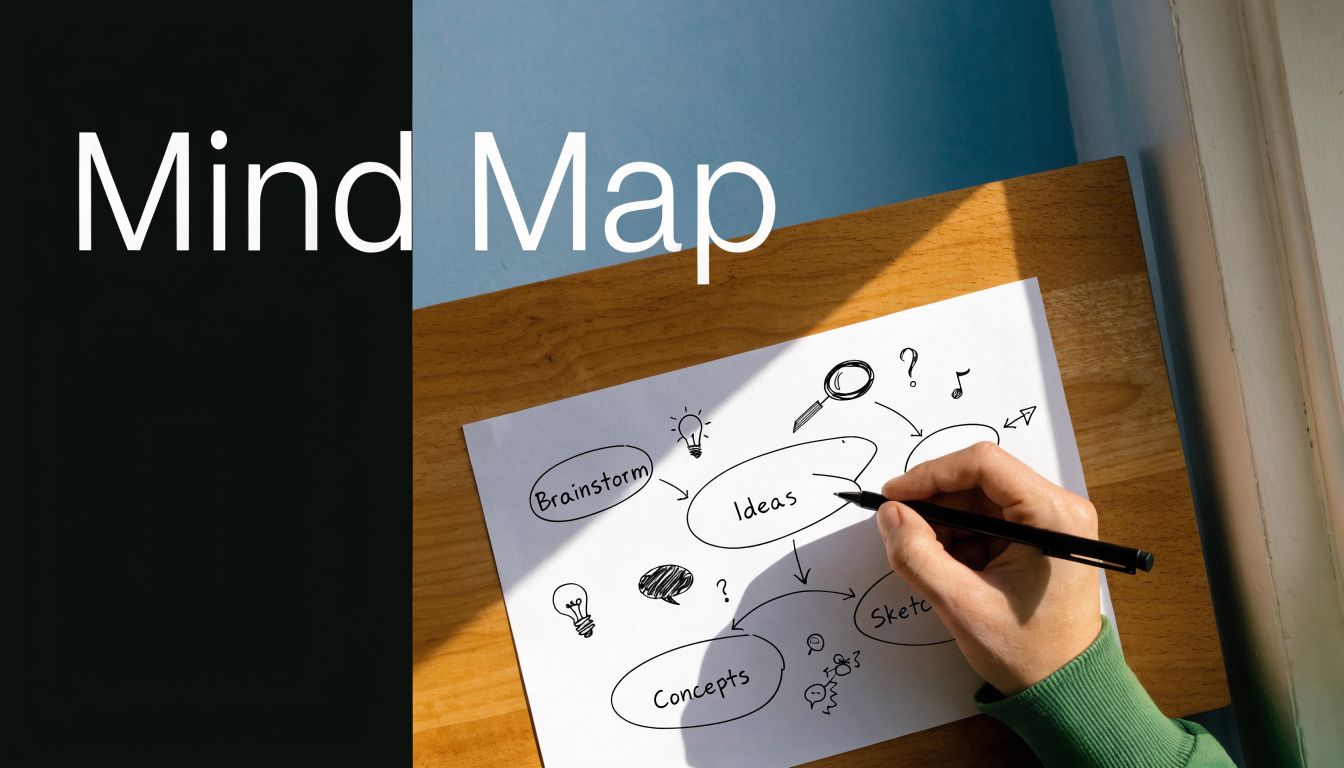
An adult learner revising Biology could create one map for each unit, with central topics such as cells, organisation, infection, and ecology. By the end of revision week, those maps become a visual set of chapter summaries that are much easier to scan than pages of long notes.
Why visual links help
Your brain remembers patterns and connections better than endless paragraphs. A map lets you see the whole topic at once. That’s especially helpful in essay subjects, where you need to link evidence, ideas, and structure.
One revision guide for maths, statistics, and probability highlights the importance of understanding visual data forms such as bar charts, pie charts, cumulative frequency graphs, and box plots. That same habit of visual thinking can strengthen revision in other subjects too. When you map information, you teach yourself to organise knowledge, not just store it.
Try this method:
- Put the topic in the middle: Use a clear word or phrase.
- Add main branches: These are your big ideas.
- Keep words short: One word or short phrase per branch works best.
- Use colour with purpose: Give each theme or category its own colour.
- Redraw from memory: Don’t just admire the map. Rebuild it later without notes.
Here’s a helpful visual guide if you want to see the method in action.
Mind maps are also kind to tired brains. After a long workday, you may not have energy for long note-making. A single page with branches, arrows, colours, and quick prompts can feel lighter and more manageable. That makes it easier to come back the next day.
4. The Pomodoro Technique
When your day is packed, “I’ll revise later” can turn into “I’ve done nothing again.” The Pomodoro Technique cuts through that. You work for 25 minutes, take a 5-minute break, and repeat.
That short structure helps because starting is often the hardest part. Twenty-five minutes feels possible, even on difficult days. It’s long enough to make progress and short enough not to scare you off.

A working adult studying GCSE English might use one Pomodoro to review vocabulary, one to plan an essay, and one to test quotations. That’s a solid evening’s work without needing a silent three-hour block.
Why this suits adult learners
Some revision advice is written as if everyone has long afternoons free. Many adults don’t. Some are fitting study around shifts, school runs, caring duties, or tiredness after work.
A UK revision guidance gap highlights that adult learners often need methods adapted into small, manageable study periods with regular days off, including short study bursts such as the Pomodoro Technique. That matters. Your study plan has to fit your life, or it won’t last.
Use Pomodoro sessions with a clear target:
- One session, one task: Don’t mix everything together.
- Choose the task first: Example: revise cell structure or answer two algebra questions.
- Protect the time: Put your phone away if possible.
- Break properly: Stand up, stretch, get water, breathe.
Some days, one focused session is enough. Done is better than perfect.
You can also pair Pomodoro with other gcse revision techniques. Use one session for active recall, another for flashcards, and another for past paper questions. That variety keeps revision from becoming dull.
Most of all, this method helps you trust small effort. Adults often underestimate what steady short sessions can achieve. But when those sessions stack up over weeks, they create real momentum. That momentum can carry you much further than guilt ever will.
5. Past Paper Practice
It is 9:20 at night. The kitchen is finally quiet, your notes are open, and you want revision that proves you are getting somewhere. Past papers help with that. They turn revision from passive reading into practice you can measure.
They also prepare you for a part of the exam that textbooks cannot fully teach. Real papers show how exam boards phrase questions, what command words really demand, and how easy it is to lose marks through rushing, not reading carefully, or giving the right idea in the wrong form.
For adult learners, that matters a great deal. If your study time is limited, you need revision that trains both knowledge and performance. Past papers do that together. They work like a driving lesson on real roads. You are still learning the rules, but you are also learning how to use them under pressure.
Learn the exam as a skill
Many adults know more than they think they do, yet still feel shaken when a question looks unfamiliar. That is often an exam technique problem, not a lack of intelligence. Past paper practice helps you spot patterns. You begin to recognise the wording, the structure of mark schemes, and the difference between a one-mark definition and a six-mark explanation.
Save My Exams also advises learners to move from examples to exam-style questions and then to past papers, because applying knowledge is often harder than recognising it in your notes. That gap becomes even more noticeable when you are tired after work or trying to study around family responsibilities.
If you are still getting used to the system itself, this guide to what GCSE grades mean can help you see how your effort connects to the result you are aiming for.
A simple staged approach works well:
- Open-book stage: answer questions with your notes nearby, so you learn the paper format without panic.
- Supported stage: use fewer prompts and compare your answers carefully with the mark scheme.
- Timed stage: complete sections under realistic time limits.
- Review stage: check every missed mark and write down why you lost it.
Start small if a full paper feels too heavy. One question after dinner is still real progress. Two questions on a lunch break still count. A parent studying in short windows can build strong exam skill the same way a wall is built, one brick at a time.
Focus first on what the paper taught you about your strengths and weak spots. Your score matters, but the lesson inside the score matters more. Maybe you know the content but misread command words. Maybe you explain well but run out of time. Once you can name the problem, you can fix it.
Past papers can feel exposing, especially if school did not leave you with much confidence.
Treat that feeling with patience. A practice paper is rehearsal. It is a safe place to make mistakes, learn the examiner's habits, and become calmer with each attempt. Every paper you complete is evidence that you are building something steady for yourself and for the people watching you do it.
6. Digital Flashcards
Digital flashcards turn spare moments into useful revision time. You can use them on the bus, in a waiting room, during a tea break, or while dinner is in the oven. That flexibility makes them a strong choice for adults with busy homes and unpredictable days.
Apps such as Quizlet are popular because they’re simple to use and easy to update. You can sort cards by topic, share decks with other learners, and return to difficult items again and again.
A GCSE Biology learner, for example, might build cards for definitions such as osmosis, diffusion, enzyme, and pathogen. Another learner might make quote cards for English Literature or formula cards for maths.
Keep them lean and useful
The biggest mistake with flashcards is trying to put too much on one card. If the answer runs like a paragraph, the card becomes a mini textbook. That slows you down.
Instead, keep each card focused.
- One idea per card: This helps your brain retrieve the answer clearly.
- Use images when needed: Diagrams help with science and geography.
- Add audio for languages: Hearing the word can support memory.
- Edit often: Remove cards you’ve mastered and improve weak ones.
This method works especially well for factual material, but it can also support conceptual learning. You might put a process on one side and the steps on the other, or a key term on one side and a simple example on the other.
Digital flashcards also pair well with active recall. You aren’t just reading information. You’re trying to answer before checking. If the app also spaces cards over time, you get two strong techniques working together.
For adults who feel they’ve “lost the habit” of studying, flashcards are a gentle way back in. You don’t need a perfect desk, a large notebook, or a whole free evening. You only need a few focused minutes and a willingness to return to the cards regularly.
That steady return matters more than glamour. Quiet consistency is often what changes a learner’s future.
7. Interleaving
Many learners revise in blocks. They do one topic for a long stretch, then move on. That feels neat and satisfying, but it can create a false sense of mastery. Interleaving is different. It mixes topics within the same session.
In maths, that might mean answering a few algebra questions, then some geometry, then probability. In science, it could mean mixing cell biology with equations and required practical thinking. Your brain has to work out which method fits each question.
That extra effort is useful because exams are mixed too. They don’t usually say, “For the next twenty minutes, only use one type of thinking.” They ask you to switch.
Make your brain choose the method
Interleaving strengthens discrimination. In plain language, that means you get better at spotting what kind of problem is in front of you and deciding how to tackle it.
This matters in subjects that involve data and interpretation. GCSE business and market research content expects learners to judge information quality by looking at factors such as sample size, question design, data source credibility, and bias. Real questions often require you to decide which idea applies, not just remember a definition. Interleaving helps train that decision-making habit.
A simple interleaving session might look like this:
- Start with two topics: Don’t mix too many at first.
- Alternate question types: Switch after a small batch.
- Say why the method fits: Explain your choice aloud or in notes.
- Return to weak areas later: Mixed practice shows what still feels shaky.
A GCSE Maths learner could spend one session moving between fractions, algebra, and data handling. At first, that may feel harder than staying with one topic. That’s expected. Harder practice often creates stronger recall later.
When revision feels slightly demanding, your brain is often doing the right kind of work.
This technique can be especially helpful if you tend to panic when a question looks unfamiliar. Interleaving teaches flexibility. It helps you stay calmer because you’ve already practised switching gears.
And that’s a powerful skill, not just for exams, but for life. Adults do this every day anyway. You already move between work tasks, family needs, and practical decisions. Interleaving turns that real-life flexibility into exam strength.
8. The Feynman Technique
If you can explain something clearly, you probably understand it. If you can’t, there’s usually a gap somewhere. The Feynman Technique helps you find that gap and fix it.
Choose a topic, then explain it as if you were teaching a child. Use plain language. Avoid long textbook phrases. If you stumble, go back, check your notes, and try again.
This works because it exposes the difference between vague familiarity and solid understanding. You may think you know a science process or a historical cause, but when you try to explain it clearly, weak spots show up fast.
Teach the topic out loud
An adult returner revising GCSE Physics might explain electricity to a family member using everyday examples from the home. Another learner might write short blog-style notes in plain English to test whether the ideas really make sense.
If you’re curious about how you prefer to process information, this guide to the reflector learning style may help you think about how you learn best.
This technique is also useful because current revision advice often treats all learners the same. Yet one gap identified in UK revision guidance is the lack of personalised frameworks to help adults match methods to their own learning profile, memory habits, or neurodiversity, even though common advice often includes broad approaches such as active recall, mind mapping, and past papers. The Feynman method can help you notice what suits you. If speaking helps, say it aloud. If writing helps, script it first.
Try it like this:
- Pick one small concept: Don’t start with a whole unit.
- Explain it straightforwardly: Use short, everyday words.
- Find the wobble: Notice where your explanation gets messy.
- Return and repair: Check the textbook, video, or class notes.
- Explain it again: Aim for clarity, not fancy language.
A strong explanation sounds natural. It doesn’t hide behind complicated wording.
This is also a lovely method for parents. If your children see you explaining a topic at the kitchen table, they see courage in action. They see that learning isn’t only for the young. They see that grown-ups can start again, keep going, and improve. That example can shape a family far beyond exam season.
GCSE Revision Techniques: 8-Point Comparison
| Method | Implementation (🔄) | Resources & effort (⚡) | Expected outcomes (⭐) | Ideal use cases (📊) | Key advantages (💡) |
|---|---|---|---|---|---|
| Spaced Repetition: Making Your Memory Work for You | Moderate – requires setting schedules and creating decks | App or paper flashcards; upfront content creation time | ⭐ High long-term retention; efficient review scheduling | 📊 Factual learning (languages, definitions, formulas) | 💡 Adaptive focus on weak items; minimal daily time once set up |
| Active Recall: The Secret to "Knowing" vs. "Recognising" | Low–moderate – design questions and self-testing routine | Minimal (paper/oral/apps); little tech required | ⭐ Strong improvement in retrieval and exam performance | 📊 Any subject needing recall (history, science, maths) | 💡 Quickly highlights gaps; easy to combine with other methods |
| Mind Mapping: Seeing the Big Picture | Low – creative but simple process; risk of clutter | Paper, pens or mind‑map software; moderate time to create | ⭐ Improves conceptual organisation and connections | 📊 Essay-based and integrative subjects (English, History, Geography) | 💡 Visualises relationships; aids planning and revision overview |
| The Pomodoro Technique: 25 Minutes to Success | Very low – timer-based, simple cycles to adopt | Timer or app; minimal setup; fits short time windows | ⭐ Increases focus and reduces procrastination | 📊 Busy schedules, short study windows, time management practice | 💡 Prevents burnout; makes productive use of small time slots |
| Past Paper Practice: The Ultimate Exam Rehearsal | Moderate – requires realistic simulation and marking | Past papers, mark schemes, quiet timed space; reflective time to review | ⭐ High exam preparedness, timing and answer-structure skills | 📊 Final exam prep; building exam technique and stamina | 💡 Reveals exam patterns and common pitfalls; builds confidence |
| Digital Flashcards: Your Pocket‑Sized Study Buddy | Low–moderate – app learning curve and deck curation | Smartphone/tablet, cloud app; ongoing maintenance | ⭐ Good short-term and spaced recall; portable practice | 📊 Vocabulary, quick facts, on‑the‑go revision | 💡 Syncs across devices; analytics and easy sharing |
| Interleaving: Mixing It Up for Better Learning | Moderate – needs deliberate session design and mixing | Multiple topic materials; planning to alternate items | ⭐ Enhances transfer, problem selection skills, long-term mastery | 📊 Problem-solving subjects (Maths, mixed-topic practice) | 💡 Trains flexible application; reduces overfitting to one topic |
| The Feynman Technique: Teach It to Learn It | Moderate – iterative explaining and simplification | Paper/voice recorder or peer; time for refinement | ⭐ Deep conceptual understanding and clarity | 📊 Conceptual topics (Physics, complex theories, essay themes) | 💡 Exposes hidden gaps; forces simple, testable explanations |
Your Journey Starts Now
These gcse revision techniques are more than study methods. They are practical tools for building a different future, one session at a time. You don’t need to become a perfect student overnight. You need a plan that fits your life, respects your responsibilities, and helps you keep going when confidence feels shaky.
That’s why the right approach matters so much.
Spaced repetition helps you remember. Active recall helps you test what you really know. Mind mapping helps you see the bigger picture. Pomodoro helps you use short pockets of time well. Past papers help you prepare for your exam. Digital flashcards make revision portable. Interleaving makes you flexible. The Feynman Technique helps you understand topics thoroughly enough to explain them clearly.
You don’t have to use all of them at once. Start with one or two. Build from there. Revision works best when it becomes regular and realistic, not when it becomes punishing.
If school didn’t go well the first time, that doesn’t decide what happens now. Adult learners often study with more purpose than they ever had as teenagers. You know what’s at stake. Better job options. Better pay. Access to further study. The pride of finishing something important. The chance to show your children that it’s never too late to aim higher.
That last part matters significantly.
When your child sees you revising after work, turning up to online lessons, and trying again after a hard day, they learn something powerful about resilience. They learn that success isn’t magic. It’s built. Steadily. Repeatedly. That lesson can stay with them for life.
There will be awkward days. Days when you feel rusty, tired, or discouraged. Keep going anyway. Progress doesn’t always feel dramatic. Often it looks like a set of flashcards reviewed before bed, one past paper question answered at lunch, or a single Pomodoro completed before the school run. Those moments count. They are how change happens.
You also don’t have to do this alone. Support makes a difference, especially when you’re balancing study with work, family, and self-doubt. The right course, the right tutor, and the right encouragement can turn a distant goal into something solid and reachable.
Your ambition is valid. Your second chance is real. Your future can still expand in ways you may not have thought possible.
Start small. Stay steady. Let each revision session be proof that you’re moving towards something better.
Next Level Online College supports adult learners across the UK with flexible online study, recognised qualifications, and real human guidance. If you’re ready to build confidence, gain the grades you need, and become the role model your family already hopes you can be, this is a strong place to begin.