
You might be reading this after the kids have gone to bed, or in a quiet moment before work, wondering if you’re really ready to study for maths again. Part of you wants a better future. Part of you still remembers school and the sinking feeling maths used to bring.
Both feelings can be true.
You can feel nervous and still move forward. You can doubt yourself and still succeed. Many adults come back to maths because they want more for their family, more choice in work, and more belief in themselves. That matters. Every page you revise, every question you try, and every lesson you finish is proof to your children that it’s never too late to grow.
Your Time to Shine A Fresh Start with Maths
A lot of adults return to maths carrying old labels. “I was never good at it.” “I’m too far behind.” “I’ve left it too long.” Those thoughts feel heavy, especially when you’re trying to build a better life and you don’t want to fail in front of your family.
But this isn’t about going back to the classroom version of you.
This is about the person you are now. You’ve handled work pressure, family responsibilities, money worries, and real life. That means you already have strengths that matter in maths study. You know how to keep going when something is hard. You know why this goal matters. You know who you’re doing it for.
Your reason is powerful
Maybe you want to get into nursing, teaching, business, social work, or university. Maybe you need a qualification to move up at work. Maybe you want to help your child with homework without feeling panic rise in your chest. These aren’t small reasons. They are life-changing reasons.
When you study for maths as an adult, you’re not just learning formulas. You’re building a new story about yourself.
- For your children: they see a parent who doesn’t give up
- For your career: you open doors that closed too early
- For your confidence: you prove that old setbacks don’t get the final word
You do not need to feel ready before you begin. Often, confidence grows because you begin.
Some adults need Functional Skills. Others need GCSE Maths. Some are aiming even higher because university is now the plan. If you’re trying to work out which route fits your future, this guide to GCSE Maths for adults can help you see what the qualification involves.
A fresh start works better than a harsh start
Don’t begin by demanding perfection from yourself. Begin by being organised, kind, and steady. Maths improves through practice, not through shame. If you miss a day, come back the next day. If a topic confuses you, slow it down. If a question goes wrong, that isn’t proof that you can’t do maths. It’s proof that you’re in the middle of learning.
That middle place is where progress happens.
Find Your True Starting Line
The best way to study for maths is to start at the right level. Not the level you think you “should” be at. Your real level. That takes pressure off straight away.
Some adults need to rebuild basics first. Others still remember more than they think. The point is to find out calmly, without turning it into a test of your worth.
Know the difference between common routes
In simple terms, Functional Skills Maths focuses on practical maths used in everyday life and work. GCSE Maths goes broader and deeper, and it’s often needed for further study, training, or university routes.
If you’ve been away from education for years, don’t guess. Check.
A gentle way to do that is to:
- try a short diagnostic quiz
- look at which topics feel familiar
- notice where you freeze, not just where you get answers wrong
- write down three topic areas that need work
That gives you a proper starting line.
Maths anxiety is common, not a personal flaw
Many adults think they’re the only one whose mind goes blank around numbers. They aren’t. A report from NCETM found that 52% of adult learners in Functional Skills Maths report high maths anxiety, often linked to difficult school experiences. The same verified data says confidence-building modules increased course completion rates by 40% for working adults.
That matters because it changes the story.
Your anxiety is not evidence that you can’t learn. It may be an old stress response that shows up when maths appears.
Practical rule: If a topic makes you panic, shrink the task. Don’t say, “I need to master fractions.” Say, “Today I’m going to add two simple fractions.”
A calm check-in beats harsh self-judgement
Use this quick self-check before you choose what to revise:
| Area | Ask yourself | What to do next |
|---|---|---|
| Number skills | Can I handle percentages, fractions and decimals? | Rebuild basics first if these feel shaky |
| Problem solving | Can I read a word problem and spot what it wants? | Practise one step at a time |
| Confidence | Do I avoid maths even when I have time? | Add low-pressure practice |
| Goal | Do I need maths for work, college or university? | Match your course to your next step |
If you’re weaker than you hoped, that’s useful information. If you’re stronger than you feared, celebrate it. Either way, you now have something solid to work from.
Build a Study Timetable for Your Real Life
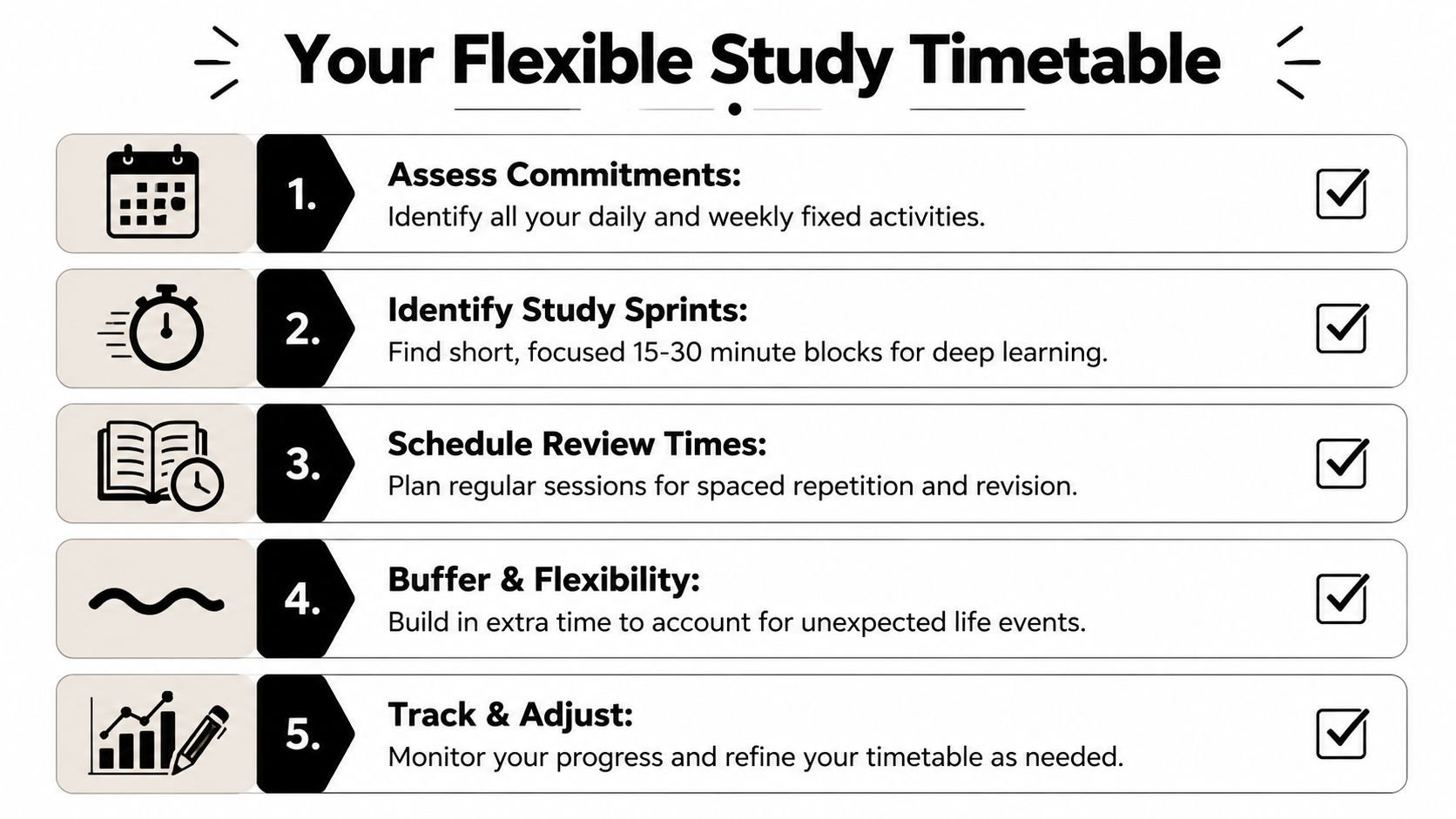
Adult learners often think success comes from long, perfect study sessions. It usually doesn’t. Real progress comes from a timetable you can keep when work is busy, the washing is piling up, and life gets noisy.
That’s why short study sessions matter so much.
A report from the Institute for Fiscal Studies found that flexible 15 to 30 minute daily study sessions boost memory and retention by 55% for employed UK learners compared with traditional 2-hour blocks. The same verified data says 47% of adult learners who drop out cite time conflicts as the main reason.
Build around your life, not against it
If you’re a parent or working adult, your schedule needs to be flexible. A rigid plan often looks good on paper and fails by Wednesday. A realistic plan leaves room for real life.
Try this pattern:
- Morning slot: revise one small topic for 15 minutes before the house gets busy
- Lunch slot: answer 4 or 5 questions instead of scrolling your phone
- Evening slot: review mistakes for 20 minutes after dinner
- Weekend slot: do one longer catch-up session if needed
This is sometimes called a study sprint. It works because you can begin quickly, focus hard, and stop before your brain gets tired.
A weekly plan you can actually keep
Pick three kinds of session across the week.
| Session type | Example | Why it helps |
|---|---|---|
| Learn | Watch one short lesson and copy one worked example | Builds understanding |
| Practise | Answer questions on the same topic | Turns ideas into skill |
| Review | Go back to mistakes and retry them | Stops forgetting |
Don’t fill every spare moment. Leave breathing room. If one session gets missed, move it instead of quitting the week.
A good timetable is not the busiest one. It’s the one you can still follow on a tired Thursday.
For extra help building a routine you’ll stick to, these GCSE revision techniques can help you organise your week without burning out.
Keep the plan visible
Write your timetable on paper, put it in your phone calendar, or stick it on the fridge. Keep it simple enough that your family can understand it too. That helps because your study time starts to feel real. It becomes part of home life, not something hidden and squeezed in.
When your children see you protecting even a short study slot, they learn something bigger than maths. They learn commitment.
Learn Maths the Smart Way Not the Hard Way
Many adults spend hours “studying” maths without improving. They watch videos, read notes, nod along, and feel busy. Then they try a question alone and everything disappears.
That’s not because they aren’t capable. It’s because passive study feels safer than active study, even though it works less well.

A study on UK students showed that spaced practice beat cramming. Students who reviewed topics with gaps between sessions achieved 28% higher delayed post-test retention, with 82% accuracy compared with 54% for massed practice. That’s a strong reminder that how you study for maths matters.
Stop only watching. Start doing
Watching a clear lesson can help you understand the first step. It cannot do the learning for you. Maths sticks when you retrieve it from memory and use it yourself.
Here’s a stronger pattern:
Look at one worked example
Example: solving a linear equation such as 3x + 5 = 20.Cover it up
Try to remember the steps without peeking.Do a similar question alone
Example: 2x + 7 = 19.Check where you went wrong
Don’t just mark it. Fix it.
That one cycle is more useful than reading the same page again and again.
Use spaced practice in a simple way
Spaced practice means coming back to a topic after a gap instead of trying to “finish” it in one sitting. You don’t need a complicated system to begin.
Try this:
- Day 1: learn percentages
- Day 2: practise percentages briefly
- Day 4: return to percentages and mix in ratio
- One week later: test yourself again
The gap makes your brain work harder. That effort helps memory last.
If recalling a method feels harder after a few days, that often means the practice is doing its job.
Flashcard apps can help with this. Anki is a popular option because it spaces reviews for you. You can use it for formulas, fraction rules, angle facts, and key methods. A notebook can work too if you prefer pen and paper.
Mix topics so your brain learns to choose
Adults often revise one topic for too long because it feels tidy. Real exams don’t arrive in tidy blocks. They mix subjects and expect you to spot the method.
That’s why mixed practice helps. After a short run of one topic, combine it with another. For example:
- percentages with ratio
- algebra with substitution
- area with perimeter
This teaches you to recognise what a question is really asking.
Here’s a short lesson to support that kind of active learning:
Keep proof of your progress
Use a mistakes book. Every time you get a question wrong, write:
- the question type
- the mistake you made
- the correct method
- one fresh example
This turns errors into revision tools. It also gives you visible proof that you’re learning, which matters on the days when confidence dips.
From Understanding to Unstoppable Fluency
There’s a moment many adult learners know well. You understand the topic when the teacher explains it. You can follow the steps. But in a timed task, you feel slow, unsure, and stuck.
That gap is often about fluency.
Fluency means basic facts and methods come to mind quickly enough that your brain has space left for the harder part of the question. It’s not about rushing. It’s about freeing up mental energy.
According to UK National Tutoring Programme data discussed in this fluency report, daily 15-minute timed drills on core facts helped 67% of adult learners achieve Functional Skills Level 2, compared with 39% who didn’t use this method. The same verified data also notes that this fluency supports performance under exam pressure.
Train the basics until they feel lighter
Think of fluency like this. If you still have to work hard to recall simple multiplication facts, fraction equivalents, or percentage links, harder questions become crowded. Your working memory gets too full.
Start with short drills on basics such as:
- times tables
- fraction, decimal and percentage conversions
- simple algebra rearranging
- common area and perimeter formulas
Use a timer if it helps, but keep it low-stakes. This is practice, not punishment.
Turn speed work into a game
Timed work can scare adults because it reminds them of failure. That’s why the tone matters. Treat it like training, not a judgement.
Try this approach:
- do 5 minutes untimed first
- then try 5 minutes with a gentle timer
- stop before frustration takes over
- repeat on another day
If timing makes your mind go blank, go back a step. Build accuracy first. Then build pace.
Short drills work best when they stretch you a little, not when they overwhelm you.
Productive struggle is a good sign
You don’t need every question to feel easy. In fact, some struggle is useful. Productive struggle means the task is challenging enough to make you think, but not so hard that you shut down.
A good question should make you pause, not panic.
Here are signs you’re in the right zone:
| Sign | What it means |
|---|---|
| You need to think for a minute | Good, your brain is working |
| You can start but not finish | You may need a hint or worked example |
| You make one or two errors | Normal part of learning |
| You feel total shutdown | The task is too hard right now |
When that last one happens, shrink the task. Use easier numbers. Break the question into steps. Ask, “What is the first thing I know?”
Fluency grows from many small wins. Over time, questions that once felt impossible start to feel familiar. That’s when confidence becomes more than a feeling. It becomes evidence.
How to Walk into Your Exam with Confidence
Confidence on exam day doesn’t come from hoping you’ll be fine. It comes from knowing you’ve prepared in a way that matches the actual paper.
That means practising under exam conditions before the exam arrives.
Use past papers with a purpose
Don’t save past papers until the very end. Use them in stages.
At first, do them open-book. Pause, check notes, and learn the style of questions. Later, do sections timed. Closer to the exam, sit a full paper in one go.
This helps you practise three different skills:
- recognising question types
- managing time
- staying calm when you hit a difficult question
Have a simple exam routine
The night before, don’t try to learn everything. Review your summary notes, your mistakes book, and a few key methods. Then stop.
On the day:
- arrive with what you need
- read each question carefully
- start with one you can do
- mark tricky questions and return later
- keep breathing when your mind races
If you’re taking Functional Skills, GCSE, or another maths exam and want a practical route through the final preparation stage, this guide on how to pass Functional Skills Maths Level 2 may help you focus on what matters most.
Remember what this exam really means
This isn’t only about a paper and a grade.
It’s about the job application you’ll finally make. The university form you’ll feel brave enough to fill in. The example you’re setting at home. The quiet pride of knowing you came back to something that once knocked your confidence and you kept going anyway.
No exam takes away the courage it took to begin. And no wrong answer can erase the progress you’ve already made.
If you’re ready to turn determination into a recognised qualification, Next Level Online College offers flexible online courses designed for adult learners across the UK. With support for Functional Skills, GCSEs, A Levels and more, it’s a practical next step if you want study to fit around work, family and real life while building the future you want.