
You might be reading this after work, after the children are in bed, or during a quiet moment when you're thinking, “I need something to change.” Maybe you want a better job. Maybe you want to stop feeling nervous when numbers come up. Maybe you want to help your child with homework and feel proud instead of embarrassed.
If that sounds like you, you're not behind. You're starting from where you are, and that matters.
Functional skills maths level 1 can be a powerful first step. It isn't about being “good at school maths” or pretending you've always felt confident with numbers. It's about learning practical maths you can use in daily life, at work, and in future study. It's also about proving something important to yourself. You can still learn. You can still grow. You can still open new doors.
A New Beginning for You and Your Family
A lot of adult learners carry an old story about maths.
It might be the memory of sitting in a classroom feeling lost. It might be a teacher who moved too fast. It might be years of saying, “I'm just not a maths person.” When that story sits in your mind for a long time, it can affect much more than test scores. It can affect confidence, job choices, and the way you see your future.
But here's what I want you to know as a tutor. Adults often learn differently from children. You bring life experience, determination, and a real reason for studying. You're not learning maths just to pass time in a classroom. You're learning it because you want more control over your life.
Why this matters beyond the classroom
For many people, passing functional skills maths level 1 means more than gaining a certificate. It can mean:
- Feeling capable again when filling in forms, checking bills, or reading work data
- Setting an example at home so your children see that learning doesn't stop when school ends
- Taking a first step towards better work with more responsibility and more options
- Building momentum for bigger goals like Level 2, GCSEs, or university access later on
You do not need to be fearless to begin. You only need to be willing.
There's something powerful about a parent opening a workbook at the kitchen table. Children notice that. They notice effort. They notice courage. They notice when you keep going even when something feels hard. That example can stay with them for years.
It's not going back. It's moving forward
Many adults worry that starting a maths course means reliving school all over again. It doesn't.
This qualification is for real life. It helps you build useful skills in a steady, manageable way. You're not trying to become a mathematician. You're learning how to understand numbers with more confidence, make better decisions, and qualify for new opportunities.
That's a new beginning. Not just for your education, but for the kind of future you want your family to see you create.
What Exactly Is Functional Skills Maths Level 1
A lot of adults ask this question, with a bit of worry behind it. They are not asking for a textbook definition. They are asking, “Is this something I can do?”
Yes, it is.
Functional Skills Maths Level 1 is a practical maths qualification for adults who want to feel more capable in daily life, more confident at work, and more prepared for further study. It focuses on the kind of maths people use in real situations, not pages of theory that feel far away from ordinary life.
A simple way to view it is this. If Level 2 is often the goal employers or colleges ask for, Level 1 is the stage that helps many learners rebuild skills calmly and properly. It gives you a clear stepping stone, and for many people, that step changes more than they expected.
A qualification built for real life
This course is centred on useful maths.
You learn how to work with numbers, measurements, and data in ways that connect to everyday tasks. That could mean checking whether a bill looks right, comparing prices in a supermarket, measuring space at home, reading a work rota, or making sense of a chart in a meeting.
The three main areas are:
- Numbers and the number system, including whole numbers, fractions, decimals, and percentages
- Measurements
- Handling data
You also build confidence with skills such as reading and comparing large numbers, working with positive and negative numbers, and carrying out calculations that come up in ordinary decisions.
For an anxious learner, that matters. You are not being asked to become “a maths person” overnight. You are learning how to stay calm, break a problem into steps, and reach an answer you can trust.
What level is it, really?
Many adults want to know where Level 1 sits before they commit time and effort to it. That is a sensible question.
It is a recognised qualification that sits below Functional Skills Level 2 and gives you a solid platform to build on. If you want help placing it alongside school qualifications, this guide on what Functional Skills is equivalent to in relation to GCSEs explains it clearly.
That comparison can ease a lot of self-doubt. Adults often worry that they are “behind” without really knowing what level they are aiming for. Once you can place the qualification in context, the path usually feels much less intimidating.
Who usually takes it
This qualification suits adults in many different situations.
Some are returning to learning after years away and want a fresh start that feels manageable. Some need maths to apply for a course, apprenticeship, or job. Some want to support their children with homework without feeling that knot in their stomach. Some want to stop avoiding numbers.
If that sounds familiar, you are in the right place.
Many learners come to Level 1 carrying old memories from school. They may have been told they were bad at maths, or they may have started to believe it themselves. Functional Skills takes a different approach. It treats maths as a skill you can build through practice, patience, and clear teaching.
Why many adults prefer this route
GCSE maths can feel broad and academic. Functional Skills Maths Level 1 is more focused on application. It asks, “Can you use maths in life?” rather than “Can you remember lots of methods in isolation?”
That difference often helps confidence return.
When the maths connects to shopping, travel, time, work, or family budgeting, it starts to feel less like a test of intelligence and more like a set of tools. And each time you understand a question that once would have made you freeze, you prove something important to yourself. You are capable of learning. You are capable of progress. You are capable of building a better future, one clear step at a time.
The Practical Maths Skills You Will Master
A lot of adults arrive at this stage expecting a list of school topics that once made them feel small. What they usually find instead is something far more reassuring. These are practical skills you can use at the till, at work, at home, and when helping your child with homework.
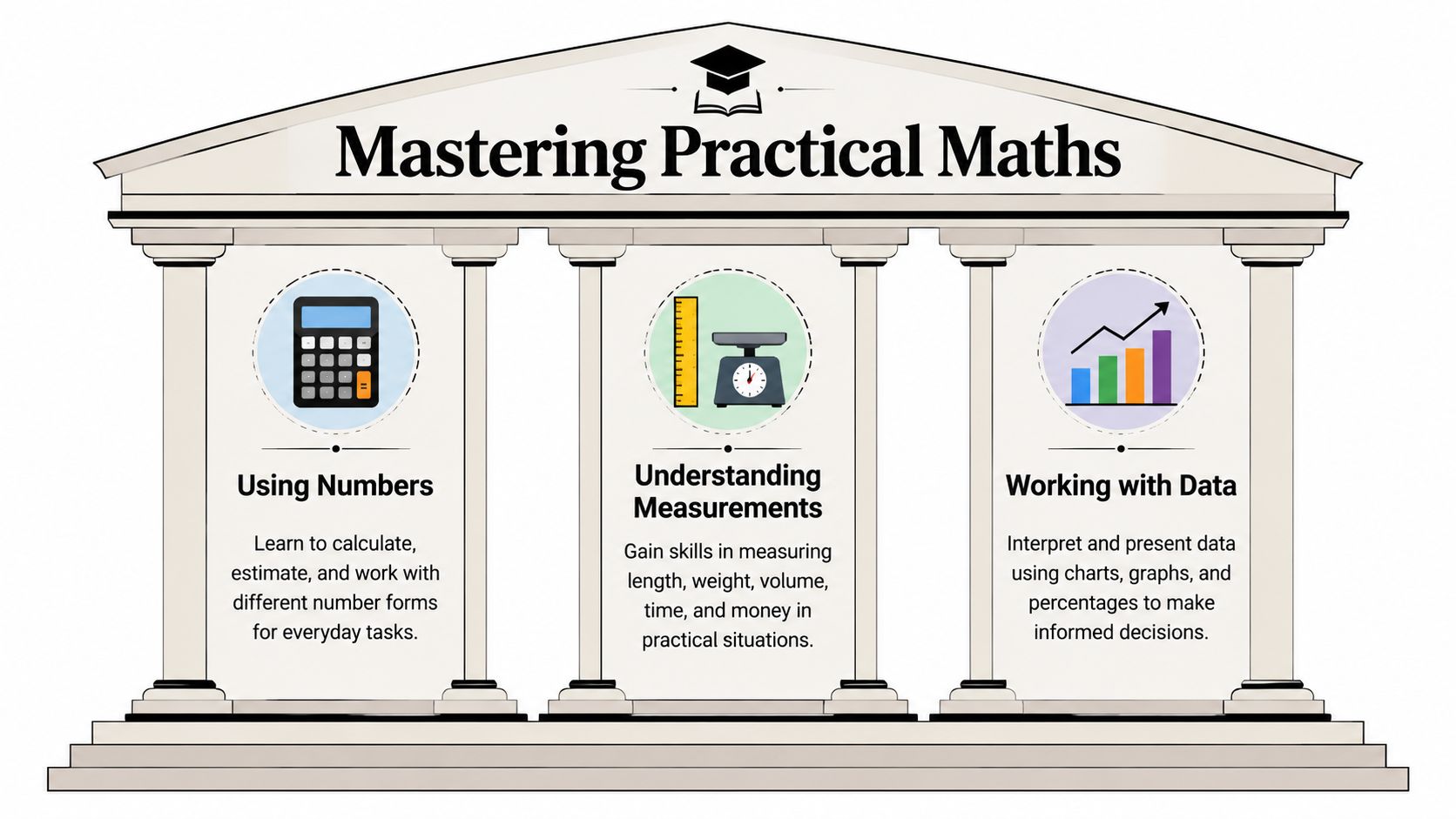
The course centres on three main areas: using numbers, understanding measurements, and working with data. As noted earlier, it also includes reading information from tables, charts, and graphs. In other words, you are learning how to make sense of the kinds of numbers that show up in ordinary life.
Using numbers
This is often where confidence starts to grow.
You will practise whole numbers, fractions, decimals, and percentages. You will also read, compare, and use larger numbers clearly. If those words bring back old worries, pause for a second. These skills are not abstract puzzles. They are the maths behind sale prices, payslips, bills, savings, and everyday spending choices.
Fractions, decimals, and percentages are really three ways of describing the same part of a whole. A discount label in a shop, a bank statement, and a school attendance figure may look different, but they all rely on the same basic understanding. Once that clicks, many questions start to feel less random.
Common examples include:
- Shopping and money: calculating discounts, checking change, comparing deals
- Pay and bills: reading amounts on payslips, statements, or invoices
- Planning ahead: estimating a total before you spend so there are no nasty surprises
Small wins matter here. Getting one percentage question right can do more than improve a score. It can chip away at that old belief that maths is only for other people.
Understanding measurements
Measurements turn maths into something you can see and use.
You meet them in recipes, journeys, room sizes, work rotas, fuel costs, and daily timings. The course helps you work with length, weight, capacity, time, and money so that practical tasks feel clearer and less stressful.
A simple way to view this topic is to see measurement as the maths of real life. If number skills help you work out how much, measurement helps you work out how big, how far, how heavy, or how long. That might mean checking whether furniture will fit, working out travel time, or adjusting a recipe for more people.
Some learners also come across position and direction. That can sound unfamiliar at first. It often becomes much easier when taught through real examples, such as reading directions, following a route, or understanding where something is placed. If you want to get a feel for the style of questions used in assessment, a Functional Skills maths test guide with practice support can help you see what to expect.
Working with data
Data skills help you read the world with more confidence.
You will learn to read tables, diagrams, charts, and graphs, then pick out the information that matters. You may also summarise and compare sets of information and interpret probability in a simple, practical way. That sounds technical, but its aim is straightforward. It helps you stop guessing and start judging information calmly.
Here is what that looks like in daily life:
| Situation | Maths skill |
|---|---|
| Reading a workplace chart | Understanding labels, totals, and comparisons |
| Reviewing weekly spending | Spotting patterns and seeing where money goes |
| Looking at a news graphic | Interpreting figures instead of skimming past them |
| Checking a report or timetable | Pulling out the facts you need quickly |
This part of the course often changes more than exam performance. It helps you ask better questions, feel less intimidated by information, and trust your own judgement. For many adults, that shift carries into family life too. You are not just learning maths. You are building the confidence to say, “I can work this out.”
Your Plan to Prepare and Pass with Confidence
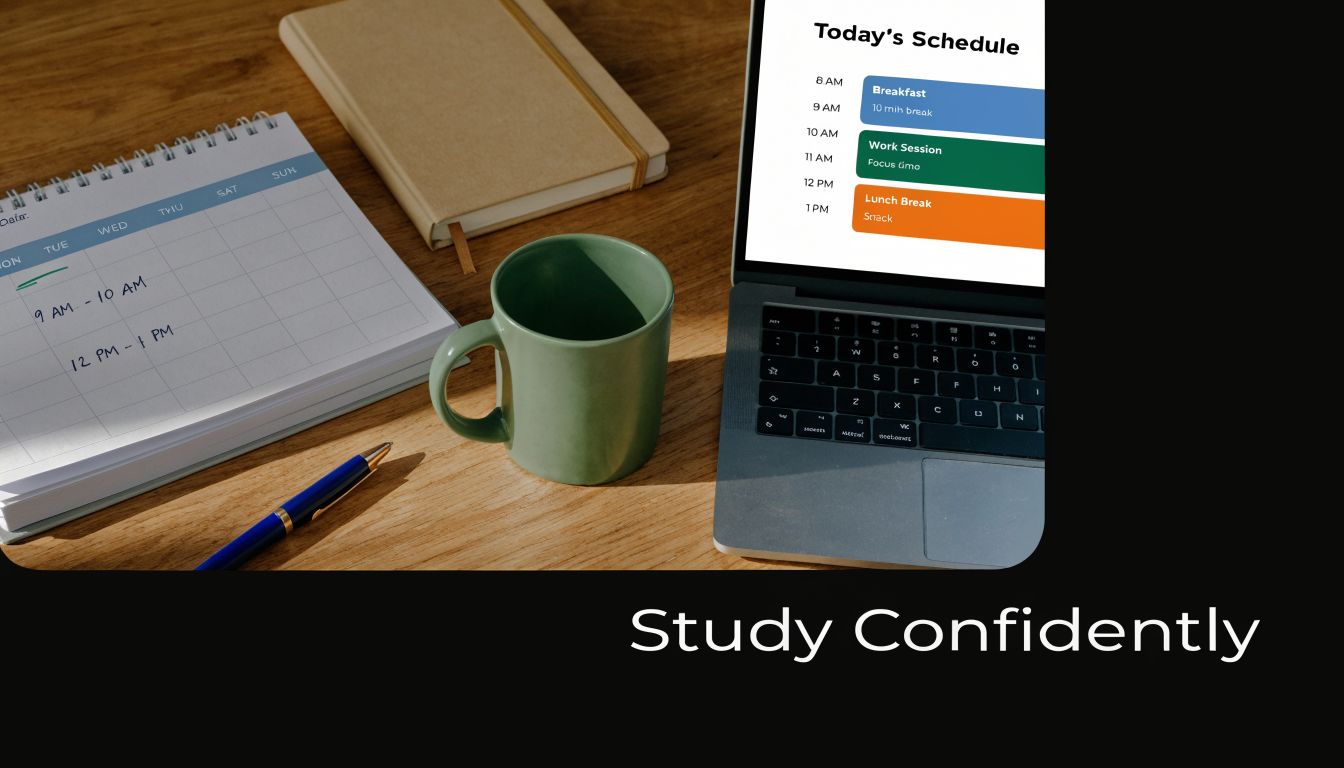
You sit down after work with a cup of tea, open your notebook, and feel that old knot in your stomach. Maybe school maths left you feeling behind. Maybe you worry you will freeze in the test. That feeling is common, and it does not mean you are bad at maths. It means this matters to you.
Passing usually comes from a clear routine, steady practice, and getting familiar with the style of questions before test day. Functional Skills Maths Level 1 is offered by awarding bodies such as Edexcel and NCFE, and the assessment focuses on practical maths you can learn step by step. You do not need to race. You need a plan you can stick to.
For many adults, that plan does more than prepare them for an exam. It starts rebuilding trust in themselves. Each session you complete is proof that you can return to learning, keep going, and finish something that once felt out of reach. If you have children, they notice that too. They see you trying, practising, and refusing to give up.
A simple weekly study rhythm
Short, regular study sessions often work better than long sessions that leave you drained. Maths is a bit like building strength in a muscle. Ten to twenty focused minutes, repeated often, tends to do more than one exhausting burst.
Try a weekly pattern like this:
One session for number skills
Practise fractions, decimals, percentages, and whole-number calculations.One session for measures and everyday problems
Work on time, money, distance, and practical measuring questions.One session for data handling
Read charts, answer questions from tables, and practise finding averages and range.One short recap session
Return to mistakes and work out why the answer went wrong.
That final step matters a lot. Mistakes are not proof that you cannot do it. They are signposts. They show you exactly where your understanding needs more support.
Learn the question style before the test
An unfamiliar exam can feel bigger than it is. Once you know how questions are usually written, the paper often feels calmer and more manageable.
A few simple habits can help:
Read the full question slowly
Many wrong answers happen because a learner rushes past one key word.Underline what you need to find
This helps you separate the information you need from the information that is just there to distract you.Set your working out clearly
Even if you feel unsure, a clear method helps you stay organised.Check whether your answer makes sense
If a bus fare comes out as £437, your maths is asking for another look.
If you want to get used to the format before assessment, practising with a Functional Skills maths test guide with practice questions can help you feel more prepared.
Study habit: Spend time on the topics that make you pause. That is often where the biggest progress happens.
Give extra attention to the topics that feel slippery
Some topics can feel harder because they involve several steps or a picture as well as numbers. Angles are a good example. You may understand part of the method but still lose confidence when the question is laid out differently.
Slow the process down.
Draw the shape again. Label the information. Say what you know before trying to find the answer. If you are using a protractor, handle it carefully and check where zero starts. Adult learners often do better when they turn a confusing page into a physical task they can see and control.
A short video can also help break a topic down in a calmer way:
Build confidence like a skill
Confidence grows from evidence. Each question you answer, each method you repeat, and each small improvement gives your brain a new message. You are learning this. You are getting better at this.
Some weeks will feel easier than others. That is normal. Progress in maths is rarely a straight line. It is more like climbing stairs in low light. You do not always see the whole staircase, but each careful step still takes you higher.
Keep going, even when your progress feels quiet. One day you will answer a question that used to scare you, and you will realise something important. You are not the person who gave up on maths. You are the person who came back and passed.
Unlocking Doors to Your Future Career and Study
You fill in a job application and reach the part that asks for maths. This time, instead of feeling that familiar knot in your stomach, you know you have something real to put down. That moment can feel much bigger than a qualification. It can feel like proof that your future is changing.
Passing functional skills maths level 1 often changes two things at once. It strengthens your practical options, and it strengthens the way you see yourself. You may notice it first in ordinary moments. Reading a payslip feels clearer. Following a timetable feels less stressful. Looking at figures in a meeting no longer makes you want to shrink into the background.
That growing confidence matters.
Once you have passed, the next step often feels easier to believe in. Level 1 works like a solid first rung on a ladder. You do not need to see the whole climb yet. You just need one secure place to put your foot.
What can come next
Many adult learners use Level 1 to build momentum for a bigger goal.
After passing, you might choose to:
- Progress to Functional Skills Maths Level 2
- Work towards GCSE maths
- Meet an entry requirement for a course, apprenticeship, or job
- Feel ready to apply for training or study that once seemed out of reach
For some people, the qualification starts with a private promise: “I want to prove to myself that I can do this.” Later, that quiet promise grows. It becomes, “I can go further than I thought.” If you are looking at your own options, a Level 1 Functional Skills Mathematics course for adults can be the starting point for that change.
Why employers value practical maths
Employers often need people who can use numbers calmly and accurately in everyday tasks.
That may include checking stock, reading rotas, measuring materials, understanding prices, spotting errors, or making sense of a simple table or chart. In administration, retail, customer service, hospitality, care, and support roles, these skills help you carry out tasks with less stress and more independence.
Resources like the TES Functional Skills statistics bundle show the kind of practice materials teachers and learners use to build these practical skills.
Passing a maths qualification doesn't just add a line to your CV. It can change the way you walk into a room.
The family impact is real
The effect often reaches beyond work or study.
When children see a parent return to learning, keep going through self-doubt, and earn a qualification, they see courage in action. They learn that struggling with something does not mean stopping. They learn that adults can grow, improve, and keep promises to themselves.
That example stays with a family. So does the pride.
For many learners, functional skills maths level 1 is not only about numbers. It is about becoming someone who feels more capable, more hopeful, and more ready to say yes to new chances.
How to Start Your Journey with Flexible Support
It's 9:30 at night. The house is finally quiet, your phone still has work messages on it, and you're staring at a maths page wondering if you've left it too late to go back to learning.
Many adults know that feeling.
The problem usually is not a lack of ability. It is the weight you carry into study. Work deadlines, family responsibilities, tiredness, and memories of school can all sit in the room with you. When that happens, even a simple question can feel much bigger than it really is.
That is why flexible support matters so much. Good support gives you space to learn without feeling rushed or judged. It helps you build skill and confidence together, which is often what adult learners need most.
Why support matters
Learning maths as an adult is a bit like rebuilding strength after a long break. You would not expect yourself to sprint on day one. You would start steadily, practise often, and get help with the parts that feel weak.
Maths works in a similar way.
A helpful course breaks topics into manageable steps, explains ideas in plain English, and gives you time to go over something again when it does not click straight away. It also gives you feedback that is calm and clear, so you know what to do next instead of feeling stuck.
For many anxious learners, that steady rhythm changes everything. A wrong answer stops feeling like proof that you are “bad at maths” and starts feeling like useful information. That shift is powerful.
What to look for in a course
A strong functional skills maths level 1 course should support the person as well as the learner.
Look for:
- Clear teaching that explains methods straightforwardly and shows one step at a time
- Flexible study options so learning can fit around work, parenting, and everyday life
- Regular feedback that helps you improve without knocking your confidence
- Patient tutor support so you can ask questions and get unstuck quickly
- A recognised qualification that can help you move on to further study or work goals
If you want a course built for adult learners, you can explore this NCFE Level 1 Functional Skills Mathematics course for adults.
Start before you feel confident
Many people wait for the moment when they feel ready.
That moment often does not arrive first.
Confidence usually grows in the doing. It grows when you complete one task you thought you could not do. Then another. Then another. Bit by bit, the fear loses some of its power.
Starting now does not mean you have to be fearless. It means you are willing to give yourself a real chance.
And that choice can mean more than a qualification. It can mean showing your children what persistence looks like. It can mean feeling prouder of yourself when you apply for jobs, help with homework, or speak up instead of shrinking back. Sometimes the first lesson is not really about numbers at all. It is about beginning to believe that your future can still change.
Your Questions About Functional Skills Maths Answered
How long does it take to complete
That depends on your starting point, your schedule, and how much time you can give each week.
Some adults move through it quickly because they already remember some of the basics. Others need more time, especially if they've been away from education for years. Neither route is wrong. The best pace is the one you can keep up without burning out.
Is this the same as a GCSE
It isn't the same qualification, but it is a recognised maths qualification focused on practical skills.
Functional skills maths level 1 is designed around real-life maths for work, study, and everyday living. Many adults prefer this approach because it feels more direct and less abstract than school-style maths. For some learners, it also works well as a step before moving on to Level 2 or GCSE maths.
What happens if I don't pass the first time
Not passing first time does not mean you've failed as a learner.
It usually means you now know more clearly what needs work. Maybe you need more practice with data, more help with angles, or a calmer test strategy. Adult learners often improve a lot once they understand the exam format and focus on the topics that held them back. One result is not the end of your story. It's part of the learning process.
The important thing is to stay kind to yourself, keep going, and use better support for the next step.
If you're ready to take a real step forward, Next Level Online College offers flexible online study, recognised qualifications, and supportive guidance for adult learners who want to build confidence, improve career options, and make their families proud.