
Some evenings feel heavier than others. You finish work, sort the house, help with dinner, look at your children, and think, “I want more than this. I want better choices. I want to prove to myself that I can still do it.”
If that sounds like you, you're not behind. You're not too old. And you're not the only adult feeling nervous about taking a functional skills test.
Many people come back to learning after years away from school. They worry they've forgotten everything. They worry they'll look silly. They worry they'll fail before they've even started. But a functional skills test isn't there to catch you out. It's there to help you show what you can do in real life, at work, at home, and in your future plans.
A New Beginning Starts Here
Sarah is a good example of the kind of learner I've taught many times. She worked hard, cared for her family, and kept everyone else going. But every time she saw a job she liked, the same words stopped her: English and maths required.
That hit hard. Not because she wasn't capable, but because life had moved on and she felt stuck.
For a while, she told herself she'd leave it. Then her child asked for help with homework one night, and something shifted. She didn't just want a certificate. She wanted confidence. She wanted to be able to say, “I did this,” and mean it.

That is why this matters. A functional skills test can be the first step towards a better job, further study, or feeling proud of yourself again. It can help you become the parent who shows their children that learning does not stop at school. It can help you become the person in your family who breaks the pattern of self-doubt.
You don't need to feel ready for the whole journey. You only need enough courage to take the first step.
A lot of adults think a test means pressure, fear, and old school memories. In reality, this qualification is much more practical than many people expect. It focuses on useful skills. Reading clearly. Writing properly. Working with numbers in everyday situations.
Why this step feels so big
Coming back to education can bring up old feelings. You might be carrying memories of being told you were “not academic”. You might have left school early. You might feel rusty.
That doesn't mean you can't succeed.
- Low confidence isn't low ability: Many adults know more than they think. They've been using English and maths in daily life for years.
- A fresh start changes things: Learning as an adult is different. You have a reason now. That reason gives you focus.
- Your family sees your effort: When children watch an adult keep going, they learn resilience, not perfection.
What Exactly Is a Functional Skills Test
Think of a functional skills qualification as a toolbox. It gives you the core tools for modern life and work. Not fancy tools you never use. The tools you reach for all the time.
A functional skills test checks practical English or maths skills. That means the sort of things people use when they read letters, write emails, understand payslips, compare prices, or plan a weekly budget. It's designed to be useful, not confusing.
In England, Wales, and Northern Ireland, Functional Skills have been an important part of adult education for years. In the 2022/23 academic year, over 250,000 Functional Skills certificates were awarded in maths and English combined, which shows how many learners are using these qualifications to move forward, as explained in this guide to comparing data sets in Functional Skills maths.
What the test is really looking for
The biggest misunderstanding is this. People think the test wants school-style knowledge with no real purpose. That's not the point.
The test is usually checking whether you can do things like:
- Read with understanding: pick out the main message in a letter, article, or workplace document
- Write clearly: produce writing that makes sense, uses the right tone, and follows basic spelling and punctuation rules
- Use maths in context: solve number problems linked to money, measurements, time, charts, or percentages in everyday life
If you've ever checked a bill, compared supermarket deals, sent a message to a manager, or followed instructions, you've already used some of the skills involved.
Why people choose it
A functional skills test often suits adults because it feels more direct and less abstract than older school memories. It's built around application. That can make the qualification feel more approachable.
If you want a fuller explanation of the English side, this page on what Functional Skills English is breaks it down in a simple way.
Practical rule: Don't ask, “Was I good at school?” Ask, “Can I build useful skills now?” That question is far more helpful.
Here's a simple way to see it:
| Everyday situation | Functional skills area |
|---|---|
| Writing an email to work | English writing |
| Reading appointment details | English reading |
| Checking prices and offers | Maths |
| Planning travel time | Maths |
| Joining in a discussion | Speaking and listening |
That's why this qualification matters so much. It isn't about proving you can pass an old-fashioned school exam. It's about showing you can handle life and work with confidence.
Finding Your Level in English and Maths
Starting can feel confusing because there are different levels. The easiest way to understand them is to picture a staircase. You don't need to leap to the top. You just find the step you're on and move up from there.
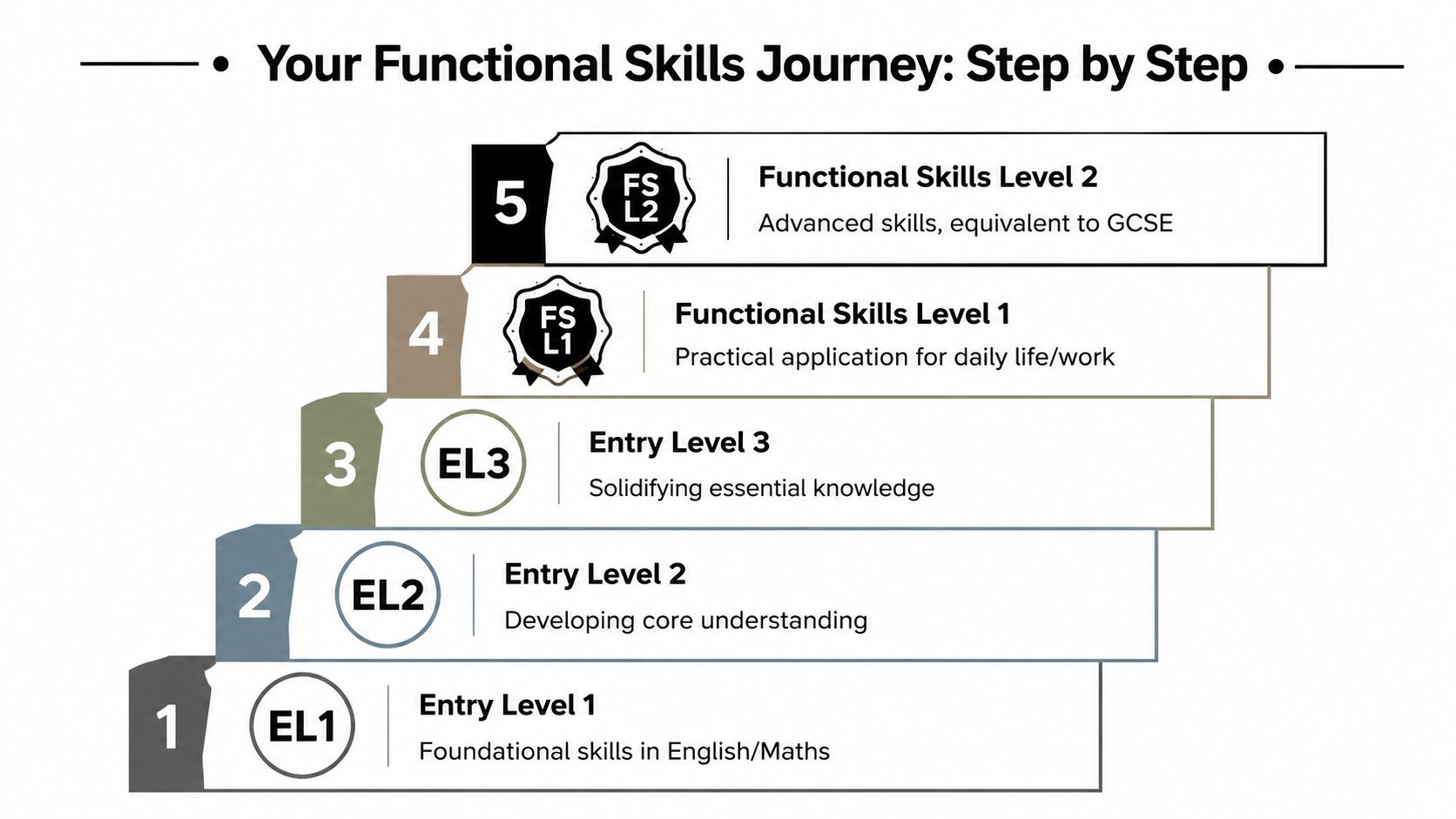
The staircase journey
At the lower steps are Entry Level 1, Entry Level 2, and Entry Level 3. These levels help learners build the basics. They are useful if you've been out of education for a long time or feel you need to rebuild your confidence from the ground up.
Then come the two main stages most adults ask about:
- Level 1, which builds solid practical skills for everyday tasks and work
- Level 2, which is widely accepted as being similar to a GCSE grade 4 or old grade C
Many adults aim for Level 2 because it is commonly requested for jobs, apprenticeships, and further study.
One reason this route is so well known is that Functional Skills English Level 2 had 142,000 successful awards in 2022/23, making it the most popular choice for many adults who need a recognised qualification, as noted in this video on Functional Skills English Level 2.
If you want to explore the main goal many adult learners work towards, this page on Functional Skills Level 2 maths and English is a useful next read.
What English includes
English is not just one single skill. It has separate parts, and that often confuses learners at first.
| English part | What it means in plain language |
|---|---|
| Reading | Understanding written information |
| Writing | Producing clear sentences and organised answers |
| Speaking, Listening and Communication | Taking part in discussion and expressing ideas clearly |
Some adults are stronger in one area than another. For example, you might speak very confidently at work but feel less sure about punctuation. That's normal.
What maths includes
Functional Skills maths is about practical number use. You may see topics such as:
- Money and budgeting: working out totals, change, or value
- Time and measures: reading timetables, measuring length, weight, or volume
- Data handling: looking at tables, charts, or simple comparisons
- Problem solving: choosing the correct method to answer a real-life question
Lots of adults discover that maths feels easier when it's linked to shopping, travel, wages, cooking, or work tasks.
How to know where to begin
You don't need to guess your level alone. Many learners start by taking a short assessment or speaking to a tutor. That helps identify whether Entry Level, Level 1, or Level 2 is the best place to begin.
The right starting point matters because confidence grows fastest when work feels challenging enough to stretch you, but not so hard that it knocks you back. Starting lower is not failure. It's smart. A strong staircase needs a strong first step.
What to Expect on Your Test Day
The unknown is often worse than the test itself. Once you know what test day looks like, it usually feels much less frightening.
Many functional skills tests can be taken online under remote invigilation. That means an invigilator supervises the exam through your webcam to make sure the rules are followed fairly. It sounds formal, but the process is usually straightforward when you've prepared your space in advance.
The basics you'll need
For remotely invigilated exams, you'll typically need a webcam with at least 1280×720 resolution, valid photo ID, and a suitable computer setup. Rules also prohibit a second monitor or headphones, as explained in this guide to Functional Skills exam requirements.
Accepted photo ID often includes documents such as a passport or driving licence. The main thing is that your name and photo must be clear.
Before the exam begins
Most learners feel calmer when they know the order of events. A typical experience may look like this:
- You log in early: this gives you time to settle and sort any last-minute issues.
- You show your ID: the invigilator checks that you are the right person.
- You show your room or desk area: this helps confirm that your space follows the rules.
- You begin the test: once checks are complete, you can focus on your questions.
Keep your desk simple. A clear space helps you think clearly too.
Common worries answered simply
Here are some of the things adults often ask me before a functional skills test:
“What if I'm not good with computers?”
You don't need advanced computer skills. You mainly need to follow instructions, use your mouse or keyboard, and stay calm.“What if I forget a rule?”
Read the guidance beforehand and check your setup the day before. Small preparation makes a big difference.“What if I panic?”
Pause, breathe slowly, and focus on one question at a time. The test is completed step by step, not all at once.
A test day goes better when it feels familiar. That's why practice, planning, and knowing the rules matter so much. When the unknown disappears, confidence has room to grow.
Your Simple Plan to Prepare and Beat Exam Nerves
Most adults don't fail because they can't learn. They struggle because they try to prepare in a rushed, unfocused way while juggling real life. A better plan is simple, steady, and realistic.
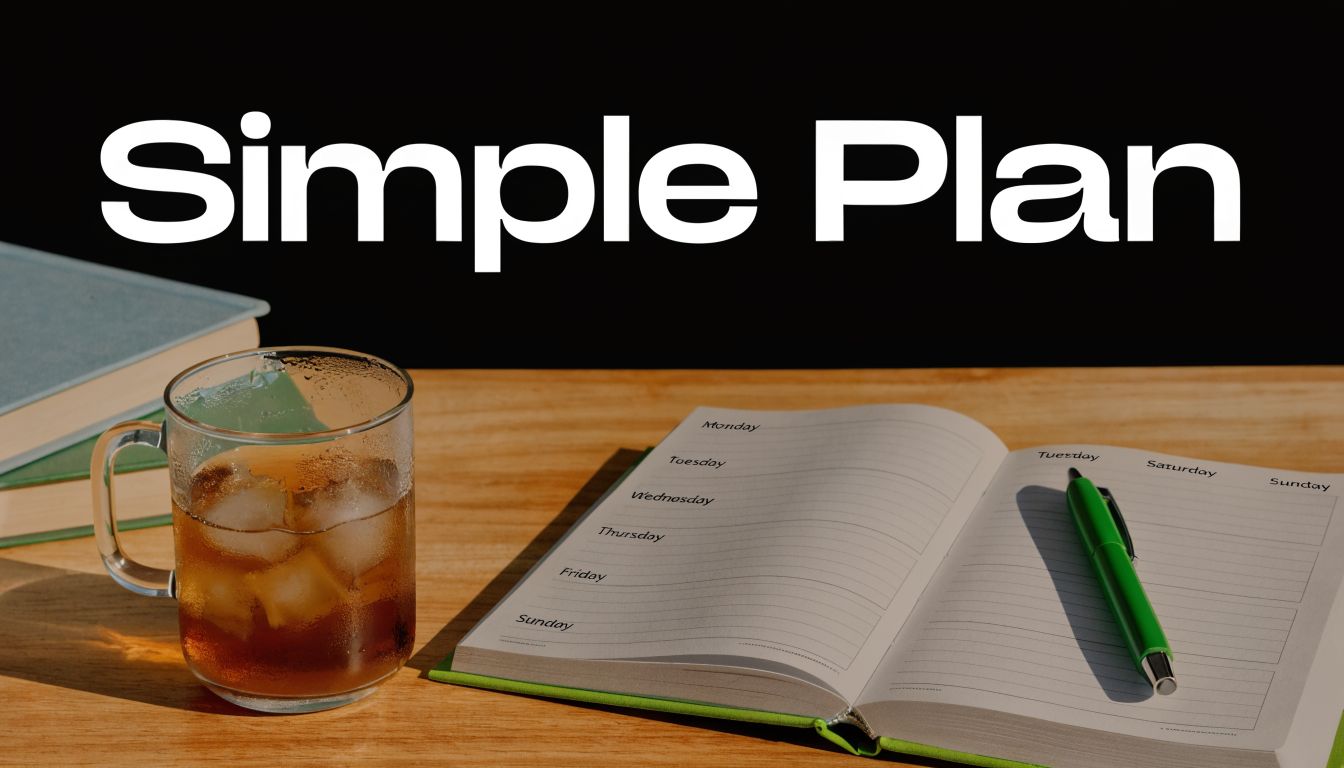
You do not need to study all day. You need a routine you can keep. Twenty focused minutes is better than a long session you dread and avoid.
Start with what you need most
One of the smartest first steps is a diagnostic test. An initial diagnostic test can identify your skills gaps with around 85% accuracy, helping you focus on the topics you most need to improve, according to this explanation of Functional Skills diagnostic tests.
That matters because many learners waste energy revising things they can already do. A good diagnostic gives you a clearer target.
If maths is the area making you most anxious, this guide on how to pass Functional Skills maths Level 2 can help you understand how to revise in a more focused way.
A simple weekly method
Try this approach if life is busy:
- Pick short study slots: choose times you can protect, such as after dinner or before work
- Work on one topic at a time: don't mix everything together if that leaves you overwhelmed
- Use practice questions: these help you get used to the style of the functional skills test
- Review mistakes gently: mistakes show where learning needs to happen. They are not proof that you can't do it
A maths session might focus on ratio, money, or reading a chart. An English session might focus on reading a short text, spotting the main point, or improving sentence structure in writing.
Calm your nerves before they grow
Exam nerves are normal, especially if education has been painful in the past. Feeling anxious does not mean you are not ready. It means this matters to you.
Try these steadying habits:
| Moment | What to do |
|---|---|
| The night before | Set out your ID, charge your device, and avoid last-minute cramming |
| One hour before | Drink water, sit somewhere quiet, and read your notes lightly |
| Just before starting | Take slow breaths and remind yourself you only need to answer one question at a time |
| If you get stuck | Skip it, move on, then return later |
A short revision walkthrough can also help things feel more familiar:
Confidence grows through action
Many adults wait to feel confident before they begin. In truth, confidence usually comes after action.
“I'm nervous” and “I'm not capable” are not the same thing.
Try speaking to yourself the way you would speak to your child. You wouldn't say, “You'll never get this.” You'd say, “Keep going. You're learning.” Give yourself the same kindness.
A good preparation plan is not about being perfect. It's about building proof. Proof that you can show up, learn a topic, correct an error, and try again. That proof changes how you see yourself.
Why Passing Is a Victory for You and Your Family
When you pass a functional skills test, you gain more than a certificate. You gain evidence that you can still grow, still achieve, and still open doors that once felt closed.
That feeling changes people. I've seen adults walk taller after passing. Not because life becomes easy overnight, but because they stop seeing themselves through the lens of old failure.

What it can mean at home
Children notice effort. They notice when a parent studies after work. They notice when someone in the family keeps going even when it's hard.
That has real value.
- You model resilience: your children see that setbacks don't have to define a person
- You change the family story: education becomes something possible, not something for other people
- You build self-respect: success earned through effort often feels deeper than success that came easily
What it can mean for work and future study
A Functional Skills Level 2 qualification carries real weight. 92% of UK employers recognise Functional Skills Level 2 as proof of essential English and maths skills, which is why it can be a strong addition to your CV, as noted earlier in the section on what the qualification is.
That recognition matters when you're applying for roles, changing direction, or preparing for further learning. For many adults, it becomes a stepping stone towards college courses, apprenticeships, or university pathways.
Passing tells employers and education providers something important. You can commit, improve, and meet a recognised standard.
It's not just about eligibility
Yes, qualifications can help with applications. But the personal shift often matters just as much.
Here's what many adults gain after passing:
| Before passing | After passing |
|---|---|
| “I'm not good at this” | “I can learn if I stick with it” |
| Avoiding forms, emails, or numbers | Facing tasks with more confidence |
| Feeling embarrassed about education | Feeling proud of progress |
| Thinking opportunities are closed | Seeing new options ahead |
That inner change is powerful. It can affect how you speak in interviews, how you help your children, how you carry yourself at work, and how willing you are to aim higher next time.
A pass doesn't just say you met a standard. It says you came back for yourself. And often, for the people you love too.
Your Supported Journey with Next Level Online College
Returning to education works best when you don't feel alone. Adults need more than course content. They need structure, encouragement, and people who understand how busy life can be.
Next Level Online College was built around that reality. The college supports adult learners across the UK with flexible online study, recognised qualifications, and guidance designed for real life. That matters if you're balancing work, childcare, shift patterns, or the simple challenge of rebuilding confidence after years away from education.
What stands out most is the human side. Learners aren't expected to just log in and somehow figure it all out. They can benefit from academic support, motivation, and practical guidance as they work towards their goals. For many adults, that kind of support is the difference between stopping at the first wobble and keeping going.
There's also reassurance in knowing that one difficult day doesn't define the whole journey. Adult learning isn't about perfection. It's about progress, support, and having a path forward even if you need more time or another attempt.
If you've been thinking about taking a functional skills test, treat that thought with respect. It may be the start of something much bigger than one exam. It may be the beginning of a new standard for your life, your confidence, and your family's future.
If you're ready to take that first step, Next Level Online College offers flexible, fully supported online courses for adult learners who want a fresh start in English, maths, and beyond. Whether you're aiming for work, university, or personal pride, you can begin with a team that believes you can do this.