
You might be reading this after the kids have gone to bed. The house is finally quiet. You've found an old results slip, or maybe you've looked at a job advert and felt that familiar sting. “GCSE English and maths required.” It can bring back old school feelings very quickly.
That feeling doesn't mean you've failed. It means you still care about your future.
Many adults come back to education carrying doubt, shame, or the idea that they've “missed their chance”. You haven't. GCSE resits for adults are not a step backwards. They're a decision to move forwards with purpose. You're not the same person you were at 16. You've lived, worked, cared for people, paid bills, solved problems, and kept going through hard times. That strength matters in education.
For some people, the goal is a better job. For others, it's university. For many, it's personal. They want to prove something to themselves. They want their children to see that learning matters. They want to feel proud when they say, “I went back and did it.”
Your Fresh Start in Education Begins Today
Sarah is the kind of learner I've met many times. She works hard, looks after her family, and puts everyone else first. For years, she told herself she was “just not academic”. Then her child started bringing home homework and asking for help. Sarah realised she didn't want to keep saying, “I was never good at school.”
So she looked again at education. Not as a teenager. As an adult with a reason.
That's often how this journey starts. Not with perfect confidence. With a quiet thought that life could be bigger than this. A thought that says, “I want more for myself, and for the people I love.”
A brave step, not a small one
Choosing GCSE resits for adults takes courage. It means facing a subject that may once have knocked your confidence. It means making space in a busy life. It means believing that your future deserves effort.
That is something to be proud of already.
If you're exploring online GCSE courses for adults, you're already doing something powerful. You're gathering information instead of giving up. You're looking for a route forward instead of staying stuck.
You do not need to feel ready to begin. You need to be willing to begin.
Why this matters so much
A GCSE can be more than a qualification. It can be the key that opens the next door. That might be a college course, a training programme, a university application, or a job you've wanted for years.
It can also change the way you see yourself.
When adults pass a subject they once feared, something shifts. They stop saying, “I can't.” They start saying, “What next?” That change reaches beyond the classroom. It shows up at work, at home, and in the example you set every day.
If your confidence has taken knocks in the past, that doesn't mean you're not capable. It means you may need the right support, a clear plan, and a learning style that fits adult life. That's very different from sitting in a school classroom years ago and hoping for the best.
Become the Role Model Your Family Admires
When adults return to study, they often think the biggest prize is the grade. The grade matters, of course. But the deeper change is what happens inside you while you earn it.
Your children notice more than you think. They notice when you keep going even when you're tired. They notice when you sit down to study instead of saying “I'm too old for this”. They notice discipline, patience, and determination.

What your family really sees
They don't just see books and notes. They see an adult who refuses to be defined by old results.
That matters. A child who watches a parent learn gets a powerful message. Learning isn't only for school. Learning is for life. Effort matters. Starting again is allowed. Growth doesn't stop when you leave the classroom.
For many adults, that becomes one of the proudest parts of the whole journey.
- You show resilience: Your family sees that hard things can be faced.
- You show commitment: Even with work and responsibilities, you still make time for a goal.
- You show self-belief in action: Not loud confidence. Quiet, steady action.
- You show what hope looks like: You become proof that change is possible.
It's not selfish to want more
Some adults feel guilty about spending time on their own education. They worry they should be focusing only on work, children, or money. But improving your qualifications can support all of those things.
A GCSE pass can help you move towards careers with better progression. It can help you meet entry requirements for future study. It can give you choices you may not have right now. More choices can mean more stability, more fulfilment, and a stronger future for your family.
That isn't selfish. That's responsible.
A truth many adult learners need to hear: improving your education is also a way of caring for your family.
Pride grows slowly, then all at once
At first, progress can feel small. One worksheet. One lesson. One evening of revision when you wanted to quit. Then the small things build. You understand a topic that once confused you. You answer a question correctly without guessing. You stop dreading the subject.
Then one day, the result arrives.
That moment can mean far more than a number on a page. It can heal an old wound. It can prove that the story you've told yourself for years was never the whole truth. You were never “bad at learning”. You may have needed time, support, and a reason that mattered enough.
And if your children see you achieve that, they'll remember it.
How GCSE Resits for Adults Actually Work
The process sounds more complicated than it is. Once you break it into steps, it becomes much easier to manage.
Adults usually approach this in the same way they'd book any important appointment. You check what you need, find the right place, choose your date, and prepare properly. That's all far more manageable than it first appears.
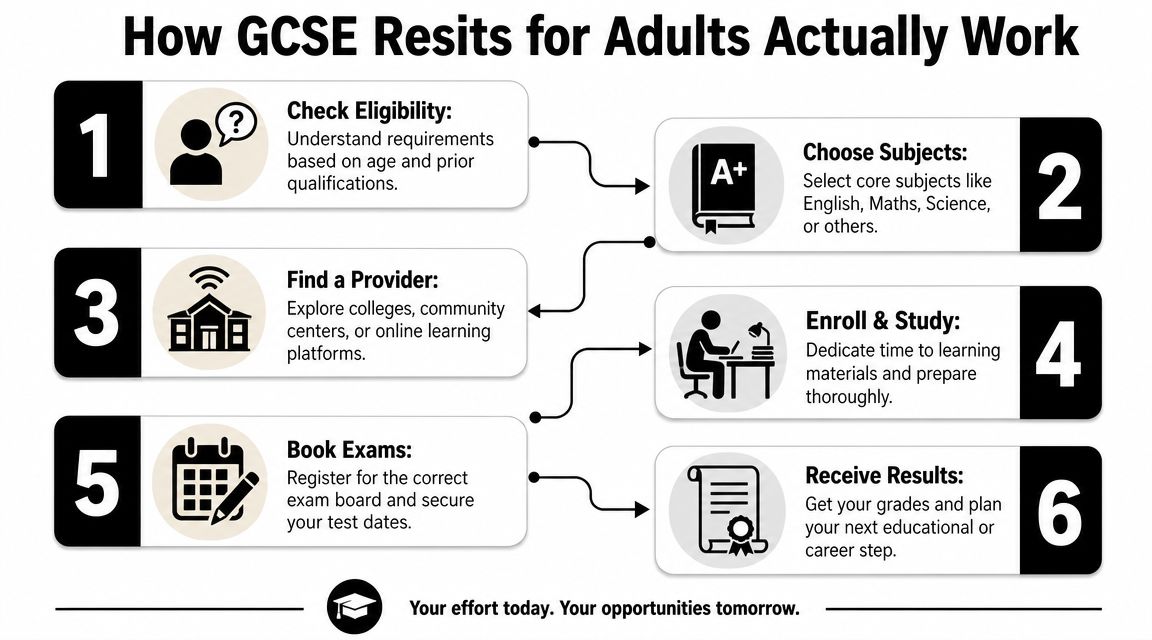
The basic process
Decide which subject you need
Most adults resit English, maths, or both because these subjects are common entry requirements for jobs, college courses, and university pathways.Choose how you'll study
You might study through an online course, a local college, or independently.Find an exam centre
If you're not sitting the exam through a school, you'll usually enter as a private candidate. That means you're booking the exam through an approved centre rather than through a school you attend full-time.Register before the deadline
Deadlines matter. Centres need time to process entries and organise exam arrangements.Sit the exam and receive your result
Your result carries the same value as any other GCSE grade.
The part that often confuses adults
The biggest practical issue is usually not the studying. It's the exam timetable.
The National Careers Service says GCSE English and maths can be resat in autumn, while other GCSE subjects are usually deferred to the next summer series. It also advises learners to contact their school or college, and to think about whether a university will accept a resit grade in that admissions cycle. For private candidates, this makes centre capacity, entry deadlines, and timetable alignment especially important, as explained in the National Careers Service guidance on GCSE resits.
That means if you need maths or English, you may have a sooner opportunity. If you need another subject, you'll usually need to plan for the summer series.
Practical rule: don't assume you can book late just because you found a course late. Exam centres and deadlines can decide your whole timeline.
A quick refresher on grades can help if the system feels unfamiliar. This guide to what GCSE grades mean can make the scale easier to understand before you choose your next step.
Who helps organise the exam
You may hear names like AQA, Edexcel, or OCR. These are exam boards. They set the papers and mark them. Your exam centre will normally tell you which board your exam is with, and your course materials should match that specification.
You don't need to become an expert in exam administration. You just need to know three things:
- Your subject and level
- Your exam centre
- Your entry deadline
This short video gives a useful overview before you start making decisions.
One more thing to check
If your goal is university, teacher training, or a specific profession, check the entry rules early. Some providers accept resits without issue. Others may want the grade by a certain point in the admissions cycle.
That's why adult learners do best when they plan backwards from the goal. Start with where you want to go. Then choose the qualification, exam date, and study route that get you there in time.
Choosing Your Best Way to Study and Succeed
The right study method is the one you can keep doing. That matters more than picking the option that sounds impressive.
Adults often try to force themselves into a study style that doesn't fit real life. Then they blame themselves when it becomes hard to keep up. Usually, the problem isn't ability. It's the mismatch between the course and the learner's daily routine.
The three main routes
Most adults choose between an online college, a local further education college, or self-study with an exam-only entry. Each one can work. The best fit depends on your schedule, confidence, and how much support you need.
| Factor | Online College | Local College | Self-Study (Exam Only) |
|---|---|---|---|
| Flexibility | Usually easier to fit around work and family life | Fixed timetable and travel required | Fully flexible, but self-managed |
| Support | Structured lessons and tutor support | Classroom teaching and peer contact | Very limited unless you arrange help separately |
| Routine | Good balance of structure and freedom | Strong routine if you can attend regularly | Depends entirely on your own discipline |
| Travel | Study from home | Travel to campus | No classes to attend |
| Confidence-building | Helpful for adults who want guidance without a classroom setting | Helpful if you learn best face to face | Harder if you've been out of education for years |
| Exam planning | May include guidance on booking and preparation | Often more integrated if the college runs the exams | You organise the exam centre yourself |
Online learning for busy adult life
For many adults, online study is the most realistic choice. If you work shifts, care for children, or have changing responsibilities, flexibility matters. You need something you can return to after dinner, early in the morning, or during a free hour at the weekend.
That doesn't mean learning alone.
A structured online course can give you lessons, tutor guidance, set content, and a clear path through the syllabus, but without asking you to rearrange your whole life around a campus timetable. One example is Next Level Online College, which offers online courses for adult learners studying around work and family commitments.
Local college and self-study
A local college can suit learners who want face-to-face teaching and a fixed routine. Some adults thrive when they physically go somewhere to learn. It can create separation from home life and make study feel more official.
Self-study works best for a smaller group of learners. Usually, these are people who already know the subject quite well, feel comfortable working alone, and mainly need an exam booking rather than teaching. If your confidence is low or your last experience of the subject was difficult, self-study can feel lonely very quickly.
Pick the route you can stick with on tired days, not just the one you like the sound of on motivated days.
Questions to ask yourself before choosing
Try these simple checks:
- When will I study? Be honest. If your week is full, a rigid timetable may become stressful.
- What kind of help do I need? Some learners need regular feedback. Others mainly need materials and a deadline.
- How long have I been out of education? The longer the gap, the more valuable structure usually becomes.
- Do I need accountability? If you often put your own goals last, support and check-ins can make a big difference.
Your choice doesn't need to be perfect. It needs to be practical. Adult learners often succeed when they stop asking, “What should the ideal student do?” and start asking, “What can I keep doing every week without burning out?”
GCSEs or Functional Skills Which Is Right for You
This is one of the most important decisions you'll make. Many adults are told they “need English and maths” but aren't told which qualification is the right one for their goal.
That can waste time and energy.
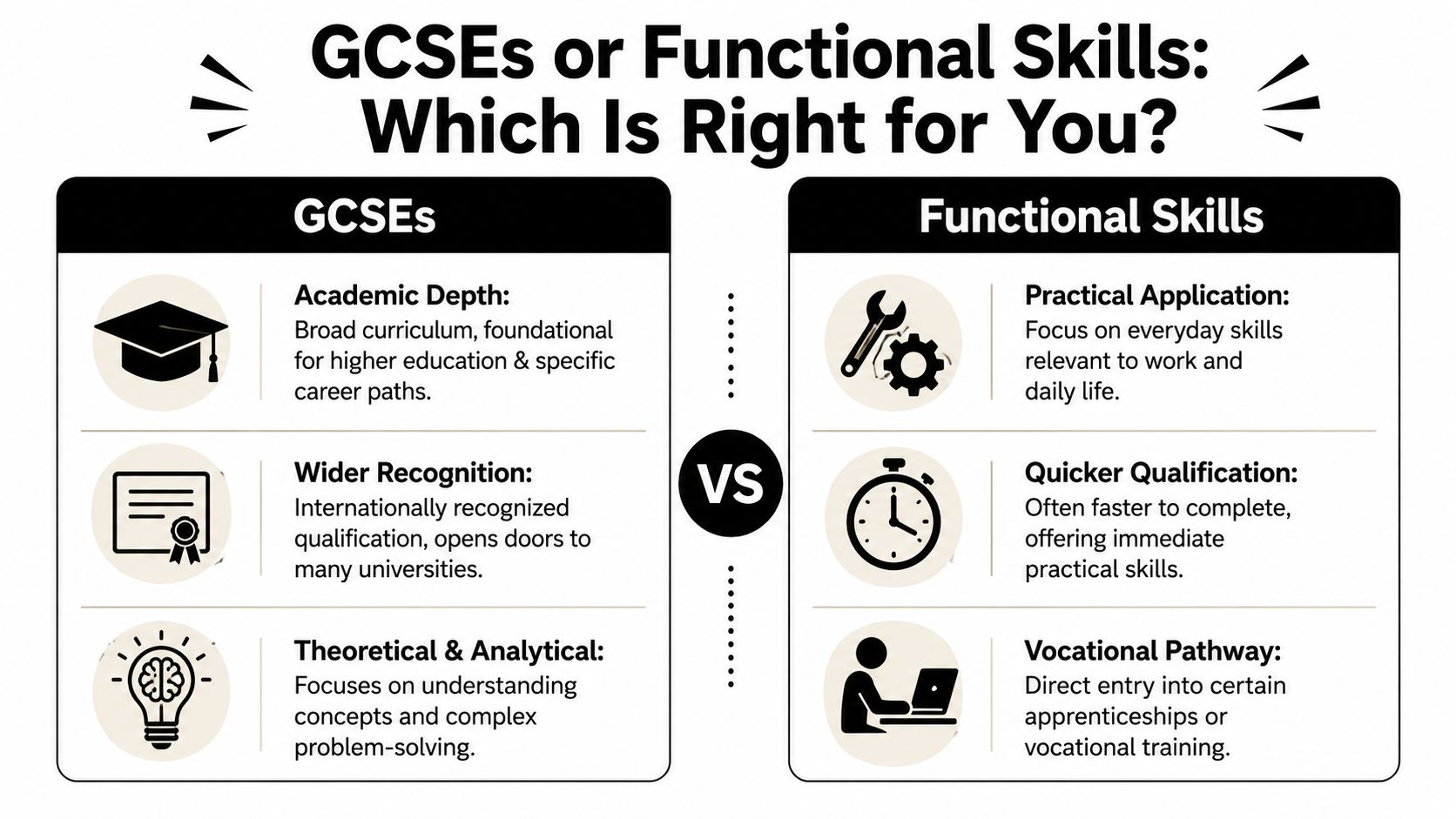
Think of it as the right tool for the job
A GCSE and a Functional Skills qualification both help you prove your ability, but they don't always serve the same purpose.
A GCSE is often the stronger choice when a university, training provider, or profession specifically asks for a GCSE grade. Functional Skills can be a very practical route when the requirement is broader and the provider accepts it.
Government and FE-sector reporting show this choice matters because GCSE resit outcomes are uneven, and English and maths should not be treated as one generic decision. The same reporting also points out that Functional Skills can be a more direct and achievable route for many, depending on whether a university or employer specifically requires a GCSE grade, as discussed in FE Week's coverage of English and maths resit policy.
When a GCSE is usually the safer route
You should lean towards a GCSE if:
- A university asks for it by name
- A profession has a strict entry rule
- Your future course lists a GCSE grade as essential
- You want the broadest recognition for later options
If the rule says “GCSE”, don't guess. Get written confirmation before choosing an alternative qualification.
When Functional Skills may make more sense
Functional Skills may suit you if your goal is practical progression and the organisation you're applying to accepts it. For many adults, that can mean a faster, clearer route to meeting an entry requirement without taking on the full GCSE syllabus.
It can be especially helpful if you're balancing work, family, and study, and you need a qualification that feels closely tied to everyday reading, writing, speaking, or maths skills.
If you want a clearer breakdown, this guide to Functional Skills and GCSE equivalence can help you compare the two.
Don't ask which qualification is better in general. Ask which qualification your next step accepts.
A simple decision framework
Use this checklist before you enrol:
Name your goal
Job, promotion, university, apprenticeship, access course, teacher training, or personal achievement.Check the exact wording
Does the requirement say GCSE specifically, or does it accept equivalents?Match the qualification to the goal
If Functional Skills is accepted, it may be the more direct route. If GCSE is required, that answers the question.
This decision alone can save you months of effort. It can also protect your confidence, because there's nothing more frustrating than working hard for a qualification that doesn't fit the next step you want to take.
Your Action Plan to Get the Grades You Deserve
A strong resit plan works like a sat nav. You do not need to know every road in the country. You need to know where you are now, where you want to get to, and the next turn to take.
That matters for adult learners because time and energy are limited. If you spend both on topics you already feel comfortable with, revision can feel busy without changing your result. Progress usually comes faster when you spot the parts that are costing you marks and work on those first.
Why focused support matters
Analysts at the Education Policy Institute found that many learners who resit English and maths make only small gains, and that the biggest improvements often come from teaching that targets the specific areas where marks are being lost, rather than broad revision across everything, as explained in the Education Policy Institute's resit analysis.
That is good news.
It means you do not need to master the whole syllabus at once. You need a clear diagnosis, a realistic plan, and steady practice in the topics that will make the biggest difference. For many adults, that shift changes everything. Revision stops feeling like a fog and starts feeling like a route.
Your next three moves
Start with these steps:
Write down the exact grade or qualification you need
Keep it specific. If a course, employer, or training provider has given you an entry requirement, save the wording and read it carefully.Find your mark-losing areas early
Use a past paper, an assessment, or tutor feedback to identify the topics that keep tripping you up. Treat this like checking the foundations before decorating the room.Build a weekly routine you can keep
A simple plan that survives tired evenings and busy weekends will take you further than an ambitious timetable you abandon after ten days.Ask for guidance before you book anything
One conversation can prevent the wrong exam entry, the wrong level, or a study option that does not fit family life.
This is about more than a grade
A GCSE pass can open doors to work, training, and further study. It can also do something quieter and just as important. It can rebuild trust in yourself.
Children notice what adults do with setbacks. When they see you return to education, keep going after a long day, and sit an exam you once thought was behind you, they learn something powerful about persistence. Your resit becomes part of your family story. Not the story of a result you missed years ago, but the story of what happened when you chose to try again.
You do not need to feel fully confident before you begin. Confidence usually grows after a few completed tasks, a few better practice papers, and a few moments where you realise, "I can do this."
If you're ready to take the next step, Next Level Online College offers flexible online study options for adults returning to education. If you're unsure whether you need a GCSE resit or another route, reaching out for guidance can help you choose the qualification that fits your goal and your life.