
You might be here because of a quiet moment that hit harder than usual.
Your child asks for help with homework and you freeze. Or you spot a job advert and read the words “GCSE English required” and feel that old sinking feeling. Or maybe you're tired of saying, “I'll do it one day,” while life keeps moving.
That feeling doesn't mean you've failed. It means you want more. More confidence. More choices. More security for the people you love.
Plenty of adults in the UK are in exactly this position. Some left school early. Some had a bad experience in education. Some were busy raising children, working, caring for relatives, or just surviving. None of that means your chance has gone. It means your path is different.
The best time to start was years ago. The next best time is now.
It Is Never Too Late to Write Your Own Success Story
A lot of adults start looking for English courses for beginners after a small moment that won't leave them alone. It might be filling in a form and worrying about spelling. It might be staying quiet in a meeting because you don't trust your writing. It might be wanting to show your children that education matters, but feeling ashamed that you never got the support you needed yourself.
That shame needs to go.
Wanting to improve your English as an adult is not embarrassing. It's responsible. It's brave. It's the kind of decision that changes the direction of a life.

You are not starting from nothing
You already know how to keep going when things are hard. You already manage real life, real pressure, real responsibility. That matters in education more than people think.
An adult learner often brings something younger students don't. Purpose.
You're not studying because someone told you to. You're studying because you want a better future. That makes your effort stronger, even if your confidence feels shaky at first.
You do not need to be naturally academic to succeed. You need a clear route, proper support, and the willingness to keep showing up.
A new story can begin with one small step
You don't need to solve your whole future tonight. You only need to choose the first proper step.
That might mean finding a course that starts at the right level. It might mean asking what qualification you need. It might mean admitting, “I need help with the basics.”
That honesty is powerful. It opens the door.
The adults who go furthest are rarely the ones who feel most confident at the start. They're the ones who stop hiding from the problem and decide to face it properly.
Why Improving Your English Is a Gift to Your Whole Family
Learning English isn't selfish. It's one of the most practical things you can do for your family.
When your reading and writing improve, everyday life gets easier. Forms make more sense. Emails feel less stressful. Instructions, messages from school, and job applications stop looking like a wall of words. You stop avoiding things. You start dealing with them.
That changes the mood in a home.
Your children are watching what you do
Children don't only listen to advice. They copy what they see.
When they see you studying after work, asking questions, trying again after a setback, and refusing to give up, they learn something bigger than English. They learn that effort matters. They learn that adults can grow. They learn that education doesn't end at school.
That example can stay with them for years.
In England, the 2024 OECD Adult Skills Survey found that 25% of adults scored at or below Level 1 in literacy, meaning they could only handle very simple texts. If you've struggled, you are not the only one. You are part of a much bigger group of adults trying to move forward.
Better English opens more doors
A stronger level of English helps with much more than conversation. It affects job applications, training, promotions, further study, and confidence in professional settings.
If you want a more secure income, a new career, or a route into higher study, English is often one of the first gates you have to walk through. That's why this matters so much. It isn't only about grammar. It's about access.
Here's what improving your English can mean in real life:
- More confidence at home: You can help with homework, read school letters properly, and speak up without feeling foolish.
- A stronger example for your children: They see a parent who doesn't quit.
- Better chances at work: You can apply for roles that once felt out of reach.
- A clearer future: Qualifications become possible, then realistic, then normal.
Practical truth: Families often rise when one adult decides to raise their own level first.
Pride matters more than people admit
There's a deep kind of pride that comes from finishing something you once thought was beyond you.
Not fake confidence. Real confidence.
The kind that comes from knowing you can sit an exam, write clearly, understand what you're reading, and build a future with your own effort. Your children feel that difference. Your partner feels it. You feel it when you walk into a room differently.
That's why the right beginner course can be life-changing. It doesn't just teach English. It helps rebuild self-belief.
Understanding Your Beginner English Course Options
Not all English courses for beginners are equal. Some help you practise casually. Some help you move towards a recognised UK qualification. If you want better work options, further study, or a path to university, that difference matters a lot.
The first question isn't “What app should I download?” The first question is “What outcome do I need?”
Functional Skills is the key route for many adults
For adults in the UK, Functional Skills English is often the smartest place to start. It's the main recognised route for adults who need solid reading, writing, speaking, and listening skills for work and further study. UK-focused guidance notes that beginner courses should be benchmarked against Functional Skills English expectations because they are the main nationally recognised pathway for adults who need foundational literacy.
That matters because a lot of beginner courses sound helpful but don't lead anywhere formal.
A proper course should move you towards skills you can use in real tasks. Reading short texts. Writing clearly. Completing forms. Taking part in spoken discussions. Those are the kinds of things employers and education providers care about.
Other options exist, but they serve different goals
Some learners need ESOL because English isn't their first language. That can be an excellent route when the course is structured well and matched to your needs.
Then there are apps, video lessons, and casual self-study platforms. These can help with practice. They are fine as extras. They are usually not enough on their own if your goal is a recognised qualification.
Use this simple comparison to stay focused.
Comparing Beginner English Course Options
| Course Type | Best For | Leads to a Recognised Qualification? | Good for University Applications? |
|---|---|---|---|
| Functional Skills English | Adults who need a clear UK qualification for work or further study | Yes | Yes, as part of a wider progression route |
| GCSE English | Adults ready for a higher step after building foundations | Yes | Yes |
| ESOL courses | Adults learning English as an additional language | Sometimes, depending on provider and course | Sometimes, depending on progression options |
| Informal apps and self-study | Extra practice, vocabulary building, confidence | No | No |
If you want a route that supports real progression, look at online English courses for adults that are built around recognised outcomes rather than casual practice.
What a beginner course should actually teach
A weak course piles on grammar and leaves you alone. A useful one helps you build skills step by step.
Look for courses that include all four core areas:
- Reading: Understanding short texts, instructions, messages, and forms.
- Writing: Producing clear sentences, basic paragraphs, and everyday written tasks.
- Speaking: Answering clearly, discussing ideas, and building confidence out loud.
- Listening: Following spoken information and everyday communication.
There's another point many learners miss. Good beginner teaching needs quick correction. Adult learners improve faster when they practise, get feedback, and then try again while the mistake is still fresh. Passive watching is not enough.
If a course only gives you videos and hopes for the best, keep looking.
The best beginner English course is not the one with the flashiest adverts. It's the one that leads somewhere real.
Your Pathway from Beginner English to a University Degree
A lot of adults think university belongs to other people. Teenagers with perfect grades. People who never struggled. People who knew what they were doing from the start.
That's nonsense.
Education in the UK is not one giant leap. It's a staircase. You take one step, then the next. If you begin with beginner English, that does not trap you at the bottom. It gives you a proper first foothold.
Start with the step that matches your level
Many adults need to rebuild basic confidence first. That's sensible. Starting at the right level is not a weakness. It's good planning.
Government participation data reported 765,000 adult learners across FE and skills in 2023/24 in the UK, showing strong demand for courses linked to real outcomes rather than vague study with no destination, as noted in this adult learning participation reference. Adults are going back into education because they want progress they can use.
That should encourage you. Adult study is not unusual. It's a normal route forward.
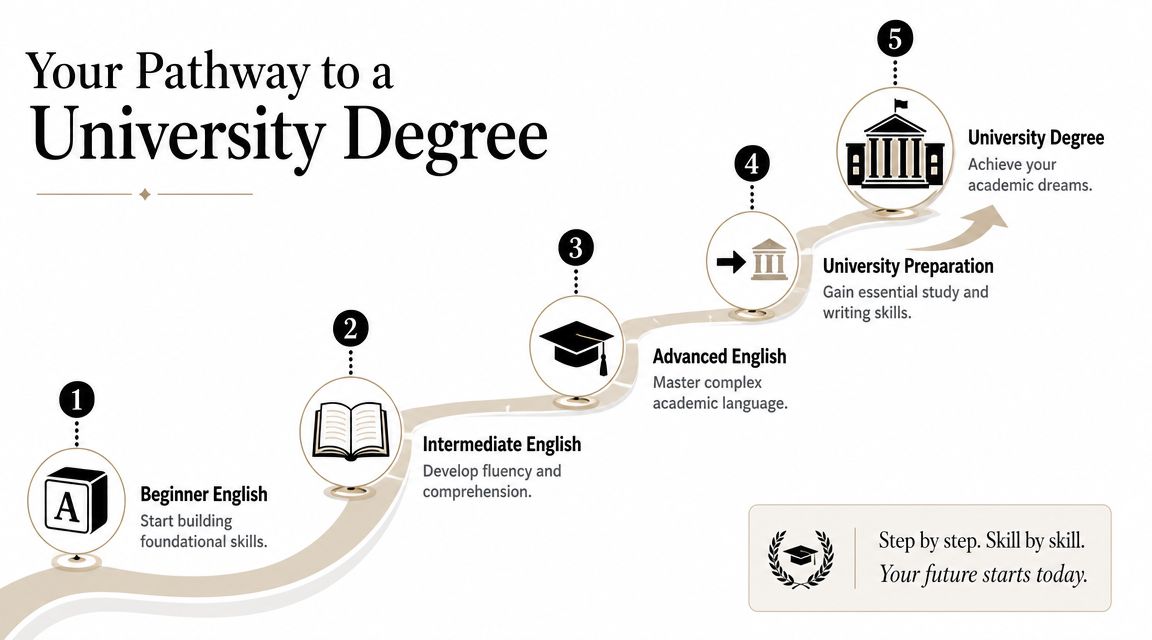
A simple progression route
Here's the pathway in plain English:
Beginner English
You build the basics. Reading, writing, speaking, and listening start to feel manageable.Functional Skills English
This gives you a recognised foundation and proves you can use English in practical situations.GCSE English
This is a bigger qualification and often opens more doors for jobs and higher study.Access to Higher Education or A Levels
These prepare you for university-level study.University
You apply with the qualifications you've built step by step.
That route is real. Adults use it every year.
If university is your long-term goal, it helps to read a clear guide on how to get into universities so you can see how each stage fits together.
Stop thinking in terms of forever
One reason adults give up before they start is that they look too far ahead.
They think, “I could never do a degree.” Maybe not this month. That's fine. You don't need to do a degree this month. You need to pass the next step in front of you.
Clarity beats confidence at the beginning. When you know the next step, you can take it even if you feel nervous.
A beginner course is not the end of the story. It's the first page.
And once you complete one level, your mind changes. The goal stops feeling like fantasy. It starts feeling like a plan.
How to Choose the Right Course for Your Life
A course can look good on a website and still be completely wrong for your life.
Many adults waste time by choosing based on price, promises, or convenience alone. Then the course doesn't fit around work, children, stress, or low confidence, and they blame themselves.
Don't do that. Choose for real life.
Support matters more than hype
For adult learners, success often depends on support, not just content. UK-focused beginner guidance highlights that the best courses for adults balancing work and family are those with structured support, pacing, and assessment preparation, because sticking with the course is often harder than starting it.
That's exactly right.
A beginner does not need a mountain of content. A beginner needs a course that keeps them moving, corrects mistakes, and helps them recover after a bad week.
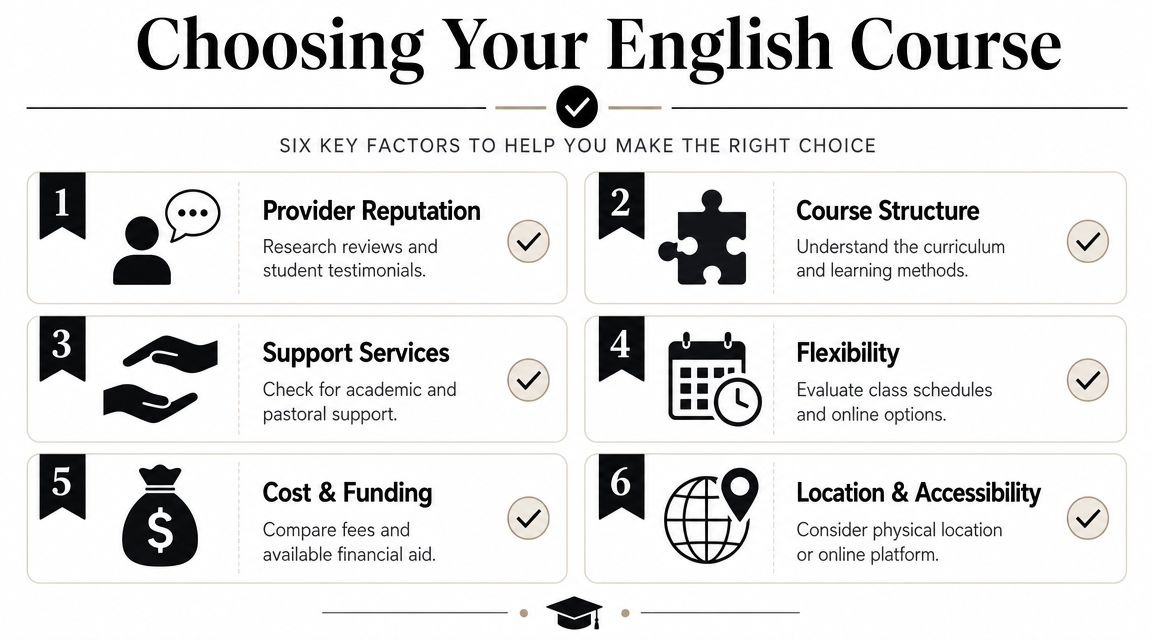
Use this checklist before you enrol
Ask these questions before choosing any provider:
- Is the qualification recognised? Casual practice is fine as a bonus, but your main course should lead to something useful in the UK.
- Can I study around work and family? If the timetable is too rigid, many adults won't last.
- Will I get real feedback? You need correction on writing, speaking, and task work.
- Is there help when motivation drops? Low confidence is common. Good providers expect that and support it.
- Does the course prepare me for assessment? You need to know what success looks like, not just watch lessons.
- Is the learning structured clearly? Beginners need order. Random lessons create confusion.
Red flags you should take seriously
Some providers sell hope without giving enough support. Be careful if you see any of these:
- No clear progression: If they can't explain what comes after the course, the route may be weak.
- Too much independence: Self-paced is helpful, but total isolation is not.
- Lots of marketing, little detail: If everything sounds exciting but nothing sounds specific, pause.
- No mention of feedback or assessment: That usually means poor preparation.
A good course should feel organised, calm, and human. Not noisy.
Choose the course you can actually finish
This is my strongest advice. Don't choose the course that sounds most impressive. Choose the one you can realistically complete.
That means the right level, proper support, manageable pacing, and a qualification that moves your life forward. Adults often do best when a course respects the fact that they are juggling several responsibilities at once.
Finishing changes confidence. Finishing leads to the next step. Finishing is what turns good intentions into a better future.
Affording Your Studies and Finding Support
Money worries stop many good people before they even ask what's possible. That's a mistake.
You do not need to assume that study is out of reach. Some providers offer payment options, and some adult learners may be able to explore funding routes depending on the course and their circumstances. The smart move is to ask early, not rule yourself out in your own head.

Don't only ask what it costs
Ask what it gives you in return.
A recognised course can lead to the next qualification. That next qualification can lead to better work, further study, and more confidence dealing with the world. Cheap courses that go nowhere can cost you more in the long run because they waste your time and leave you in the same place.
The UK's English national curriculum became statutory in 2014, and it sets clear benchmarks for literacy in maintained schools. Understanding those national curriculum benchmarks for English helps adult learners see what qualifications such as GCSE English represent in the wider system. In simple terms, there is a clear standard, and you can work towards it.
If you want flexible options that fit adult life, it helps to compare adult education courses online and ask direct questions about support, assessment, and payment.
The right college does not leave you alone
Support should be built in from the start.
You may need academic help. You may also need someone to notice when you're slipping, overwhelmed, or close to quitting. Both matter. Adults don't usually fail because they are incapable. They struggle because life gets messy and nobody helps them get back on track.
Good support can include:
- Academic guidance: Help with reading, writing, assignments, and exam preparation.
- Pastoral support: Encouragement, check-ins, and someone to talk to when confidence drops.
- Clear study structure: Small steps, deadlines, and realistic pacing.
- Assessment preparation: Practice that matches the level you're working towards.
This short video is useful if you're thinking about what adult study support can look like in practice.
You are allowed to need help
Some adults feel they should be able to handle everything on their own. That belief causes a lot of unnecessary suffering.
Needing support doesn't mean you're weak. It means you're learning properly.
The strongest choice you can make is to stop pretending you have to do this alone. Ask about funding. Ask about flexibility. Ask who will help if you get stuck. Serious providers will answer those questions clearly.
Your New Chapter Can Start Today
You don't need perfect confidence to begin. You need a decision.
If you've been searching for English courses for beginners, take that seriously. It means part of you is ready. Ready to stop putting yourself last. Ready to build skills that help at home, at work, and in your long-term future. Ready to become the person your children can point to with pride.
Choose the route that leads somewhere real. Choose support, not just content. Choose a course that fits your life, not an ideal life you don't have.
One course can become one qualification. One qualification can become the next. That is how adults change everything.
Start small if you need to. Just don't stay stuck.
If you want a flexible, fully supported route into recognised qualifications, explore the courses at Next Level Online College. You can start by speaking to an advisor, asking questions, and finding the right level for where you are now.