
You might be reading this after work, after the school run, or late at night when the house is finally quiet. Part of you wants something better. You want a career that feels steady, respected and meaningful. You want to prove to yourself, and maybe to your children too, that it's not too late to learn, qualify and build a future you feel proud of.
At the same time, it's normal to feel unsure. Many adult learners worry they've been out of education too long. They wonder if online study will be too hard, whether they're “academic enough”, or if a real healthcare career can begin from a laptop at the kitchen table.
It can.
The key is understanding what dental nurse training online really means in the UK. It isn't a shortcut or a vague internet course. It's a structured route into a recognised profession, with online study for the theory and supervised practice in a dental setting for the hands-on skills.
That honest detail matters. Once you see how the parts fit together, the path starts to look much more manageable.
Your Dream of a New Career Starts Here
A lot of adult learners arrive at this point carrying old doubts. Maybe school didn't go well the first time. Maybe life got busy. Maybe money, family responsibilities or confidence knocked education to the bottom of the list for years.
That doesn't mean your chance has gone.
Some of the strongest learners are adults who know why they're studying now. They're not doing it because someone told them to. They're doing it because they want more security, more pride, and a better example to set at home. If that sounds like you, your reasons are powerful.

Why this path feels possible for busy adults
Dental nursing appeals to many career changers because it offers a real profession with a clear route in. You don't need to guess your next step for years. You can move forward in an organised way, learning theory online while building practical experience in a dental practice.
That matters when you're trying to fit study around children, work shifts or caring responsibilities.
If you're also rebuilding your confidence in learning, it can help to look at wider adult education courses online so you can see that returning to study is something many adults do successfully. You are not behind. You are starting from where you are now.
You don't need to feel fearless before you begin. You need a route that makes sense and support that helps you keep going.
What readers often get wrong at the start
Many people search for dental nurse training online hoping the whole journey can happen remotely. That's the part that causes confusion. The online part is real and important, but it sits alongside practical training in a real dental setting.
That isn't bad news. It's in fact what gives the qualification value.
It means when you finish, you won't just have read about the job. You'll have practised it, been guided through it, and built evidence that you can do it safely and confidently. For an adult learner who wants a proper career change, that's a strong foundation.
More Than a Job A Chance to Make a Real Difference
Dental nursing is about much more than instruments, appointment rooms and clinical routines. It's a people job.
On one day, you might help a worried patient feel calm enough to go ahead with treatment. On another, you might support a child through their first visit and help shape a better attitude to dental care for years to come. You become part of the reason a patient feels safe, listened to and looked after.
The human side of the role
A dental nurse is a key part of the team. Dentists rely on trained support in surgery. Patients notice the person who explains things clearly, stays calm and treats them with kindness. Practices need people who are organised, professional and ready to help things run smoothly.
That mix of care and skill is one reason the role feels worthwhile.
For many adult learners, this is very important. They don't just want any job. They want work that has purpose. They want to go home knowing they helped someone, solved a problem, or made a difficult appointment easier.
Why this career can change how you see yourself
When your confidence has taken a knock, a respected healthcare role can do more than improve your income. It can change your identity.
You stop seeing yourself as someone who “missed their chance”. You start seeing yourself as someone who trained, qualified and joined a professional field. Your children see that too. They see revision notes on the table, early mornings, persistence, and a parent who kept going.
That example lasts.
- You become a calm presence: Patients often arrive nervous, embarrassed or uncomfortable. Your reassurance matters.
- You join a proper professional team: You're not on the edge of healthcare. You're part of it.
- You build a future with progression: This isn't just about the first job. It can be the first step in a longer career.
Practical rule: If you want work that combines caring for people with structured training and a recognised qualification, dental nursing is a strong option to explore.
There's also dignity in doing skilled work well. Setting up correctly, supporting treatment safely, communicating clearly and staying organised may sound simple on paper, but in practice they are valuable professional strengths. Many adults already have these qualities from parenting, customer service, care work or office jobs. Training helps you turn those strengths into a recognised healthcare career.
How Your Online and Practical Training Work Together
The easiest way to understand dental nurse training online is to compare it to learning to drive. You can study the Highway Code and road signs from home, but at some point you still need to get into the car with an instructor and show that you can do the job safely.
Dental nursing works in a similar way.
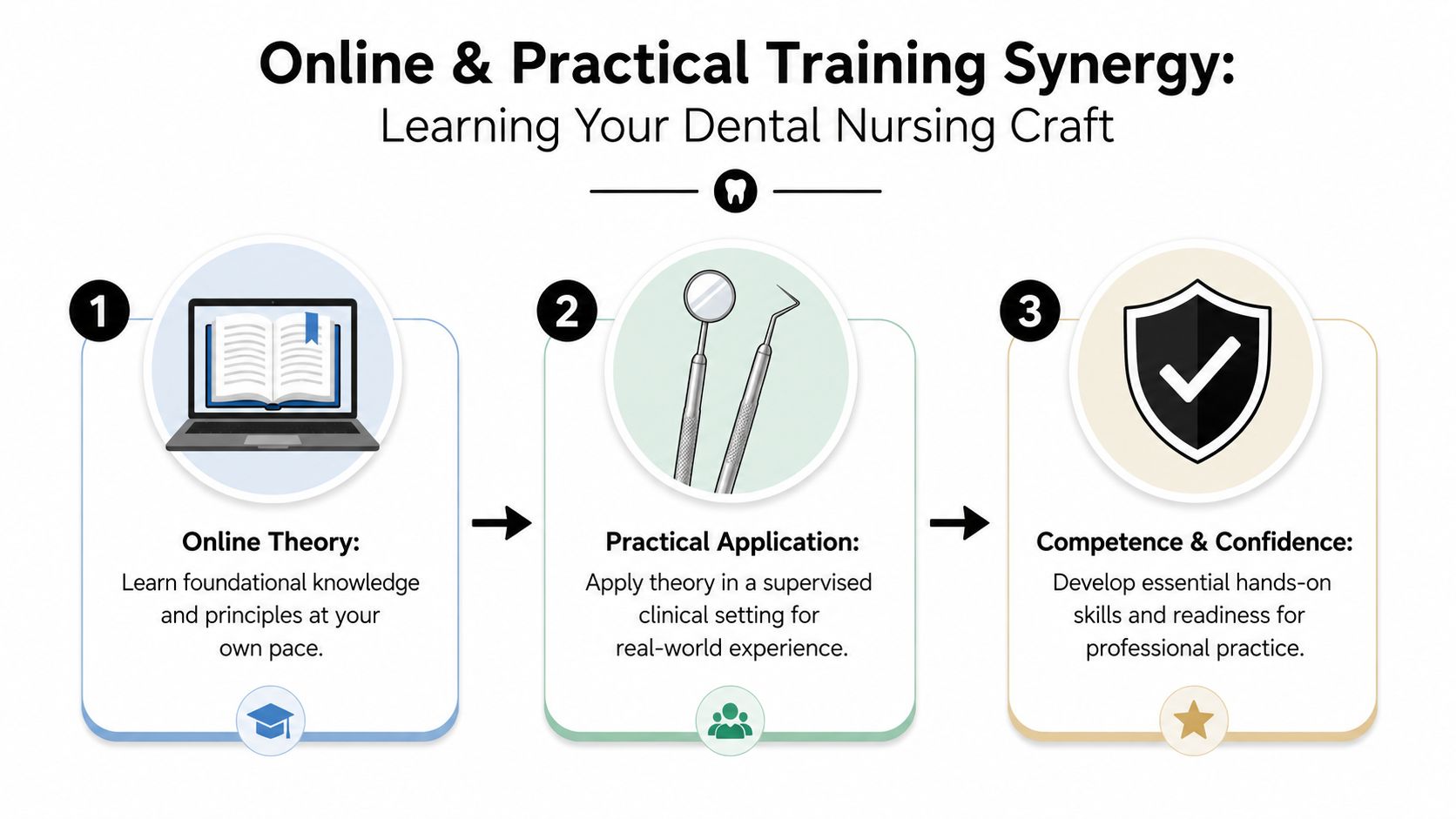
The online side helps you learn the knowledge. The practical side helps you prove that you can use that knowledge in a real clinical setting. In the UK, recognised dental nurse training is structured as a Level 3 qualification, and the NEBDN says learners typically take 12 to 24 months to complete training, including a workplace portfolio before final assessments, as outlined in the NEBDN qualifications overview.
What you study online
Online learning usually covers the theory that supports safe practice. That can include topics like infection control, dental anatomy, patient care, cross-infection procedures, record keeping and professional standards.
The big advantage is flexibility. You can study in the evening, early morning or weekends, depending on how your life works. For many adults, that flexibility is the difference between “I'd love to” and “I can do this”.
If you're checking whether a course is properly recognised, it helps to understand the basics of accreditation for online courses. In a regulated career, recognition matters.
What happens in the dental practice
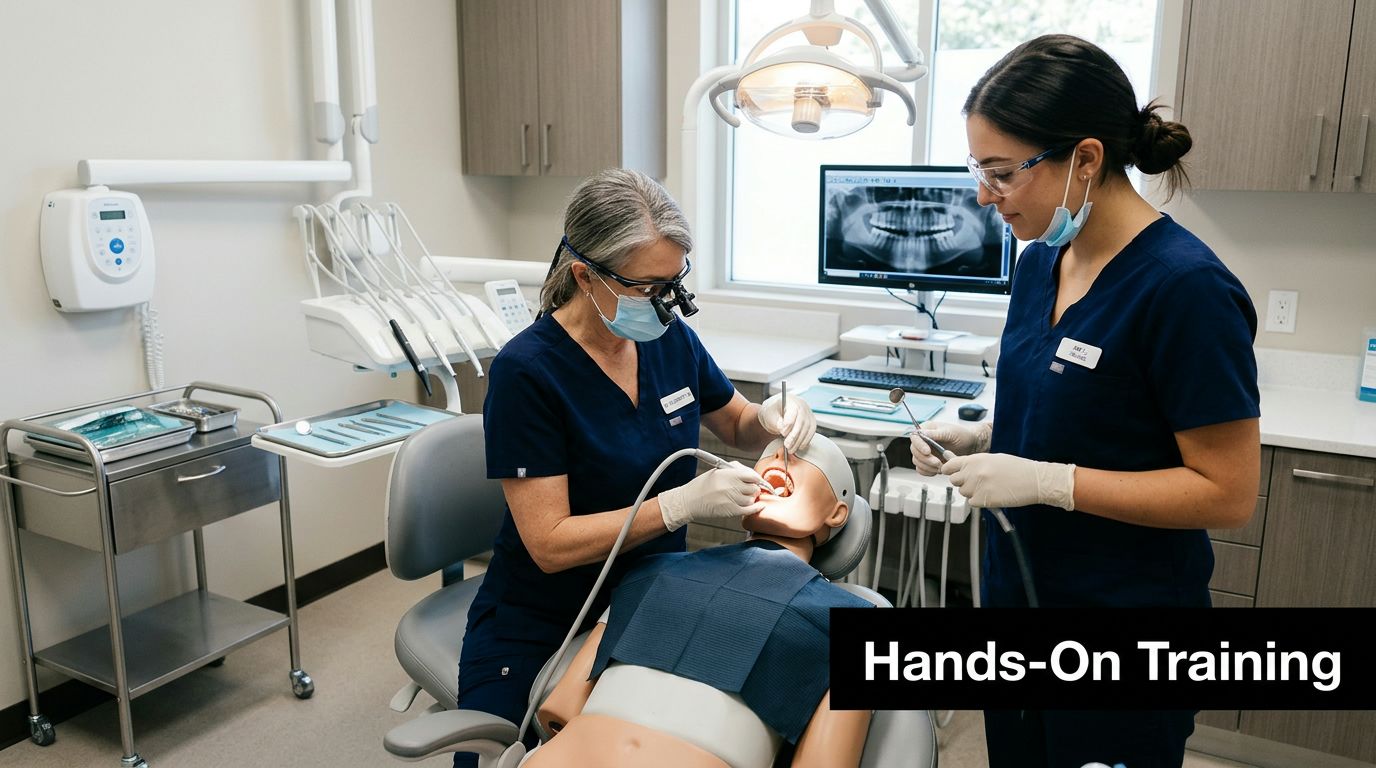
The practical side is where your confidence grows fastest. You watch, assist, ask questions and gradually carry out tasks under supervision. Over time, the words you learned online start to make sense in real life.
You also build a portfolio of competence evidence from the workplace. Think of this as a record of your growing ability. It shows that trained professionals have seen you perform key tasks to the required standard.
Here's the blended model in simple terms:
- Study the theory online so you understand the principles behind safe dental care.
- Work in a supervised dental setting where you apply that learning with real patients and a real team.
- Complete your portfolio and assessments to show you're ready for final exams and professional practice.
Online study gives you flexibility. Workplace practice gives you proof. You need both for a qualification that leads to professional readiness.
This is why online training for dental nursing shouldn't be dismissed as “just an online course”. It's better understood as a flexible route into a hands-on profession.
The Official Qualifications That Build Your Future
A recognised qualification is the part that turns hope into a real career plan.
If you are coming back to study after years away, it is easy to worry about choosing the wrong course or wasting money on something employers will not respect. That concern is sensible. In dental nursing, the goal is not any certificate. The goal is a regulator-approved route that leads to a genuine professional qualification in the UK.
For many learners, that route is a Level 3 dental nursing qualification, often the NEBDN National Diploma in Dental Nursing. The title matters because it helps you tell the difference between an informal online course and training that leads to a recognised outcome. This is a common point of confusion for career changers. “Online” describes how much of the theory is taught. It does not mean the qualification is less real.
That distinction can lift a huge weight off your shoulders.
A good course is built like a bridge. One side is your online study at home. The other side is your supervised learning and assessment in practice. The qualification joins those two parts together so you can progress from beginner to competent trainee, then from trainee to qualified dental nurse.
What a recognised course usually includes
A proper course should show you the full route from enrolment to qualification, not just sell you access to lessons.
| Component | What It Is | How It Works |
|---|---|---|
| Qualification | A regulated Level 3 dental nursing course | You work towards a recognised professional outcome |
| Online learning | The theory side of training | You complete guided study at home around work and family commitments |
| Workplace training | Supervised practice in a dental setting | You build day-to-day skills with support from experienced staff |
| Portfolio | Evidence of your competence | You record practical tasks and observations that are checked in the workplace |
| Final assessment | External exams and practical assessment | You complete the assessment process needed to qualify |
If a course page talks only about flexibility, but says very little about supervised practice, portfolio work, or final assessment, pause and ask more questions. Adult learners do best when the path is clear. You should be able to see where you are starting, what you must complete, and what qualification you will hold at the end.
The costs to plan for
Money worries are real, especially when your studies affect the whole household. A training plan feels much more manageable when the costs are clear from the start.
One UK provider advertising NEBDN-accredited online training lists a total course fee of £1,790 plus an examination fee of £545 for the final Objective Structured Clinical Examination (OSCE), with workplace support during training, as shown on the School of Dental Nursing course information page.
Fees vary between providers, so the useful habit is to ask direct, practical questions before you enrol.
- What is included in the course fee? Check for learning materials, tutor support, mock exams, administration, and guidance for workplace evidence.
- What costs are separate? Exam fees are often charged apart from tuition.
- What help do I get with practical requirements? You need to understand how the provider supports your portfolio and assessments.
Clear answers now can prevent stress later.
What if you do not have the GCSEs you think you need
This is one of the biggest reasons adults hold back. They assume one missing qualification means the whole dream is out of reach.
In reality, entry requirements often work more like a checklist than a verdict on your ability. Some providers prefer GCSEs. Others accept equivalent qualifications or allow you to strengthen your foundations first. If you need to build those core skills, Functional Skills Level 2 maths and English can be a practical stepping stone.
Key point: A missing qualification today does not have to end the journey. It may mean taking the next step in the right order.
That matters for your confidence as much as your application. You do not need a perfect academic past to build a respected future. You need a clear route, honest information, and the willingness to keep going one stage at a time.
For many adult learners, that is how a new career begins. Not with certainty, but with a decision to back yourself.
Securing Your All-Important In-Practice Training
For many learners, this is the part that feels most daunting. Finding a dental practice can sound like a big obstacle, especially if you're new to the field and don't know anyone in dentistry.
But this step is not a barrier put there to make life difficult. It's the part that turns study into a profession.
Some UK course pages stress that trainees must work in a dental practice and complete guided learning, portfolios and exams before qualifying. That's why the best question isn't “Can I do it entirely online?” but “How do I secure the practice experience I need?” This point is explained clearly by a UK training provider in its guidance on dental nursing routes and practical requirements.
Why the placement matters so much
A dental practice is where you learn the rhythm of the job. You see how appointments run, how patients are greeted, how surgery rooms are prepared and how the team communicates under pressure.
You also gather the workplace evidence needed for your portfolio. Without that supervised setting, you can't build the practical proof required for progression.
Ways to improve your chances
You don't need years of experience to approach a practice well. You need preparation, honesty and a professional attitude.
- Contact local practices directly: Ask whether they take trainee dental nurses or can offer work-based experience linked to training.
- Show that you understand the route: Explain that you know training is blended, with online study and supervised practice.
- Present yourself as reliable: Practices value punctuality, care, kindness and willingness to learn.
- Keep your message simple: A short email and a polite phone call can be enough to start a conversation.
- Be ready for a slower start: Some learners need to contact several practices before finding the right fit.
What to say when you reach out
A good first message doesn't need fancy wording. It needs clarity.
You could say that you're planning to begin recognised dental nurse training online, understand that supervised practice is essential, and are looking for an opportunity to train within a dental setting. Mention any strengths you already have, such as customer service, care experience, administration, communication or calmness under pressure.
Practices don't expect a finished professional. They're looking for someone who is serious, teachable and dependable.
It also helps to remember that this stage is the beginning of your career, not an awkward extra task. The practice where you train may become the place where you grow, qualify and build your confidence. Many adult learners discover that once they take the first brave step and start asking, the process feels far less mysterious than they feared.
From Trainee to Qualified Professional Your Career Path
You can picture this moment clearly. A year or so from now, you walk into the practice not as the nervous new starter who is still learning the language of dentistry, but as a qualified professional who knows your role, supports patients with confidence and has earned your place there.
That change matters. It means the study hours, the practical training and the days when you wondered if you were too rusty to learn again were all building towards something recognised and real.
Recent UK reporting from the British Dental Association on dental workforce pressures shows that staffing challenges remain a serious issue in dentistry. For you, that means this qualification connects to a genuine need in the UK, not a vague hope that a job might appear at the end.
What the path looks like after training
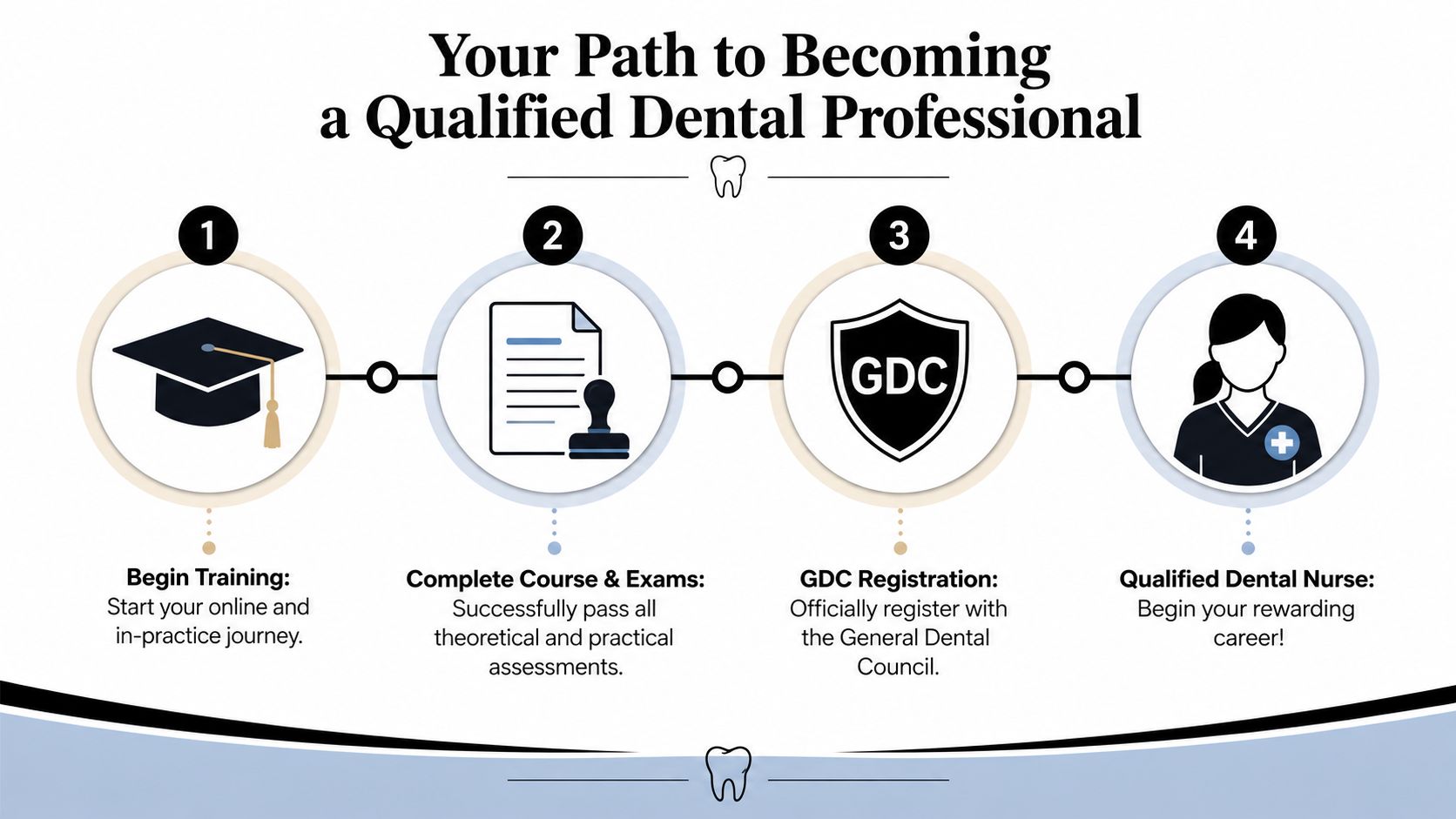
The route becomes much less intimidating once you see it as a sequence of stages. Like learning to drive, you do not begin as a finished professional. You learn the rules, practise under supervision, prove that you can do the job safely, and then gain formal recognition.
A typical path looks like this:
- Begin as a trainee dental nurse while studying the theory online and building skills in practice.
- Complete your course work and assessments so your knowledge and practical ability can be checked properly.
- Finish the approved qualification requirements for your training route.
- Apply for professional registration through the correct process for qualified dental nurses in the UK.
- Start work as a qualified dental nurse with a regulator-approved qualification behind you.
That last point is often the one career changers worry about most. Online dental nurse training does not mean a lesser qualification. The online part covers the theory. The practical part happens in a real dental setting. Together, they lead to a recognised outcome that employers understand and respect.
Why this can become a lasting career
Qualification is not the end of the story. It is the point where your options begin to widen.
Some dental nurses build happy, steady careers in general practice and take pride in becoming the calm, capable person patients rely on. Others go on to study areas such as oral health education, radiography, orthodontics or practice leadership. The foundation is the same. Once you are properly trained, you have something solid to build on.
This is one reason adult learners often thrive. You are more likely to see the bigger picture. Better pay matters. Stability matters. Being able to tell your children, partner or family, “I went back, I trained, and I qualified,” matters too.
A professional qualification does more than change your job title. It can change how you see yourself and what your family believes is possible.
If you feel nervous about whether you can really reach that point, that is normal. Many people feel exactly that way at the start. The important thing is that this path is manageable because it happens step by step. You do not need to become confident all at once. You need to keep going long enough for training, practice and experience to turn you into the professional you hoped you could become.
Your Questions Answered About Dental Nurse Training
Can I really do this if I haven't studied in years
Yes. A lot of adult learners start this journey after years spent working, raising children, caring for family, or putting their own plans on hold.
The first hurdle is usually confidence, not ability. Studying again can feel strange at the start, a bit like using a muscle you have not used for a while. It feels stiff before it feels strong. Once you get into a routine and understand what your course expects from you, that lost confidence often starts to come back.
You do not need to feel ready for the whole year. You only need to be ready for the first step.
Do I need GCSEs to begin
Sometimes yes, sometimes no. Entry requirements vary between providers, and some will accept equivalent qualifications or offer a way to build missing skills first.
If you are worried about this, ask direct questions before you apply. Ask what qualifications they accept, whether they consider alternatives, and what support is available if your English or maths needs work. Adult learners often assume one missing certificate has closed the door. Very often, it has not.
Can I do the whole course from home
The theory can be studied online, but the full training route also includes learning in a real dental practice.
That point matters because it clears up one of the biggest misunderstandings for career changers. “Online” does not mean a made-up qualification or a shortcut. It means the classroom side is flexible, while the practical side happens where dental nursing is done. You learn the knowledge at home, then apply it with real patients, real equipment, and a real team.
That blend is what turns study into a profession.
What if I struggle with the coursework
That fear is common, especially if school was not a happy experience for you.
Start small. Read one page. Write down the main idea in your own words. Study little and often rather than waiting for a perfect free afternoon that may never appear. Short, steady sessions usually work better for busy adults than long bursts of last-minute revision.
It also helps to remember what you already bring with you:
- Life discipline: You know how to keep going even when you feel tired.
- Responsibility: Other people already rely on you.
- Purpose: You are not studying for the sake of it. You want a better future.
- People skills: Patience, warmth, and calm matter in dental settings.
Those are not small advantages. They are part of what can make adult learners very good dental nurses.
Am I too old to start over
No. Patients do not need the youngest person in the room. They need someone calm, kind, observant, and professional.
Age can bring exactly that. If you have spent years dealing with pressure, caring for others, solving problems, and showing up on difficult days, you already have qualities that transfer well into practice. Many employers value maturity because it often comes with steadiness and good judgement.
Starting later does not mean you missed your chance. It can mean you are choosing your future with more purpose.
How do I get the work placement I need
This is often the question that worries people most, and it deserves an honest answer. You may need to be proactive.
Some learners begin by contacting local dental practices and asking whether they take trainee dental nurses. Others start in a reception or support role and then move into training once they are inside the practice. It helps to prepare a simple CV, explain clearly that you are training, and show that you understand the role includes both study and hands-on learning.
If this part feels intimidating, break it down. Make a shortlist of practices. Call or email a few each week. Follow up politely. One conversation can open the door to the placement that makes the whole qualification possible.
Is dental nurse training online worth it
It can be a very good route if it fits your life and leads to a recognised qualification through both theory study and in-practice learning.
For many adults, the primary value is flexibility with purpose. You are not studying randomly and hoping it leads somewhere. You are working towards a role with clear responsibilities, respected training, and the chance to improve your income and stability. For parents especially, that can mean more than a new job title. It can mean becoming the person your children watch when they learn what persistence looks like.
A better future often starts in ordinary moments. An application sent after dinner. Notes taken at the kitchen table. A quiet decision to try.
If you're ready to rebuild your confidence through learning, Next Level Online College offers flexible online study designed for adults balancing work, family and everyday life. Whether you need to strengthen your English and maths, prepare for further study, or take the next step towards a new career, it's a supportive place to start turning hope into action.