
Some adults carry the same quiet worry for years. You want a better job, a promotion, an apprenticeship, or even university, but one missing maths or English qualification keeps getting in the way.
That can feel heavy. It can make you think you left it too late, or that education is for other people.
It isn't.
Plenty of adults come back to learning after work, raising children, and dealing with real life. They're not starting from nothing. They're starting with determination, life experience, and a reason that matters. Often that reason is family. You want your children to see you trying. You want to feel proud when you say, “I did it.” You want doors to open instead of closing in front of you.
If you've been searching for the Functional Skills Level 2 equivalent, you're asking exactly the right question. You don't just want a label. You want to know what it means for your future, where it's accepted, and whether it's the right route for your goal.
Your Fresh Start Begins with Understanding Your Options
A lot of adult learners sit at the kitchen table late at night with the same thought. “I know I can do more, but I'm stuck because I don't have the right qualification.”
Maybe you've seen a job you could do well, but the advert asked for maths or English at Level 2. Maybe you've looked at an apprenticeship, or a college course, or a university page, and felt confused by all the different terms. GCSEs. Functional Skills. Level 2. Equivalency. It can seem like a system built for people who already understand it.
It doesn't have to stay confusing.
A Functional Skills Level 2 qualification is not an informal badge or something that only “sort of counts”. The government's qualification levels guidance places Level 2 alongside GCSE grades 9 to 4 and other recognised Level 2 qualifications. That means it is an official qualification used for progression into further study, apprenticeships, and many jobs.
Why this matters to real people
Think about a parent who wants to move into a more secure role. They may already be organised, reliable, and good with customers, but an employer still asks for a recognised maths or English qualification. Functional Skills Level 2 can be the step that turns “almost there” into “eligible to apply”.
For some people, this qualification is about earning more. For others, it's about becoming a role model at home. Children notice when a parent keeps going. They notice effort. They notice courage.
You don't need a perfect school past to build a strong future.
A qualification can change what feels possible
When adults return to education, they often bring something younger learners don't always have. Purpose. You know why you're doing this. You know what's at stake.
That makes a difference.
If your goal is a better career, more confidence, or a route into further study, understanding your options is the first win. Once the system starts to make sense, the next step becomes much easier to take.
What a Functional Skills Level 2 Qualification Really Means
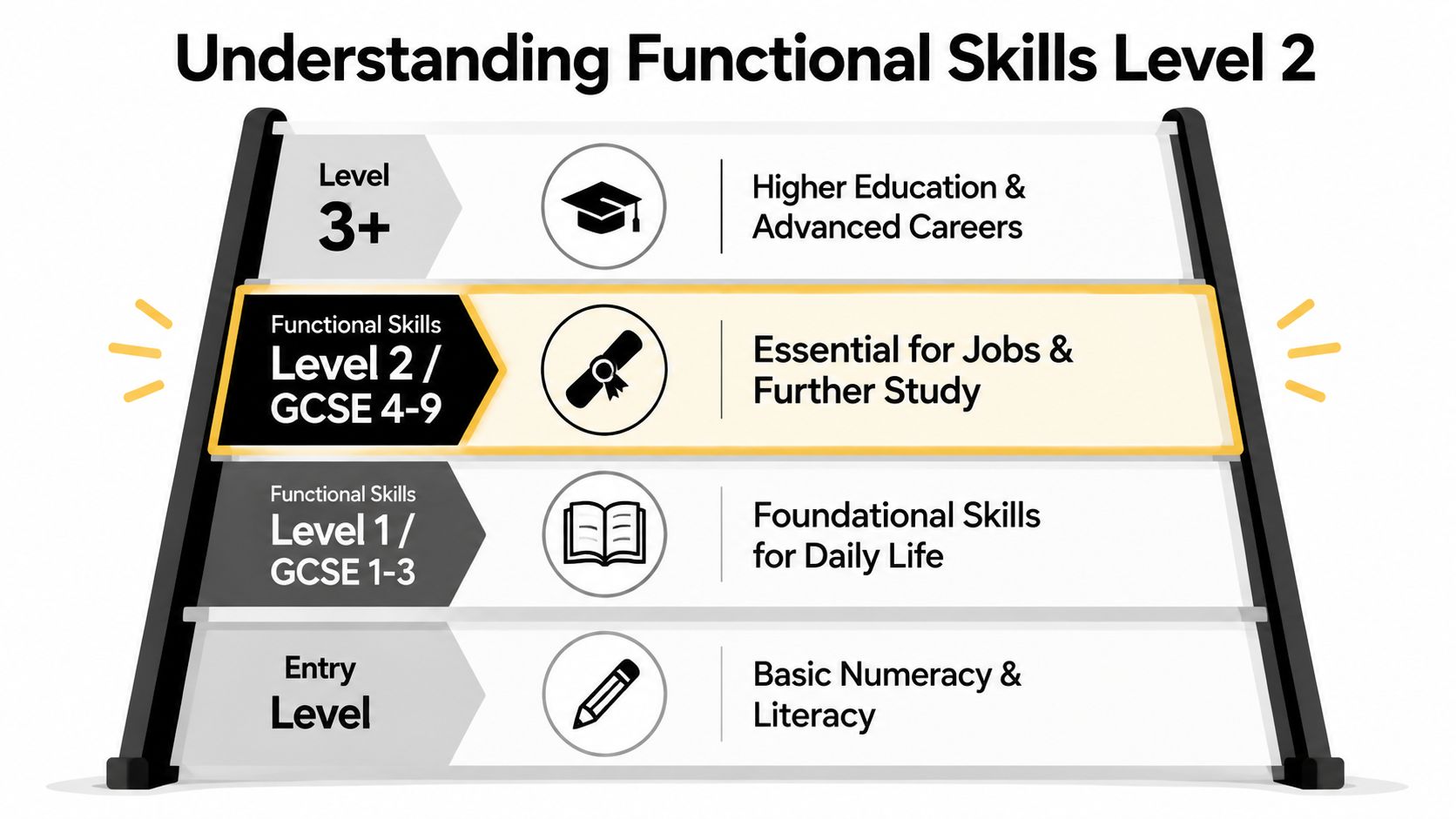
Think of qualifications like steps on a ladder. Entry Level is the starting point. Above that is Level 1. Then comes Level 2, which is the step many employers, colleges, and training providers look for when they ask for a solid standard in maths or English.
That's why the phrase Functional Skills Level 2 equivalent matters so much. People want to know what this step matches in plain terms.
The simple answer
Functional Skills Level 2 is formally treated as equivalent to GCSE grade 4 in England.
Pearson states this in its Functional Skills results guidance. That's a key reason so many adults choose this route when they need a recognised qualification for work or further study.
If you've seen people mention the old grade C, that's because GCSE grading changed in England. Grade 4 is the modern standard pass.
What it tests in real life
Functional Skills isn't built around broad academic study in the same way as a full GCSE. It focuses more on the skills people use in life and work.
In maths, Level 2 includes working confidently with:
- Whole numbers
- Fractions
- Decimals
- Percentages
- Ratios
- Percentage change
- Calculations with numbers up to one million
That's one reason this qualification carries real weight. It isn't a watered-down option. It's a practical standard that shows you can use maths in meaningful situations.
For English, the same idea applies. The focus is on communication you can use. Reading clearly. Writing accurately. Understanding information. Expressing yourself in a way that works in everyday life, training, and employment.
Why adults often choose it
Many adults don't need to go back and study a whole school-style programme if their real aim is to meet an entry requirement and move forward. They need a qualification that is recognised, useful, and achievable around the rest of life.
That's why many learners look at Functional Skills Level 2 maths and English courses when they want a direct route to a qualification they can use.
Helpful way to think about it: GCSEs often go wider. Functional Skills goes straight to the core skills you need to show.
If you've been doubting whether this “counts”, it does. The question isn't whether it matters. The question is whether it fits your goal.
Functional Skills vs GCSEs A Friendly Comparison
Functional Skills and GCSEs are both respected qualifications. The better choice depends on what you need, how you learn, and where you want to go next.
For adult learners, the difference often comes down to style. One route feels more practical and direct. The other is broader and more academic.
Functional Skills Level 2 vs GCSE At a Glance
| Feature | Functional Skills Level 2 | GCSE |
|---|---|---|
| Level | Level 2 qualification | Level 2 qualification when achieved at the standard pass level |
| How results are given | Pass or fail | Graded on a 9 to 1 scale |
| Main focus | Applied English or maths for everyday life and work | Broader academic subject study |
| Assessment feel | More focused on practical task performance | More focused on full subject coverage |
| Flexibility | Often available year-round | Usually linked to fixed exam periods |
| Best fit for many adults | People who need a recognised qualification for progression | People who need a GCSE specifically |
The pass or fail point matters more than many people realise. The government's Functional Skills maths subject content guidance sets out Functional Skills as a pass/fail qualification, while GCSEs use the 9 to 1 grading scale.
Why that difference can feel easier to manage
Some adults feel nervous about going back into education because school exams knocked their confidence. A pass/fail result can feel clearer and less intimidating when your goal is simple. You need the qualification. You need the door to open. You don't need a spread of grades.
That doesn't mean Functional Skills is “easy”. It means the qualification is designed differently.
The content feels different too
GCSEs cover a wider curriculum. That can be the right path if you need a GCSE specifically or if your next step asks for a certain GCSE grade.
Functional Skills is more focused. It aims at using core skills in realistic situations. That's why many adults who are balancing work, parenting, and other responsibilities find it a better fit for their lives.
You can see a fuller explanation of the comparison in this guide to Functional Skills equivalent to GCSE.
What about other Level 2 qualifications
You may also see qualifications such as NVQs, diplomas, or certificates at Level 2. These can also sit on the same national level, but they don't all serve the same purpose.
If your barrier is specifically an English or maths entry requirement, Functional Skills Level 2 is the qualification people usually mean when they ask for a GCSE-equivalent threshold in those subjects.
A practical rule: Choose the qualification that matches the exact rule written in the entry requirements, not the one that merely sounds similar.
That one habit can save you time, money, and disappointment.
Where Your Level 2 Qualification Can Take You
This is the question many individuals care about most. Not “What is it?” but “Will it get me where I want to go?”
In many cases, yes. But you need to match the qualification to the destination.
For jobs and career progress
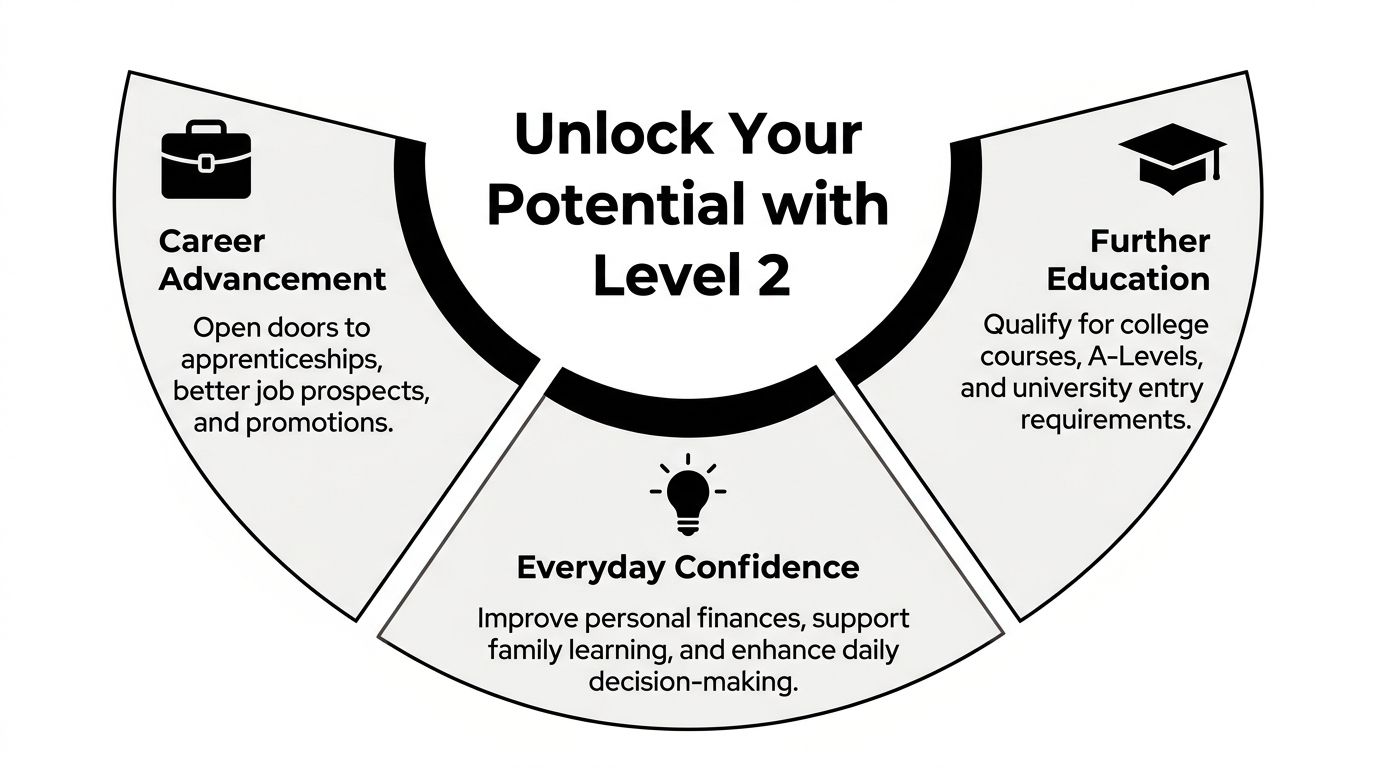
Functional Skills Level 2 is widely used as a recognised benchmark for adults who need English or maths for employment. Because it is a formal Level 2 qualification on the national framework, employers can use it as evidence that you've reached an accepted standard.
That matters if you're applying for a new role, trying to meet a promotion requirement, or moving into a field that asks for a Level 2 qualification in English or maths.
In simple terms, it can help turn your experience into something that ticks the box on paper.
For apprenticeships and training
Many learners use Functional Skills Level 2 to meet entry requirements for vocational training and apprenticeships. It works well for adults who want a recognised qualification without returning to a full school-style route.
There's also a practical advantage. Functional Skills is often described as a more flexible route for adults because it can fit around work and family life more easily than a full GCSE programme.
For university and higher education
You need to be careful and specific. Some universities and courses accept Functional Skills Level 2. Some don't. Acceptance can vary by course and institution.
Prospects explains this clearly in its guide to Functional Skills qualifications and progression routes. It notes that Level 2 is broadly equivalent to GCSE grade 4 to 9, but acceptance for university entry depends on the provider and the course requirements.
That means two things can be true at once:
- Functional Skills Level 2 can support university entry
- A particular course may still ask for GCSEs
Many adults often get caught out here. They hear “equivalent” and assume “accepted everywhere”. Those are not the same thing.
Check the exact course page. If it says “GCSE required”, take that seriously. If it says “GCSE or equivalent accepted”, Functional Skills Level 2 may be suitable.
The safest way to decide
Use this quick check before you enrol:
Name the goal clearly
Job, apprenticeship, Access to HE, university, or promotion.Read the exact entry requirement
Look for the words GCSE, Level 2, Functional Skills, or equivalent.Ask if you're unsure
Contact the employer, university, or training provider directly and keep their reply.
That last step is powerful. It replaces guesswork with certainty.
Choosing the Right Path for You and Your Family
Some choices become easier when you stop asking, “Which qualification is best?” and start asking, “Which qualification is right for my goal?”
That shift matters. It turns confusion into a plan.

If this sounds like you
If you need a recognised maths or English qualification for work, an apprenticeship, or a course that accepts Level 2 equivalents, Functional Skills may be the right route.
If you need a qualification sooner rather than later, Functional Skills can also suit adult life well. National Numeracy explains that Functional Skills can often be completed faster than a full GCSE programme and exams are commonly available year-round. That flexibility is a big reason many adults choose it.
If a university or profession asks for a specific GCSE grade, then a GCSE may be the better route for you.
A simple decision guide
You need a quick, recognised route for work or training
Functional Skills is often a strong fit.You want practical learning linked to daily life and work
Functional Skills usually feels more relevant.Your chosen course says “GCSE only” or asks for a specific GCSE grade
GCSE is the safer option.You're returning to study after a long break and want to rebuild confidence first
Functional Skills can be a good stepping stone.
Think about the life you're building
This decision isn't only about an exam. It's about what comes after it.
A qualification can help you move into work that feels more secure and more satisfying. It can help you support your children with homework and show them that learning doesn't stop when school ends. It can change how you see yourself.
The right path is the one that gets you to your goal without asking you to carry extra weight you don't need.
You don't have to prove yourself by choosing the hardest route. You need the route that is accepted, realistic, and right for your future.
Your Next Step to a Brighter Future with Next Level
You don't need to stay stuck in the place you're in now. If missing qualifications have held you back, that can change.
A recognised Level 2 qualification can help you move towards a better job, further study, or a new direction altogether. Just as important, it can help you rebuild trust in yourself. Many adult learners start with low confidence. They finish with proof that they can learn, achieve, and keep going.
That matters at home as much as it does at work. When your children see you studying, showing up, and refusing to give up, they learn something bigger than maths or English. They learn resilience.
If you're ready to take that step, explore Functional Skills English and Maths Level 2 courses at Next Level Online College. The college is built for adult learners who need flexibility, support, and a path that fits around real life.
You don't need all the answers today. You just need one clear next move. A course page. A conversation. A decision to begin.
Small steps can change a life.
If you're ready to move forward, Next Level Online College offers flexible online study designed for adults who are balancing family, work, and big goals. Whether you need Functional Skills to access a job, an apprenticeship, or a route towards university, their team can help you choose the right course and start with confidence.