
You might be reading this after a long shift, after the children are in bed, or during a quiet moment when you're wondering if life could look different a year from now. You want a career that feels stable, respected and worth the effort. You also want something practical. Something that could help you earn better, feel proud of yourself, and show your family what starting again can look like.
That's where finance careers often open a door.
Many adult learners get stuck on one question. What's the difference between accountants and bookkeepers? The words sound similar, and people often use them as if they mean the same thing. They don't. They're closely linked, but they're not identical.
The good news is that this isn't about choosing between a “small” job and a “big” one. It's about choosing the right first step on a ladder. For many people, bookkeeping is the doorway into finance. For others, accountancy is the long-term aim. Both are valuable. Both can lead to work that matters. Both can help you build a future that feels more secure than the one you've had before.
Your Journey into a Rewarding Finance Career
If you've been out of education for a while, finance can sound more intimidating than it really is. Words like ledgers, accounts, tax and compliance can make it feel like you need to be naturally brilliant with numbers before you even begin. You don't.
Many people come into finance because they want a fresh start. They want work that's organised, dependable and respected. They want a role where effort leads somewhere. If that sounds like you, bookkeeping and accountancy are worth understanding properly.
One career ladder with two different starting points
A simple way to think about it is this. Bookkeepers keep the financial records accurate and up to date. Accountants use those records to explain what they mean and what should happen next.
That's the heart of the difference between accountants and bookkeepers.
In real life, someone might start by learning how money moves through a business. They may begin with invoices, receipts, payments and bank checks. Over time, they may grow into analysing reports, supporting tax work, preparing statements and advising on decisions. That journey can be gradual, and that's one reason finance suits adult learners so well.
Starting again doesn't mean starting from nothing. You bring life experience, discipline and determination with you.
For some learners, the bigger dream sits further ahead. It may be university. It may be a professional role with more responsibility. If that's on your mind, reading about routes into university as an adult learner can help you see that education isn't closed off to you.
Why this choice matters
Choosing between bookkeeping and accountancy isn't just about job titles. It's about pace, confidence and progression.
- If you want a practical first step, bookkeeping often feels easier to picture.
- If you enjoy the bigger picture, accountancy may become your long-term goal.
- If you're unsure, that's normal. Many people begin with the foundations and build upward.
You don't have to know everything today. You only need to understand where each path begins.
What a Bookkeeper Does Every Day
A bookkeeper is the person who keeps a business's financial diary in good order. Every payment, every bill, every sale and every receipt needs to be recorded properly. If that sounds detailed, it is. But it's also clear, structured work, and many people find that reassuring.

The day-to-day tasks
A bookkeeper usually works close to the daily flow of money. That can include:
- Recording transactions such as sales, purchases and payments.
- Managing invoices so money owed in and money owed out are tracked properly.
- Updating ledgers so the records stay complete and organised.
- Checking bank records against business records to make sure they match.
- Processing payroll entries so staff pay is entered correctly.
- Keeping paperwork tidy for VAT, reporting and later review.
This work matters because businesses can't make good decisions from messy records. If the information going in is wrong, everything that follows becomes harder.
Why businesses rely on bookkeepers
Think of a bookkeeper as the person who keeps the ground solid. They help a business know what has happened financially. Without that, there's confusion.
A small business owner might know they're busy, but still not know whether customers have paid, which bills are due, or whether their records match the bank. A careful bookkeeper helps bring order. They don't just type numbers into software. They help create trust in the records.
Practical rule: Bookkeeping is mainly about recording financial activity accurately and consistently.
What kind of person suits bookkeeping
Bookkeeping often suits people who like routine, care about getting details right, and enjoy seeing a clear result from their work. You don't need to be loud, flashy or brilliant at mental maths. You do need to be reliable.
Many bookkeepers work with tools such as cloud accounting software, digital invoices and payroll systems. That means modern bookkeeping is not only about paper files and calculators. It's often computer-based, organised and methodical.
Where people get confused
People sometimes think bookkeeping is “just admin”. It isn't. It's financial administration with responsibility attached to it. If records are missing or entered badly, payroll can be wrong, bills can be missed and year-end work becomes much more difficult.
The difference between accountants and bookkeepers starts here. A bookkeeper usually focuses on what happened and makes sure that record is right.
What an Accountant Does for a Business
An accountant works with the financial information a business already has and asks a bigger question. What does it mean?
That's why accountants are often seen as the people who step back, study the numbers, and help a business understand its financial position. If a bookkeeper keeps the story in order, an accountant explains the story and helps shape the next chapter.
Looking beyond the daily entries
An accountant's work is less about typing in every transaction and more about reviewing, interpreting and reporting. Their tasks can include preparing financial statements, looking at tax treatment, checking compliance, and helping a business plan ahead.
They may also review how a company is performing over time. Are costs rising? Is cash flow under pressure? Does the business need to budget differently? Should it prepare more carefully for tax obligations? These questions sit closer to accountancy than bookkeeping.
The bigger picture role
Accountants often help with work such as:
- Financial statements that show the wider financial position.
- Tax and compliance where rules need to be understood and applied properly.
- Analysis of performance, patterns and risks.
- Advice to help owners or managers make better decisions.
- Period-end work that pulls records together into a complete picture.
This is why many people describe accounting as more analytical. The role usually asks for judgement, not only accuracy.
Good accounting doesn't begin with guessing. It begins with clear records, then turns those records into useful decisions.
What kind of person suits accountancy
If you like understanding how parts fit together, accountancy may appeal to you. It suits people who want to go beyond recording and move into explanation, responsibility and decision support.
This doesn't mean accountants never deal with detail. They do. But their detail serves a broader purpose. They need to understand rules, spot issues and communicate clearly about what the numbers are saying.
For an adult learner, that can be encouraging. You don't have to choose your final destination immediately. You can learn the foundations first, then build towards the more strategic side if that's where your interest grows.
A Clear Comparison of Roles and Responsibilities
For many learners, the easiest way to understand the difference between accountants and bookkeepers is to place the two roles side by side.
The table below gives a simple overview first.
| Aspect | Bookkeeper | Accountant |
|---|---|---|
| Main focus | Recording daily financial transactions | Interpreting financial information |
| Time focus | Day-to-day and recent activity | Period-end, wider reporting and future planning |
| Typical tasks | Invoices, payroll entries, ledgers, bank checks | Financial statements, tax treatment, analysis, advice |
| Main question | What money came in and out? | What do these numbers mean? |
| Core strength | Accuracy and organisation | Judgement and analysis |
| Entry route | Often more accessible at the start | Usually needs higher-level study or professional pathway |
The clearest split
A useful UK benchmark makes this even clearer. Indeed's career comparison explains that bookkeeping can be performed with relatively limited formal entry requirements, while accountant roles typically expect higher-level accounting education and, for regulated work, professional membership or qualification pathways.
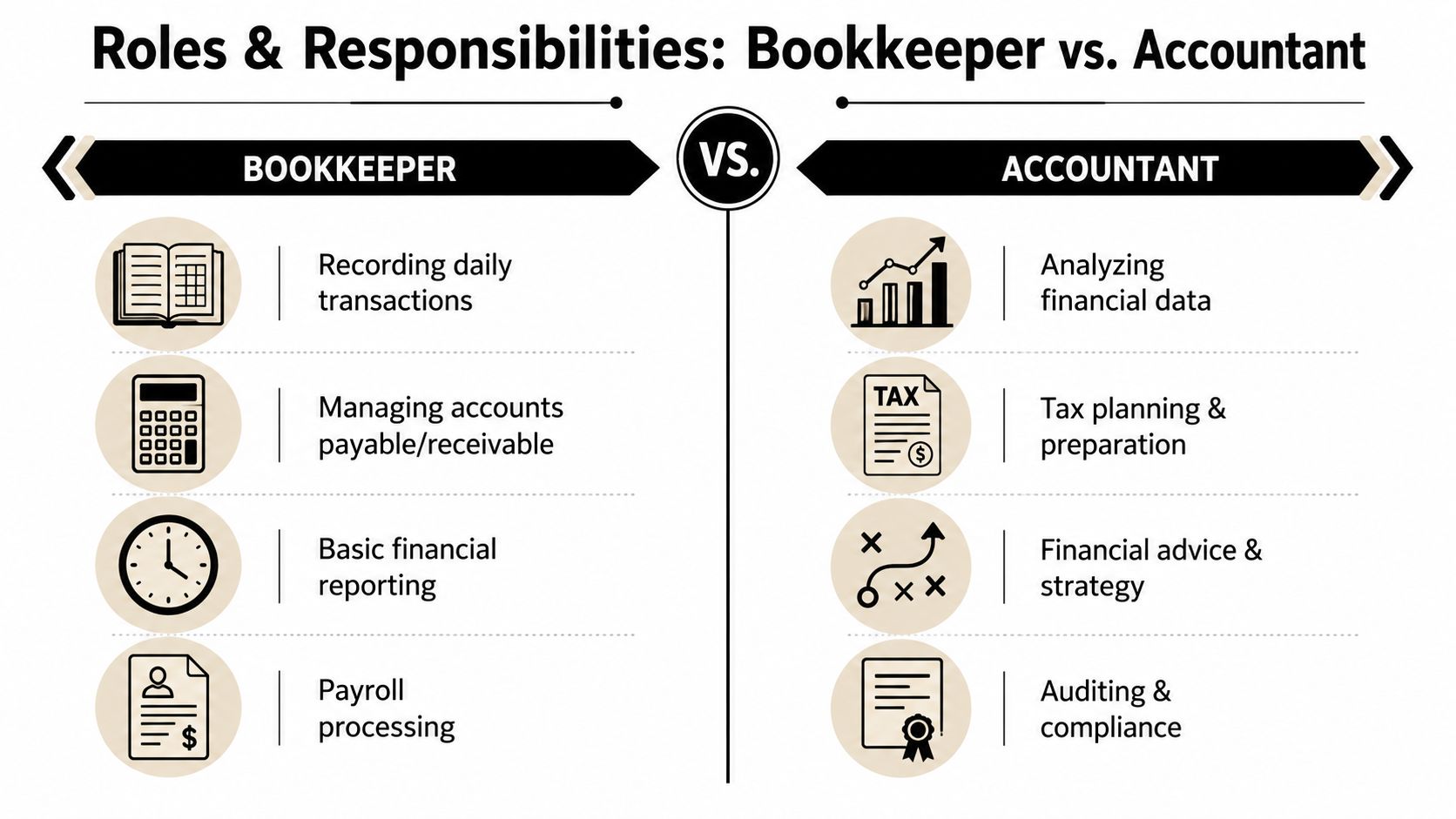
That same explanation also shows the practical split in plain terms. A bookkeeper is usually focused on high-frequency processing such as invoices, receipts, payroll entries and ledger maintenance. An accountant is usually focused on period-end close, variance analysis, tax treatment and strategic advisory work.
What this looks like in real life
Here's a simple example.
A shop receives payments from customers, pays suppliers, runs payroll and covers rent and utilities. The bookkeeper records these entries, updates the ledgers and checks that the records match the bank. The accountant reviews the resulting information, helps prepare formal reports, checks financial treatment and advises on what the business owner needs to do next.
So both roles are valuable. One is not “better” in a moral sense. They serve different purposes.
A short video can help if you prefer learning by listening and watching.
Where the line can blur
In smaller businesses, one person may do a bit of both. That's one reason people get confused. A business owner might say, “my accountant does the books,” or “my bookkeeper helps with accounts.” In casual conversation, that happens a lot.
But the core distinction still matters:
- Bookkeeping keeps the records clean
- Accounting turns records into insight
- Qualifications often rise as responsibility rises
The more a role depends on judgement, compliance and advice, the closer it moves towards accountancy.
UK Salaries and Career Growth Potential
Pay matters. If you're returning to study, you're not only thinking about interest and job satisfaction. You're also thinking about bills, security and what kind of future you can build.
That's one reason the difference between accountants and bookkeepers matters so much in practical terms.
What the UK pay data shows
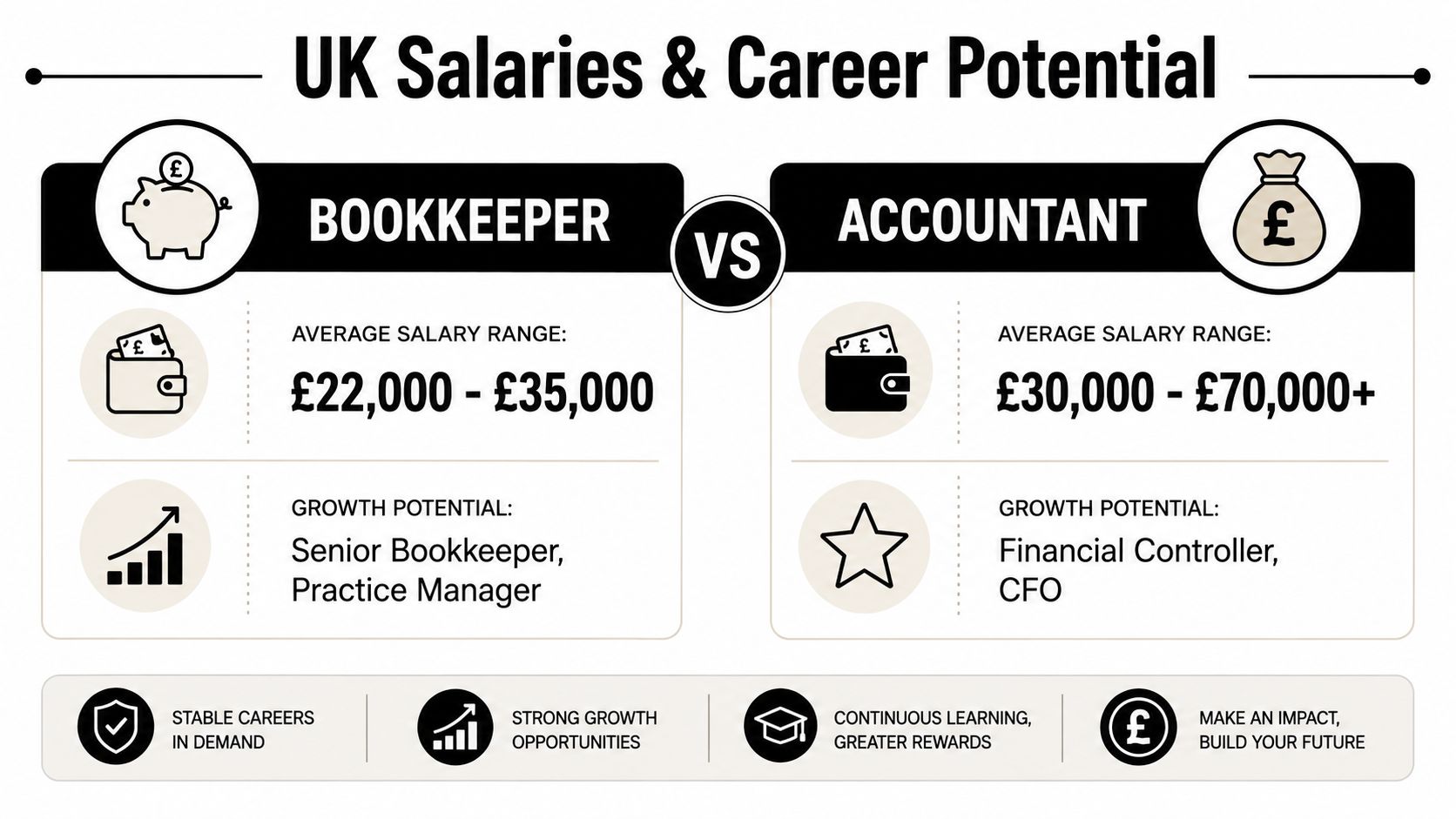
Practice Protect's summary of Office for National Statistics Annual Survey of Hours and Earnings data reports median gross weekly pay for bookkeepers, payroll managers and wages clerks at around £550 per week, while accountants and chartered and certified accountants are around £1,050 per week. That means accountants earn close to double the weekly median in the same broad area.
The same source says that, when annualised, this is roughly £28,600 versus £54,600 before adjustments, although exact totals vary by region and hours worked.
Why the gap exists
This gap doesn't mean bookkeeping isn't valuable. It means the market usually pays more where the work involves broader technical judgement, reporting, compliance and advice.
Bookkeepers usually focus on recording transactions, reconciliations and ledgers. Accountants usually move further into financial statements, tax matters and interpreting numbers for decision-making. More responsibility often brings higher pay.
Why this should encourage you
For an adult learner, this can be motivating rather than discouraging.
You don't need to look at accountancy salaries and think, “That's for someone else.” It may represent the next rung on the ladder. A person can begin with bookkeeping skills, build confidence, gain practical experience and then continue studying.
- A starting point can still be powerful
- A first qualification can open a door
- Progression can raise earning potential over time
Your first finance role doesn't have to be your final one.
That mindset matters. A stable entry role can help you grow into a stronger long-term career.
Qualifications and Your Training Path in the UK
For many adults, qualifications are the scariest part of the whole idea. You may worry you've been out of education too long, or that you're “not academic enough”. That fear is common, but it doesn't tell the truth about what adult learners can achieve.
In finance, qualifications aren't there to shut you out. They're there to show what you can do and help you move forward with confidence.
The common UK starting point
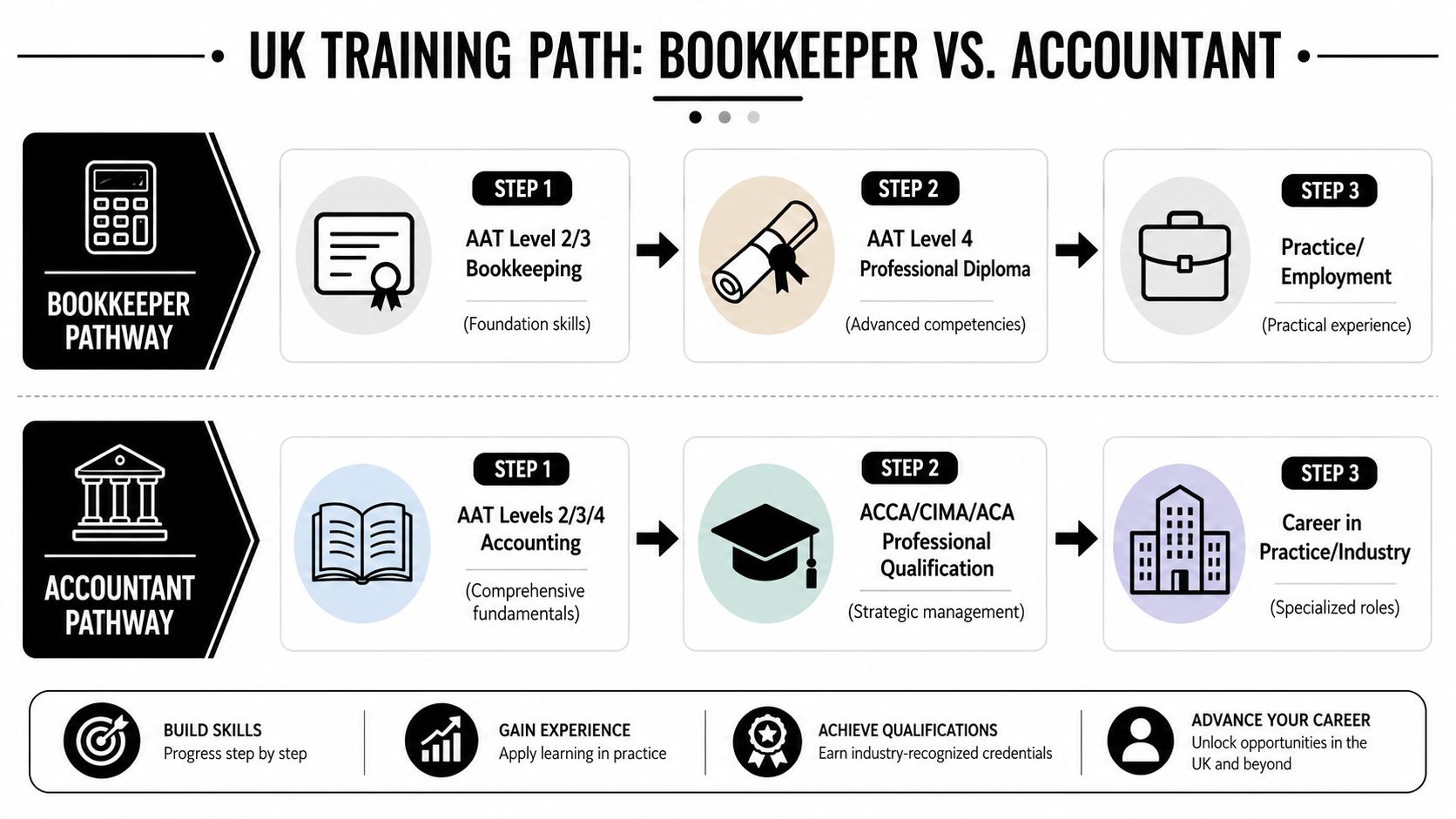
A helpful fact from the UK pathway is that AAT qualifications are widely used as an entry route into bookkeeping and accounting, with over 120,000 students, members and apprentices across more than 90 countries. That same source explains that AAT's structured levels progress from foundational record-keeping to more analytical accounting work.
This is important because it shows something many nervous learners need to hear. There is a route in. You don't have to leap straight to the most advanced stage.
A simple way to view the pathway
You can think of the route like this:
Learn the basics of financial records
Bookkeeping skills often begin by mastering these basics. You learn how transactions are recorded, how ledgers work, and why accuracy matters.Build stronger accounting knowledge
As your confidence grows, you can move into wider accounting topics, reporting and interpretation.Move towards higher responsibility
At this stage, roles often involve more judgement, compliance and decision support.
What qualifications mean in real life
A qualification is not only a certificate. It can mean:
- Proof of ability when you apply for work
- A clearer pathway so you know what to study next
- Greater confidence because your skills have structure
- A stronger future for your family because your earning options can widen
For some adults, the first challenge isn't finance content itself. It's rebuilding study habits, maths confidence, writing confidence or readiness for higher-level learning. That's why stepping-stone study matters so much.
If your longer-term plan includes university-level progress or business-focused study, an Access to Higher Education Diploma in Business and Management can be part of that wider journey.
You are allowed to build slowly
A lot of people think success only counts if it happens quickly. Adult education teaches a different lesson. Slow progress is still progress.
If you begin with a foundation and then move upward, that's not a compromise. That's a smart strategy.
Qualifications can be a key. They don't measure your worth. They unlock the next door.
The difference between accountants and bookkeepers is partly about tasks, but in the UK it's also shaped by qualification pathways and professional milestones. That's good news, because pathways can be followed step by step.
Choosing Your First Step into Finance
If you're still unsure, keep it simple.
Bookkeeping may suit you if you want a practical entry point, enjoy organised work, and like the idea of handling the day-to-day financial records that keep a business running. It can be a strong first move for someone rebuilding confidence.
Accountancy may suit you if you're drawn to the wider picture, want to interpret financial information, and can see yourself growing into work that involves reporting, tax, compliance or advice. For many people, though, this becomes the destination after the foundations are in place.
A smart choice doesn't have to be a permanent one
This is the most reassuring part. Choosing bookkeeping first does not trap you there. It can give you experience, routine, software skills and confidence with financial data. Those are powerful building blocks.
That matters even more because the work itself is changing. NerdWallet's discussion of bookkeeping versus accounting notes that firms reported stronger use of cloud tools, automation and AI in day-to-day finance work, meaning many bookkeeping tasks are now software-led and the boundary between roles is shifting rather than fixed.
So your future may involve digital bookkeeping tools, real-time reporting and modern finance systems, not only traditional paperwork.
A gentle decision guide
Aim for bookkeeping first if:
- You want a clearer starting point
- You like accuracy and routine
- You want to get into finance sooner and build upward
Aim for accountancy as a long-term goal if:
- You want broader responsibility
- You enjoy analysis and problem-solving
- You're willing to keep studying over time
If you're exploring broader business knowledge alongside your finance goals, Business A Level study options can also support that wider understanding.
The most important thing is this. Starting counts. Taking action counts. Choosing a path that helps you become more secure, more confident and more hopeful is something to be proud of. Your children don't need to see perfection. They need to see courage.
Next Level Online College supports adults across the UK who are returning to study, changing careers or building qualifications for a better future. If you're ready to strengthen your confidence in English, maths, business or higher-level study, explore the flexible online courses at Next Level Online College and take your first step towards a career that can make you and your family proud.