
Some nights you sit down to study after work, make a cup of tea, open the laptop, and still feel stuck. You read the same page twice. You watch a lesson and think, “Why isn't this going in?” That feeling can knock your confidence fast, especially if you've come back to education after a long break.
A lot of adult learners assume the problem is them. They think they're rusty, not clever enough, or too old to get back into learning. That isn't fair, and it often isn't true. Sometimes the core issue is simpler. You're trying to learn in a way that doesn't feel natural to you.
That's where Honey and Mumford learning styles can help. Not as a label. Not as a box. More as a helpful mirror. It gives you a way to notice how you usually approach new information, new tasks, and new challenges.
When you understand that, study can start to feel less like a battle and more like a skill you can build. That matters if you want better qualifications, more choice at work, and the pride of showing your children that it's never too late to start again.
Your Key to Unlocking How You Learn Best
You log in for an evening of online study after a full day of work. One classmate starts the activity straight away and learns by trying things out. Another reads the instructions twice, makes notes, and joins in once the task feels clear. Both are serious about doing well. Both can succeed. They learn in different ways.
That difference matters more than many adult learners realise.
Honey and Mumford learning styles give you a simple way to notice the kind of study approach that feels more natural to you. The benefit is not in giving yourself a label. It is in giving yourself permission to learn in a way that fits how your mind takes things in and makes sense of them.
That can be a big relief.
If study has felt harder than it should, you may have started to question yourself. You may have wondered whether you have lost your confidence, fallen out of the habit of learning, or missed your chance. A better question is often, "Am I using study methods that suit me?"
Practical rule: If a study method keeps draining your confidence, the answer may be to try a different method.
Honey and Mumford's model can help you spot patterns in how you approach new information, discussion, practice, and problem-solving. Once you can see those patterns, you can make smarter choices. You can pick revision methods that hold your attention, plan study sessions that feel less frustrating, and build routines you are more likely to stick with.
It works a bit like finding the right pair of shoes for a long walk. You are still the one doing the walking, but the journey feels steadier when the fit is right.
For adults returning to education, that steadiness matters. Confidence grows when you stop judging yourself for struggling and start understanding what helps you learn well. That confidence can carry into every part of your goal, whether you want better work options, want to prove something to yourself, or want your family to see you building a stronger future through study.
What Are the Four Honey and Mumford Learning Styles
Honey and Mumford describe four common ways people tend to approach learning: Activist, Reflector, Theorist, and Pragmatist.
That does not mean you have to pick one label and stay there. It means you can start to notice which approach feels more natural to you, especially when you are studying online and trying to rebuild confidence.
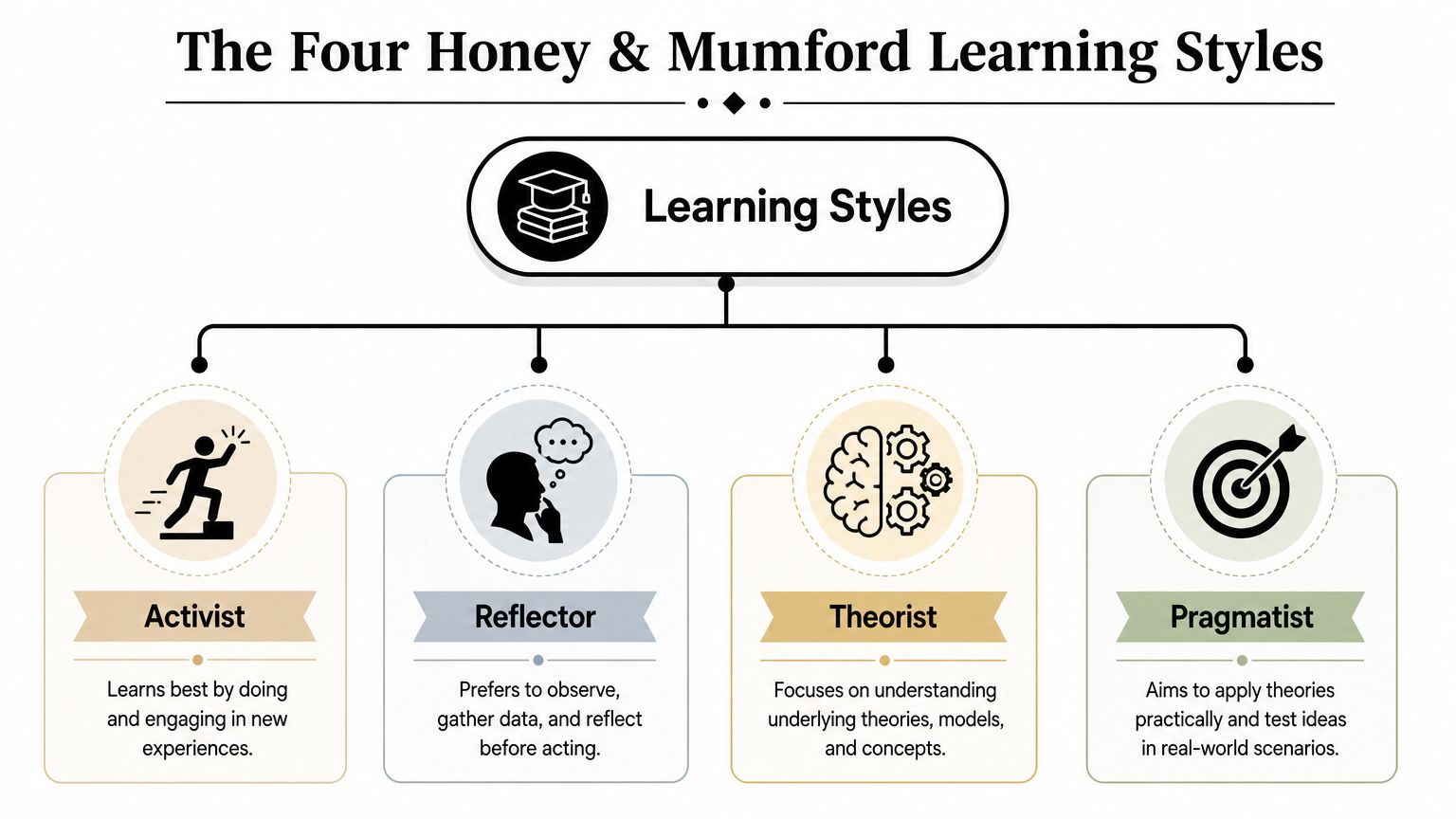
The four styles are best understood as preferences. A preference is your usual starting point. Some learners want to get involved straight away. Others want time to watch, organise ideas, or test whether something will be useful in real life. Once you can see your starting point more clearly, study often feels less like guesswork.
Activist
An Activist learns best by getting involved. If this sounds like you, you often understand more once you have started than when you are still reading instructions.
In study, this can look like:
- Starting quickly: You would rather try the task than spend too long preparing
- Joining in: Discussions, quizzes, breakout rooms, and interactive activities help you stay focused
- Learning through action: Practice helps ideas make sense
Activists often do well when study feels active and varied. If learning stays too passive for too long, your attention may drift.
Reflector
A Reflector prefers to pause first. You usually like to observe, gather information, and think things through before responding.
In study, you may prefer:
- Watching before attempting: Examples and demonstrations help you feel ready
- Thinking time: You like a moment to process what you have learned
- Careful responses: You often give stronger answers after reflection
If you are a Reflector, there is nothing wrong with needing space before you speak or submit work. That pause is often part of how you produce thoughtful, steady work.
Theorist
A Theorist wants ideas to make logical sense. Clear steps, organised notes, and sound explanations can help you feel secure.
You may enjoy:
- Clear structure: Lessons that follow a logical order
- Understanding the reason: You want to know why a method works, not only what to do
- Patterns and systems: You like connecting one idea to another
For a Theorist, confusion often grows when learning feels messy or poorly explained. Good structure can make a big difference to your confidence.
Pragmatist
A Pragmatist wants to know how learning will be used. You are often looking for the practical value behind the topic.
You may like:
- Useful examples: Case studies, demonstrations, and real situations
- Immediate application: Trying out a method soon after learning it
- Relevant study: Content that links to work, family life, or everyday tasks
Pragmatists often stay motivated when they can see a clear purpose. If a topic feels too abstract for too long, it may start to feel distant or frustrating.
None of these styles is better than another. They simply describe different ways learners often begin making sense of something new.
Many adults see themselves in more than one style, and that is completely normal. You might be a Reflector in group discussions, but a Pragmatist when learning a job skill. You might like clear theory first, then want to test it straight away. The goal is not to put yourself in a box. The goal is to notice what helps you learn with more confidence, so study feels more natural and more possible.
Discovering Your Preferred Learning Style
You sit down for an online lesson after work. One activity clicks straight away, while another leaves you drained or unsure of yourself. That difference matters. It can show you how you naturally get started with learning.
Understanding your preference gives you a clearer starting point. It is less about giving yourself a label and more about giving yourself permission to study in a way that feels natural. For many adult learners, that shift builds confidence fast. It can help you stop thinking, "Maybe I am not cut out for this," and start seeing a method that fits you better.

A good way to spot your preference is to notice your first instinct in a learning situation. Some learners want to jump in. Others want time to watch, sort, test, or apply. Your pattern often shows up in small moments, like how you begin a new module or what kind of revision makes you feel steady.
Quick questions to ask yourself
Read through these prompts slowly. You do not need perfect answers. Look for the set that feels most familiar most of the time.
Activist questions
- Do you like starting before you fully know what you are doing?
- Do you learn more quickly by trying, discussing, or taking part?
- Do long explanations lose your attention?
Reflector questions
- Do you prefer to observe before joining in?
- Do you like time to process before giving an answer?
- Do you learn a lot by reviewing what went well and what did not? If so, this guide to the Reflector learning style in online study may feel especially familiar.
Theorist questions
- Do you want ideas explained in a clear order?
- Do models, frameworks, and logical steps help you feel settled?
- Do you lose confidence when teaching feels scattered?
Pragmatist questions
- Do you keep asking how you will use this in real life?
- Do examples help more than abstract explanations?
- Do you want to test useful methods quickly?
What your answers usually mean
Many adults recognise themselves in more than one group. That is normal. You might prefer one style when learning at home and another when learning a work skill. You may also find that your strongest preference changes as your confidence grows.
Your answers are best treated like a map, not a rulebook. A map helps you choose a good route. It does not force you down one road forever.
If one or two styles stand out, that gives you a useful clue about how to begin. Starting in a way that suits you can make online study feel calmer and more manageable, especially when you are balancing family life, work, and responsibilities at home.
If you have ever thought, “I'm just not academic,” try replacing it with, “I learn best in a different way.”
That small change can affect how you see yourself. And when your confidence rises, it becomes easier to keep going, finish what you started, and build the future you want for yourself and the people who believe in you.
Practical Study Strategies for Your Learning Style
You sit down to study after work. One method tells you to make detailed notes. Another says to jump straight into practice questions. A third suggests talking through ideas with other people. If you have ever felt unsure which approach is right, your learning style can give you a useful place to start.
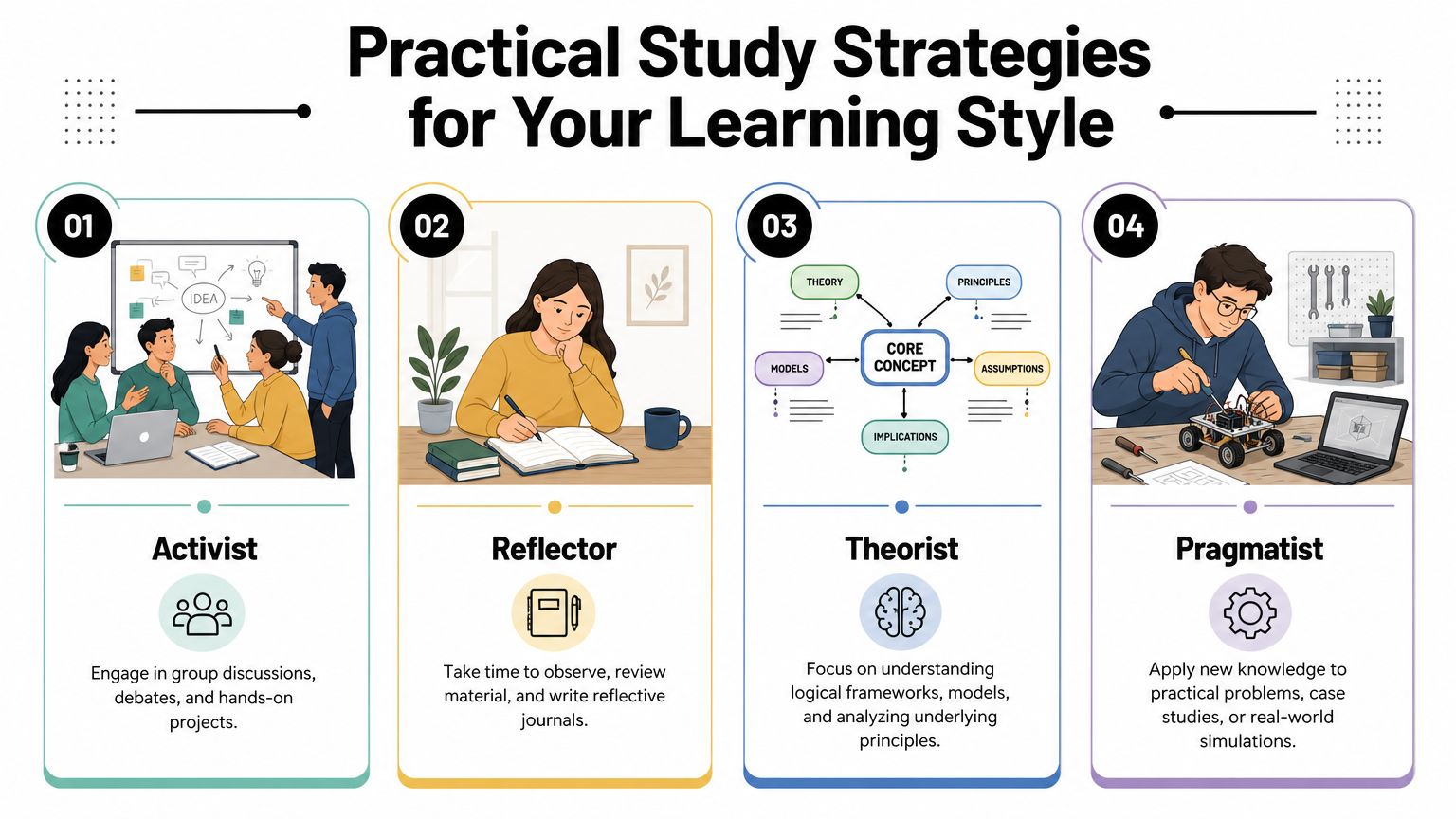
The goal is not to box yourself in. It is to give yourself permission to begin with methods that feel more natural. That often makes studying feel less heavy and helps confidence grow, especially if you are returning to education as an adult and want to build a better future for yourself and your family.
If you learn like an Activist
Activists usually learn best by doing. They often understand a topic faster once they have tested it, even if the first attempt goes wrong.
Try these:
- Start with action: Try a short quiz or simple task before reading the full chapter
- Talk it out: Join a study group or explain the topic aloud to yourself
- Use movement: Write ideas on sticky notes and move them around to sort them
- Set mini challenges: Turn revision into short timed tasks
A helpful Activist routine is simple. Try something, notice what happened, then adjust and try again. It works like learning to cook from a recipe by making the meal, not only reading the instructions.
If you learn like a Reflector
Reflectors often need a little space to take things in. They may look quiet on the outside, but a lot is happening in their thinking.
Helpful methods include:
- Keep a study diary: Write what you learned, what confused you, and what to revisit
- Watch worked examples: See how a question is answered before doing your own
- Pause before responding: Give yourself time after a lesson to process
- Review feedback carefully: Look for patterns in comments before changing your approach
If that sounds familiar, this guide to the Reflector learning style for adult study can give you more ideas.
If you learn like a Theorist
Theorists often feel more settled when ideas come in a clear order. They usually want to know how the parts fit together, not just what to memorise.
Useful ideas:
- Build neat notes: Group topics into headings and subheadings
- Create mind maps: Connect ideas so the structure becomes easier to see
- Ask why: Look for the reason behind each fact or process
- Use comparison tables: Sort similar concepts side by side
A Theorist often studies best when the subject feels organised. It is similar to building a shelf with instructions in the right order. Once the structure is clear, the pieces make more sense.
If you learn like a Pragmatist
Pragmatists usually want to know how learning will help in real life. If an idea feels too distant or abstract, motivation can drop quickly.
Try this approach:
- Look for real use: Ask how the topic connects to your job, home life, or goals
- Solve practical problems: Use examples based on everyday situations
- Test ideas quickly: Use a new method as soon as you learn it
- Make action points: End each session with one thing you will apply
This style can be powerful for adult learners because it keeps study tied to purpose. When you can see how today's lesson could help you at work, at home, or in your next step forward, it becomes easier to keep going.
Why mixing styles often works best
A preferred style gives you a strong starting point. Good study habits usually combine several approaches.
For example, you might begin like an Activist with a practice question, pause like a Reflector to review mistakes, organise the idea like a Theorist, then finish like a Pragmatist by using it in a realistic situation. That kind of mix helps you learn more fully and stops study from feeling flat.
A good study session might look like this:
| Style phase | Example study action |
|---|---|
| Do | Try a practice question |
| Reflect | Review what went well and what didn't |
| Understand | Read the explanation and organise the idea |
| Apply | Use it in a new question or real-life example |
If one method has not worked for you before, that does not mean you are bad at learning. It may mean you were using a method that did not suit you yet. A better fit can help study feel calmer, more manageable, and more rewarding.
Using Your Style to Succeed With Online Study
Online study gives you freedom, but it also asks you to manage your own time, energy, and focus. That's where knowing your learning preferences can give you an edge.
For self-led study, the Honey and Mumford model works well as a learning framework because it helps sequence activities from experience, review, conclusion, and planning, which suits adults organising their own online learning, as outlined in MTD Training's explanation of the Honey and Mumford learning cycle.
Making online learning fit your style
If you're an Activist, long passive sessions may drain you. Break lessons into shorter chunks and follow each one with a task. You might also benefit from practical active learning strategies for online study so you stay involved rather than just watching.
If you're a Reflector, online study can suit you well. Recorded lessons, saved notes, and quiet review time give you space to think without pressure. That can be a real advantage when your home life is busy.
If you're a Theorist, digital learning often makes it easier to stay organised. You can sort folders, label notes clearly, and revisit explanations until the logic clicks.
If you're a Pragmatist, online study works best when you connect each topic to a clear purpose. Keep asking, “Where will I use this?” If the answer is linked to a better job, university entry, or helping your children with schoolwork, motivation becomes more solid.
Online learning works best when you build a routine that suits your real life, not somebody else's perfect timetable.
Here's a helpful reminder if you're exploring how this kind of study feels in practice.
Confidence grows with structure
Many adult learners think motivation arrives first. Often it doesn't. Structure comes first. Motivation grows after you've completed a few small wins.
That's why your style matters in online study. When you choose study methods that feel natural, you waste less energy fighting the process. You settle faster. You keep going longer. And you start collecting proof that you can do this.
A Balanced View on Your Learning Journey
It's worth holding this model with a light grip.
The Open University presents Honey and Mumford as a preference model for self-reflection, rather than a scientifically proven way to improve learning outcomes. The practical message is clear. Knowing your style can be useful, but limiting yourself to one style alone usually isn't the best approach, as discussed in The Open University's learning materials on learning preferences.
Use it as a guide, not a label
That means you don't need to say, “I'm a Reflector, so I can't do presentations,” or “I'm an Activist, so reading isn't for me.” Those conclusions can shrink your confidence instead of building it.
A better way is to think like this:
- Start with comfort: Use your preferred style to get going
- Add stretch: Practise the less comfortable styles in small ways
- Stay open: Let the task decide the method when needed
This is often the most realistic path for adult learners. Some tasks need action. Some need deep thought. Some need theory. Some need practical use.
You are not behind
If you've returned to study after years away, you may feel nervous about whether you still have what it takes. You do. You may need support, a plan, and permission to learn in ways that suit you.
You can also shape your study in a more flexible way with personalised learning plans that support adult learners. That kind of support can make a big difference when life is already full.
The strongest learners aren't the people who never struggle. They're the people who keep adjusting until study starts to work.
Keep going. Your education can lift more than your grades. It can strengthen your confidence, widen your career options, and show your children what courage looks like. Every time you sit down to learn, you're building something bigger than a qualification. You're building a future.
If you're ready to take that next step, Next Level Online College offers flexible online courses designed for adults who want recognised qualifications, stronger confidence, and a clear path towards university, career progress, and a future their family can feel proud of.