
You might be reading this after the children have gone to bed, with work clothes still on, wondering whether it's too late to go back and fix the exam results that have followed you for years. Maybe you want a better job. Maybe you want university to be possible. Maybe you want to prove to yourself, and to your family, that you can finish what life interrupted.
If that's where you are, you're not behind. You're starting from experience.
Learning as an adult feels different because your reasons are deeper. You're not just taking an exam. You're building a steadier future, showing your children what courage looks like, and giving yourself more choices. If you've been searching for how to retake GCSE for adults, the good news is that there is a clear path forward, and you can take it one step at a time.
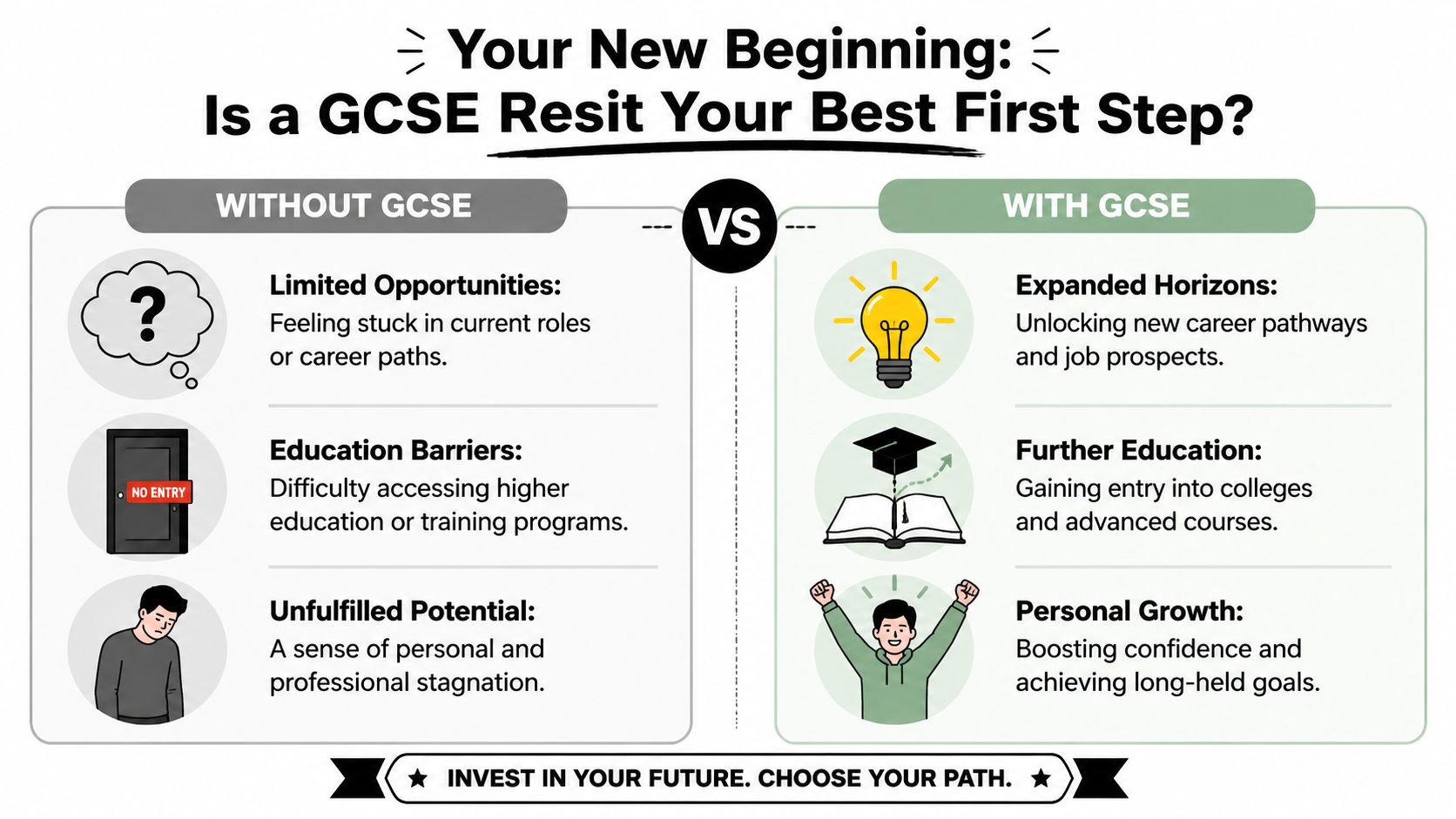
Your New Beginning Is a GCSE Resit Your Best First Step
Wanting more for your family is a powerful reason to return to education. Many adults come back to study because they're tired of feeling blocked by one missing qualification. They want access to better paid work, training, or university. They want to stop saying “I can't because I never got my Maths or English.”
That decision matters. It tells your children that setbacks don't get the final word.
Before you enrol anywhere, ask one important question. Do you need a GCSE, or would Functional Skills do the job? At this point, many adults lose time and money. They sign up for a full GCSE course when a faster route may have been enough for their goal.
GCSE or Functional Skills
A GCSE is the traditional qualification many are familiar with from school. For many paths, especially if a course or university asks for GCSEs specifically, it's the right option. Adults usually prioritise Maths and English, because these are the subjects most often needed for work, further study, and entry requirements.
Functional Skills is different. It is a Level 1/2 qualification focused on using English and maths in real life. Many adults don't realise it can be a faster, cheaper and equally valid route for meeting university entry requirements for English and maths. The National Careers Service also notes that 40% of adults retaking GCSEs fail to secure grade 4 without targeted support, which is why Functional Skills can be a more achievable route for some learners through its more practical assessment style, as explained by the National Careers Service guidance on resits and alternatives.
How to choose the smarter route
Use this simple check before you commit:
| Your goal | Usually the better question to ask |
|---|---|
| University application | Does the course accept GCSE only, or GCSE or equivalent? |
| Job requirement | Is grade 4 specifically required, or is Level 2 accepted? |
| Confidence in traditional exams | Would a practical qualification suit you better? |
| Time pressure | Do you need the qualification as soon as possible? |
Practical rule: Never assume. Check the exact wording from the university, employer, apprenticeship provider, or course provider before paying for anything.
If the requirement says GCSE only, then a GCSE resit is likely your path. If it says equivalent or Level 2, Functional Skills may save you stress, study time, and money. For adults who struggled with school exams, that can be the difference between giving up and finally moving forward.
Why this decision matters emotionally as well as practically
Choosing the right route doesn't mean taking an easier way out. It means taking a wise first step. Adult learners often carry old school memories with them. A classroom, a paper, or even the word “exam” can bring back embarrassment. That's real. But your next move should fit the life you have now, not the version of you who was trying to cope at sixteen.
The bravest choice is the one that gets you where you need to go.
Finding a Study Method That Works For You
Once you know which qualification you need, the next question is simple. How are you going to study around real life? Work shifts, school runs, caring duties and tired evenings all matter. The best study method is the one you can keep doing.

Adults usually choose one of three routes. Evening classes at a local college, an online course, or self-study. Each can work. The right fit depends on your schedule, confidence and need for support.
Evening classes at a local college
A college can feel reassuring because the timetable is already built for you. You turn up, learn with other adults, and have a teacher there in person. If you like structure and find it hard to organise yourself alone, this can be helpful.
But fixed class times can also be hard. If your child is ill, your shift changes, or transport becomes a problem, missing lessons can quickly knock your confidence. College works best when your weekly routine is fairly stable.
Online study with support
For many adults, online learning gives the breathing room they need. You can study early in the morning, after the children are asleep, or at the weekend. Structured online courses also tend to work better than self-study alone for many learners, especially when tutor support is included. Adult GCSE courses commonly last 6 to 12 months, and Open Study College notes that structured support often leads to better outcomes than trying to do everything alone, as outlined in its guide to GCSEs for adults.
If you want an example of what this looks like in practice, some adults choose a flexible online option such as online GCSE English study for adults, where lessons fit around work and family life and support is built into the course rather than left to chance.
Studying online doesn't mean studying alone. For many adults, it means learning privately, flexibly and with calmer support.
Self-study on your own
Self-study can be the cheapest route in some cases, and for disciplined learners it can work well. You choose your books, use past papers, and work at your own pace. If you already know the subject fairly well and only need to sharpen weak areas, this might suit you.
The challenge is consistency. No one checks whether you studied this week. No one notices if you avoid the hard topics. If confidence is already low, self-study can become a cycle of delay and guilt.
A simple comparison
| Study method | Good for | Hard part |
|---|---|---|
| Local college | Learners who want face-to-face structure | Fixed times can clash with family or work |
| Online course | Busy adults who need flexibility and support | You still need a regular routine |
| Self-study | Very independent learners | Easy to lose momentum |
You don't need the perfect method. You need the one you'll still be using on a tired Thursday night.
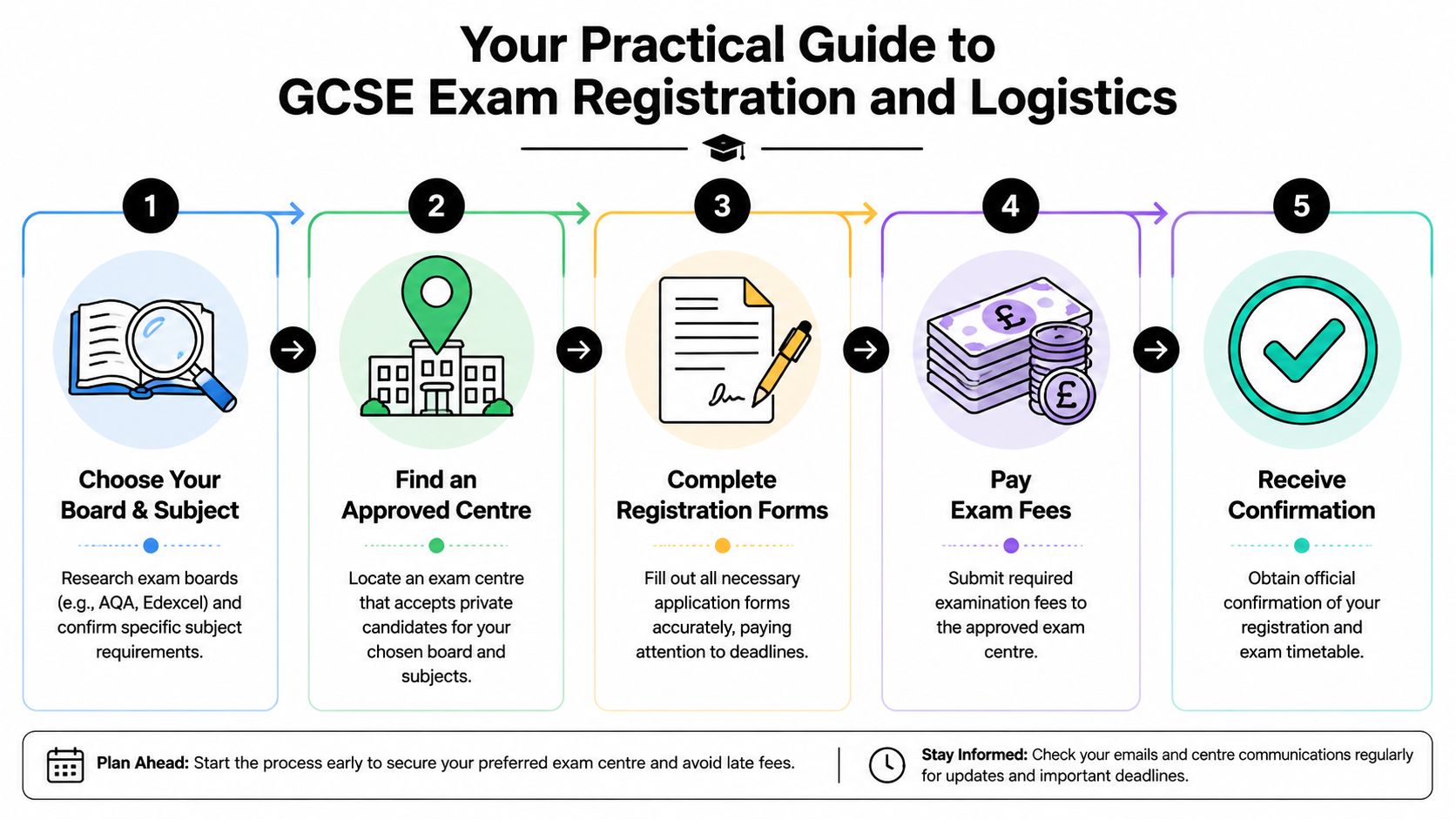
Your Practical Guide to Exam Registration and Logistics
For many adults, the hardest part isn't the studying. It's the admin. These tasks often cause people to get stuck, especially if they're entering as a private candidate.
You can study at home, but the final GCSE exam must be sat in person at a physical exam centre, and adults should register for a place about six months before the exam date, as explained in this guide on retaking GCSEs for adults and booking an in-person exam.
What private candidate means
A private candidate is someone entering the exam independently, rather than through a school they attend. That sounds simple, but in real life it can take persistence. A major hurdle for adults is booking an exam as a private candidate. You must contact local schools and colleges yourself to ask if they accept external candidates, there's no central list, and the exam fee is often £100 to £200 per subject, paid directly to the centre, according to the UK government's guidance on improving your English, maths and IT skills.
That's why early planning matters so much. The centre space, the fee, the paperwork and the deadline all need attention.
A step by step checklist
Choose your subject and exam board
Check whether you need GCSE Maths, English Language, or another subject. If you're using a course, make sure it follows a recognised exam board such as AQA or Pearson Edexcel.Search for local centres early
Contact nearby schools, colleges and independent centres. Ask whether they accept private candidates for your subject and exam board.Ask the right questions
Don't just ask about price. Ask about deadlines, identification needed, and any forms you must complete.Pay and get confirmation in writing
Keep every email and receipt. You want proof of your booking and a clear exam timetable.Check whether online study matches your exam plan
If you're learning remotely, make sure your course prepares you for the same board and specification your centre will use. Some adults find this easier to understand after reading a plain explanation of whether you can do GCSEs online and what still has to happen in person.
Dates adults often miss
There are two timing points that catch people out:
- Maths and English resits are only available in November
- Other subjects are usually taken in May or June
If you delay centre booking, you can miss the exam window entirely. That's not a small mistake. It can push your plans back by months.
Book the exam centre first enough in advance that the studying has a real deadline. Adults often revise more steadily once the date feels real.
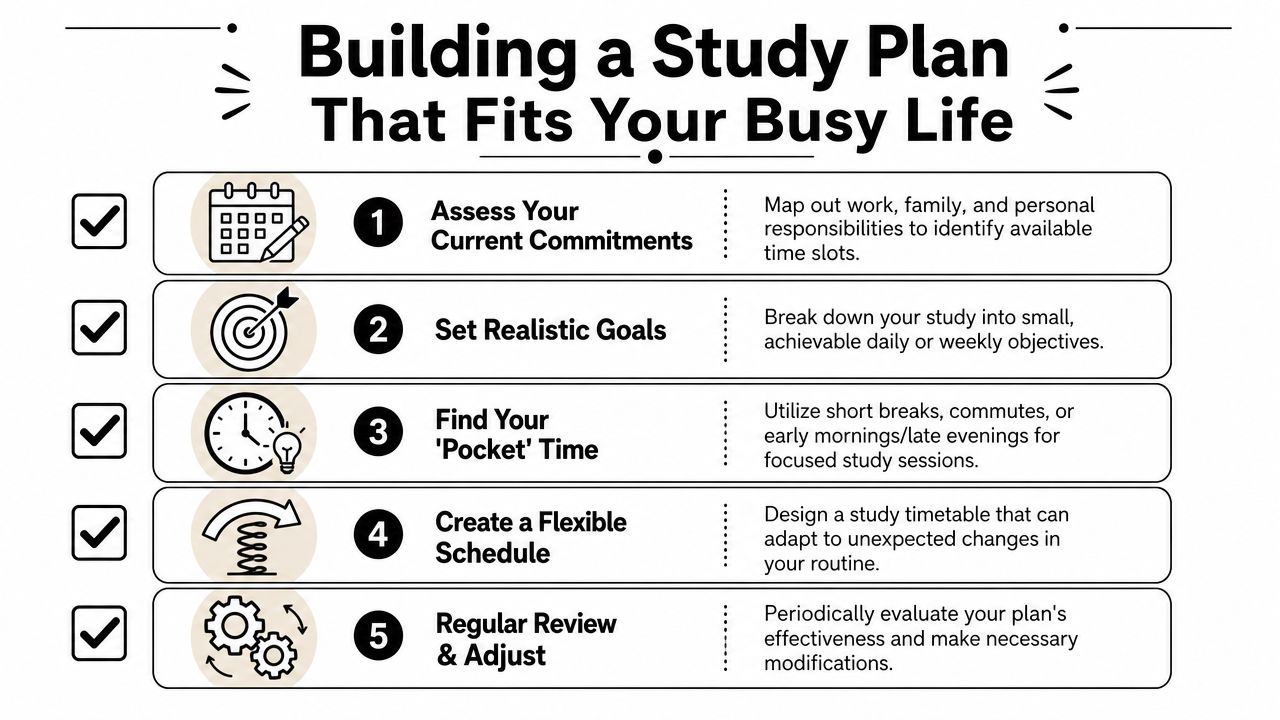
Building a Study Plan That Fits Your Busy Life
A good plan doesn't try to turn you into a full-time student. It works around the life you already have. That means school runs, long shifts, family meals, and the fact that some evenings you'll feel exhausted.
The adults who do well usually don't chase perfect study days. They build a pattern they can repeat.
A realistic week can still be powerful
Take a parent working full time. They might revise for a short session before the house wakes up on two weekdays, do one evening session after dinner, and use part of the weekend for a past paper. That doesn't look dramatic, but repeated week after week, it moves you forward.
Tutorful recommends that adult learners aiming to resit GCSE Maths spend 10 hours a week, with 70% of that time on weak topics and 30% on stronger areas, using a mix of early morning study, evening revision and weekend practice, as described in this adult GCSE maths and English study guide.
What to put in your plan
A successful study plan for adults includes weekly targets, past paper practice under timed exam conditions, and full exam simulation with a timer, no notes and the right equipment. It's also important to book your exam centre about six months before the exam date, because late registration after February can cause fees to double, according to this advice on retaking GCSEs as an adult and preparing under real exam conditions.
Try building your week around these three blocks:
Short learning blocks
Use these for new content. This could be one topic, one video lesson, or one page of notes turned into questions.Weak area sessions
Put your hardest topics here. In Maths, that may be fractions, percentages or algebra. In English, it may be reading questions or structuring a writing response.Timed practice
Such practice nurtures confidence. The more often you sit with the clock running, the less strange the actual exam feels.
Keep goals small enough to win
Adults often set targets that are far too big because they're trying to “catch up”. That usually backfires. A better weekly target is one you can finish.
Here's a simple model:
| Time available | Sensible target |
|---|---|
| Busy weekday | One focused task |
| Free evening | One topic plus a few practice questions |
| Weekend session | One timed paper or a larger revision block |
If you need help making your revision stick, practical methods like retrieval practice, active recall and timed repetition can help. A useful starting point is this guide to GCSE revision techniques for adult learners.
Your study plan should reduce panic, not create it. A calm plan done consistently beats an ambitious plan abandoned after one week.
The habit that changes everything
Treat study like an appointment with your future. Put it in your diary. Tell your family. Protect it kindly but firmly. Your children don't need to see a perfect parent. They need to see a parent who keeps going.
How to Overcome Common Hurdles and Boost Your Confidence
You miss a few study sessions because work ran late, your child gets ill, or life becomes crowded. By Sunday night, it can feel as if the whole plan has fallen apart. Many adult learners know that feeling well. The problem is rarely one missed week. The problem is the story your mind tells about that missed week.
Old school memories can still have a loud voice. A bad result at 16 can make a 35-year-old doubt themselves before they even open a textbook. I have seen this again and again. Adults often are not fighting the subject alone. They are also fighting embarrassment, comparison, and the fear of proving an old label right.
That fear feels personal, but it is also predictable. Once you can name it, you can work through it.
The hurdles that catch adults most often
Some obstacles are emotional. Others are practical, and practical problems often shake confidence fastest because they involve money, deadlines, and big decisions. Adult learners usually get stuck in a few familiar places: choosing the right qualification, checking whether a college or university will accept it, and making sure the full cost fits their budget before they commit.
The wrong choice can cost both time and money. A GCSE and a Functional Skills qualification are not interchangeable in every situation. Functional Skills can be a smart route if you need a recognised English or maths qualification for work, everyday confidence, or access to some training courses. A GCSE may be the better fit if a university, apprenticeship, or employer asks for that exact qualification. The best path is the one that matches your real goal, not the one that looks quickest on paper.
Private candidate booking can also feel more complicated than adults expect. Exam centres vary. Fees vary. Deadlines can arrive earlier than you think, especially if your subject includes coursework, speaking assessments, or limited centre availability. If that sounds stressful, treat exam registration like booking travel for an important family event. You do not wait until the night before and hope a seat appears. You check the details early, confirm what is accepted, and make sure you are paying for the right thing.
Before you spend money, pause and answer these questions clearly:
- What does my goal require: GCSE or Functional Skills?
- Will my chosen college, university, or employer accept that qualification and any resit grade?
- What is the full cost, including tuition, exam entry, and centre fees?
- Am I booking as a private candidate at the correct centre for the correct exam board and paper?
A clear answer to those four questions removes a huge amount of anxiety.
Confidence grows from proof, not from perfect feelings
Confidence is less like a light switch and more like a savings jar. Each small action adds something you can draw on later. One finished topic. One practice paper marked and reviewed. One evening when you studied even though you were tired.
That is why waiting to "feel ready" often keeps adults stuck. Readiness usually comes after action, not before it.
When motivation drops, use simple evidence you can see:
Keep a record of completed sessions
A notebook, wall calendar, or notes app works well. Visible progress helps your brain stop treating effort as invisible.Judge the task, not your mood
Ask, “Did I complete the next step?” That question is much fairer than, “Did I feel confident today?”Use learner language
“I don't understand this yet” keeps the door open. “I'm just bad at maths” shuts it.Notice what is improving
You may still find algebra hard, but perhaps you now understand the question more quickly or make fewer careless mistakes. That counts.
You are not repeating the past. You are building a new result with adult patience, adult reasons, and adult determination.
When money, time, and fear all show up together
This is common. It does not mean you are failing. It means you are an adult with real responsibilities.
If money is the main pressure, slow the decision down and check the qualification carefully before you enrol. Paying for the wrong course creates more stress later. If time is the pressure, reduce the size of the study task, not your commitment to the goal. Twenty focused minutes still keeps the habit alive. If fear rises when you see exam questions, bring the fear closer in small doses. Do one question. Then two. Then a short timed section. Familiarity calms the nervous system.
There is also a family layer to this that many guides ignore. Adults are often revising while cooking dinner, working shifts, caring for children, or supporting parents. That can make progress feel slower than it "should" be. Slower does not mean weaker. A parent who studies steadily through a busy life is showing a powerful kind of resilience. Your family may remember that example long after they forget the grade itself.
Confidence grows when you keep promises to yourself, even small ones. Finish today's task. Ask the awkward question before booking the exam. Revisit the topic you nearly avoided. Those moments may look ordinary, but they are how adults pass.
From Exam Day to Your Dream Future
By the time exam day arrives, your main job is to stay steady. Get your equipment ready the night before. Know where the centre is. Leave early. Eat something simple. Breathe slowly before the paper starts. You don't need to feel fearless. You just need to be settled enough to show what you know.
If the exam doesn't go exactly as hoped, that isn't the end. Adults in the UK can retake GCSE exams as many times as they need. There is no age limit and no maximum cap on resits, which means you have room to keep going until you reach the grade 4 or higher you need for your future, as explained by Pass My GCSE in its guide to GCSE resits for adults.
That changes the whole story. This isn't one chance. It's a path.
What success really opens up
Passing a GCSE can mean applying for university with confidence. It can mean qualifying for training that leads to more fulfilling work. It can mean earning more and feeling proud of how you provide for your family. It can also mean something quieter but just as important. You stop carrying the label of “the person who never got round to it.”
Your children see that. They see you revise when tired, keep going after setbacks, and sit an exam anyway. That example can shape how they think about effort, learning and resilience for years.
The next small step matters more than the perfect long-term plan. Choose the qualification that fits your goal. Choose the study method that fits your life. Then begin.
If you want a flexible route back into learning, Next Level Online College offers online courses for adults in GCSEs, Functional Skills and other recognised qualifications, designed to fit around work and family life. It's worth exploring your options, checking what qualification you need, and having a calm conversation about the path that suits your future.