
You might be reading this on your phone after work, with a cup of tea going cold beside you, wondering if you've left it too late to catch up. Maybe your child can open apps faster than you can. Maybe job adverts ask you to apply online, upload a CV, and join video interviews, and it all feels like a language everyone else learned years ago.
If that's where you are, you're not behind in life. You're at a starting point. And starting points matter.
Digital literacy skills aren't about becoming a computer expert. They're the everyday skills that help you send an email, search for trusted information, fill in forms, use online learning, and protect yourself online. For adults returning to education in the UK, these skills can make the difference between feeling stuck and moving forward with confidence.
They also connect directly to real goals. Passing Functional Skills. Managing GCSE coursework. Applying for better jobs. Helping your children with homework. Showing your family that growth doesn't stop when adulthood gets busy.
Your First Step Into the Digital World
A lot of adult learners know this feeling. You see an online course that could help you get your qualifications. You click the page, read a little, then stop. There are buttons to press, forms to complete, maybe a login to create. Nothing looks impossible, but it all feels unfamiliar enough to make you close the tab.
That moment can knock your confidence. It can make you think, “Maybe study isn't for me anymore.”
It is for you.

Many adults come back to learning after years of putting family, work, and bills first. They aren't lazy. They aren't incapable. They haven't had the chance to build these skills in a calm, supportive way. If you need help understanding how online study systems work, this guide to online course access for adult learners can make the first steps feel more manageable.
According to the Good Things Foundation basic digital skills briefing, approximately 8.5 million adults in the UK lack the Foundation-level essential digital skills for everyday life. That means you are not alone, and taking this step is a brave and powerful choice that many others are making too.
What this can look like in real life
You might want to:
- Apply for a college course but feel nervous about setting up accounts and passwords
- Help your child with school messages sent through apps or email
- Look for a better job but feel unsure about online application forms
- Study towards university and know you'll need to use online lessons and submit work digitally
You don't need to know everything before you begin. You only need to be willing to learn the next small step.
Digital confidence grows the same way confidence in English or maths grows. One clear lesson at a time. One small win at a time. One day, what felt confusing starts to feel normal.
The Five Building Blocks of Digital Confidence
Digital literacy skills can sound like a big, formal phrase. In practice, they're a set of simple building blocks. Think of them as tools in a small toolbox. You don't need every tool on day one. You just need to know what each one does.
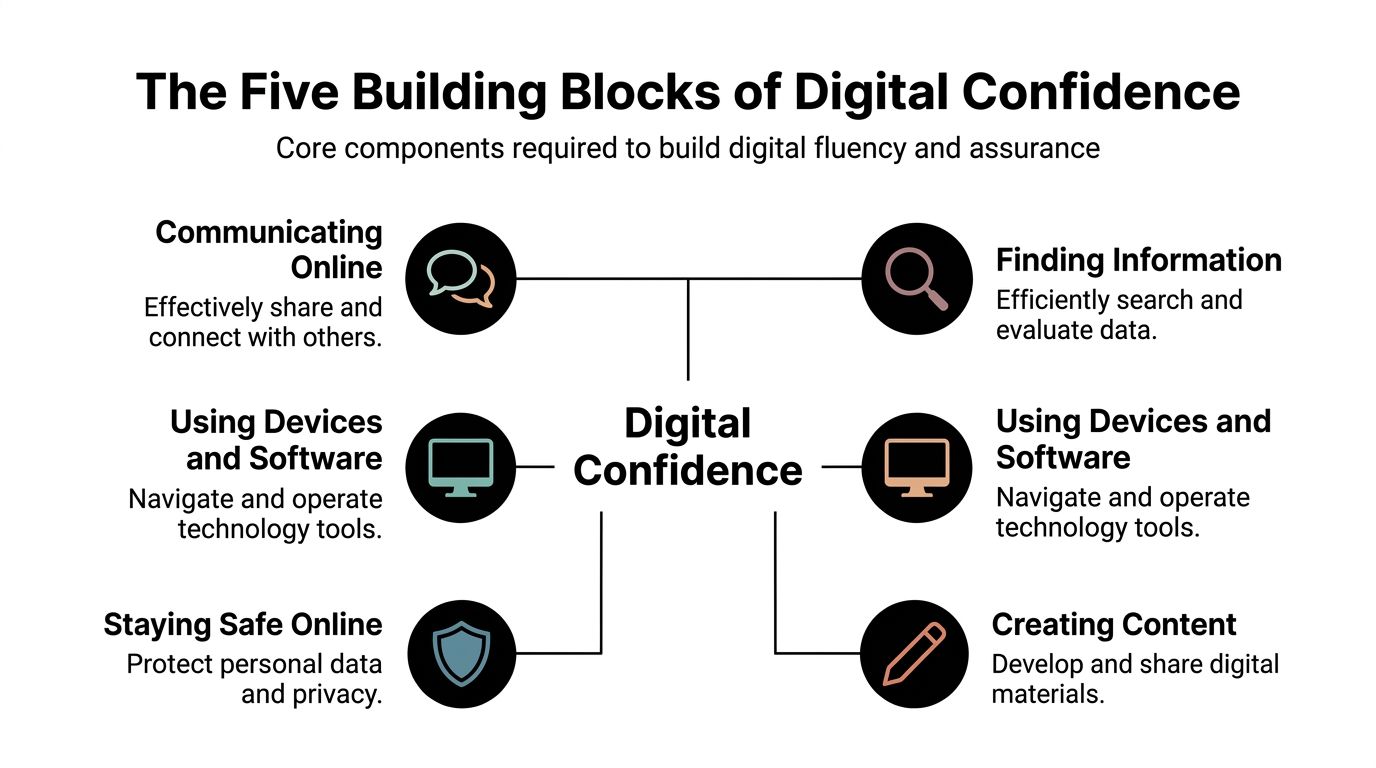
The ONS overview of the UK's digital divide noted that in 2018, an estimated 4.3 million people in the UK had zero basic digital skills, meaning they couldn't even use a browser. Learning just one of these building blocks puts you on a path far ahead of where many people start.
Communicating online
This means using digital tools to speak to other people clearly.
That could be sending an email to a tutor, replying to a message from your child's school, or joining a video call. It isn't about fancy writing. It's about knowing how to open the right app, type a clear message, and press send with confidence.
A simple example is emailing a teacher to ask for help with an assignment. You write a subject line, explain your question, and check for a reply later.
Finding information
This is the skill of searching for what you need and choosing useful results.
If you type “free maths revision UK” into Google, you'll get many answers. Digital confidence means knowing how to pick the one that matches what you need. Maybe it's the official site for an exam board. Maybe it's a tutorial video that explains one topic in plain language.
Practical rule: Search with clear words. “GCSE English past papers” usually works better than “help with English stuff”.
This skill matters in study because adult learners often need to find timetables, revision materials, course details, and support services online.
Using devices and software
This part is about handling the tools themselves.
A device might be a laptop, tablet, or smartphone. Software means the programmes or apps you use on it, such as Microsoft Word, Google Docs, Zoom, or a college learning platform.
Here are a few examples of this building block in action:
- Opening and closing apps so you can move between email, browser tabs, and documents
- Typing and saving a file so your work doesn't disappear
- Uploading a document when a course asks you to submit an assignment
- Resetting a password when you can't log in
These are learnable habits, not signs of intelligence.
Staying safe online
Online safety is like locking your front door before bed. You do it to protect yourself and your family.
That means choosing strong passwords, being careful with strange emails, and not clicking every link you see. If a message says your bank account is in danger and asks you to act fast, pause first. Pressure is often a warning sign.
A good starting habit is to stop and ask, “Do I trust who sent this?”
Creating content
This is the part many adults don't realise they already do. If you've typed a message, written notes on your phone, or shared a photo, you've already started.
Creating content includes writing a CV, making a basic document, filling in an online form, or putting together coursework. For adult learners, it often means producing the work that helps you pass a course and move on to the next level.
| Building block | Everyday example |
|---|---|
| Communicating online | Emailing a tutor |
| Finding information | Searching for library opening times |
| Using devices and software | Saving a document in Word |
| Staying safe online | Ignoring a suspicious message |
| Creating content | Writing a CV or assignment |
How Digital Skills Can Change Your Family's Future
Learning digital literacy skills isn't only about screens. It's about what those screens can help you do. A safer job search. Better study options. More control over money, time, and opportunity.
For many adults, the deepest reason for learning is family. You want your children to see you trying. You want to show them that education matters, even when life has been messy or interrupted. You want to be the parent, grandparent, aunt, uncle, or carer who proves that it's never too late to build a better future.
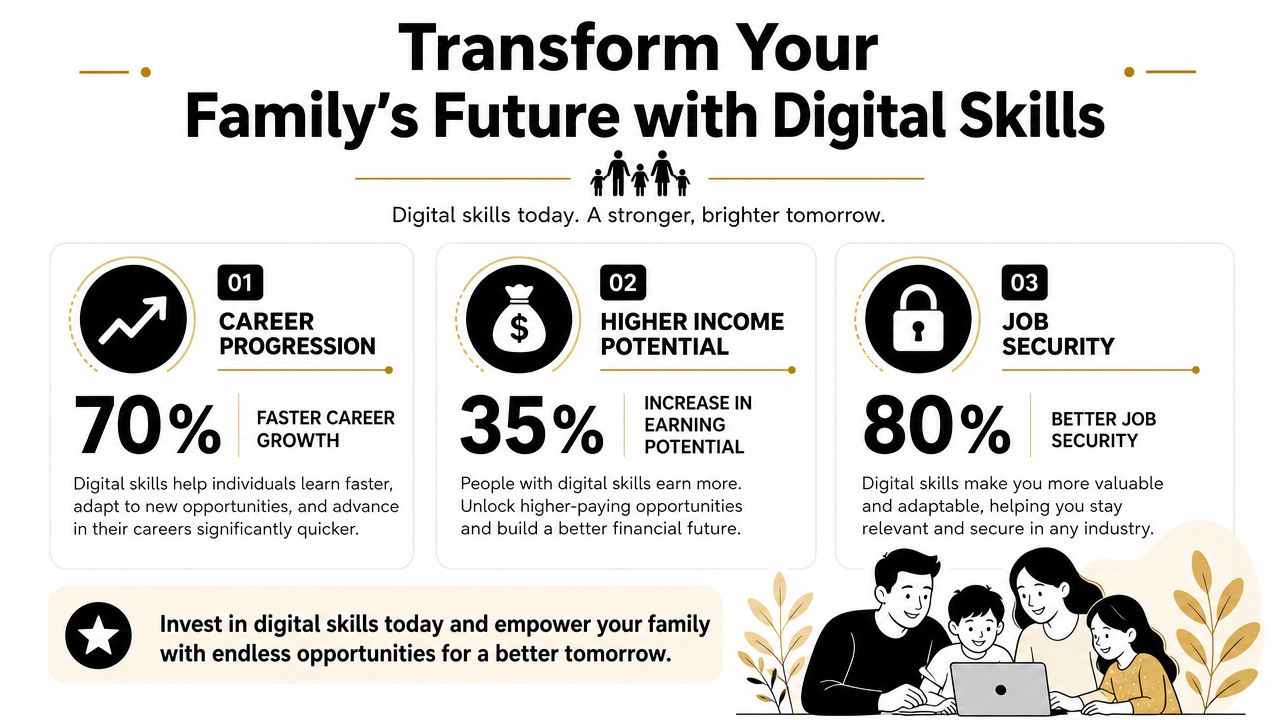
The House of Commons Library briefing on digital exclusion and the economy states that the digital skills gap costs the UK economy an estimated £63 billion every year. By gaining these skills, you are not just improving your own life. You are becoming one of the most in-demand people in the entire country.
Better work can start with basic confidence
Many jobs now begin with a digital step. You search online. You fill in a form. You upload a CV. You reply to messages. You may even need to take online training once you get the role.
If you've been thinking about office work, admin, customer service, or IT support, growing your confidence with digital tools can open new doors. Some adults also use this stage to explore routes into technical study, such as CompTIA A+ training for entry-level IT knowledge, once they feel ready for something more specialised.
Your children notice more than you think
Children don't only learn from what we say. They learn from what we do.
When they see you studying, asking questions, and sticking with something difficult, they learn resilience. When they see you sending emails, joining online lessons, or practising new tasks instead of giving up, they learn that progress matters more than perfection.
A parent who keeps learning gives their child permission to believe in their own future.
Everyday family life gets easier
Digital literacy skills can also reduce stress at home. They help you:
- Manage school communication through email, portals, or apps
- Handle household tasks like paying bills or checking appointments online
- Support homework when schools use websites and digital resources
- Plan ahead by comparing courses, jobs, travel, or childcare information online
The result isn't just convenience. It's a stronger sense that you can cope with modern life instead of feeling pushed around by it.
And when you feel more capable, your family feels it too.
Easy Ways to Start Building Your Digital Skills Now
The fastest way to build confidence is to stop waiting for the perfect moment. Start with tiny actions. Small tasks feel less scary, and each one teaches your brain, “I can do this.”
The NCFE report on digital participation says that 20% of people in the UK still lack the essential digital skills for life, such as being able to transact online or manage their safety. Mastering even one of these micro-tasks is a significant step towards full digital participation.
Start with tasks that already fit your life
You don't need expensive equipment or hours of free time. If you have a phone, tablet, laptop, or access to a library computer, you can begin.
Try a few of these:
Search for something useful
Open Google and find the opening times for your local library, GP surgery, or supermarket. This builds confidence with search words.Send one simple email
Write a short message to a trusted friend or family member. Use a subject line such as “Test email from me”.Save a note on your device
Type a shopping list or weekly plan in Notes, Word, or Google Docs, then save it.Watch a how-to video
Use YouTube to find a tutorial about cooking, gardening, DIY, or another hobby you enjoy. This makes learning feel familiar.
Build one habit at a time
A lot of learners get confused because they try to learn everything at once. It's better to repeat one task until it feels normal.
For example:
- Monday: Practise opening your email and reading messages
- Wednesday: Search for bus times or college information
- Friday: Type a few lines in a document and save it
Small-win method: If a task takes under ten minutes, it's a good practice task.
Try these confidence-building challenges
These are a little more advanced, but still manageable.
- Create a folder on your laptop or phone called “My Learning”
- Rename a file so you can find it later
- Download a document and then locate it again
- Use a password you can remember safely instead of reusing the same easy one everywhere
- Fill in a practice form such as a newsletter sign-up, checking each box before you submit
What to do when you get stuck
Getting stuck doesn't mean you've failed. It means you've reached the part where learning happens.
Use this simple rescue plan:
| Problem | What to try |
|---|---|
| I can't find a file | Check Downloads, Documents, or search by filename |
| I forgot my password | Use the “forgot password” link and follow the steps slowly |
| I don't understand a button | Hover over it, tap carefully, or search what that button means |
| I'm worried I'll break something | Practise on a non-important task first |
A calm approach helps more than speed. Read screens line by line. Press one thing at a time. If something goes wrong, pause and go back. Most digital mistakes can be fixed.
Real Stories From Adult Learners
Leanne had been out of education for years. She worked hard, looked after her family, and kept putting herself last. When she finally decided to study again, she wasn't most worried about the course content. She was worried about the laptop.
The first week felt clumsy. She forgot passwords, clicked the wrong tabs, and took ages to upload a document. But she kept a notebook beside her and wrote down each step. “Open browser. Log in. Find lesson. Download worksheet.” After a while, those steps stopped feeling strange.
A few months later, Leanne was using email with confidence, joining online lessons, and submitting work on time. What changed most wasn't only her skill level. It was the way she saw herself. She no longer said, “I'm no good with technology.” She started saying, “I'm learning.”
A dad who wanted to help at home
Mark wanted to improve his job options, but another reason pushed him forward. His daughter kept bringing home school tasks that used websites and online logins. He hated feeling unable to help.
So he began with the basics. He learned how to search properly, open attachments, and spot the difference between a real school message and junk mail. Once those tasks felt easier, he felt ready to return to formal study.
Progress often starts with something deeply personal. A child asking for help can become the reason a parent changes their future.
Now Mark handles online forms with less stress, supports school communication at home, and feels more prepared to take on qualifications that can lead to stronger work opportunities.
These stories are representative, but they're common for a reason. Adult learners rarely need magic. They need patience, support, and proof that confidence can be rebuilt.
Get a Qualification in Your New Digital Skills
Self-taught practice is a strong start, but a recognised qualification can take your progress further. It turns effort into something you can show employers, training providers, and future course tutors.
For adults returning to education, structure matters. When you're learning alone, it's easy to miss steps or lose heart. A formal course gives you a clearer path. It breaks digital literacy skills into lessons you can follow, with support when something doesn't make sense.
Why qualifications matter
A qualification doesn't just say you tried. It shows that you can use digital tools in a practical, organised way.
That can support you if you want to:
- Prepare for Functional Skills or GCSE study that uses online learning systems
- Improve your CV with evidence of up-to-date skills
- Get ready for workplace tasks like documents, email, and online communication
- Build towards further study with more confidence in using digital platforms
The FutureDotNow summary of workforce upskilling says that fully upskilling the UK workforce with essential digital skills is estimated to boost the economy by over £23 billion annually. Gaining a formal qualification places you at the centre of this economic growth.
What supportive study can look like
A good course should feel clear, not cold. It should explain basics without talking down to you. It should recognise that adult learners often juggle work, children, caring duties, and self-doubt at the same time.
If you're looking for a recognised starting point, an NCFE Level 1 Digital Functional Skills course can provide a structured route into these essential skills.
Some learners also benefit from seeing how online learning works before they commit. This short video gives a feel for what supported online study can look like.
The link between digital skills and wider study goals
If your bigger dream is university, don't dismiss these early digital steps as “just basics”. They are the foundation.
Online research, submitting assignments, checking feedback, joining student systems, and managing timetables all depend on digital confidence. The learner who can log in, stay organised, and ask for help online is in a far stronger position to keep going when a course gets demanding.
Qualifications in digital skills can be the quiet turning point that makes everything else feel possible.
Your New Beginning Starts Today
You don't need to be naturally “good with computers” to build digital literacy skills. You need practice, patience, and the courage to keep going when something feels new.
You've already done something important by reading this far. You've faced the subject instead of avoiding it. That matters. It means part of you is ready for change, even if another part still feels nervous.
A better future for your family is built through ordinary actions repeated over time. One email sent. One file saved. One lesson completed. One course passed. Those steps may look small from the outside, but they can lead to real pride, stronger job options, and a powerful example for your children.
You can become the adult who didn't give up. The one who returned to learning. The one who showed their family what determination looks like.
Start where you are. Keep it simple. Let confidence grow.
If you're ready for a supportive next step, Next Level Online College offers flexible online courses designed for adult learners across the UK. Whether you're starting from scratch or building towards Functional Skills, GCSEs, A Levels, or university, you can explore a path that fits around work, family, and real life.