
You might be reading this after a long day. Maybe the children are finally quiet. Maybe you're thinking about bills, work, and that uncomfortable feeling that life could be better, if only you knew where to start.
A lot of adults feel exactly like that when they look at education again. They want a career with more stability. They want work they can be proud of. They want their children to see them trying, learning, and moving forward. But confidence can feel shaky when you've been out of study for a while.
That's why a CompTIA A+ course matters to so many people. It isn't just about computers. It's about taking one brave step towards a new future.
Your First Step Towards a New Career in Tech
It is 9:30 at night. The house is finally quiet. A parent sits at the kitchen table with a cup of tea gone cold, looking at a course page and wondering, “Could I really do this?”
That question matters. It is not only about learning computers. It is about building a steadier future, proving to yourself that you can grow again, and showing your children what courage looks like in everyday life.
Many adult learners start here. They are hardworking people who have spent years putting family, bills, and other responsibilities first. They want a career that feels more secure, but they also want something deeper than a payslip. They want to feel proud when they say what they do. They want their family to see them working towards something better.
CompTIA A+ gives that goal a clear shape.
A+ is widely known as an entry-level IT support qualification. It connects well with beginner roles such as help desk, service desk, and desktop support, and it is often chosen by people starting fresh or changing careers. For someone who feels unsure where to begin, that matters. A clear first step is easier to commit to than a vague idea of “getting into tech.”
And that is often the biggest hurdle. Adult learners do not usually need more ambition. They need a path they can trust.
Why this first step matters so much
Starting a course like this can mean far more than gaining a certificate. It can mean:
- More stability: a route into work that is organised, practical, and used by employers
- More pride: being able to say, “I went back to learning, and I finished what I started”
- A stronger example for your children: showing them that progress is possible at any age
- A clearer path: moving from guessing to following a structured plan
Studying again can feel intimidating at first. That is normal. If you have been away from education for years, you might worry that everyone else will understand the technical terms faster, learn quicker, or feel more confident.
They will not all feel confident. Many are nervous too.
A good starting qualification works like the first few lessons in driving. You are not expected to handle every road on day one. You begin with the basics, practise them, and build control step by step. A CompTIA A+ course does the same job for tech. It helps you build a foundation, one skill at a time, until the subject stops feeling out of reach.
You do not need to be a computer expert before you start. You need the willingness to begin.
For many adults, that choice changes more than their CV. It changes how they see themselves. Instead of saying, “I wish I had done something different,” they can say, “I am training for a better future.”
That is a powerful sentence. So is this one.
You can do this.
What You Will Learn in a CompTIA A+ Course
A good CompTIA A+ course teaches you how to solve everyday tech problems calmly and step by step.
That matters more than many adults expect. You are not just learning computer terms for an exam. You are building the kind of practical knowledge that can lead to stable work, steady progress, and a future your family can feel proud of. For many learners, each topic mastered is proof that going back to education was a brave decision worth making.
The main areas you will study
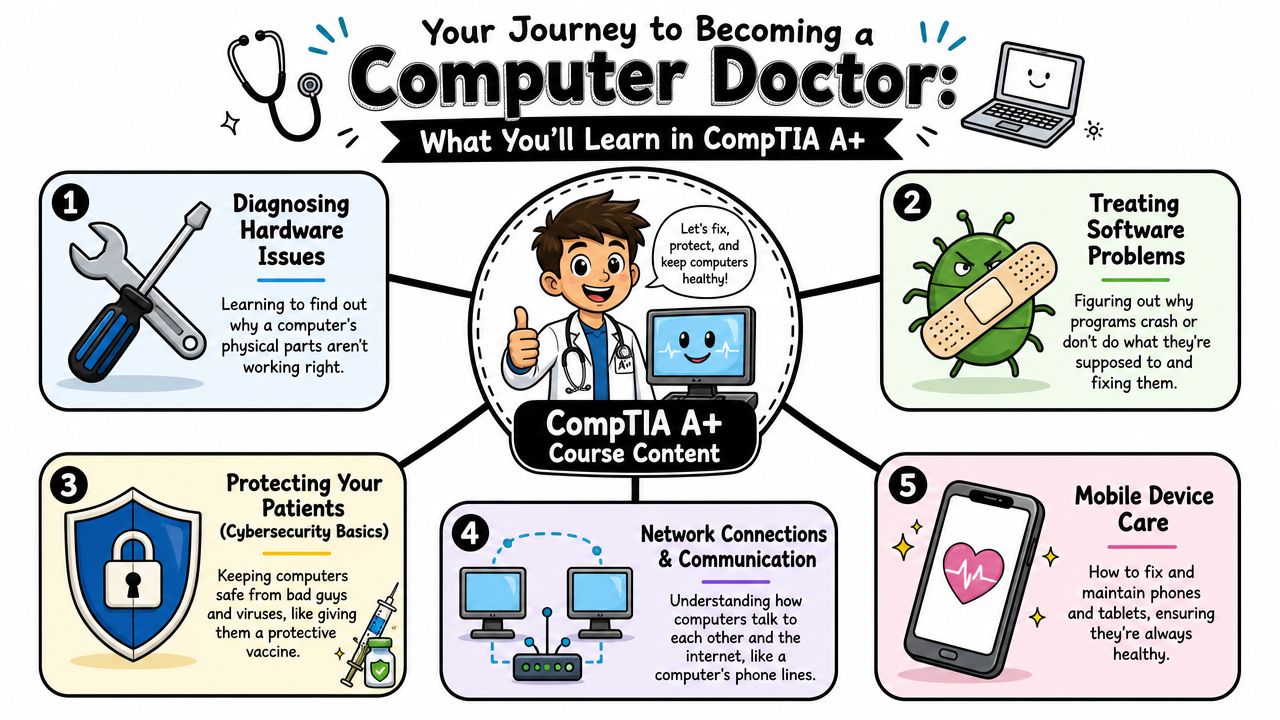
The course material can be compared to learning how a system works as a whole. Each part has a job, and when one part goes wrong, you learn how to spot it.
- Hardware: the physical parts of a computer, such as memory, storage, screens, cables, and internal components
- Networking: how devices connect and share information
- Operating systems: software like Windows, macOS, and Linux that helps the device run properly
- Security: how to protect devices, accounts, and data from common risks
- Mobile devices: phones and tablets, which are part of day-to-day support work
- Troubleshooting: how to work through a problem in a clear order until you find the cause
If words like "operating systems" or "networking" sound intimidating, that is completely normal. A beginner-friendly course teaches these topics in a sensible order, so you are not expected to understand everything at once.
What that learning looks like day to day
One lesson might show you why a laptop will not start. Another might explain why a printer will not connect, why Wi-Fi keeps dropping, or why a user cannot sign in. Later, you learn how to test possible causes instead of guessing.
That is what makes the course feel practical. You are learning how to fix the kinds of problems that happen in homes, offices, schools, and businesses every day.
Here is a simple view of the course content:
| Part of the course | Plain English meaning |
|---|---|
| Hardware | What the machine is made of |
| Networking | How devices talk to each other |
| Operating systems | The main software that runs the device |
| Security | How to keep systems safe |
| Troubleshooting | How to find the problem and fix it |
Practical rule: if you can follow instructions, spot patterns, and stay patient with a problem, you can learn IT troubleshooting.
Many adult learners worry they need years of experience before they start. A good course expects the opposite. It starts with the basics, gives you room to practise, and helps your confidence grow one small win at a time.
That emotional side matters. The first time you understand a technical problem and explain it in plain English, something shifts. You stop seeing yourself as someone who is "trying to get into tech" and start seeing yourself as someone who belongs there.
And that can mean a great deal at home. Your children see you studying. Your family sees you sticking with something difficult. You see yourself making progress toward a career that offers more security and a stronger sense of pride.
You can learn this. One topic at a time.
Understanding the CompTIA A+ Exams
The exam part often makes adults freeze. They picture one giant test, full of impossible questions, with no room for nerves.
That isn't how A+ works.
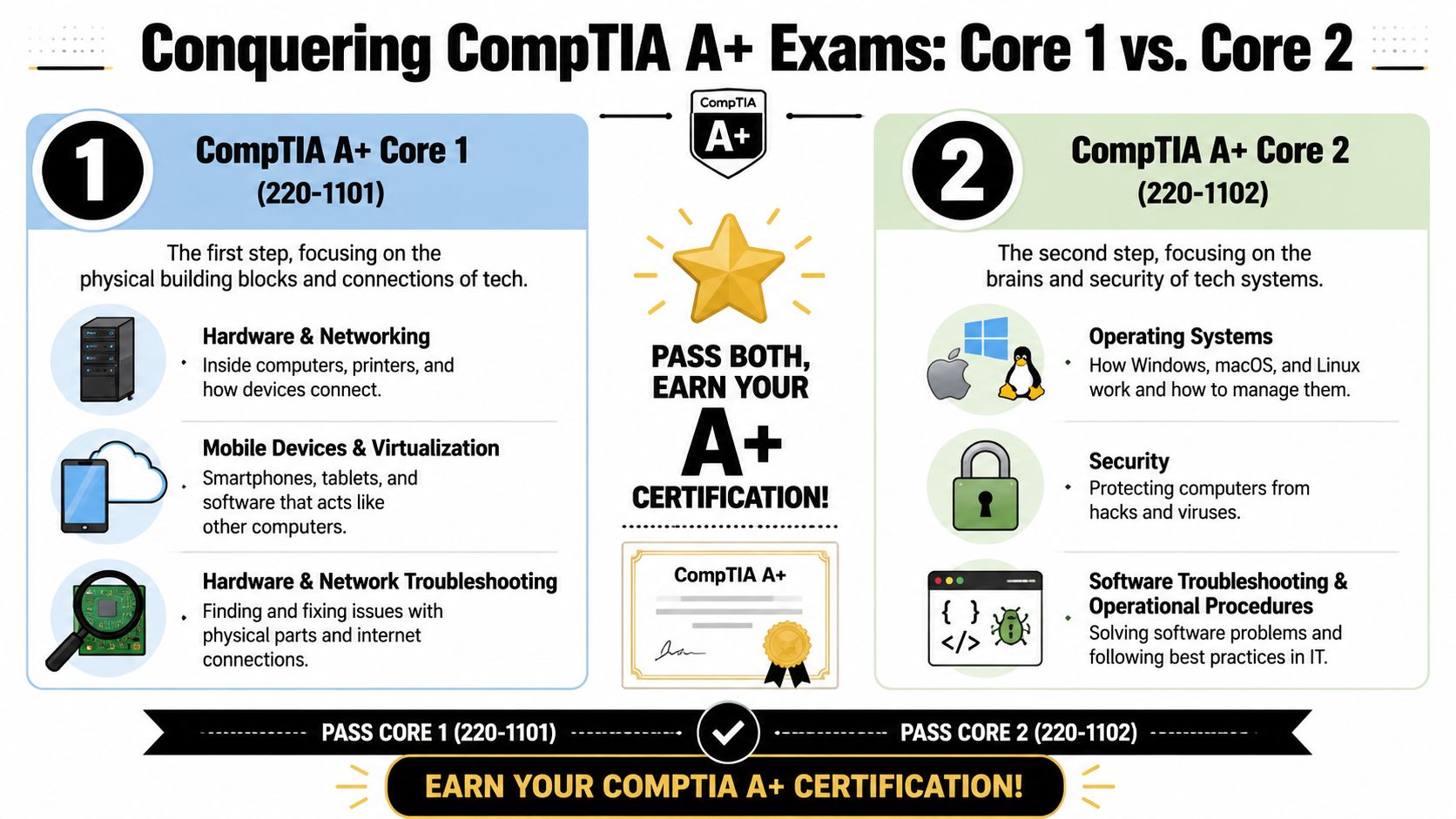
The qualification is made up of two exams. They are Core 1 (220-1201) and Core 2 (220-1202), and both must be taken from the same version. Each exam has up to 90 questions, each lasts 90 minutes, and the passing scores are 675 out of 900 for Core 1 and 700 out of 900 for Core 2 according to CompTIA's Core 1 and Core 2 v15 page.
That structure matters because it breaks the journey into two manageable parts.
What Core 1 feels like
Core 1 is the part many learners think of as the “physical tech” side.
It focuses on areas such as hardware, networking, mobile devices, and troubleshooting those kinds of issues. Continuing with the computer doctor idea, you learn to check the body and its connections.
You are learning things like:
- Device parts: what common components do
- Connections: how machines link to networks and other equipment
- Mobile tech: how phones and tablets fit into support work
- Problem finding: how to narrow down what is wrong
What Core 2 feels like
Core 2 moves more into the system that runs the machine and the rules that keep it safe.
That includes operating systems, security, software troubleshooting, and operational procedures. This is closer to understanding the computer's brain and immune system.
A simple comparison helps:
| Exam | Main focus |
|---|---|
| Core 1 | Hardware, networking, mobile devices |
| Core 2 | Operating systems, security, software issues |
Passing A+ isn't about being perfect. It's about showing that you can handle the basics across the real tasks that entry-level IT support jobs involve.
Many adults also worry about exam pressure. A useful way to look at it is this. The tests are not there to catch you out. They are there to check whether you can use the skills the job asks for.
Because the learning is split into two parts, you can focus your attention properly. You don't need to hold every topic in your head all at once. You prepare for one block, then the other. That makes the goal feel much more reachable.
And once you've passed both, you haven't just “sat an exam”. You've proved to yourself and to employers that you can learn new skills and apply them with care.
How to Choose an Online CompTIA A+ Course
Not every online course is a good fit for an adult with work, family, and real life going on in the background.
A shiny webpage isn't enough. You need a course that works for the way adults study. That usually means late evenings, weekends, and stolen little pockets of time between other responsibilities.
Look for support, not just content
Some courses give you videos and leave you alone with them. That can be hard when your confidence is already low.
A better option is a course that understands adult learners may need help when they get stuck, lose momentum, or need something explained in plainer language. Support matters because returning to study is not only an academic challenge. It is also a confidence challenge.
When comparing options, look for these signs:
- Flexible study: can you learn around shifts, school runs, and family life?
- Clear structure: does the course show a sensible order for learning?
- Human support: can you ask questions when a topic doesn't click?
- Encouragement: does the provider seem to understand nervous learners?
Check the practical side of home study
A CompTIA A+ course also has a technical side to think about, especially if you plan to learn or sit exams online.
CompTIA's technical requirements for remote assessment include at least 3.6 Mbps internet bandwidth per user, a CPU around 2.4 GHz or faster, 4 GB RAM or more, and a compatible 64-bit Windows, macOS, Linux, or ChromeOS device according to CompTIA's technical specifications guidance.
That means your course provider should understand normal home-learning problems. Slow broadband, shared laptops, noisy rooms, and tired evenings are not rare exceptions. They are common.
Choose a course that fits your life as it is now, not the perfect life you wish you had.
You may also find it helpful to compare broader accredited online courses in the UK so you can see what good learner support looks like across different subjects.
Questions worth asking before you enrol
Try asking these before you commit:
- Is it beginner-friendly? You shouldn't feel punished for being new.
- How is the learning organised? A clear route helps you keep going.
- What happens if I lose confidence halfway through? Strong support matters.
- Can I study at my own pace? Adult life is rarely neat.
- Does the provider understand online learning at home? This is more important than many people realise.
A good choice won't make the work disappear. But it will make the journey feel steady instead of lonely.
Your Plan for Success as an Adult Learner
Most adult learners don't fail because they lack ability. They struggle because life is busy, energy is limited, and self-doubt talks too loudly.
The answer is not to become superhuman. The answer is to build a routine that is small enough to keep and strong enough to move you forward.
Build small wins into your week
One A+ exam lasts 90 minutes and has up to 90 questions, which works out at about one minute per question according to this training reference on exam timing. That means part of your preparation should include calm, steady time practice.
You don't need huge study days to get there. You need regular contact with the material.
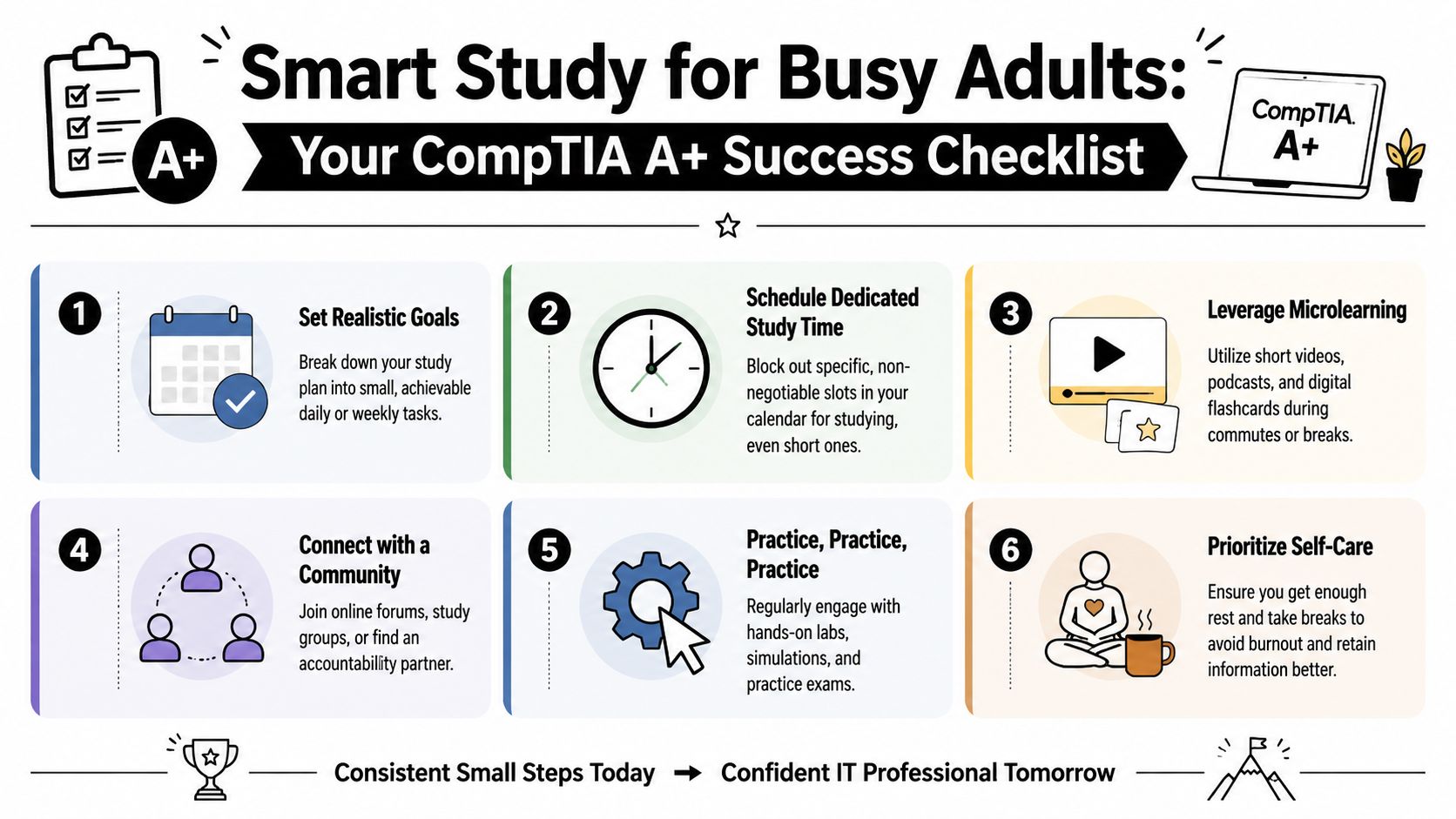
Try habits like these:
- Use short study blocks: twenty or thirty focused minutes can do a lot
- Keep one study space: even a small corner table can train your brain to settle
- Study at the same time when possible: routine reduces stress
- End with one quick recap: this helps ideas stick
Make your family part of the journey
Adult study feels lighter when the people around you understand why it matters.
Tell your children or partner what you are doing. Let them see your notes. Let them celebrate when you finish a module or understand a tricky topic. That turns learning into a shared story of progress, not a private struggle.
Some adults even find motivation in saying, “I'm doing homework too.” Children notice that. They remember it.
Keep this in mind: every study session is evidence that you're building a better future, even if today's progress feels small.
If managing your week feels hard, these practical time management tips for students can help you create a routine that works in real life.
Be kinder to yourself than you think you need to be
You may forget things. You may need to replay lessons. You may have a week where family life takes over.
That does not mean you are failing. It means you are human.
A simple reset plan helps:
- Missed a few days? Start again with one short session.
- Feeling behind? Focus on the next topic, not the whole course.
- Worried about exams? Practise under gentle time pressure, then build up.
- Confidence low? Look back at what you already understand now that you didn't before.
Studying as an adult is not about looking impressive. It is about staying steady long enough for change to happen.
Your Future Career with a CompTIA A+ Qualification
It is late in the evening. The house is finally quiet. You close your laptop after another study session and realise something important. You are not only learning how computers work. You are building a more secure future for the people who rely on you.
That is why this qualification matters.
For many adults, a CompTIA A+ course is the first real step into stable work in tech. It can lead to entry-level roles where you solve everyday IT problems, help users get back to work, and become the calm person others turn to when something goes wrong. In practical terms, that often means jobs such as helpdesk support, service desk support, desktop support, and junior IT support.
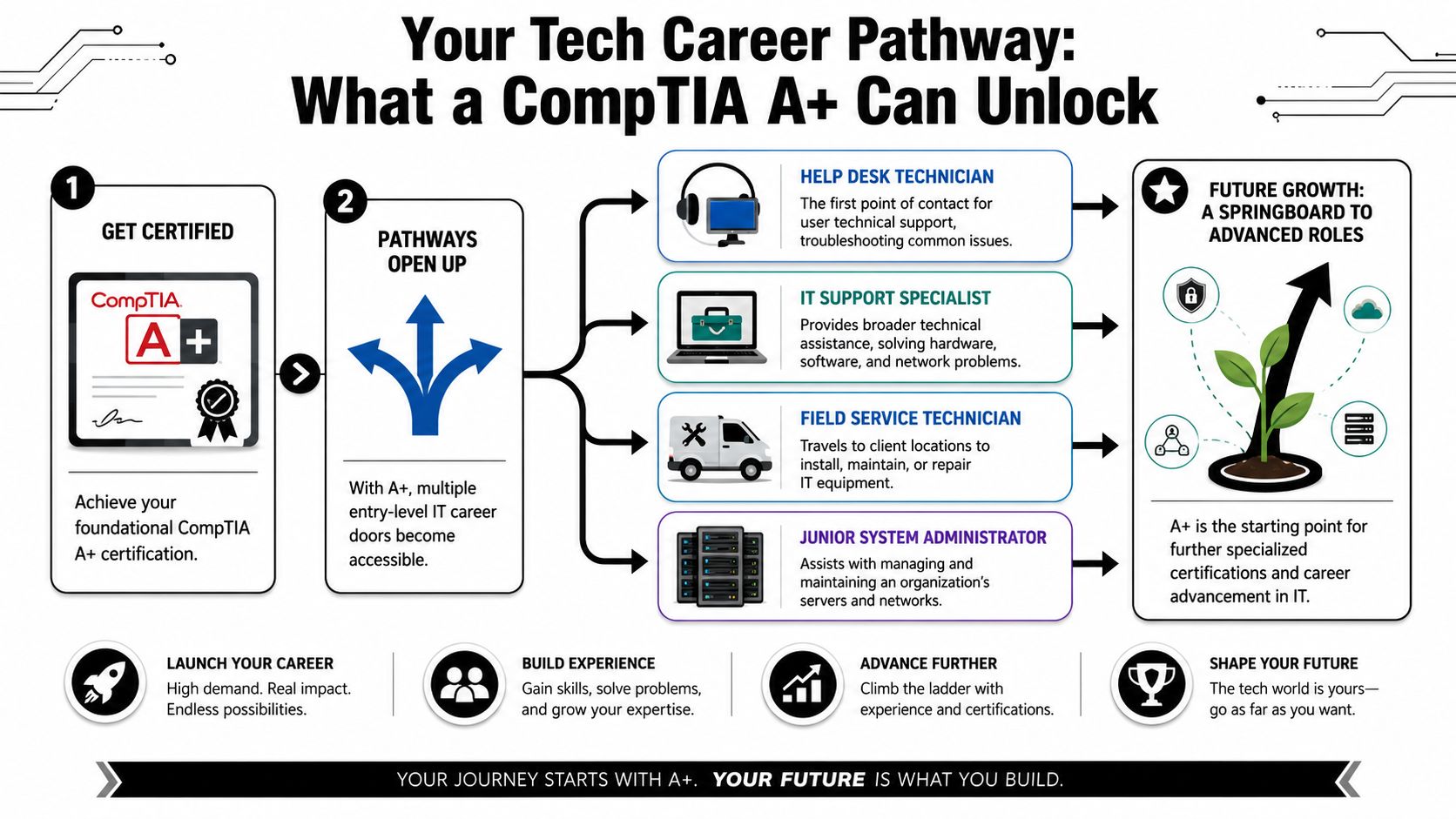
These roles may sound modest at first, but they are where many strong careers begin. They give you paid experience, proof that you can do the work, and a chance to grow your confidence one solved problem at a time. A helpdesk role is a bit like learning to drive on local roads before joining a motorway. You build control first, then range.
The kinds of roles it can lead to
A+ connects well with support-based roles where patience, clear thinking, and reliability matter just as much as technical knowledge.
That can include roles such as:
- Helpdesk support: answering user questions and guiding people through fixes
- Service desk support: logging issues, prioritising them, and helping keep support organised
- Desktop support: setting up devices, fixing faults, and keeping staff productive
- Junior IT technician roles: helping a wider team maintain the systems a business uses every day
If you are worried that these jobs sound too technical, pause there for a moment. Many of them are built around practical problem-solving. You do not need to know everything on day one. You need a foundation, a willingness to learn, and the confidence to start.
Why this matters beyond the job title
The job title is only part of the story.
The bigger change is often personal. You become someone who kept going. Someone who returned to learning, even after a long break. Someone your children can watch and say, "If they can do that, maybe I can do hard things too."
That example stays with a family.
A qualification like this can also open your mind to future study. Once your confidence grows, you may start looking at broader computing routes and subjects such as A Level Computer Science pathways. Not because you must decide everything now, but because success tends to make the next goal feel possible.
A+ can be the start of something bigger
As noted earlier, CompTIA offers certifications across different areas of IT. That is one reason A+ is often seen as a starting point rather than the final destination.
After you gain experience in support, you may choose to move into networking, cybersecurity, cloud, or another specialist area. Many adults find that the first win matters most. It proves they can learn again, pass an exam again, and change direction again.
That proof is powerful.
A CompTIA A+ course can give you a respected starting point, a clearer career path, and a genuine chance to build work that feels steady and worthwhile. For an adult who wants to make their family proud, that matters.
You do not need perfect confidence before you begin. You build confidence by beginning.
And yes, you can do this.
If you're ready to take that first brave step, Next Level Online College offers flexible online learning built around adult life in the UK. With strong support and a focus on helping returners rebuild confidence, it can be a practical place to start turning hope into a real plan.