

Some evenings feel like a race you can't win. You finish work, sort dinner, answer a message from school, look at the washing, then remember your assignment is still waiting. By the time you sit down, your energy has gone and your confidence has gone with it.
If that sounds familiar, you're not failing. You're living a busy adult life while trying to build a better future.
That's why time management for students matters so much. It isn't about becoming a perfectly organised person with colour-coded folders and a flawless routine. It's about giving your goals a real place in your week, even when life is noisy. It's about proving to yourself that your education matters too.
Your First Step to a Brighter Future
When adults come back to learning, they often think the hardest part will be the subject itself. Sometimes it is. But very often, the main battle is finding steady time to study without feeling guilty, rushed, or exhausted.
That struggle is common. Student experience surveys consistently show that time management is one of the skills most closely linked to academic success, and UK higher education serves over 2.9 million students according to this UK higher education research summary. So if you feel like keeping up is hard, you're in very good company.
Why this matters more than you think
Poor time management doesn't just lead to late work. It can chip away at your self-belief.
You start to think:
- “Maybe I'm not cut out for this.”
- “I've left it too late.”
- “Other people are coping better than me.”
Most of the time, that isn't true. The problem usually isn't your ability. It's that your days are already full, and no one has shown you how to build study into real life.
Practical rule: Good time management isn't about squeezing every minute dry. It's about deciding what matters and protecting some space for it.
Progress beats perfection
You don't need the perfect planner. You don't need long silent afternoons. You don't need to suddenly become a different person.
You need a system that works on normal days, not ideal ones.
That may mean studying at the kitchen table. It may mean doing half an hour after the school run. It may mean reading notes on the bus, writing a paragraph while dinner cooks, or using a Sunday evening to plan the week ahead. Small steps still count.
Here's the truth I want you to hold on to. Every time you keep a study promise to yourself, you build trust in yourself. That matters far beyond coursework. It changes how you see your future. It shows your children that effort matters. It shows your family that change is possible. It reminds you that your dreams are still worth making room for.
You can learn this. You can get more organised. And you can build a routine that helps you move forward, one honest week at a time.
Set Goals That Inspire You and Your Family
A timetable helps, but it won't carry you through a hard week on its own. You also need a reason strong enough to pull you back when you feel tired.
For many adult learners, that reason is personal. You might want a better job. You might want to earn more. You might want to prove to yourself that you can finish what you started. You might want your children to see you studying and learn that it's never too late to grow.

Start with your real reason
Forget fancy goal-setting language for a moment. Ask yourself these simple questions:
- What do I want my course to help me do?
- Who am I doing this for?
- What will change in my life if I keep going?
- How will I feel when I pass?
Your answers might sound like this:
| Goal | Deeper reason |
|---|---|
| Pass my maths course | Help my child with homework and move towards university entry |
| Finish my qualification | Apply for a better job with confidence |
| Get back into study | Show myself I can still learn and succeed |
That second part matters most. “Pass the course” is a target. “Make my family proud and open new doors” is a reason to keep going when motivation dips.
Keep your goals simple and visible
Write down one main goal and two smaller support goals.
For example:
- Main goal: Complete my course successfully.
- Support goal 1: Study on three set evenings each week.
- Support goal 2: Hand work in before the deadline whenever I can.
Put those goals somewhere you'll see them. Try your fridge, notebook, phone wallpaper, or study space. If your course provider offers structured support, tools such as personalised learning plans can help turn a big ambition into clear weekly actions.
Your goal should make you feel something. If it doesn't, it won't help much on tired days.
Choose words that build confidence
A lot of learners write goals in a harsh way. They tell themselves to “stop being behind” or “finally get it together”. That language makes studying feel like punishment.
Try kinder, stronger wording instead:
- “I'm building a better future.”
- “I'm becoming a role model for my children.”
- “I'm giving myself another chance.”
- “I'm working towards a career that fits my potential.”
This may sound small, but it changes the way you approach your week. Time management for students becomes easier when your plan is tied to hope, not shame.
When your reason is clear, the hard days still feel hard. But they don't feel pointless. And that makes all the difference.
How to Decide What to Do First
A long to-do list can make you freeze. Everything looks urgent. Everything feels important. So you bounce from one task to another and end the day feeling busy but not satisfied.
That's where a simple decision tool helps. Many people call it the Eisenhower Matrix, but you don't need the fancy name. Think of it as four boxes: Now, Later, Ask for Help, Drop.
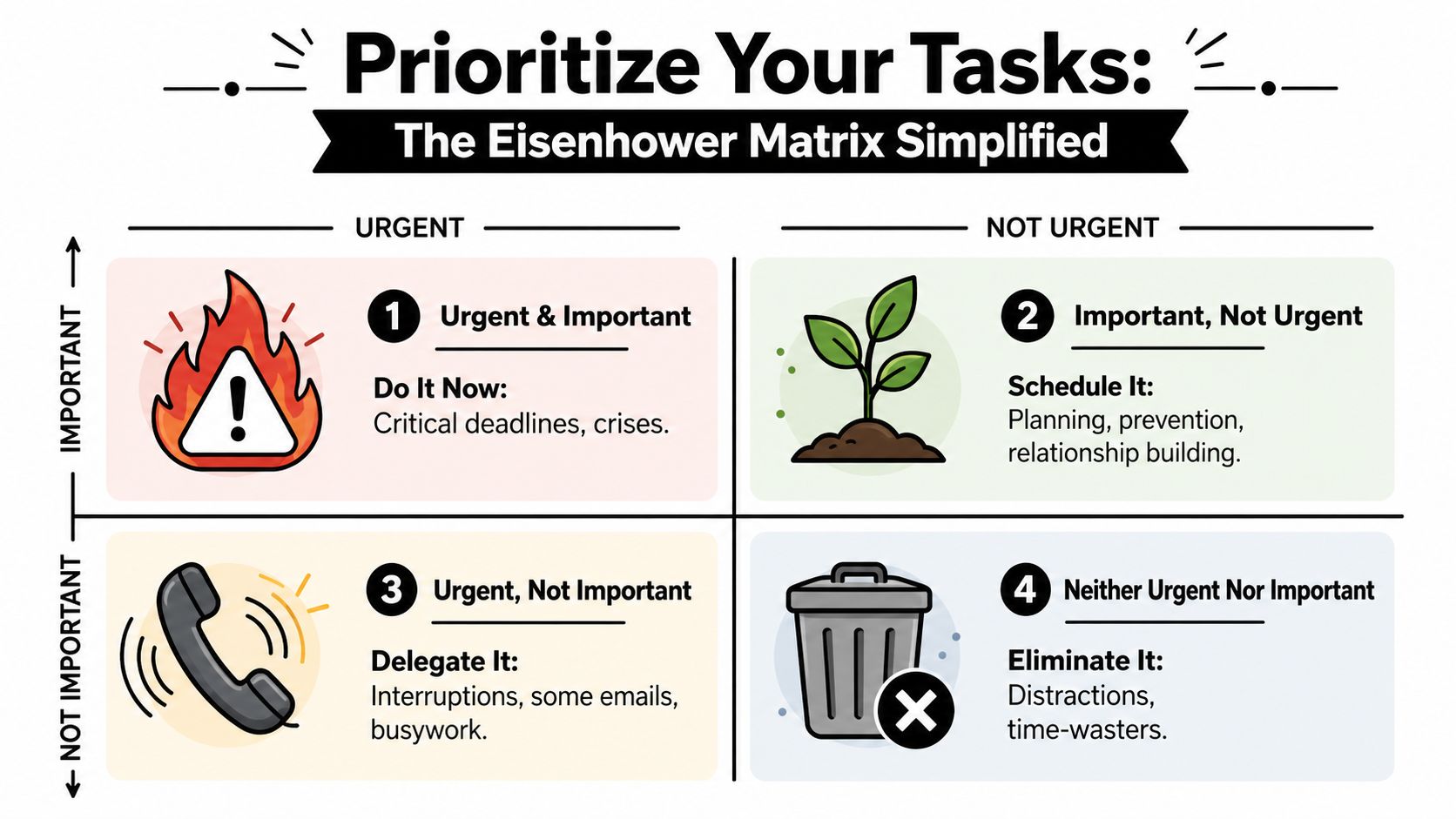
The four boxes that clear your head
Here's a simple way to use it:
| Box | What it means | Example |
|---|---|---|
| Now | Urgent and important | Assignment due tomorrow |
| Later | Important but not urgent | Planning next week's revision |
| Ask for Help | Urgent but not central | Someone else can collect the shopping |
| Drop | Neither urgent nor important | Endless scrolling on your phone |
This works because it stops you treating every task the same way.
A coursework deadline and a random notification are not equal. A quiet hour spent planning an essay often matters more than doing five tiny jobs that only feel productive.
Try it with a real day
Let's say your Wednesday looks like this:
- finish part of an assignment due tomorrow
- reply to a group chat
- book a dentist appointment
- start reading for next week
- tidy a cupboard
- watch videos you didn't plan to watch
Put them into the boxes.
Now: finish the assignment
Later: start reading for next week
Ask for Help: see if someone else can make one phone call or do one errand
Drop: unplanned videos and unnecessary scrolling
That one choice can rescue your evening.
Focus on what moves learning forward
Many adult learners spend too much energy on the small stuff because the big tasks feel scary. It feels easier to answer messages, tidy the house, or re-write a neat list than to begin the essay.
That's why active study matters. If you want practical ways to make study time count, active learning strategies can help you turn reading and note-taking into real progress.
A useful question is this: “If I only get one study task done today, which one will help my future self most?”
Keep that question close. It cuts through noise fast.
When you know what belongs in the Now box, you waste less time feeling torn. You sit down and begin. That's a powerful habit, especially when your week is already crowded.
Create a Weekly Timetable That Works for You
A timetable sounds boring to some people. To me, it sounds like relief. Once your week is written down, your brain stops trying to remember everything at once.
The key is to build your plan around real life, not fantasy life. UK higher-education guidance supports a 1:2 to 1:3 study-time ratio, which means for every hour in class, you should usually plan 2 to 3 hours of independent study. It also explains that a 15-credit module typically needs about 150 to 225 hours of total learning time, and that fixed weekly blocks work better than last-minute cramming, as outlined in this study planning guidance on learning time and weekly blocks.
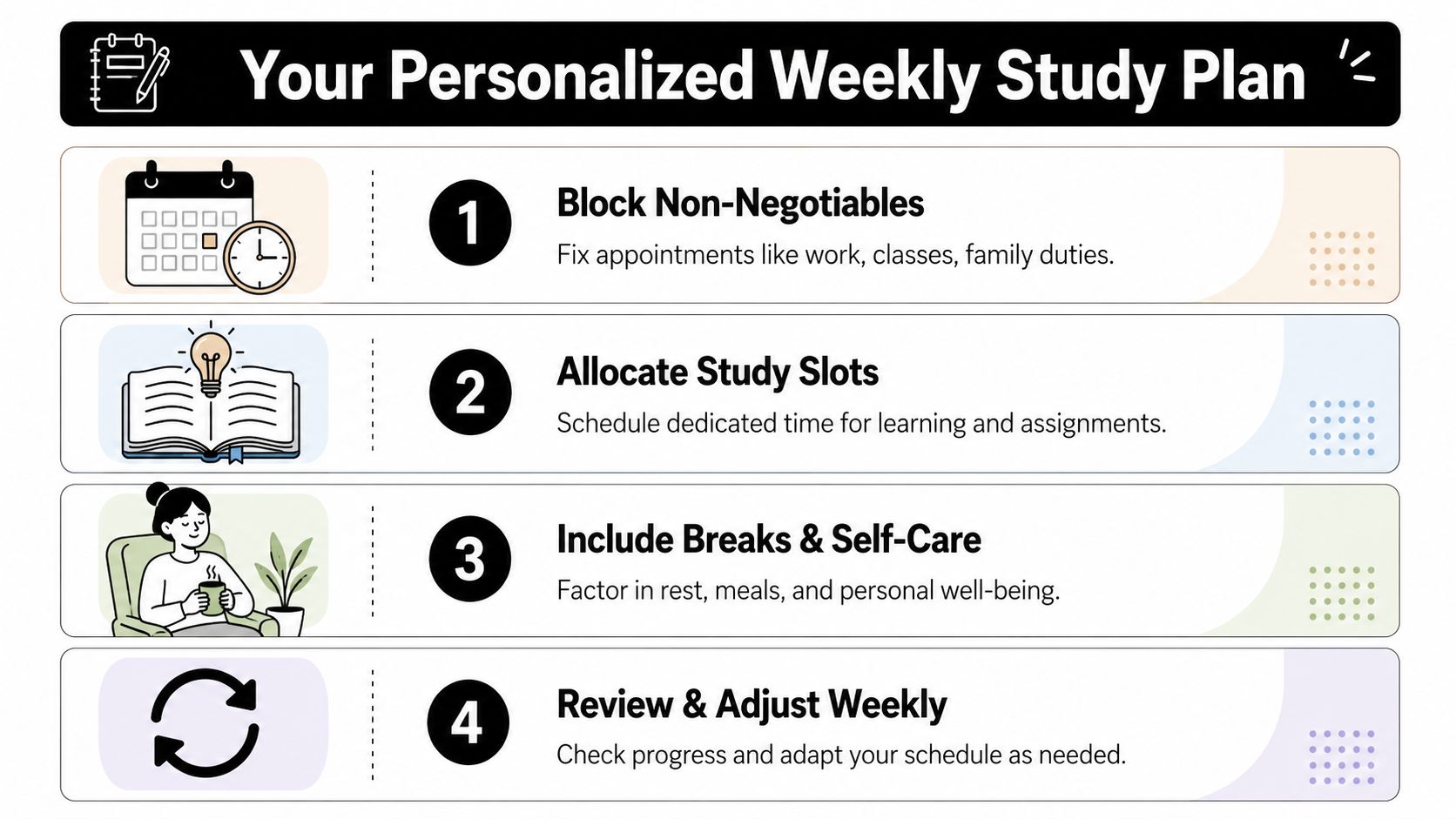
Start with what cannot move
Before you add study, block out the fixed parts of your week.
That includes:
- Work shifts
- Classes or tutorials
- School runs
- Meals
- Appointments
- Family duties
- Sleep
This step matters because many learners make the same mistake. They plan study first, then discover there's no realistic space for it.
Add recurring study blocks
Once your fixed commitments are in, look for regular pockets of time. These don't need to be huge. A steady hour on Tuesday and Thursday is often more useful than hoping for a free Saturday that never arrives.
Try this sequence:
- Map your non-flexible commitments first
- Choose recurring study blocks
- Leave buffer time for delays
- Protect recovery time so you don't burn out
Common problems are underestimating how long tasks take, skipping breaks, and treating every task as equally urgent. A timetable works best when it includes breathing room.
Fixed study blocks beat good intentions. If it isn't in the week, it often won't happen.
Use small sessions if you're starting out
If a two-hour study session feels too much, start smaller. One gentle method is the Pomodoro approach: study for 25 minutes, then take a 5-minute break. That can help you begin without feeling trapped at your desk.
A few examples of what fits into a short block:
- 25 minutes: read and highlight one topic
- 25 minutes: answer a few practice questions
- 25 minutes: write one paragraph of an assignment
- 25 minutes: organise notes for tomorrow
Small sessions build rhythm. Rhythm builds confidence.
A simple weekly example
Here's what a realistic plan might look like for someone juggling work and family:
| Day | Study block | Focus |
|---|---|---|
| Monday | 7.30 pm to 8.00 pm | Review class notes |
| Tuesday | 6.30 am to 7.00 am | Read one section |
| Thursday | 8.00 pm to 8.30 pm | Assignment paragraph |
| Saturday | 10.00 am to 11.00 am | Deeper study session |
| Sunday | 5.00 pm to 5.20 pm | Plan the next week |
That may not look dramatic. But it's real. And real wins.
If you study online, use familiar tools that are easy to check. A paper diary works well. So do Google Calendar, your phone reminders, or a wall planner in the kitchen. The best tool is the one you'll consistently open.
Review, don't judge
At the end of the week, take five minutes to ask:
- What worked?
- What kept getting missed?
- Was I too ambitious?
- Where do I need more buffer time?
This isn't about telling yourself off. It's about improving the plan.
Time management for students gets easier when your timetable becomes a living tool, not a test of whether you're disciplined enough. You are building a rhythm that fits your life, and that's much more useful than copying someone else's perfect schedule.
Balance Your Studies with Real Life
Real life doesn't politely step aside because you've made a timetable. Children get ill. Work asks you to stay late. Trains are delayed. You feel tired before you even open your notebook.
That's why the best plan is not rigid. It's resilient.
In England and Wales, nearly half of part-time students are in paid work during term time, and many full-time students work too, according to this student support article discussing paid work alongside study. So time management for students is often less about finding large empty spaces and more about fitting study into a full, demanding week.
Protect your study time at home
One of the hardest parts of adult learning is that people around you may not realise studying is real work.
A simple conversation can help. Try saying:
- “I need this hour to focus on my course.”
- “I'm not ignoring anyone. I'm working towards something important.”
- “Can we agree that this evening slot is my study time?”
Families often become more supportive when they understand the reason behind your routine. Children can also learn a lot from seeing you stick with something difficult.
If improving core subjects is part of your path back into education, support pages such as study for maths can also help you find practical ways to fit subject practice into busy weeks.
Use the scraps of time
You may not get long peaceful sessions. That doesn't mean your week is hopeless.
Short pockets can still help:
- On a commute: listen to recorded notes or review flashcards
- While waiting: read one page or test yourself on key facts
- During a lunch break: plan your next study task
- Before bed: check tomorrow's priority
These little moments won't replace deeper study, but they keep your course alive in your mind.
Good enough is powerful. A smaller study session still counts.
When the week goes wrong
Let's say your child is off school and your whole plan collapses. Don't write the week off.
Instead:
- move one key task to another day
- reduce your target
- choose the smallest useful study action
- begin again the next morning
That might mean reading for ten minutes instead of writing an essay draft. Fine. The point is to keep the thread.
Being kind to yourself is part of good time management. Adults often think they must be tougher, stricter, more disciplined. But shame rarely helps. Clear choices help. Flexible plans help. Restarting quickly helps.
Your life is busy because you carry a lot. That doesn't mean education is out of reach. It means your plan needs to respect reality, and so should your expectations.
Beat Procrastination and Build Momentum
Procrastination often looks like laziness from the outside. It usually isn't. More often, it's fear.
You put off the assignment because you don't know where to start. You avoid the revision because you're scared you won't understand it. You leave the email unopened because part of you worries you're already behind. That's a confidence problem as much as a time problem.
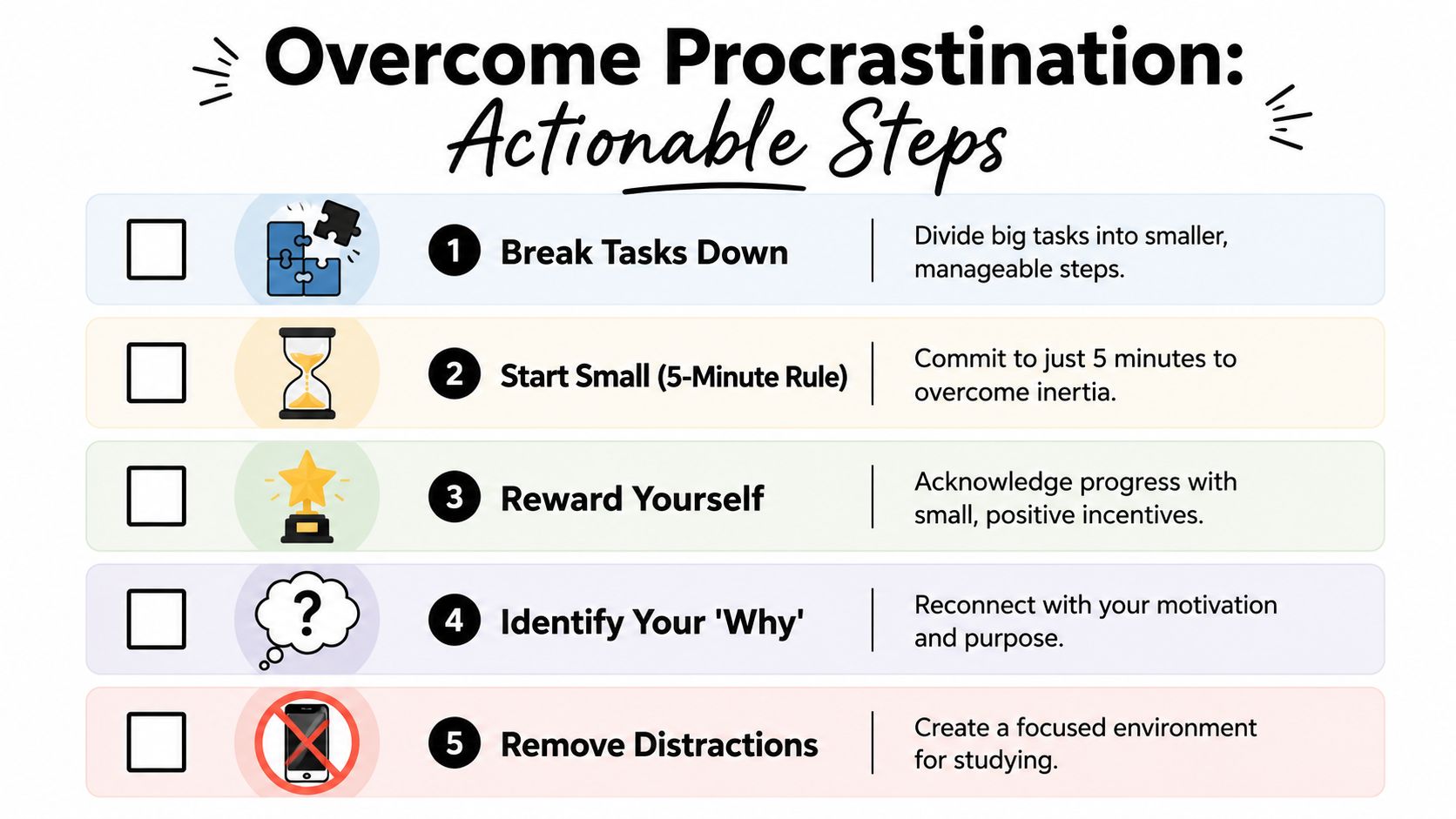
Make starting smaller
When a task feels heavy, shrink the starting point.
Try these:
- Open the document only
- Write one messy sentence
- Read the first paragraph
- Study for five minutes and stop if you need to
That last one is powerful. Very often, starting is the hardest part. Once you begin, your brain settles.
Here's a short video that can give you an extra push when procrastination creeps in.
Remove friction before you study
Make it easier to begin than to avoid the task.
A few useful moves:
- Put your notebook on the table early
- Charge your laptop before you need it
- Silence your phone
- Close extra tabs
- Write down your first tiny step before your session starts
If the room is ready and the task is clear, you're less likely to drift.
Look after your energy, not just your clock
Sometimes the issue isn't planning. It's overload.
Recent survey reporting discussed by Inside Higher Ed on student pressures, financial strain, and time management support notes that financial strain and work commitments are major pressures, and that feeling overwhelmed isn't always a pure time management problem. Sometimes you need rest, fewer commitments, or support with wellbeing, not a stricter app.
That matters because adult learners often blame themselves for being tired. But if you are working, caring, travelling, and studying, tiredness is not a moral failure. It's information.
Ask yourself:
| Question | If the answer is no |
|---|---|
| Am I getting enough rest to think clearly? | shorten the study target |
| Is my weekly plan realistic? | remove or move one commitment |
| Do I need support, not pressure? | speak to your tutor or support team |
If your system keeps breaking, the problem may be the load, not your character.
A quick-start 30-day plan
If you want momentum, keep the first month simple.
Week 1
- Write your main reason for studying
- List your fixed weekly commitments
- Choose two study blocks
Week 2
- Use the Now, Later, Ask for Help, Drop method
- Break one big task into smaller steps
- Try one short focused study session
Week 3
- Tell family when your study times are
- Use one pocket of spare time for revision
- Notice what drains your energy
Week 4
- Review what worked
- Adjust your timetable
- Celebrate what you completed, even if it feels small
Momentum grows when you collect small wins. One finished paragraph. One planned week. One study session you kept even though you were tired. These are not tiny things. They are proof that you are changing your future through ordinary, steady action.
You don't need to do everything at once. You just need to keep moving.
If you're ready to turn good intentions into a plan you can follow, Next Level Online College offers flexible online courses for adult learners studying around work, family, and other responsibilities. For many people returning to education, having a clear structure and access to academic and pastoral support can make time management feel far more achievable.