

You might be reading this late at night, after work, after the washing up, after everyone else has gone quiet. Part of you wants something more. Better work. Better pay. A future that feels stable. You may also be carrying a worry that it's too late, or that computer science is only for younger people who grew up coding.
It isn't.
A Level Computer Science can be a serious turning point for an adult learner. It gives you a recognised qualification, but it can also give you something deeper. It can help you trust your mind again. It can show your children that learning doesn't stop when life gets busy. It can help you move towards university, a new career, or a stronger position at work with real skills behind you.
Your Time to Build a New Future with A Level Computer Science
You might feel stuck in a job that pays the bills but doesn't inspire you. You might want to retrain, but every option seems confusing. You might even worry that studying again will bring back old school fears.
Many adult learners feel exactly that way at the start.
The powerful thing about A Level Computer Science is that it doesn't ask you to already be an expert. It asks you to learn step by step. If you can follow a process, ask questions, and keep going when something feels new, you can make progress here.
Why this subject matters now
The UK has a major digital skills shortage, with government and industry reports repeatedly highlighting a need for people with software, cyber, and data skills, as explained in DLD College's guidance on computer science careers and subject choices. That matters if you're thinking about a career change, because it means your effort can point towards areas where employers need people.
This isn't only about getting a grade on paper. It's about building a future with more options.
You don't need a perfect past in education to create a strong future in it.
For an adult learner, that can mean a lot. You may want to become the parent who studies at the kitchen table and shows your children what persistence looks like. You may want to prove to yourself that you're capable of more than your current routine allows. You may want to open the door to university after years away from education.
You are not starting from nothing
Life has already taught you useful skills. Time management. Responsibility. Patience. Problem solving. These matter in computer science more than many people realise.
If you're exploring your options as a mature learner, it helps to understand how A Levels can work for mature students. Once you see the path clearly, the course feels far less intimidating.
A Level Computer Science can be a tool for change. Not overnight. Not magically. But steadily, honestly, and in a way that can make you proud every time you sit down to study.
What Is A Level Computer Science Really About
A lot of people hear “computer science” and think of endless code on a black screen. That image puts many adults off before they've even started.
In reality, A Level Computer Science is about solving problems clearly. Code is part of it, but it's not the whole story.

It starts with instructions and logic
Think of a computer like a very literal helper. It can do amazing things, but only if the instructions are clear. In computer science, those instructions are often called algorithms.
An algorithm is just a set of steps. A recipe is an algorithm. Directions to a shop are an algorithm. A morning routine is an algorithm.
That idea helps many learners relax, because it shows that the subject is built on logic you already use in daily life.
Here are a few of the big ideas in simple terms:
- Algorithms are step by step instructions for solving a problem.
- Data is the information a computer works with, such as numbers, words, pictures, or sound.
- Programming is how you write instructions in a language a computer can follow.
- Networks are how computers share information with each other.
- Computer systems are the parts working together inside a device.
It's not only for coding experts
One reason people get confused is that “computer science” sounds narrower than it really is. It includes coding, but also how information is stored, how hardware works, how networks connect, and how technology affects people.
The Cambridge International AS & A Level Computer Science syllabus says its current specification is built around a clearly defined set of key concepts, covering information representation, communication, hardware, logic, systems software, security, ethics, computational thinking, programming, databases, and advanced areas such as AI and functional programming, as outlined on the Cambridge International Computer Science 9618 page.
That means the subject is broad. You learn how the digital world works, not just how to type code.
A short video can make that feel more real:
Why adults often do well
Adults often bring calm thinking to this subject. You may be more patient than you were at school. You may read questions more carefully. You may be better at breaking a problem into smaller parts.
Practical rule: If you can explain a process clearly in everyday life, you can learn to explain a process clearly in computer science.
That's the heart of the subject. Clear thinking. Careful steps. Trying, checking, fixing, improving.
The Exciting New Skills You Will Learn
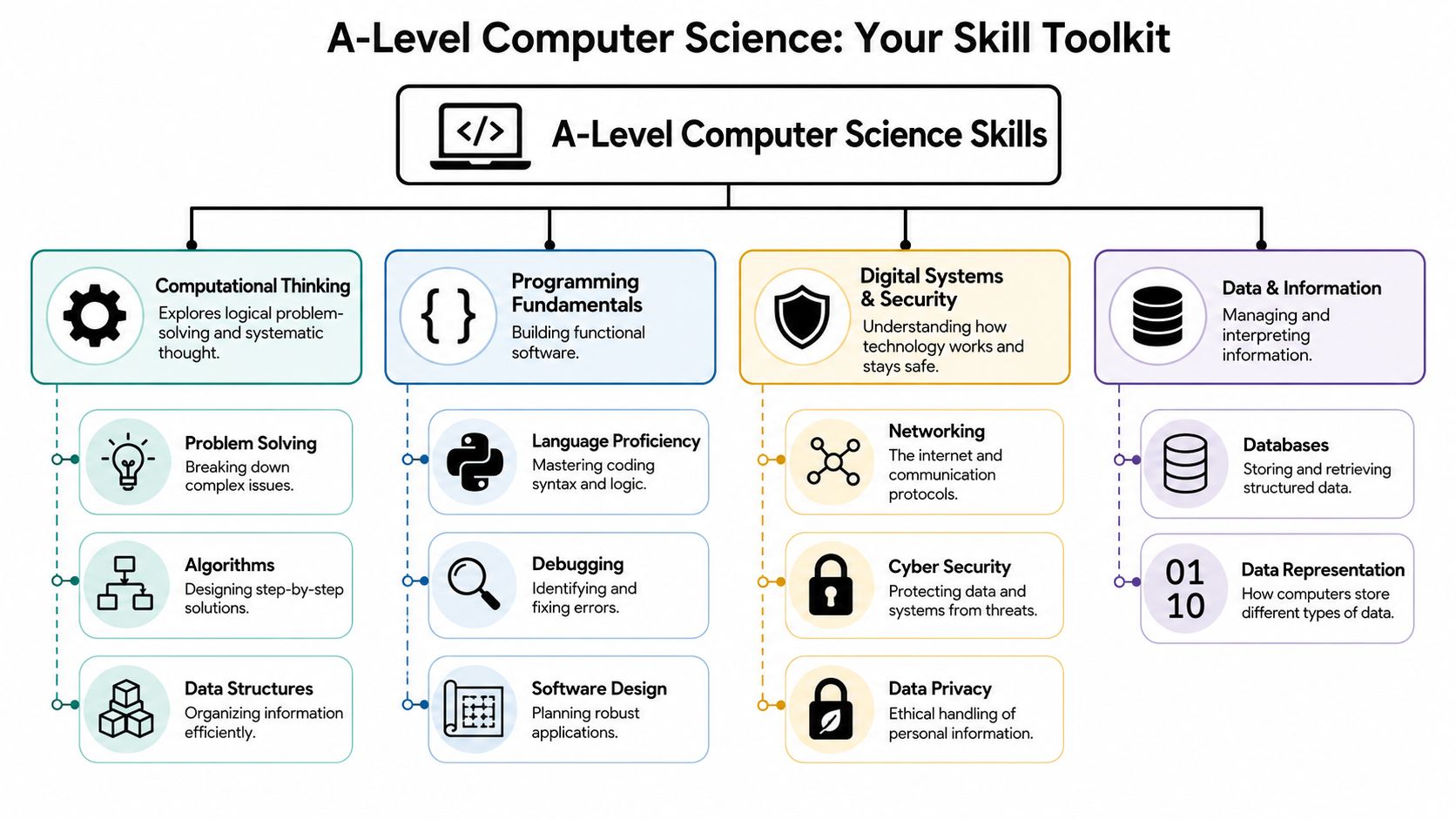
A Level Computer Science gives you a toolkit. Each topic builds a different kind of strength. Some skills help you think better. Some help you build real programs. Some help you understand the technology all around you.
You learn to think like a problem solver
One of the most valuable parts of the course is computational thinking. This means taking a big problem and breaking it into smaller, manageable parts.
If a program isn't working, you don't panic. You test one part. Then another. You look for patterns. You ask what the computer was told to do, not what you hoped it would do.
That way of thinking helps outside study too. It can make you more organised, more confident, and more methodical at work and at home.
You learn how digital information really works
A computer doesn't see a photo the way you do. It doesn't hear a song the way you do. It stores and processes information in forms it can handle.
Here, data representation comes in.
The OCR A Level Computer Science specification makes this very clear. Students are expected to understand primitive data types such as integer, real or floating point, character, string, and Boolean, and to represent positive integers in binary. OCR's specification also connects these choices to practical issues such as overflow risk, memory usage, and precision, and lists Python, H2, and SQL among assessed tools and knowledge areas in the OCR A Level Computer Science specification.
That may sound technical at first, but the basic idea is simple. Different kinds of data suit different jobs. A whole number and a decimal number are not the same. A yes or no value is different again. Choosing the right type helps a program work properly.
You learn to build with code
Programming is where many learners feel nervous. It's also where many learners discover real enjoyment.
You might start with small tasks like:
- Creating simple inputs and outputs so a program can ask a user for information and respond
- Using selection so the computer can make choices, such as “if the password is correct, let the user in”
- Using loops so the computer can repeat a task until a condition changes
Later, you may create larger programs that combine planning, testing, and improvement.
When your code fails, it doesn't mean you've failed. It means you've found the next thing to fix.
You learn what sits under the surface
Computer science also helps you understand what happens behind the screen. You study hardware, systems software, communication, security, and ethics.
The Cambridge International syllabus is built around key concepts including computational thinking, programming, and AI to deepen understanding, and it covers information representation, hardware, security, and ethics in one connected course. That makes the subject feel less like a list of topics and more like a map of the digital world.
By the end, you're not just using technology. You understand it more thoroughly. That can change how you see yourself.
How Your Progress Is Assessed
Assessment often worries adult learners more than the subject itself. That's understandable. If you've been away from education for a while, exams can feel like a giant question mark.
The good news is that A Level Computer Science usually measures your progress in more than one way.
Exams and practical work both matter
A-Level Computer Science courses typically include a non-exam assessment, often called an NEA, or a practical project where you design, develop, and evaluate your own computing solution. This sits alongside exams that test theory and problem solving, and that means revision needs active practice with code and algorithmic thinking, not just memorising facts, as described in TutorChase's guide to A Level Computer Science.
That mix is helpful.
If you've ever worried, “What if I'm not good in timed exams?”, the practical side gives you another way to show what you can do. If you've worried, “What if I can build things but struggle to explain them?”, the written papers help you develop that skill too.
The NEA can become something you're proud of
For many learners, the project becomes the most personal part of the course. You create a solution to a problem. You plan it, build it, test it, and review it.
That doesn't just prepare you for assessment. It also prepares you for real work in computing, where people rarely get marks for memorising alone. They get results by thinking, designing, checking, and improving.
A project can be more than coursework. It can be proof to yourself that you can create something real.
A quick look at exam boards
Different exam boards organise assessment in slightly different ways. Your provider will usually guide you on the one that fits your course.
| Exam Board | Assessment Split (approx.) | Key Feature |
|---|---|---|
| OCR | Varies by specification | Strong focus on data representation, programming, and internal hardware models |
| AQA | Varies by specification | Blends theory with applied problem solving |
| Cambridge International | Depends on AS or full A Level route | Uses a key concept based syllabus with broad topic coverage |
The exact paper mix and project structure can vary, so it helps to check the specification you are following and understand how marks connect to each part of the course.
If university is part of your plan, it's also useful to understand how A Level grades convert into UCAS points. That can make your long-term goal feel much more concrete.
What strong revision looks like
Many adults make an understandable mistake at first. They revise computer science as if it were only a memory subject.
A better approach is to mix methods:
- Read the specification carefully so you know what can be assessed
- Practise code regularly because fluency grows through doing
- Use past paper questions to get used to the wording and depth expected
- Review mistakes calmly so each error becomes a lesson, not a reason to doubt yourself
That style of revision builds confidence because it turns study into action.
Smart Study Strategies for Busy Adults
Adult learners rarely have long empty afternoons for revision. You may be fitting study around work shifts, school runs, caring duties, or plain tiredness.
That doesn't mean you can't succeed. It means your study needs to be realistic.
Use short sessions well
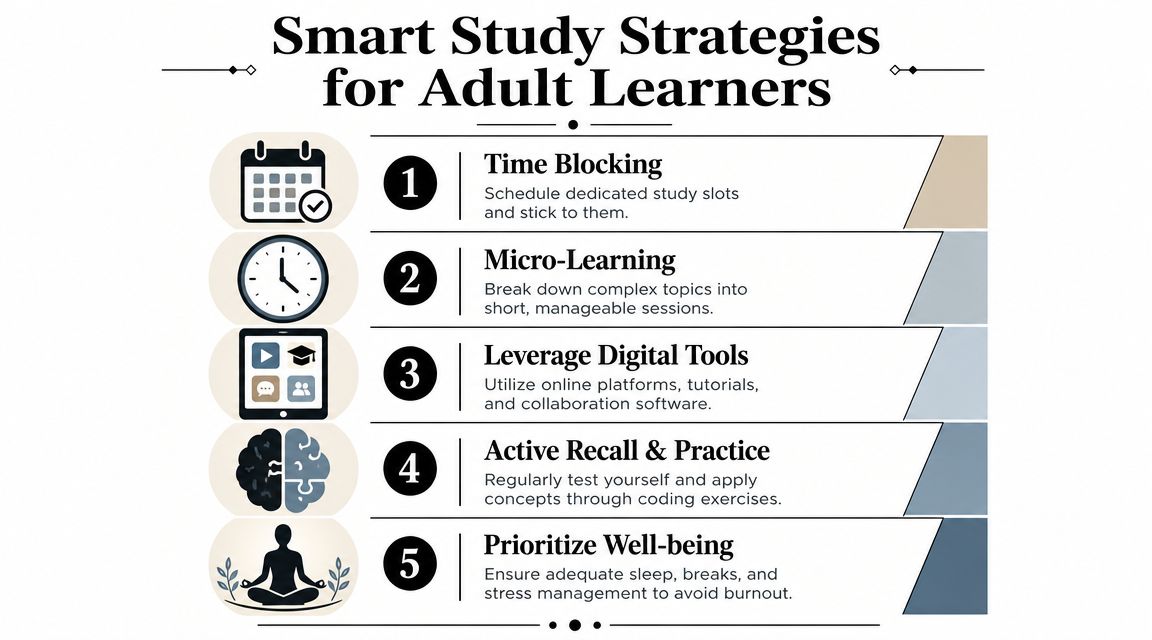
A short focused session can be more useful than a long distracted one. Try a 25-minute focus block. Choose one task only. Read one page of notes. Complete one coding exercise. Answer one exam question.
Then stop for a short break.
This works well because computer science often rewards steady practice more than cramming. A small daily habit can keep ideas fresh and stop the subject from feeling too heavy.
Build a routine that fits your life
You don't need a perfect timetable. You need a repeatable one.
Try choices like these:
- Morning study if your home is quiet before the day starts
- Lunch break review for flashcards, definitions, or short problem solving tasks
- Evening practice for coding, when you can sit with a laptop for a little longer
Some adults also keep one “anchor session” each week. This might be Saturday morning or one weekday evening. That session becomes your dedicated study slot.
Study actively, not passively
Reading notes feels safe, but it can create false confidence. Active study helps you remember and apply what you know.
Useful methods include:
- Answering questions from memory before checking your notes
- Tracing code by hand to work out what a program will do
- Fixing broken code so you learn how errors happen
- Explaining a topic aloud as if teaching your child or a friend
If you can teach a simple version of a topic, you probably understand it.
Don't study alone in your head
Online learning doesn't have to mean isolation. Ask questions. Use tutor support. Join student spaces if they are available. Let people around you know why this matters to you.
A simple sentence can help: “I'm studying for a better future, so I need this hour.”
That isn't selfish. It's responsible.
Protect your confidence
Some days will feel smooth. Some won't. You may forget things. You may get stuck on logic, syntax, or exam wording.
That is normal.
Keep a small record of wins. Finished a task? Write it down. Understood binary better today? Write it down. Completed a practice question you would have avoided last month? Write it down.
Progress in adult learning is often quiet at first. Then one day you realise the subject that once scared you has become something you can handle.
Where Your New Qualification Can Take You
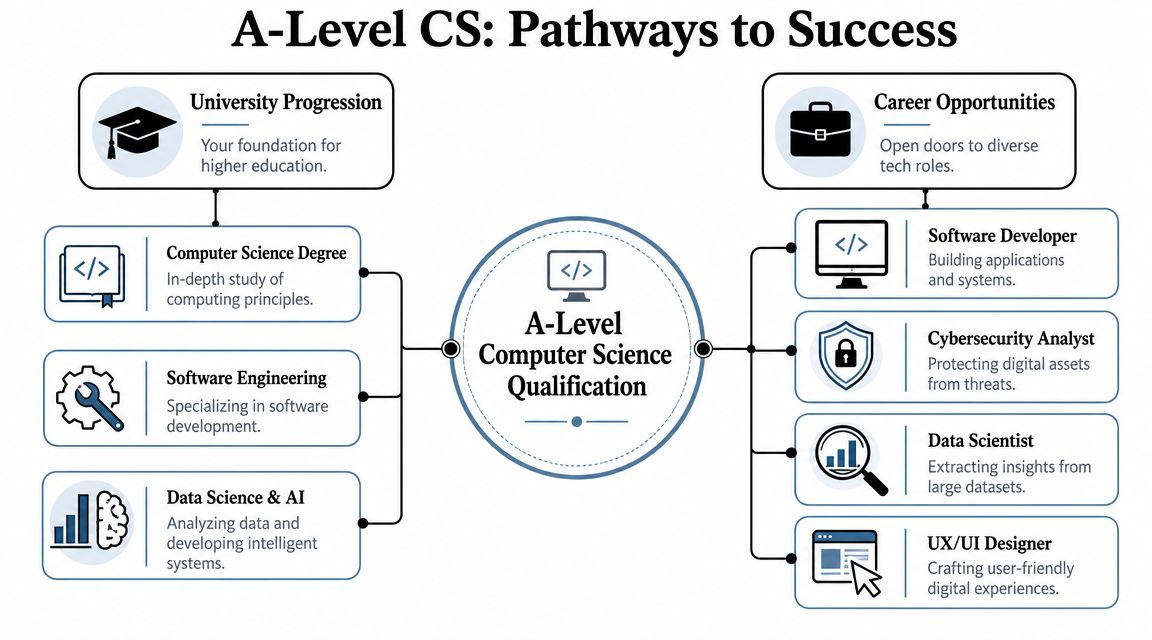
A Level Computer Science can lead in two strong directions. It can help you move towards university, and it can support a shift towards technical careers.
For many adults, those two routes are linked. University may be the bridge to the job you want. For others, the qualification itself can strengthen your profile and show serious commitment to a new field.
A strong subject for higher education
Computer Science A Level is a respected option because it shows logic, technical understanding, and disciplined study. It connects naturally to degrees in computing and related areas.
There is one point that deserves honesty. While A Level Computer Science is a powerful qualification, it's often best paired with A Level Maths for entry into top university computing degrees, because many leading UK programmes require or strongly prefer a strong mathematical background, as discussed in this video on choosing A Levels for computer science progression.
That doesn't mean you should give up if maths worries you. It means you should plan carefully. If your goal is a competitive university course, maths may need to be part of your journey too.
Careers that connect with what you learn
The subject also points towards real working roles. Common directions include:
| Pathway | How A Level Computer Science helps |
|---|---|
| Software development | Builds programming, logic, testing, and problem-solving habits |
| Cybersecurity | Supports understanding of systems, networks, and safe technology use |
| Data focused roles | Develops confidence with structured thinking, data, and computing concepts |
| Technical support and systems work | Strengthens knowledge of hardware, software, and communication between systems |
Even if your first job in tech isn't your final destination, this qualification can be the start of a larger change.
It can change how your family sees education
There is also a quieter reward that matters greatly. When your children see you study, keep going, and achieve something hard, they learn from that.
They learn that adults can grow.
They learn that education has value.
They learn that setbacks don't have to be the end of the story.
Your qualification becomes part of your family story, not just your CV.
For many adult learners, that emotional return is as important as career progress. You're not only opening doors for yourself. You're showing the people around you what courage looks like in everyday life.
This is an investment in choice
A better qualification doesn't guarantee a perfect life. But it can increase your choices.
You may choose to apply for university. You may move into a new line of work. You may use the course as proof that you can handle challenge, deadlines, and technical material. You may no longer see yourself as “someone who missed their chance”.
That shift matters. Once you believe you can learn at this level, other goals start to feel possible too.
How to Choose the Right Online Course for You
Choosing a course provider matters almost as much as choosing the subject. Adult learners need more than uploaded worksheets. You need structure, support, and a course that fits real life.
A Level Computer Science is growing in popularity. According to the British Computer Society, 15,210 students sat Computer Science A level in England in 2022, up from 12,930 in 2021. That was a 17.6% year-on-year rise, which BCS said was the largest increase of any A-level subject. BCS also said this represented a 57% increase over the previous five years, making it the highest number of entrants in England ever at that point, as reported in BCS coverage of record Computer Science A Level uptake.
That growth is encouraging, but it also means you should choose carefully.
What to look for
A strong online course should offer:
- Flexible study design so you can work around family, work, and changing routines
- Tutor support from people who understand both the subject and the needs of adult learners
- Clear assessment guidance for exams and project work
- Practical help with planning so you know what to study each week
- A sense of connection through mentoring, encouragement, or learner community
You should also check how the course handles admin, exam arrangements, and feedback. If information is vague before you enrol, that can become stressful later.
Choose support, not pressure
The right provider won't make you feel behind from the start. It will help you build momentum. It will talk to you like an adult with responsibilities, not like a teenager in a classroom.
If you want to compare flexible options, it helps to explore online A Level courses in the UK. The best fit is the one that helps you keep going when life is busy, not the one that looks impressive on paper alone.
You don't need the perfect moment to begin. You need a clear first step, a course you can trust, and the decision that your future is worth backing.
If you're ready to turn ambition into action, Next Level Online College offers flexible online learning designed for adult learners balancing work, family, and big goals. With supportive guidance and recognised qualifications, it can help you take that next step towards university, a new career, and a future you'll feel proud to show your family.