
You can be standing in the kitchen with a packed lunch on the counter, hearing the school run chaos in the background, and still wonder if university is something people like you are allowed to want. Maybe you've been out of education for years. Maybe you've put everyone else first for so long that your own plans feel dusty and far away. If that sounds familiar, you're not behind, you're just at the start of a new chapter, and an access to nursing course online can help you open it.
Lots of adults feel exactly that mix of hope and nerves. You want a better future, maybe a more secure wage, maybe work that feels meaningful, and maybe the quiet pride of showing your children that learning does not stop when you become a parent. That dream is real, and it does not belong only to people who followed the “usual” path at 18.
Online access routes have become much more normal in recent years. UCAS reported a 93% increase in online course enrolment between Fall 2019 and Fall 2020, and nearly two-thirds of college students took at least one online course in 2020 in the wider education field linked in the brief. That shift matters because it shows something important. Online study is no longer a strange plan on the edge of education, it's now part of everyday learning for many adults.
If you've been thinking, “Could I really do this?” the answer is yes, with the right route and the right support.
A New Chapter You Can Begin Today
A mother drops her child at school, comes home to a quiet house, and sits with a cup of tea that's gone cold before she's taken a sip. She opens her laptop, looks at her job, looks at her bank balance, and then looks at the dream she's kept tucked away for years. She wants more than survival. She wants progress, pride, and a future that feels bigger than the week she's having.
That moment is common. The self-doubt is common too. Many adults worry they've left it too late, that they won't remember how to study, or that everyone else will be smarter, younger, and quicker. Those fears can feel loud, but they don't mean you can't succeed.
An access to nursing course online gives that dream a route. It lets you build toward university without needing to sit in a classroom every week at a fixed time, which can be the difference between “one day” and “this is happening now”. For many learners, the goal isn't just a qualification. It's the chance to become a nurse, support other people, and show their family what persistence looks like.
Quiet truth: starting again is not a sign of failure. It's a sign that you haven't given up on yourself.
Confidence often comes after action, not before it. The first assignment, the first tutor reply, the first time you realise you understood something hard, these moments build momentum. Bit by bit, the path stops looking like a distant mountain and starts looking like a set of steps you can take.
What an Access to Nursing Course Actually Is
A lot of adults come to nursing study after life has already pulled them in other directions. Work, family, money worries, or a difficult school experience can leave a gap between where you are now and where you want to be. An Access course gives you a recognised way across that gap, so the next step feels real rather than out of reach.
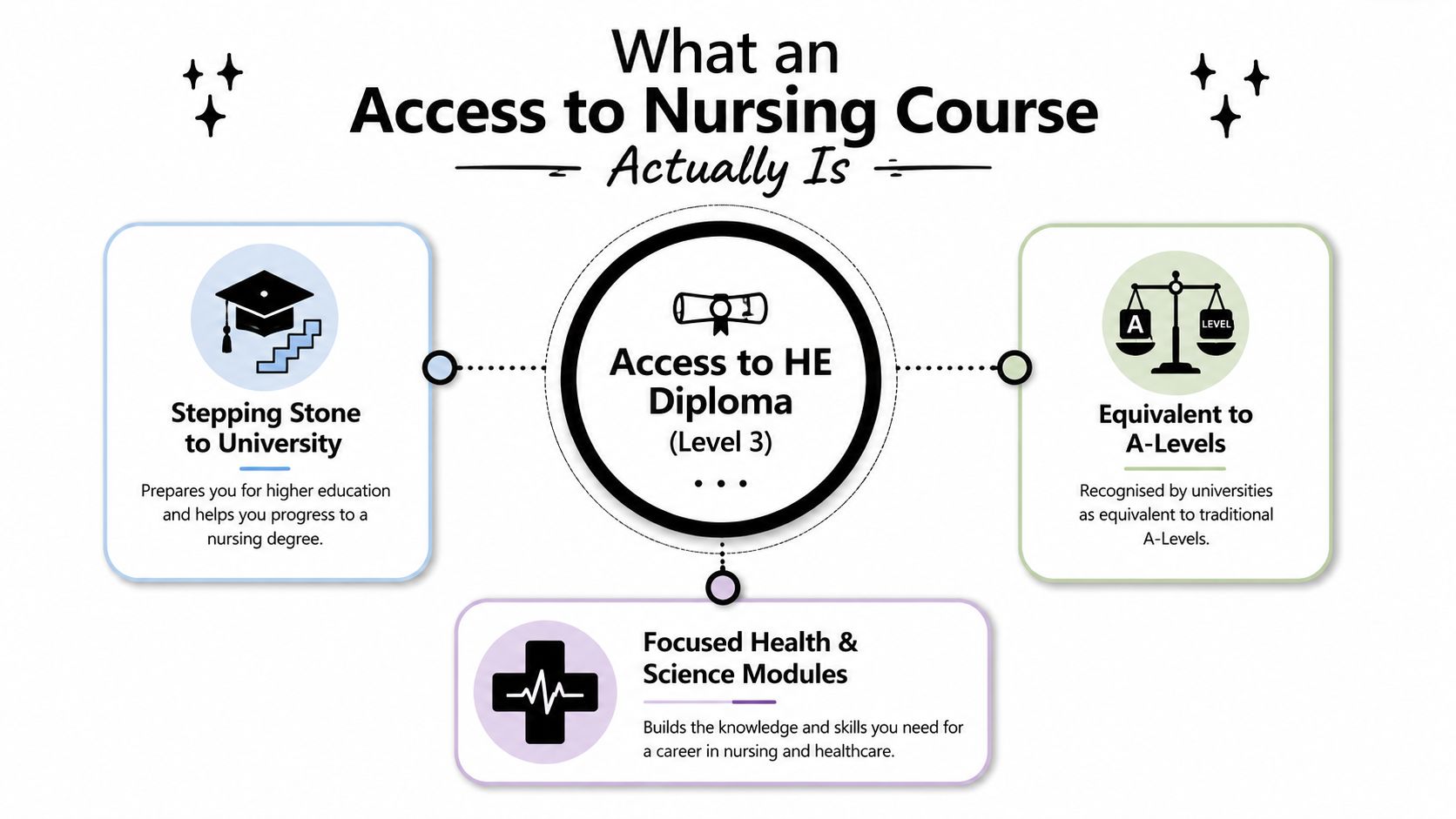
An Access to Nursing course sits inside the Access to Higher Education Diploma family, which is designed for adults who want a route into university. It is a QAA-recognised Level 3 award, and it is often described as the equivalent of three A levels (East Surrey College). That is why universities treat it as a serious entry route, not a side path.
The word “access” is doing important work here. It means a doorway, a bridge, a way in. It does not mean an easier version of learning or a lesser qualification. It means the course is built to help adults reach higher education when the usual school route did not fit their life.
A good way to picture it is as a sturdy bridge over water you would rather not wade through. You still need to cross, but the bridge gives you a clearer, safer route than trying to piece everything together on your own. That is the role this kind of course plays for many adult learners.
What the online version changes
The online route changes the place and shape of your study, not the value of the diploma. You still work towards a recognised qualification. You still build the knowledge needed for nursing degree entry. You just do it from home and around your own responsibilities, instead of arranging your whole week around a fixed classroom timetable.
That flexibility matters for adults who are juggling a lot already. A parent can study after the school run. A shift worker can fit learning around rota patterns. Someone returning to education after a long break can build confidence in smaller, steadier pieces rather than feeling thrown straight back into a classroom routine.
If you want to see one example of how this pathway is presented, the Access to HE Diploma online page shows how an online provider frames the course as a route into higher study.
Who the Course Is Built For
This kind of course suits people who have carried real life for years and still want to move into nursing. That includes parents, carers, shift workers, people changing careers, and adults who left school without the grades they needed the first time. It also suits the person who thinks, “I'm probably too old for this,” while still wanting to try.
You do not need to fit a neat student mould to belong here. That is the whole point. Many learners who choose this route have already built resilience through work, family life, and setbacks, and that experience often helps them stay steady when study feels demanding.
The usual entry picture
In England, many universities expect at least GCSE English and maths at grade 4/C or above, and some also ask for a science GCSE at the same level before admitting a nursing applicant (learndirect entry guidance). That can feel like a lot at first, so the sensible first move is to check the starting point for the route you want.
Some providers let you begin the diploma while you are still working towards Level 2 English and maths if you do not already have them. That can be a relief for adults who do not want to put their plans on hold while they sort out every missing qualification.
Practical rule: do not judge yourself by what you missed years ago. Check the entry requirements, then build from there.
If you worry about being the oldest person in the room, hold onto this. Mature learners often bring focus, determination, and life experience that younger students have not had time to build yet. A classroom does not need you to be the youngest person there. It needs you to be ready to learn.
Why Online Study Works So Well for Busy Adults
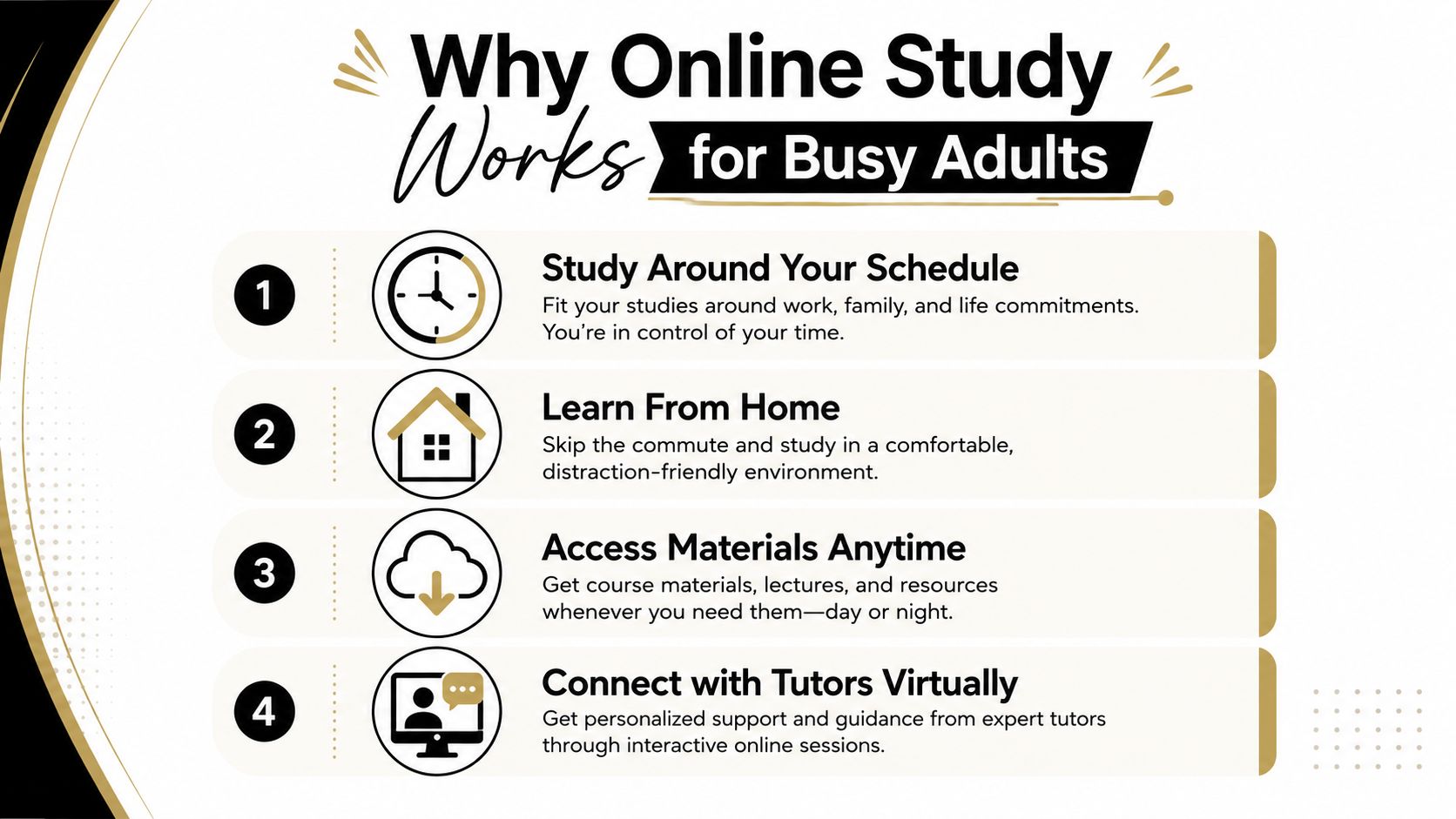
Online study works because it respects the shape of adult life. School runs happen. Shifts change. Children get ill. Parents need helping hands. A course that lets you study in the gaps between everything else can make learning feel possible instead of impossible.
The fear many adults have is not really about learning itself. It's about whether the technology will get in the way. Jisc's digital experience work shows that the sticking points for students are often platform navigation, assessment submission, and confidence using core tools, not just basic web browsing (Jisc digital experience evidence). That means support matters just as much as the laptop does.
What reliable online study should offer
- Study Around Your Schedule: live attendance should not be the only route to progress.
- Learn From Home: a calm space can help you focus when life is busy.
- Access Materials Anytime: being able to return to notes helps when memory is tired.
- Connect with Tutors Virtually: clear support makes the work feel less lonely.
Ofcom's reporting also shows why course design matters. Average fixed-line download speeds reached 223 Mbit/s in July 2024, but 11 million UK homes were still on Full Fibre availability that had not yet translated into universal access or uniform performance, so the issue is often reliability and household contention rather than headline speed (Ofcom reporting summary). That's why good online courses should not rely only on live video. They should include downloadable materials and asynchronous work so you can keep going even when the internet is patchy.
What You Will Actually Study and How It Is Assessed
An Access to Nursing diploma usually feels like a year of steady building. It is less like being thrown into a stack of tests and more like laying one brick at a time until the shape of the path becomes clear. The content is designed to prepare you for nursing degree study, so you can expect topics that support healthcare learning rather than random filler. That often means biology, health-related study, psychology, and study skills, all working together to help you feel ready for the next stage.
Assessment is usually coursework-based, and that suits many adult learners who want time to think, plan, and improve. One provider says the course is completed in 12 months and assessed through written assignments, case studies, and reflective pieces rather than exams (learndirect assessment format). For many adults, that brings real relief. You build knowledge in smaller pieces, rather than trying to hold everything in your head for one high-pressure test day.
What coursework feels like in practice
A task might ask you to write a short essay, analyse a health scenario, or reflect on how a nurse should respond in a particular situation. If you have not written formally in years, that can feel like being asked to ride a bike again after a long break. The balance is that the course gives structure. You are not expected to know everything at once. You learn, practise, improve, and then submit.
The course sits at Level 3 and is recognised as a route into higher education. One UK college describes it as a QAA-recognised qualification, and another notes its equivalence to three A levels, which helps explain why it can support university applications rather than sit beside them as an unrelated extra. If you want to check what that kind of recognition means for online study, this guide to accreditation for online courses gives a clear starting point.
Learning to write one decent assignment is like learning to cook one proper meal. You do not start with a banquet. You start with one dish, then another, and soon the process feels familiar.
If exams have knocked your confidence before, coursework can give you room to breathe. It rewards steady effort, clear thinking, and the habit of improving as you go. Those are the same habits many adult learners already use at work and at home, often without giving themselves credit for it.
How to Choose a Provider You Can Trust
A good provider should make you feel clearer, not more confused. If the website is vague, the support sounds thin, or nobody can tell you exactly what qualification you'll earn, keep looking. Adults don't need glossy promises. They need a route they can trust with their time, money, and hopes.
Start with the basics. The qualification should be regulated and recognised. The provider should explain entry requirements, study load, assessment style, and progression routes in plain English. You should also be able to see how they support learners who are returning after a long break, working, raising children, or dealing with low confidence.
Questions worth asking before you enrol
- Is the qualification recognised? You want a route that universities understand.
- What support is included? Look for subject help, feedback, and pastoral care.
- How clear are the fees? Good providers explain costs without hiding the details.
- Can you study flexibly? Adult life changes, so the course should allow for that.
- What happens if you need help with study skills? Writing, planning, and confidence support matter.
Next Level Online College, part of the Cambridge Online Education Ltd group, offers recognised and regulated qualifications including Functional Skills, GCSEs, A Levels, and Access to Higher Education diplomas. It also says it provides structured support from subject specialists and wellbeing advisors, along with finance options and over 25 years of experience supporting adult returners to education. You can check its course approach and support style through its accreditation information for online courses.
That mix matters because adult learners rarely need only one kind of help. They need teaching, encouragement, and a course design that fits real life. A provider worth your trust should understand all three.
Your Step-by-Step Path From Enrolment to University
The path is less mysterious than it first looks. You begin by checking the course, then the entry requirements, then the support options, and then you enrol online. After that, the work starts, but it happens in stages that can fit around your day instead of taking over your life.
The first weeks are usually about getting settled. That might include an onboarding call, logging into the learning platform, and making sure you know how to send work in. Once the course starts, you build module by module, and that steady pace helps confidence grow.
A simple route through the year
- Research courses and compare what each provider offers.
- Check entry requirements for English, maths, and any science expectations.
- Enrol online and complete any initial assessment or welcome call.
- Complete modules with tutor support and regular coursework.
- Gain the qualification and use it for your next step.
- Apply to university through UCAS or directly, depending on the route.
Universities usually understand that online learners have busy lives, so placement feasibility should be thought about early rather than left to the end. Nursing still needs practice-based learning, so work, caring responsibilities, and travel all need to be planned around with care. That planning is not a sign that the route is impossible. It's a sign that it's real.
If you want to read more about the progression side of the journey, the university application process page gives a useful sense of how the next step can be approached.
The best time to sort the practical parts is before you feel rushed. Clear planning makes the dream feel smaller and more manageable.
Questions Adult Learners Ask Before They Start
A lot of people carry the same worries in silence. They just don't want to sound naive by asking them out loud. Those worries are normal, and they deserve straight answers.
Yes, online Access to Nursing diplomas can be accepted by universities when they are QAA-recognised and meet the course requirements for the degree you want. The key is to check the exact entry criteria early, because nursing routes can differ between universities. An Access course is designed as a bridge, but you still need to match the right bridge to the right destination.
Funding is another common concern. UK adults often look at loan and payment options because they're balancing families, rent, transport, and everything else. A good provider should explain finance clearly so you know what you're signing up for before you start.
Placements also worry people, especially if they work or care for children. Nursing pathways still involve practical learning, so planning starts early and needs to fit local availability. That's one reason online study works best when it's paired with strong organisation and clear guidance.
And yes, it is realistic to study while working or raising a family, but only if the course is built for adult life. The study plan should allow you to move in manageable steps, not demand perfect weeks with no interruptions. Progress often comes from consistency, not perfection.
If you're still unsure, ask yourself one simple question. Do you want your children to see you choosing growth, courage, and a future that helps other people? If the answer is yes, then you're already closer than you think.
Next Level Online College offers flexible online routes for adult learners, including Access to Higher Education diplomas, GCSEs, Functional Skills, and A Levels, with support designed around work and family life. If you're ready to explore an access to nursing course online and want a path that can lead towards university with structured guidance, visit Next Level Online College and take the first step today.