
You might be sitting at the kitchen table after work, helping with homework, checking shifts, and wondering if university is still possible for you. It can feel like everyone else moved on years ago, while you've been holding everything together for your family. That feeling is real, but it doesn't mean you've missed your chance. It often means you're ready for something bigger.
The university application process in the UK can look intimidating at first, especially when you've been out of education for a while. But it's not a mystery, and it's not only for school leavers. Adults return to study every cycle, bringing work experience, care experience, resilience, and determination that can make a real difference to their application and their future.
Your Dream of University Is Closer Than You Think
She had spent years on shift work, raised children, and kept her own goals on hold. When university finally came into view, the first feeling was doubt. Would the forms make sense, would old grades still matter, would she feel out of place?
Those worries are common, and they do not mean you lack ability. They usually mean the goal matters to you. The UK university application process is built around a national system called UCAS, the main route into undergraduate higher education for decades, after it was formed in 1993 from the merger of UCCA and PCAS. That system exists to give applicants one clear route, not to turn the path into a wall.

Your story still counts
If you have worked, cared for children, supported relatives, or kept a home running, you already have evidence of commitment. Universities do not only want school reports. They want to understand your motivation, your stability, and how you are likely to cope with study.
You are not beginning from nothing. You are bringing a life that has taught you how to keep going when things are difficult. That experience matters, especially when you want to become a role model for your children and open the door to a more rewarding career.
Practical rule: treat your background as useful evidence, not as something to hide.
University can feel distant when you are busy getting through the week. Still, every small action, such as looking at course pages or checking entry requirements, brings the goal into clearer focus. Each step is a milestone, and each milestone counts.
Mapping Your Journey with a Clear Timeline
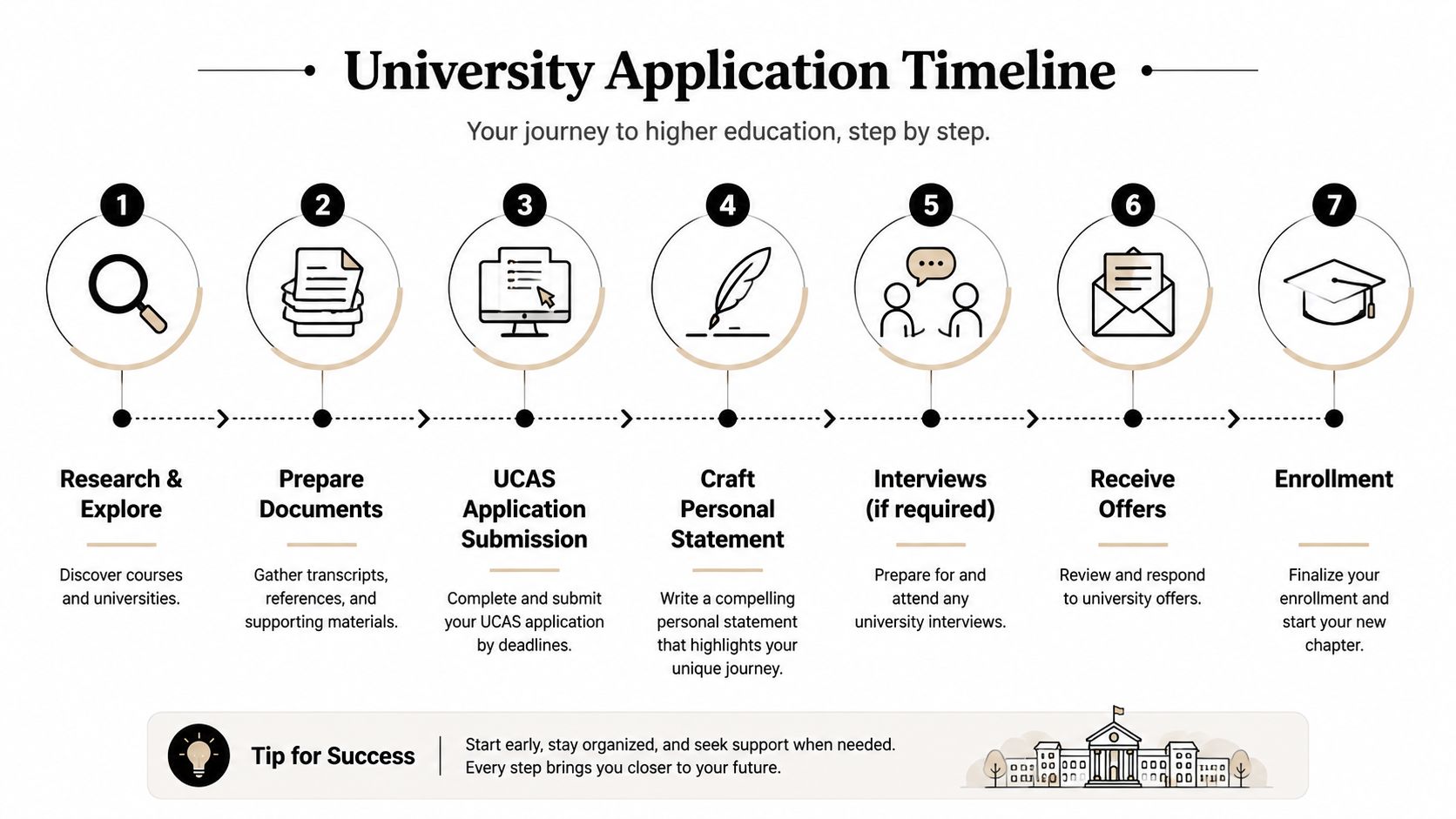
A university application can feel like a long road when you are returning to study after years away. Once you can see the stages clearly, though, the process becomes easier to handle, because each task has its own place and purpose. The university application process follows a national rhythm through UCAS, and that rhythm is set by key deadlines, with 15 January as the main equal-consideration deadline for most undergraduate courses and 15 October for Oxford, Cambridge, and most medicine, dentistry, and veterinary courses. Equal consideration means applications received by the main deadline are reviewed on the same basis. For a simple overview of the route from first search to final decision, the university entry requirement guides can help you see how the steps fit together.
A simple view of the year
A clear timeline works well for adult learners because it breaks a big goal into smaller, manageable milestones. You do not need to do everything at once. First comes research, then document gathering, then writing, then submission. If you are studying for an Access to HE course, your timetable may not look like a school calendar, but the UCAS deadlines still guide the point at which everything needs to be ready.
| Stage | What you do |
|---|---|
| Early planning | Look at courses, entry requirements, and study options |
| Document preparation | Gather certificates, references, and personal details |
| Writing | Draft and refine your personal statement |
| Submission | Send the UCAS application before the relevant deadline |
| Response | Track offers and decisions |
| Next step | Accept an offer and prepare to enrol |
Why the deadlines matter
Deadlines are not there to shut people out. They keep the system organised for applicants, universities, and schools, which matters because everyone is working through the same cycle at the same time. For adult learners, it helps to work backwards from the deadline rather than forwards from today.
If you are returning to education after a break, start earlier than you think you need to. That gives you time to collect evidence, speak to referees, and revise your statement without feeling rushed. The goal is not to have everything perfect on day one. The goal is to be ready when you submit.
Finding the Right Course and University for You
Adult learners often worry that universities will only value recent school grades. That's not the full picture. A key challenge for 40,000+ UK university applicants aged 21+ each cycle is showing readiness without recent school results, and guidance for them needs to translate work experience and qualifications like Access to HE or Functional Skills into a strong application story adult applicant readiness and experience.
What to look for in a course
The best course for you is not always the one with the flashiest name. It's the one that fits your life, your entry profile, and your goals. If you need a route into university, an Access to HE diploma can be a strong bridge. If you need to strengthen English or maths first, Functional Skills, GCSEs, or A levels may be the right next step.
Some universities are more familiar with mature applicants than others. Look for course pages that explain non-traditional entry routes clearly, and check whether the university mentions support for part-time study, commuting students, or people with caring responsibilities. If you want a place to start comparing entry routes, these UK university entry requirement guides can help you see how different pathways connect to higher education.
Turn your experience into evidence
A job in care, retail, administration, construction, or hospitality can show skills that universities care about. You may have used communication, time management, problem-solving, leadership, or calm judgement under pressure. Those are real strengths, and they belong in your application.
Your work history doesn't weaken your case. It can strengthen it if you explain what it taught you and how it connects to your chosen course.
Choose a university that can see the person behind the grades. You're not trying to fit an old-school idea of a student. You're looking for a course where your route is understood, your ambition is respected, and your family life is treated as part of your real story.
Gathering Your Documents and Strong References
A mature applicant often has more evidence than they first realise. Old certificates, work records, training notes, and the details you have built across jobs and family life can all support your application. The task is to gather them in a clear order, so nothing gets overlooked when you complete the form. The UCAS application asks for personal details, education history, employment history, course choices, a personal statement, and a reference. If one part is missing or inconsistent, it can slow things down or stop completion.
Build your checklist first
Start with the items that show your path into study. That usually means qualification certificates, any transcripts you can find, and the basic facts for your education and work history. If you studied before, look out for GCSEs, A levels, Access to HE records, or similar documents. These are the pieces that help universities see the full picture, especially if you are returning after a long break.
Keep everything in one place. A notebook, a phone note, or a simple folder all work well. The point is not to create a perfect system, it is to make the process easier when you sit down to fill in the form. If you have to pause to search for dates or course names, the application takes more energy than it should.
The reference is the part to handle early
For adult learners, the reference is often the part that needs the most planning. The referee has to submit through the UCAS portal, so choose someone who can respond reliably and on time reference management in UCAS. A former tutor, a current line manager, a training lead, or a community organiser may be suitable if they know your work well enough to speak accurately about you.
Ask early and keep the request simple. Tell them the course you want, why it matters to you, and when you need the reference. It also helps to give them a short summary of your goals, and if you already have one, share your personal statement draft so they can see the direction of your application. If you want support with that draft, this guide on how to write a university personal statement can help you shape your ideas before you send it on.
Good habit: ask early, then track it. Don't assume the referee remembers the deadline.
If you are still studying, check that predicted grades are entered correctly. Then confirm that your application moves from draft to submitted status and that you receive the confirmation email. That email is a useful sign that the system has your form, and it gives you a clear point to build from as the rest of your application comes together.
Writing a Personal Statement That Tells Your Story
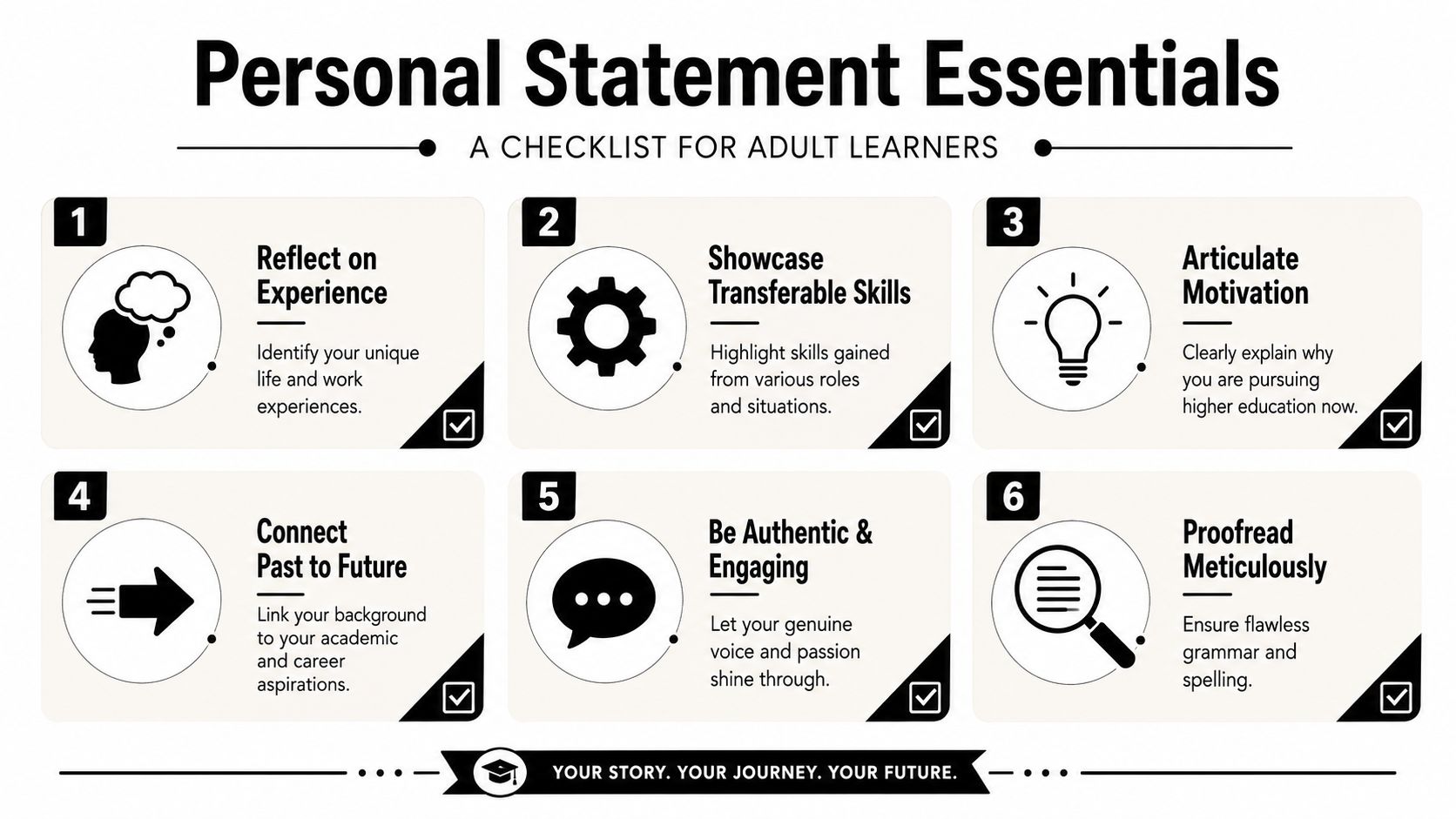
The personal statement is where your voice comes through. For adult learners, it can become the strongest part of the application because it explains not just what you want to study, but why now. UCAS personal statements are limited to between 1,000 and 4,000 characters, so every line has to earn its place UCAS personal statement length.
Shape your story around change
Think about a turning point. Maybe you returned to learning after caring for children. Maybe a job showed you that you want a different future. Maybe a long gap made you doubt yourself, then you realised you still had the drive to learn.
That story does not need to sound dramatic. It needs to be clear and honest. Explain what your past experience taught you, what pulled you towards this subject, and how the course connects to the future you want for yourself and your family.
Keep the structure simple
A short, focused structure can help:
- Why this subject now: say what sparked your interest.
- What you bring: name the skills from work or home life that support study.
- How you're preparing: mention any current learning, like Access to HE, GCSEs, or Functional Skills.
- Where you're heading: show how the course links to a career or next step.
If you want another way to organise your draft, this personal statement guide can help you think through the wording before you submit.
Your aim is not to sound perfect. It's to sound real, focused, and ready. A reader should finish your statement feeling that you know who you are, what you want, and why university makes sense for you now.
Sorting Your Finances and Finding Support
Money worries stop many adults from applying before they even finish the research stage. That's understandable, especially when you've got children, rent, transport costs, and daily bills on your mind. The good news is that the UK higher education system has established support routes, and the scale of UCAS shows you're entering a long-standing national process with structured applications, offers, and financial support scale of UCAS admissions and system support.
Make finance part of the plan, not a surprise
Treat money as one of the steps, not a last-minute shock. Look at tuition fees, living costs, and the timing of any course-related spending such as books, travel, or childcare. If you're applying while working, think about how your hours might need to change once you start.
Universities may also offer their own bursaries or hardship support, and some adult learners qualify for help linked to dependants or childcare. If you're comparing options, this higher education bursary overview is a useful place to understand how support can fit around study.
Ask practical questions before you apply
Some useful questions to ask any university are simple:
- What support is available for students with children?
- Is there help for commuting or travel costs?
- Are there bursaries or hardship funds for mature students?
- Can I study part-time or with flexible timing?
Getting clear answers can ease the fear that money will make the whole plan collapse. Many adults find that the financial picture looks less frightening once they see the support options in writing.
You're not being unrealistic by asking these questions. You're being responsible. A solid plan helps you protect your family while you invest in your future.
Your Actionable University Application Checklist
The university application process gets easier when you turn it into a short list of actions. Each step is a small win, and together they build a real path towards study, confidence, and a better future.
- Set your goal: choose the subject and career direction that fit your life now.
- Research your options: compare universities, entry routes, and support for mature students.
- Gather your documents: collect certificates, transcripts, and education history.
- Secure your reference: ask early and make it easy for your referee to respond.
- Draft your statement: keep it focused, honest, and linked to your course.
- Check your finance: look at tuition, support, and any extra costs at the same time.
- Submit with confidence: review everything carefully, then send it before the deadline.
You do not need to have it all figured out today. You need one clear next step. If you're ready to start building a stronger future for yourself and your family, take that first step now with support from Next Level Online College.