
You're sitting at the kitchen table after a long day. The children are finally asleep, your work clothes are still on, and the assignment brief is open in front of you. You read the same paragraph again, but the words seem to become more confusing each time. A small voice says, “I'm not good at this.”
That voice isn't telling the truth. Writing an assignment is a skill, not a special gift. You can learn it by breaking the task into manageable parts, making a realistic plan and asking for help when you need it. UK higher education expects assignments to develop from focused pieces of work into longer, structured academic writing. The British Academic Written English corpus contains 2,761 pieces of proficient assessed student writing from UK universities, with pieces ranging from about 500 to 5,000 words. This reflects the variety of coursework adults may meet when they return to study. The BAWE evidence base is discussed in this UK assignment writing resource.
Whether you're studying after a break, working shifts or caring for your family, you don't have to finish everything in one heroic evening. You need a clear route from the brief to the final upload. By the end, you'll know how to understand the question, plan your hours, build paragraphs, use sources, edit your work and submit it with pride.
Starting From Where You Are Right Now
Sarah had returned to education because she wanted a different future for her family. She worked during the day, helped her children with homework in the evening and studied when the house became quiet. When her first assignment arrived, she opened the document, saw several instructions on the page and closed it again.
The problem wasn't laziness. Sarah didn't know where to begin. She thought “writing an assignment” meant producing a perfect answer from the first sentence, so every blank page felt like a test of her intelligence.
A tutor helped her change the task. Instead of seeing one large assignment, Sarah saw a group of smaller jobs:
- Understand the question.
- Find useful information.
- Make a short plan.
- Write one paragraph at a time.
- Check the work before sending it.
That change matters. UK academic writing guidance treats assignments as a staged process, involving reading, planning, research, drafting, editing and checking references. A University of Warwick-linked report on academic writing in UK higher education also traces concerns about student writing standards back to a 1999 proposal by Professors David Wray and Jeremy Treglown, showing that assignment writing has been a long-standing teaching issue in the UK.
A difficult assignment becomes less frightening when you give each part its own small appointment.
Your reason for studying matters, too. You may want to enter university, move into a fulfilling career, earn more or show your children that it's possible to start again. You might feel nervous, but your children can also see your courage each time you open your notes and keep going.
You don't need to feel confident before you start. Confidence often grows because you start, practise and notice that you can do more than you expected.
Reading the Brief So You Know Exactly What Is Asked
Many assignment problems begin before the first sentence is written. A learner may answer a related question, use the wrong format or forget a key part of the marking criteria. Slow reading at the beginning can save hours later.
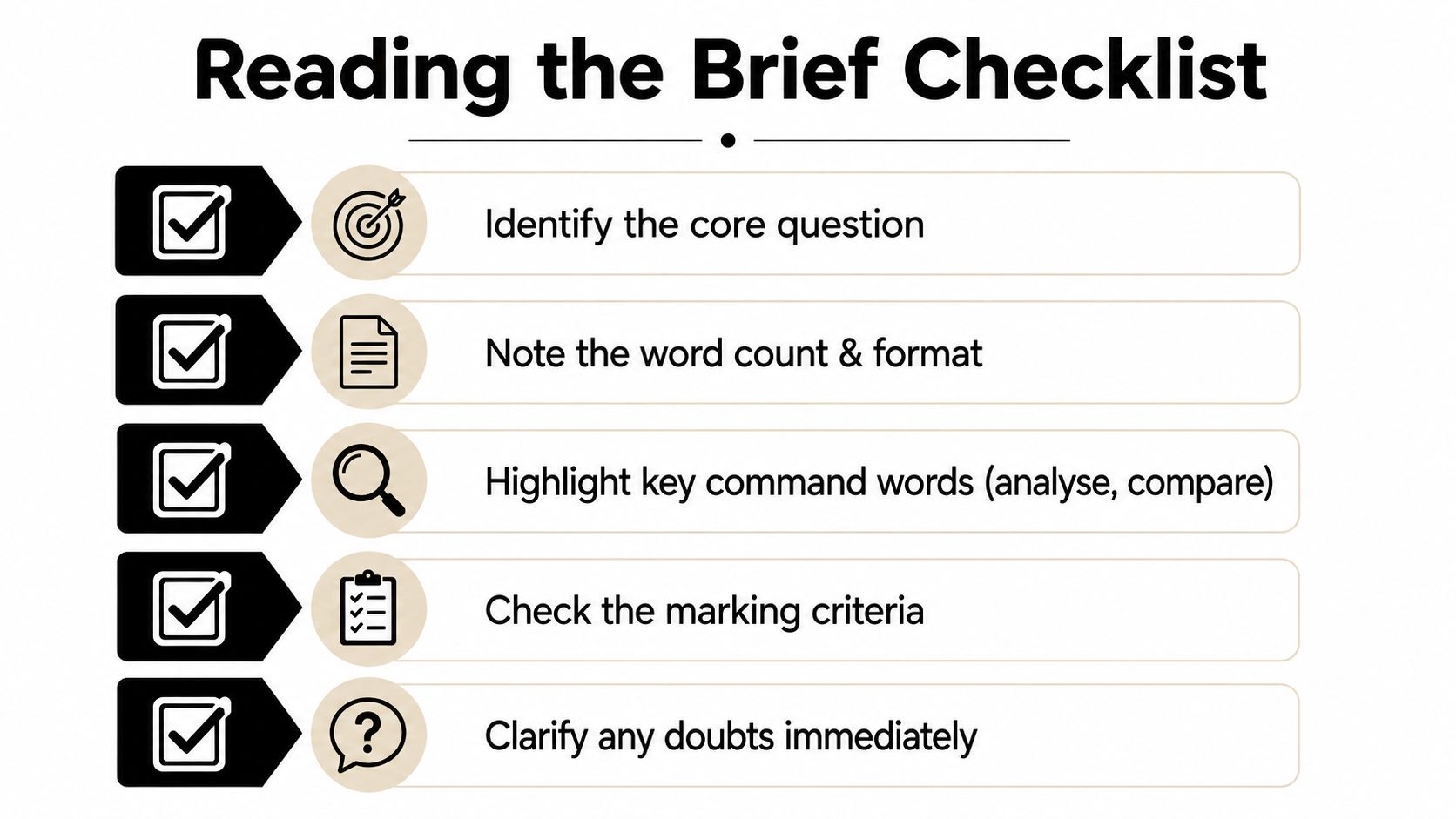
Treat the brief like a detective. Look for the core question, the command words, the word count, the deadline, the required format, the referencing style and the marking criteria.
Suppose your brief says:
Discuss how flexible working can affect employee wellbeing. Use academic sources, include examples from the UK and make recommendations for employers. Write 1,500 words and use Harvard referencing.
Break it into a simple checklist:
- Find the command word. “Discuss” means you should explain different views, use evidence and reach a balanced judgement. It doesn't mean describing the topic without making a point.
- Underline the subject. The subject is the relationship between flexible working and employee wellbeing.
- Mark the limits. Your examples should come from the UK, and your answer must include recommendations for employers.
- Record the practical rules. The word count is 1,500 words, and the referencing system is Harvard.
- Find the marking criteria. Check whether marks are awarded for research, structure, analysis, application, presentation or referencing.
Common command words need different responses. Analyse means break an idea into parts and explain how they connect. Compare means show similarities and differences. Evaluate means judge strengths, weaknesses and overall value. Describe asks for clear information, while discuss usually requires a balanced exploration followed by a reasoned conclusion.
If one instruction is unclear, ask early. You could write:
Dear [Tutor's name],
I'm checking my understanding of the assignment brief. When it asks for UK examples, should I focus on one industry or compare examples from different sectors? I'd also be grateful if you could confirm the required referencing style.
Kind regards,
[Your name]
University guidance from the University of Oxford on essay writing highlights the importance of unpacking the question, defining key terms and turning the brief into a workable plan. You're not being difficult by asking for clarification. You're making sure your effort answers the task you've been given.
Planning Your Time and Your Outline
A busy adult learner rarely has a completely empty week waiting for an assignment. Your study time may be spread across early mornings, lunch breaks, train journeys, quiet evenings or weekends. A useful plan starts with your real life, not an imaginary timetable.
Write the deadline on a calendar, then work backwards. Add separate blocks for reading, notes, outlining, drafting, revising and proofreading. Keep the blocks small enough to fit around school runs, work patterns and caring responsibilities.
A practical UK assignment workflow suggests a flexible split of 10% planning, 35% research, 30% drafting, 20% revising and 5% proofreading. This assignment planning guide explains the 10/35/30/20/5 method. It isn't a rule that punishes you if your week changes. It's a reminder not to spend all your time researching and leave no space for editing.
Build a one-page outline
Turn the question into three to five objectives. For the flexible working example, your objectives might be:
- Explain what flexible working means.
- Explore possible effects on employee wellbeing.
- Consider evidence and UK examples.
- Discuss limitations and different viewpoints.
- Recommend practical actions for employers.
Under each objective, add a few notes. You might then use this structure:
- Introduction, define the topic and state your main direction.
- Main section, explain benefits and supporting evidence.
- Main section, explore risks and alternative views.
- Main section, apply the discussion to UK workplaces.
- Recommendations, give realistic actions.
- Conclusion, answer the question clearly.
A parent with limited evenings might use shorter study blocks across several weekdays. A shift worker may use longer sessions on days off, with small note-taking tasks during breaks. Both approaches can work if the calendar shows exactly what happens next.
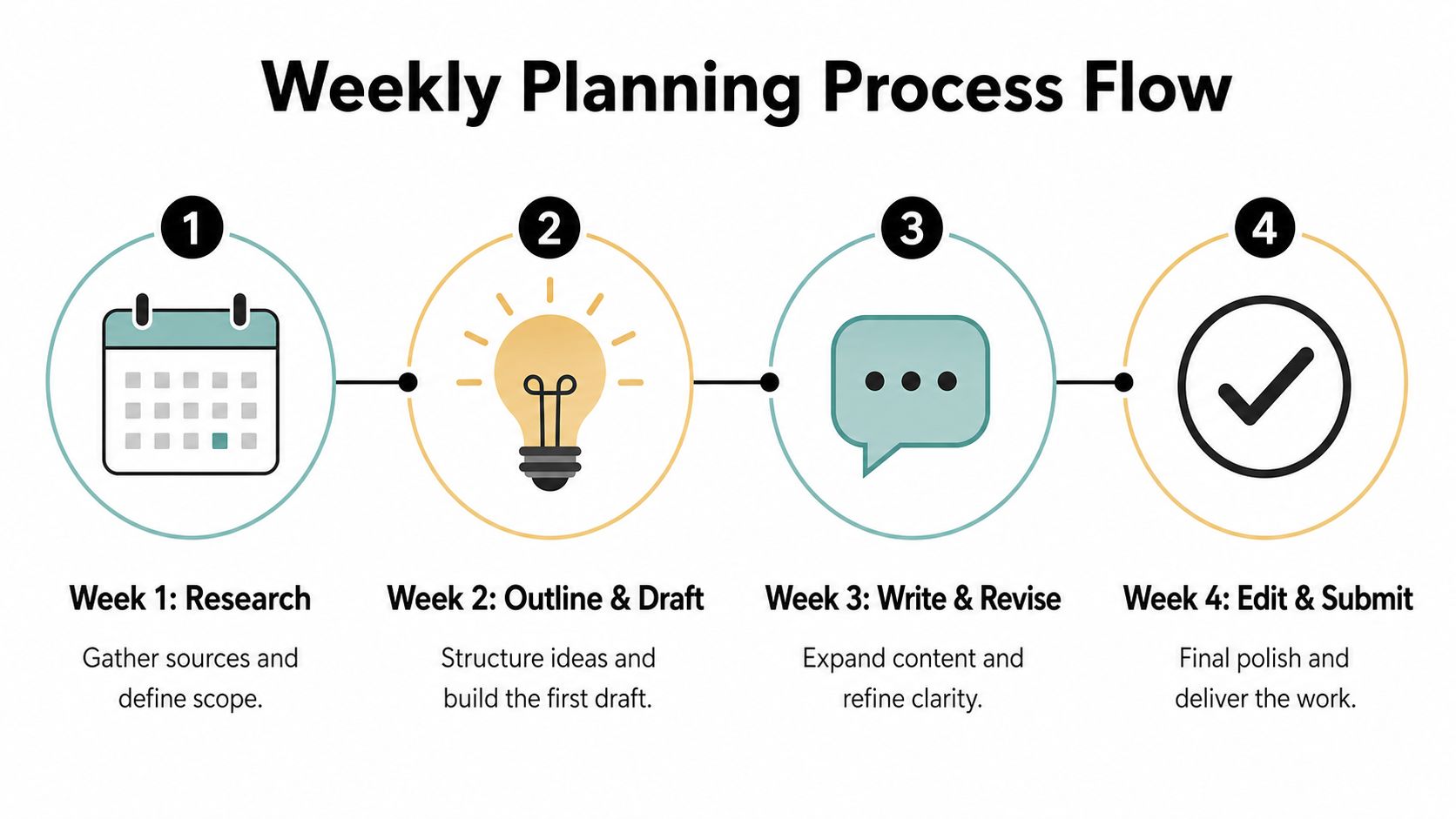
You can download study planner templates from Next Level Online College and adapt them to your own week. Put the finished plan somewhere visible, such as a fridge, desk or phone calendar.
The planning process also needs breathing space. If a child is ill or a work shift changes, move a task instead of abandoning the whole assignment. A flexible plan is more useful than a perfect plan you can't follow.
Watch this short video for another practical view of organising assignment work:
Research, Note-Taking and Building Solid Paragraphs
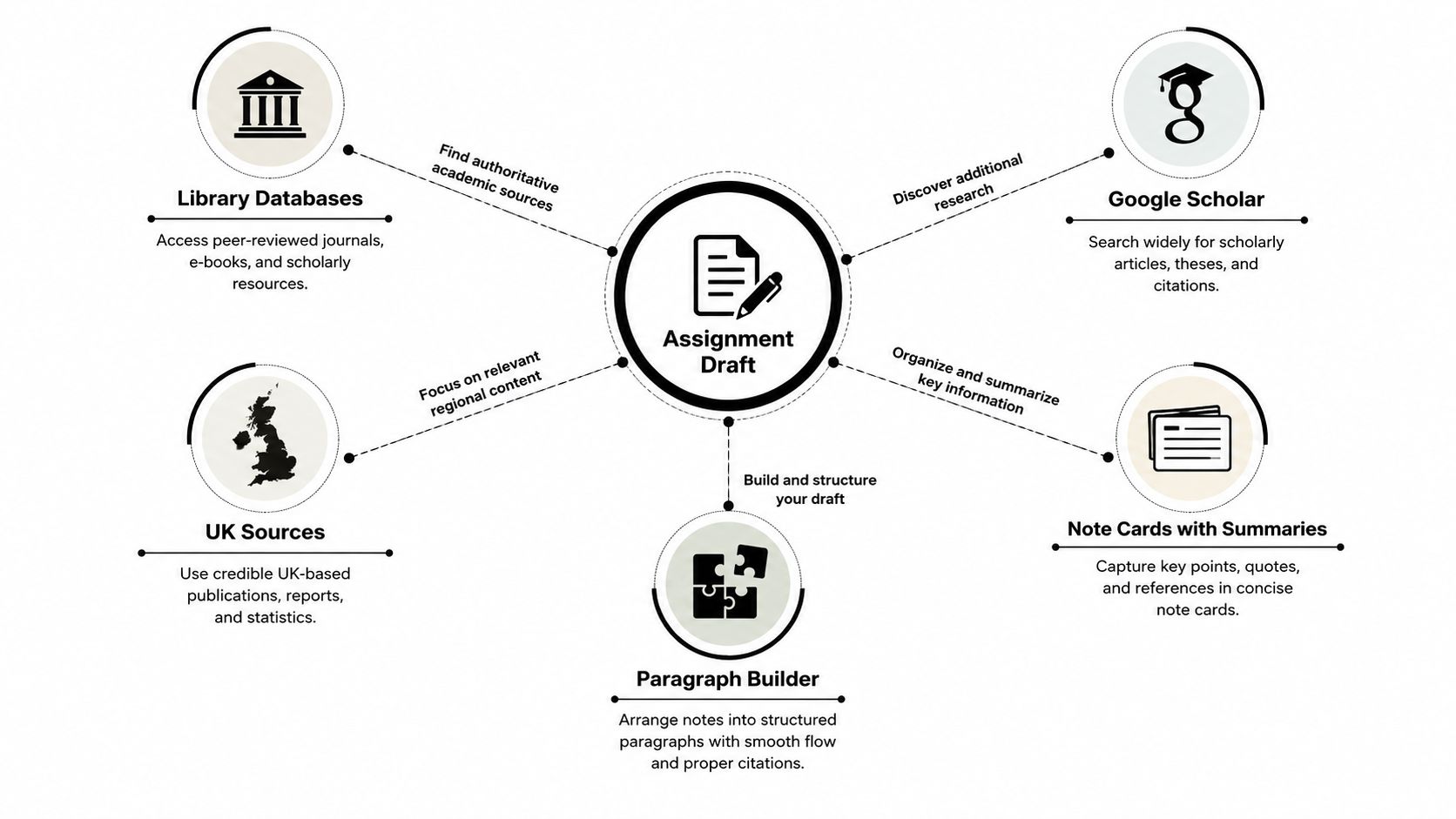
Research feels easier when you give every source a job. Start with your college library, library databases, Google Scholar and trusted UK organisations. Check who published each source, when it was published and whether it directly helps answer your question.
Don't copy large sections into your notes. Write the idea in your own words and record the source beside it immediately. This protects you from losing information later and makes referencing much less stressful.
A simple note can look like this:
| Note | Source details | Where it may fit |
|---|---|---|
| Flexible working may give employees more control over when and where they work. | Author, year, title, page or web address | Benefits section |
| Flexibility may also create blurred boundaries between work and home. | Author, year, title, page or web address | Limitations section |
The note should capture the meaning, not just a memorable sentence. If you copy exact words, use quotation marks in your private notes and record the page number where available.
Use the PEE paragraph recipe
A strong paragraph often follows Point, Evidence, Explain.
- Point: State the idea you want the reader to understand.
- Evidence: Support it with a source, example or relevant fact.
- Explain: Show why the evidence matters and connect it to the question.
A weak paragraph might say:
Flexible working is good for wellbeing. It helps people and is useful for companies.
This is too broad. A stronger version would be:
Flexible working may support employee wellbeing by giving people more control over how they manage work alongside personal responsibilities. Evidence about working arrangements can be used to examine whether this control reduces pressure, although the effect may depend on workload and the support provided by the employer. This means flexibility should be judged as part of a wider working system, rather than treated as a guaranteed solution.
The introduction should tell the reader what the assignment is about and how you'll answer it. The body should develop your argument in a sensible order. The conclusion should give a clear answer and should not introduce a completely new idea.
For example, a conclusion might say:
Flexible working can support wellbeing when employees have genuine choice, manageable workloads and clear boundaries. Employers should therefore combine flexible arrangements with regular communication and practical support.
That conclusion is short, but it answers the question and follows the discussion.
Writing in an Academic Voice Without Sounding Robotic
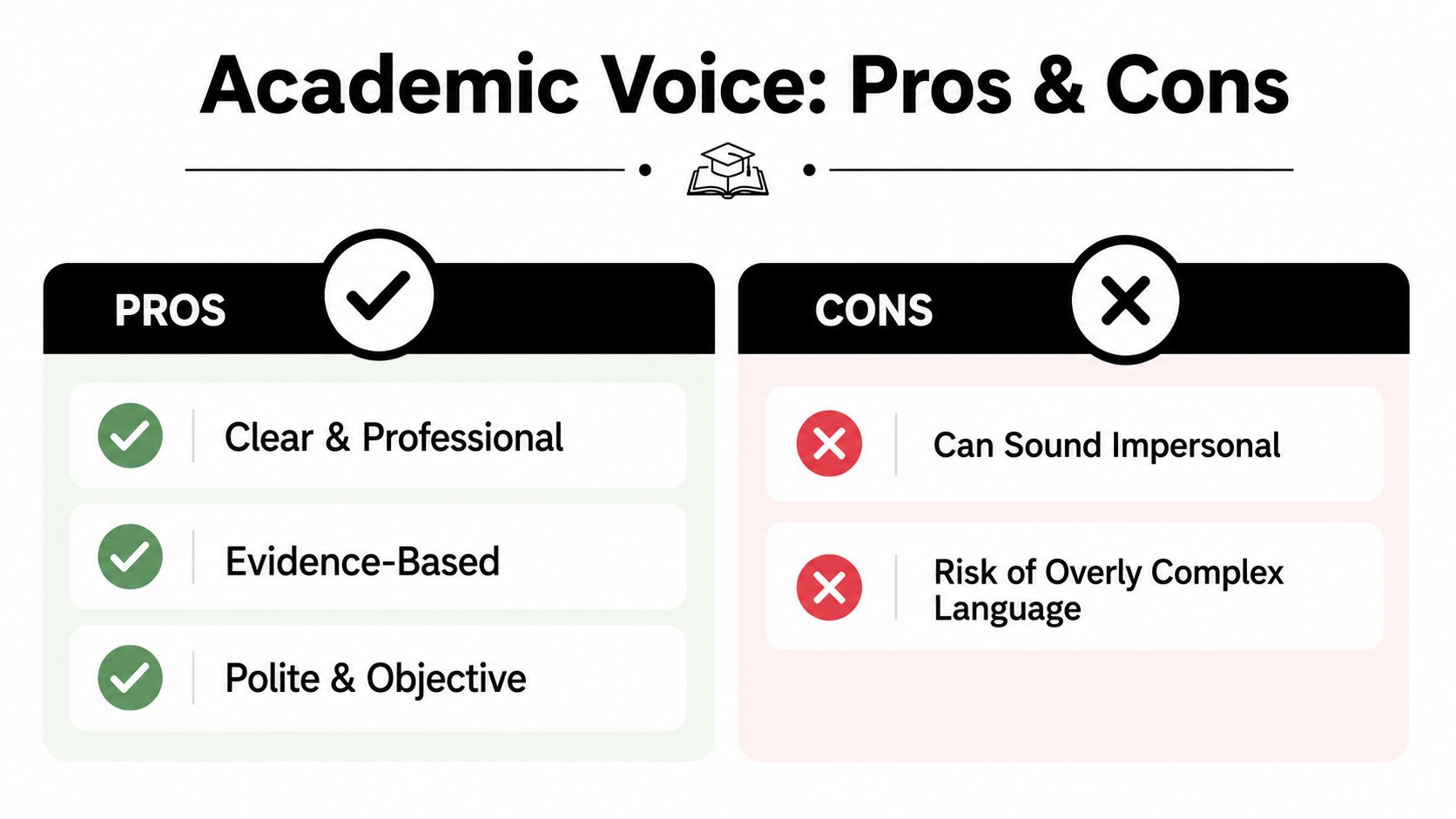
Academic writing doesn't require long words or complicated sentences. A useful academic voice is clear, respectful, evidence-based and careful. It sounds confident because each sentence has a purpose, not because it tries to impress the reader.
Compare these examples:
| Too casual or unclear | Clearer academic version |
|---|---|
| Flexible working is great for everyone. | Flexible working may support some employees, although its effects can vary. |
| Employers need to sort this out quickly. | Employers should consider practical measures to support staff. |
| Loads of people feel stressed at work. | Many employees experience pressure related to their working conditions. |
| This proves the idea is right. | This evidence supports the argument, although it doesn't settle every question. |
Use careful words such as may, can, suggests, appears and is likely when the evidence doesn't justify an absolute claim. This is called hedging. It doesn't make your writing weak. It shows that you understand the limits of the evidence.
Avoid slang, texting language and personal reactions unless the assignment specifically asks for reflection. Replace “I reckon” with “This suggests” and replace “a lot of” with a more precise description.
Keep references under control
Different subjects use different systems. Harvard referencing usually places the author and year in the text, followed by a full reference list. OSCOLA, often used for law, uses footnotes and a bibliography. Follow your course guidance rather than choosing the style you prefer.
Paraphrasing means explaining a source's idea in your own sentence structure and words, while still crediting the source. Changing only a few words isn't enough. Use a direct quote when the exact wording is important, keep it brief and provide the required citation.
You can find further practical support in this guide to improving English writing skills.
Before submitting, use your college's plagiarism or similarity checker if one is available. Read the result carefully, because a matched phrase isn't automatically misconduct. Academic integrity rules are taken seriously, but tutors, writing centres and academic support teams can help you learn the correct process.
Editing, Proofreading and Your Submission Checklist
Tom finished his draft the night before the deadline. He had answered the question, but several paragraphs repeated the same point, two references were incomplete and his conclusion introduced an idea that never appeared earlier. The writing improved when he stopped treating editing as a quick spelling check.
Use three separate passes. First, compare every section with the brief and ask whether it helps answer the question. Next, check the order of your argument, remove repetition and make sure each paragraph has a clear point. Finally, proofread the details.
Read the assignment aloud. Your ear often catches a missing word, a sentence that runs too long or a paragraph that doesn't connect smoothly. University of Bedfordshire academic skills guidance recommends reading work aloud during the final check, and also advises finishing early so you have spare days for editing.
Use this final list:
- Question: Have you answered every part of the brief?
- Structure: Does the introduction lead into the body and conclusion?
- Evidence: Does each important claim have suitable support?
- References: Are in-text citations and the reference list consistent?
- Presentation: Is the file format, layout and cover sheet correct?
- Length: Is the assignment within the required word count?
- Backup: Have you saved a second copy somewhere secure?
For a clear explanation of responsible academic work, read what academic integrity means. Submitting a checked assignment won't remove every worry, but it gives you control over the things you can control.
Turning This Skill Into a Brighter Future
Every assignment you complete is evidence that you can learn, organise your time and communicate your ideas. Those skills can support a promotion, a career change, a university application or further study. They also show your children that education can begin again at any stage of life.
The financial possibilities are real, although outcomes vary by person and background. A recent UK analysis reported a discounted lifetime earnings difference between graduates and non-graduates of £430,000 for men and £260,000 for women. After adjusting for background characteristics, it estimated a lifetime gross earnings gain from higher education of £240,000 for men and £140,000 for women. The full analysis also discusses wider benefits linked to adult education.
Next Level Online College offers flexible, tutor-supported routes including Functional Skills, GCSEs, A Levels and Access to Higher Education diplomas, with academic, wellbeing and finance support designed around adult responsibilities. Functional Skills English qualifications in England were reformed from 1 September 2019, with updated rules applying to all awards from 1 August 2021, as set out in the GOV.UK Functional Skills English conditions. For adults considering university, the Access to Higher Education Diploma is a recognised UK route, with its distinct qualification specification set out by the Quality Assurance Agency.
You've already taken an important step by learning how to begin. Open your brief today, underline the first command word and write down one small task. That is how a new future starts.
Next Level Online College offers flexible courses in Functional Skills, GCSEs, A Levels and Access to Higher Education, with tutor and wellbeing support for adult learners writing assignments around work and family life. Visit Next Level Online College to explore a supported course and take your next step towards further study or a more fulfilling career.