
Sitting down to write as an adult can feel harder than people admit. You may know what you want to say, but the blank page still makes you freeze. You might worry about spelling, punctuation, grammar, or whether your writing sounds “good enough”.
If that sounds like you, you're not behind and you're not incapable. You're learning a skill that can change everyday life. Better writing can help you pass a course, apply for a better job, write clearer emails, support your children with homework, and prove to yourself that you can do more than you once believed.
Learning how to improve English writing skills isn't about trying to sound clever. It's about making your ideas clear, strong, and useful. That's good news, because clear writing can be learned step by step.
Your Journey to Confident Writing Starts Here
A lot of adult learners carry old memories into new study. Maybe a teacher once rushed you. Maybe school made you feel embarrassed. Maybe life got busy, and writing became something you only did when you had to.
That history matters. It can make every sentence feel heavier than it should.

UK literacy data from the 2023 National Literacy Trust Annual Literacy Survey show that enjoyment of writing often falls with age. For adults coming back to education, that means rebuilding confidence and motivation is part of the job, not a side issue.
Your reason matters more than your fear
People rarely return to study for a small reason. You might want a qualification for work. You might want to get into university. You might want your children to see you trying, learning, and not giving up.
Those reasons are powerful. They can carry you through the days when writing feels slow.
- For your family: When you improve your writing, you can help with school letters, homework, forms, and everyday communication.
- For your career: Clear writing helps in emails, reports, applications, and interviews.
- For yourself: Every paragraph you finish is proof that your future doesn't have to look like your past.
You don't need to be perfect to make progress. You only need to keep practising the next small step.
A structured route can help when confidence is low. Some adults start with a recognised course so they aren't guessing what to learn next. If you're looking at practical qualifications, Functional Skills English online courses can give you a clear path and regular support.
Confidence grows from action
Many people wait to feel confident before they start writing. In real life, confidence usually comes after action. You write one short piece. You improve one sentence. You understand one correction. Then the next task feels a bit less frightening.
That's how progress works. Subtly, then steadily.
If you're nervous, that doesn't mean you can't do this. It usually means it matters to you. And that matters too.
Building Strong Foundations for Clear Writing
Strong writing starts with simple parts. A clear sentence. A logical paragraph. A full stop in the right place. These aren't tiny things. They are the tools that help other people understand you.
When adults ask how to improve English writing skills, they often think the answer must be complicated. It usually isn't. Focusing on the basics and building from there often leads to the quickest improvement.
Think of grammar as a clarity tool
Grammar isn't there to catch you out. It helps your meaning land properly.
Take these two sentences:
- Let's eat, kids.
- Let's eat kids.
That comma matters. In a work email, punctuation can affect tone, meaning, and professionalism just as quickly.
Try to see grammar and punctuation in this way:
| Writing tool | What it helps you do |
|---|---|
| Full stops | End one idea clearly before the next begins |
| Commas | Slow the reader down and separate parts of meaning |
| Capital letters | Show names, sentence starts, and important clarity points |
| Paragraphs | Group related ideas so your writing feels organised |
Build one layer at a time
In the UK, Functional Skills English gives adults a staged route to improve writing. Learners move through Entry Levels 1 to 3, then Level 1 and Level 2, and Level 2 is widely treated as comparable to a GCSE grade 4/C for progression purposes in the current system, as explained in this overview of Functional Skills English in the UK.
That matters because it shows something important. Writing isn't meant to be mastered all at once.
- Entry level work builds sentence control.
- Level 1 work strengthens planning and paragraphing.
- Level 2 work moves towards more formal structure and accuracy.
Practical rule: If your sentences aren't yet clear, don't worry about trying to sound advanced. Clear comes first.
Some learners later move from Functional Skills to GCSE study because they want a broader qualification for work or further education. If that's your goal, studying GCSE English online can be one possible next step.
Keep your language natural
Many nervous writers think better writing means longer words. It doesn't. The best sentence is often the clearest one.
Instead of writing, “I would like to utilise this opportunity to communicate”, write, “I want to explain”. The second version sounds more human and is easier to understand.
A strong foundation isn't fancy. It's solid. When your basics improve, everything built on top of them becomes stronger too.
A Simple Plan for Writing Anything Well
One reason writing feels overwhelming is that people try to do everything at once. They try to think of ideas, check spelling, improve vocabulary, fix punctuation, and sound professional in the same moment. That would make anyone panic.
A simpler method works better. Separate the job into plan, draft, and polish.
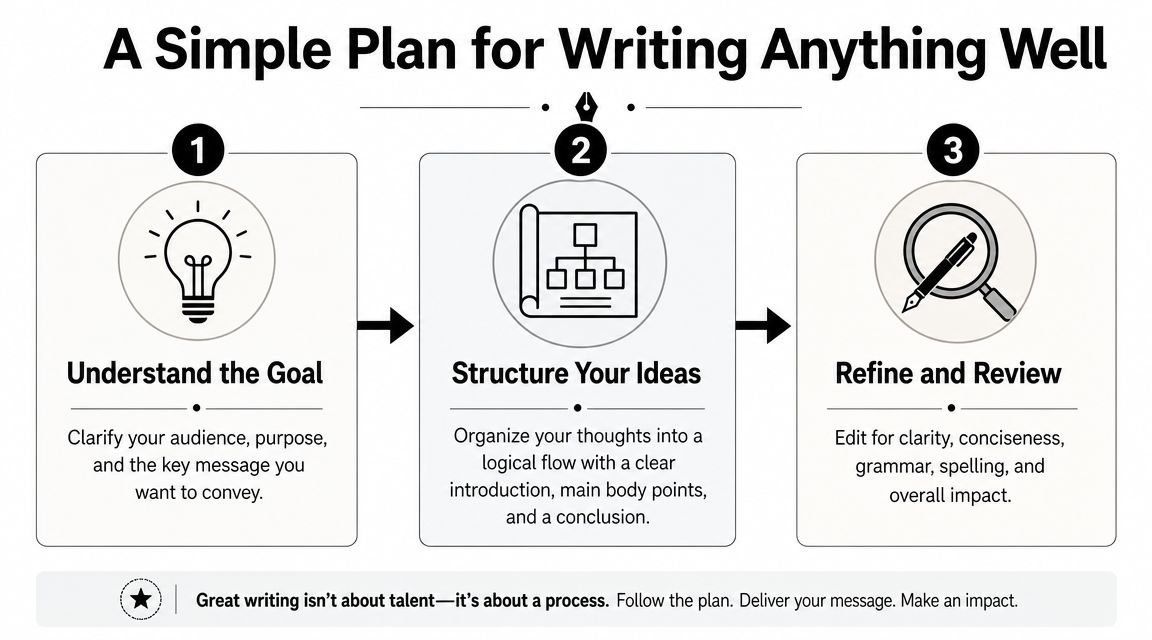
Guidance linked to the Education Endowment Foundation highlights that planning, drafting, and revising work best when they are taught as separate skills. It also notes that focusing on one feature at a time reduces cognitive load for learners, as summarised in this discussion of methods to improve writing ability for ESL students.
Plan before you write
You do not need a complicated plan. For many tasks, three notes are enough:
- What is the task asking?
- What are my main points?
- Who is reading this?
If you're writing an email to a manager, your plan might be:
- reason for email
- key information
- polite ending
If you're writing a college paragraph, your plan might be:
- main point
- example
- explanation
This stage stops the blank page from controlling you.
Draft without stopping every minute
Your draft is not your final version. It shouldn't be.
Many adults lose momentum because they edit too early. They write one line, delete it, rewrite it, worry about a spelling choice, then forget their original idea. Keep going instead. Get the meaning down first.
A rough first draft might say:
I want to do this course because I left school early and now I want better job options and I want to prove to my children that education matters.
That sentence isn't polished yet, but it contains a real idea. That's what drafting is for.
Polish in separate passes
Editing works better when you don't check everything at once. Read your work more than once, but give each read a job.
- First read for structure: Does it make sense in the right order?
- Second read for sentences: Are any lines too long, unclear, or repetitive?
- Third read for surface mistakes: Check spelling, punctuation, and capital letters.
Here is the rough sentence again after polishing:
I want to take this course because I left school early. I now want better job options, and I want to show my children that education matters.
That's clearer, and the idea is stronger.
If you're preparing for applications, it helps to practise this process on real tasks. A useful example is how to write a university personal statement, because it forces you to plan your message, draft authentically, and edit carefully.
Leave your first draft alone for a short break if you can. Even ten minutes can help you spot what you missed.
Good writing often looks calm on the page because the writer used a calm process behind the scenes.
Smart Practice That Fits Your Busy Life
Most adult learners aren't short of motivation. They're short of time. Work, children, shopping, appointments, cooking, and tiredness can fill a whole day before study even begins.
That doesn't mean you can't improve. It means your practice has to fit real life.
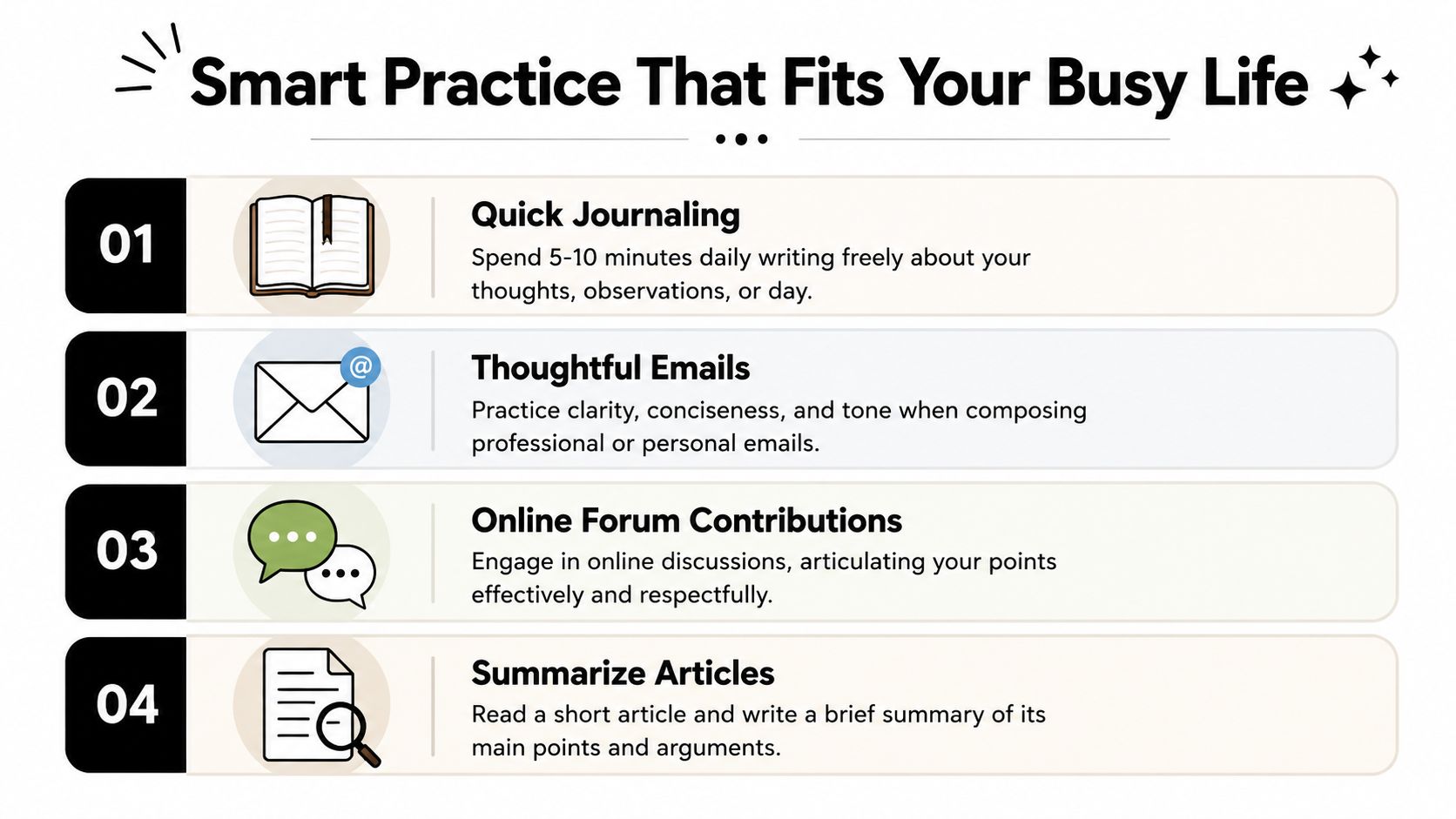
A useful way to think about practice is to connect it to the micro-skills used in UK assessments. Writing tasks for qualifications such as Functional Skills focus on clarity, correct sentence structure, punctuation, spelling, and organisation, and targeted practice with those features can make improvement more purposeful, as explained in this guide to writing skills and assessment-focused practice.
Small writing tasks that still count
You don't need to produce an essay every day. Short tasks can build real skill.
- Rewrite one email: Before sending an email, read it once for clarity. Ask, “Can the reader understand this quickly?”
- Summarise something you've read: Write a few sentences about a news story, leaflet, or chapter your child is reading.
- Keep a short daily note: Write what happened today and one thing you learned or noticed.
- Describe a problem and solution: This is good practice for workplace writing and formal responses.
What this looks like in ordinary life
A parent helps a child revise and writes a short explanation of a story chapter. That builds summary skills.
A care worker rewrites a message to make it clearer and more polite. That builds audience awareness.
A warehouse employee practises one timed paragraph on a phone during a lunch break, then checks punctuation later. That builds speed and control.
This short video may help you think about writing habits in a practical way.
Use short checkpoints
A busy person needs simple checks, not long routines. Try this after any piece of writing:
| Quick check | Ask yourself |
|---|---|
| Clarity | Can someone understand my main point quickly? |
| Sentence control | Have I written complete sentences? |
| Punctuation | Did I miss any full stops or commas? |
| Organisation | Are my ideas in a sensible order? |
Short practice done regularly beats long practice you keep postponing.
When you treat daily writing as training, not as a test, it becomes far easier to keep going.
Turning Feedback into Your Secret Weapon
Many adults dread feedback because it can feel personal. A corrected sentence may seem like proof that you're bad at writing. It isn't. It's proof that you now know what to improve next.
That shift in mindset changes everything.
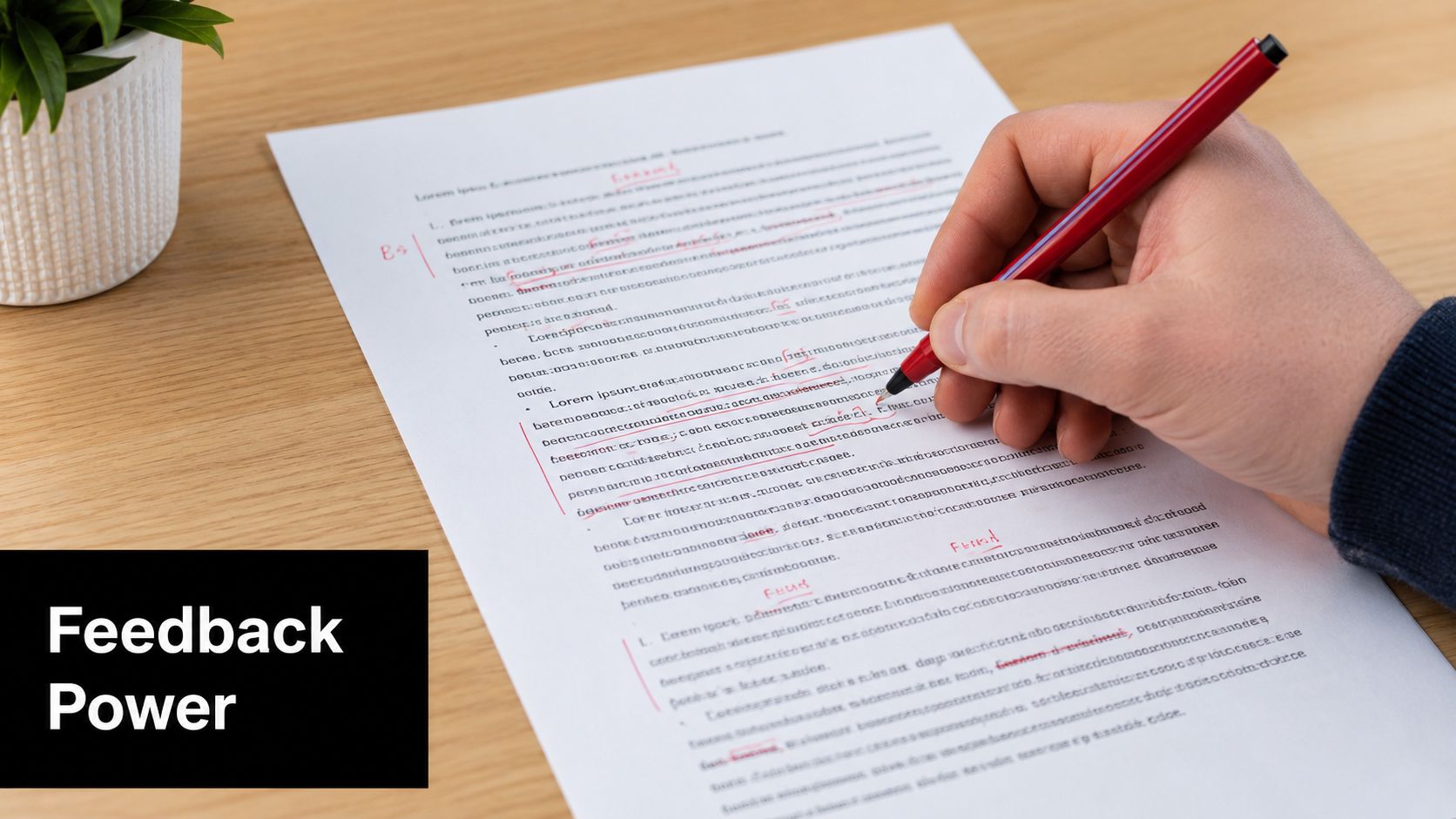
A common gap in writing advice is the feedback problem. Adult learners often improve most when they use structured revision, targeted feedback, and a personal error log rather than writing more, as discussed in this article about how to improve English writing skills through feedback.
Stop asking only “Is this good?”
That question is too big, and it rarely helps. Better questions are:
- Did I answer the task?
- Where did my writing become unclear?
- Which mistakes do I repeat?
Those questions give you something useful to work on.
Keep an error log
An error log is just a small list of mistakes you make often. It might include:
- forgetting capital letters
- writing very long sentences
- missing commas
- using the wrong word ending
- starting too many sentences in the same way
Write the mistake, then add the corrected version underneath. Over time, patterns appear. Once you can see your pattern, you can start fixing it on purpose.
Feedback is not a verdict on your ability. It's a map showing where to look next.
Learn to use feedback in stages
When a tutor, teacher, or trusted helper marks your work, don't try to fix every issue at once. Pick one or two repeated problems first.
For example:
- First focus: sentence endings
- Next focus: paragraph order
- Then: spelling patterns you often miss
This makes feedback manageable instead of crushing.
You can also self-check before asking someone else to read your work. Read it aloud slowly. If you run out of breath, a sentence may be too long. If you get lost halfway through a paragraph, the order may need work.
Feedback becomes powerful when you stop seeing it as criticism and start using it as evidence. That's often the point where confidence becomes real, because you're no longer guessing.
Write Your Own Success Story
Improving your writing is about far more than getting commas right. It's about opening doors. Clearer writing can help you pass a qualification, handle workplace tasks with more confidence, apply for a new role, and move towards university or further study.
For UK adults, writing improvement works best when it matches real goals such as Functional Skills, GCSEs, and workplace communication. General advice can help, but guidance becomes more useful when it connects directly to these outcomes, as noted in this discussion of the UK writing skills gap and practical writing expectations.
What to remember when progress feels slow
You do not need to transform overnight. Keep hold of the main ideas:
- Start with purpose: your family, career, and future matter
- Strengthen the basics: clear sentences and organised paragraphs come first
- Use a process: plan, draft, then polish
- Practise in small ways: writing done in real life still builds skill
- Use feedback well: your mistakes can teach you exactly what to fix
The bigger win
There is something powerful about an adult learner choosing not to stay stuck. Your children see it. Your family feels it. You feel it too.
Every form you complete more confidently, every email you write more clearly, and every assignment you finish adds up to a different story about who you are. Not someone who “was never academic”. Someone who kept going. Someone who learned. Someone who became a role model by taking action.
If you've been wondering how to improve English writing skills, start smaller than your fear tells you to. One paragraph. One edit. One practice task. One piece of feedback used properly.
That is how stronger writers are built.
If you're ready for structured support, Next Level Online College offers flexible online study for UK adult learners, including recognised routes such as Functional Skills, GCSEs, A Levels, and Access to Higher Education. That kind of step-by-step support can help turn good intentions into steady progress around work, family, and everyday life.